
- Release Year: 2000
- Platforms: Windows
- Publisher: Cryo Interactive Entertainment
- Genre: Special edition
- Game Mode: Single-player
- Average Score: 57/100
Description
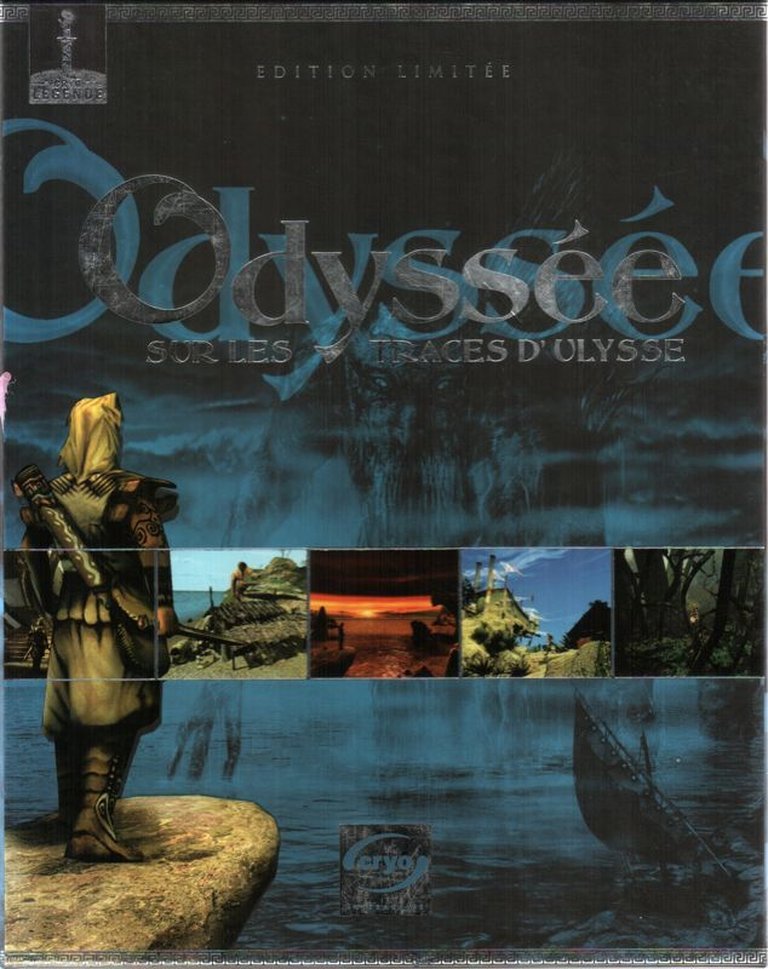
Odyssée: Sur les traces d’Ulysse (Edition Limitée) is a special edition adventure game released in 2000, set in the mythical world of Homer’s Odyssey. Players follow Heritias, a childhood friend of Ulysses, as he embarks on a perilous journey at the request of Penelope to uncover the fate of her long-lost husband. The game faithfully recreates key moments from the epic, including encounters with gods, monsters, and legendary figures like the Cyclops, Circe, and Calypso, while navigating treacherous lands and seas. This limited French edition includes an art book alongside the base game, offering an immersive retelling of Ulysses’ legendary voyage.
Odyssée: Sur les traces d’Ulysse (Edition Limitée) Patches & Updates
Odyssée: Sur les traces d’Ulysse (Edition Limitée) Reviews & Reception
en.wikipedia.org (58/100): A good mythological storyline goes a long way towards making a sometimes-frustrating game a whole lot of fun.
mobygames.com (57/100): Probably the worst game I ever bought
fr.wikipedia.org (58/100): Le jeu reçoit un accueil critique allant du mitigé au bon.
Odyssée: Sur les traces d’Ulysse (Edition Limitée): A Mythic Misstep or a Hidden Gem?
Introduction
In the pantheon of adventure games, few titles dare to tread the hallowed grounds of classical mythology with the ambition of Odyssée: Sur les traces d’Ulysse (Edition Limitée). Released in 2000 by Cryo Interactive Entertainment, this game promised players an epic journey through the eyes of Heritias, a childhood friend of Ulysses, tasked with retracing the legendary hero’s steps after his disappearance following the Trojan War. The Edition Limitée (Limited Edition) was a French-exclusive release, bundling the game with an art book—a tantalizing prospect for collectors and mythology enthusiasts alike.
Yet, beneath its lofty aspirations and mythic trappings, Odyssée emerged as a polarizing title. Critics and players alike were divided: some praised its faithfulness to Homer’s Odyssey and its atmospheric world-building, while others lambasted its clunky controls, frustrating puzzles, and technical shortcomings. This review seeks to dissect Odyssée: Sur les traces d’Ulysse (Edition Limitée) in exhaustive detail, exploring its development, narrative depth, gameplay mechanics, and lasting legacy. Was it a bold but flawed homage to one of literature’s greatest epics, or a missed opportunity that failed to capture the magic of its source material?
Development History & Context
The Studio and the Vision
Odyssée: Sur les traces d’Ulysse was developed by In Utero, a French studio known for its work on adventure games, in collaboration with Cryo Interactive Entertainment, a powerhouse in the European adventure game scene during the late 1990s and early 2000s. Cryo was renowned for its historically and mythologically inspired titles, such as the Atlantis series, Egypt, and Dragon Lore. The studio’s signature was its blend of rich storytelling, pre-rendered environments, and real-time 3D characters—a formula that Odyssée would adopt.
The game’s creative vision was spearheaded by writer Guillaume Eluerd, who sought to craft a narrative that remained faithful to Homer’s Odyssey while introducing original elements to differentiate it from a mere retelling. The protagonist, Heritias (or Heriseus in some versions), was conceived as a parallel to Ulysses, allowing players to experience the mythic journey through fresh eyes. This choice was both ambitious and risky: it allowed for creative liberties but also risked alienating purists who might have preferred a direct adaptation.
Technological Constraints and the Cryogen Engine
Odyssée was built using Cryo’s proprietary Cryogen engine, which powered several of the studio’s titles. The engine was designed to render characters in real-time 3D while placing them within pre-rendered, panoramic backgrounds—a hybrid approach that was common in adventure games of the era (e.g., Grim Fandango, The Longest Journey). This technique allowed for detailed, painterly environments but often resulted in stiff character animations and occasional clipping issues.
The game’s technical requirements were modest by modern standards but pushed the limits of late-1990s hardware:
– Minimum CPU: Intel Pentium II
– OS: Windows 95
– RAM: 64 MB
– DirectX: 7.0
– CD-ROM Speed: 2X (300 KB/s)
These specs reflect the game’s reliance on CD-ROM-based assets, with the Edition Limitée spanning two discs. The pre-rendered backgrounds, while visually impressive, were static and lacked the dynamism of fully 3D environments, which were becoming more prevalent in titles like Tomb Raider and Resident Evil.
The Gaming Landscape of 2000
The year 2000 was a transitional period for adventure games. The genre, which had dominated the 1990s with classics like Myst, Monkey Island, and Broken Sword, was beginning to wane in popularity as 3D action games and RPGs took center stage. Titles like Diablo II, Deus Ex, and The Sims were redefining player expectations, emphasizing interactivity, replayability, and immersive gameplay.
Against this backdrop, Odyssée was something of an anachronism—a traditional point-and-click adventure in an era where the genre was increasingly seen as niche. Its release in France on June 7, 2000, and later in North America (as Odyssey: The Search for Ulysses) on January 2, 2001, positioned it as a late-entry contender in a crowded field. The Edition Limitée, with its art book and collector’s appeal, was a nod to the game’s artistic ambitions, but it did little to mask its underlying mechanical flaws.
Narrative & Thematic Deep Dive
Plot Summary: A Hero’s Shadow
Odyssée begins with a premise steeped in Homeric tradition. Ten years after the fall of Troy, Ulysses (Odysseus) has vanished, leaving his wife, Penelope, to fend off suitors who seek to claim his throne. Desperate, Penelope turns to Heritias, Ulysses’ childhood friend, who has fallen from grace after an accidental murder. Heritias’ quest is twofold: to find Ulysses and redeem himself in the eyes of Ithaca’s citizens.
The narrative unfolds as a parallel odyssey, with Heritias retracing Ulysses’ steps across the Mediterranean. Key locations and encounters include:
– Troy: The ruined city where Ulysses was last seen.
– The Island of Aeolus: Home of the wind god, who aids Heritias with magical winds.
– The Land of the Lotus-Eaters: A drugged paradise where Heritias must resist temptation.
– The Cyclops’ Cave: A deadly encounter with Polyphemus, the man-eating giant.
– Circe’s Island: The sorceress who turns men into swine.
– The Underworld: A descent to consult the soothsayer Tiresias.
– Calypso’s Isle: The nymph who holds Ulysses captive.
The game’s narrative structure is episodic, mirroring the Odyssey’s own segmented storytelling. However, Odyssée takes liberties with Homer’s text, most notably in its inclusion of the Gorgon (a nod to the Perseus myth) and the omission of iconic episodes like the Sirens and Scylla and Charybdis. These choices reflect the developers’ desire to blend mythological elements while streamlining the story for gameplay purposes.
Characters: Gods, Monsters, and Mortals
The cast of Odyssée is a mix of Homeric figures and original creations:
– Heritias: The protagonist, a flawed but determined hero whose journey is as much about personal redemption as it is about finding Ulysses.
– Penelope: Ulysses’ faithful wife, whose desperation drives the plot.
– Poseidon: The vengeful sea god, who pursues Heritias with relentless fury.
– Athena: The goddess of wisdom, who occasionally aids Heritias in his quest.
– Circe and Calypso: Enchantresses who test Heritias’ resolve.
– Polyphemus: The Cyclops, a brutal obstacle in Heritias’ path.
The game’s dialogue is voice-acted in French, with the Edition Limitée retaining the original language. The voice work is competent, though some critics noted a lack of emotional range in the delivery. The interactions between Heritias and the gods are particularly noteworthy, as they highlight the game’s themes of fate, free will, and divine intervention.
Themes: Fate, Redemption, and the Hero’s Journey
Odyssée is, at its core, a meditation on the hero’s journey—not Ulysses’, but Heritias’. The game explores several key themes:
1. The Burden of Legacy: Heritias is not Ulysses, and his struggles underscore the difficulty of living up to a legend.
2. Divine Manipulation: The gods, particularly Poseidon and Athena, toy with Heritias, raising questions about free will and destiny.
3. Redemption: Heritias’ quest is as much about atoning for his past sins as it is about finding Ulysses.
4. The Allure of Myth: The game revels in its mythological setting, using it to explore timeless questions about heroism, temptation, and perseverance.
The narrative’s greatest strength is its faithfulness to the spirit of Homer’s work, even as it diverges from the letter. The inclusion of the Gorgon, for instance, serves as a clever nod to the interconnectedness of Greek myths, while the omission of the Sirens streamlines the story for pacing. However, the game’s linearity and occasional narrative gaps (e.g., abrupt transitions between locations) prevent it from achieving the depth of its source material.
Gameplay Mechanics & Systems
Core Gameplay Loop: Exploration and Puzzles
Odyssée is a third-person point-and-click adventure, with players guiding Heritias through a series of pre-rendered environments. The core gameplay loop revolves around:
1. Exploration: Navigating through detailed, panoramic backgrounds.
2. Interaction: Clicking on objects and characters to gather information or solve puzzles.
3. Puzzle-Solving: Using inventory items in creative ways to progress.
The game’s interface is a mixed bag. While it adheres to the conventions of the genre, it suffers from several flaws:
– Clunky Controls: Heritias’ movement is controlled via keyboard, which feels unintuitive and imprecise. Many players reported difficulty navigating tight spaces or avoiding hazards.
– Inventory Management: The inventory system is functional but lacks the elegance of contemporaries like Broken Sword.
– Dialogue Trees: Conversations are menu-driven, with Heritias selecting topics from a list. This system is serviceable but lacks the depth of more dynamic dialogue systems.
Combat and Character Progression
Odyssée is not a combat-heavy game, but it does feature occasional action sequences, particularly in encounters with mythological creatures like the Cyclops and the Gorgon. These segments are real-time and reflex-based, requiring players to:
– Dodge attacks by moving Heritias out of harm’s way.
– Use items (e.g., a mirror to defeat the Gorgon) in a timely manner.
The combat is simplistic and often frustrating due to the imprecise controls. Many players found these sections to be the game’s weakest aspect, as they disrupted the otherwise methodical pace of the adventure.
Puzzle Design: A Double-Edged Sword
The puzzles in Odyssée are a contentious point among critics and players. On one hand, they are logical and thematically appropriate, often tied to the game’s mythological setting. For example:
– The Lotus-Eaters: Players must resist the drug’s effects by finding an antidote.
– Circe’s Island: A multi-step puzzle involving transforming pigs back into humans.
– The Underworld: Navigating the realm of the dead requires solving riddles posed by Tiresias.
On the other hand, the puzzles suffer from several design flaws:
– Lack of Clues: Some puzzles offer little to no guidance, forcing players to resort to trial-and-error.
– Instant Death: Certain puzzles result in Heritias’ death if solved incorrectly, with no warning or checkpoint.
– Repetition: Some puzzles feel recycled, particularly in the game’s later stages.
The difficulty curve is inconsistent, with some puzzles being trivially easy while others are maddeningly obscure. This inconsistency, combined with the game’s linear progression, makes Odyssée feel more like a puzzle gauntlet than a cohesive adventure.
UI and Technical Issues
The game’s user interface is functional but dated. Key issues include:
– Poor Feedback: It’s often unclear whether an object is interactive or not.
– Limited Save System: While the game offers 30 save slots, the lack of an autosave feature is a notable omission.
– Technical Bugs: Some players reported crashes, particularly when transitioning between locations.
The pre-rendered backgrounds, while visually striking, are static and lack interactivity. This design choice, while common in the genre, feels restrictive compared to the more dynamic environments of contemporary titles.
World-Building, Art & Sound
Setting and Atmosphere
Odyssée excels in world-building, crafting a vivid and immersive interpretation of the ancient Mediterranean. The game’s environments are richly detailed, with each location reflecting its mythological significance:
– Troy: A ruined cityscape, evoking the aftermath of war.
– Aeolus’ Island: A windswept, ethereal realm befitting a god.
– Circe’s Island: A lush, foreboding jungle teeming with magical energy.
– The Underworld: A dark, mist-shrouded domain populated by spectral figures.
The art direction is one of the game’s strongest suits. The pre-rendered backgrounds are painterly and atmospheric, with a color palette that shifts to reflect the mood of each location. The character models, while blocky by modern standards, are expressive and well-animated within the constraints of the Cryogen engine.
Sound Design and Music
The game’s sound design is competent but unremarkable. Key elements include:
– Ambient Sounds: The rustling of leaves, the crash of waves, and the howl of wind contribute to the game’s immersive atmosphere.
– Voice Acting: The French voice cast delivers solid performances, though some lines lack emotional depth.
– Music: The soundtrack is orchestral and thematic, with leitmotifs for key characters and locations. While not groundbreaking, it effectively underscores the game’s epic tone.
The sound mixing is generally well-balanced, though some players noted that the music occasionally overpowers dialogue, making it difficult to hear important plot points.
Visual Fidelity and Technical Limitations
The game’s visuals are a product of their time. The pre-rendered backgrounds are stunning, with a level of detail that holds up surprisingly well. However, the real-time 3D characters are less impressive, suffering from:
– Low-Poly Models: Heritias and other characters are blocky and lack facial expressions.
– Stiff Animations: Movement is often robotic, particularly in combat sequences.
– Clipping Issues: Characters occasionally intersect with the environment in unnatural ways.
The camera system is another point of contention. While it offers dynamic angles during exploration, it can be uncooperative during puzzles or combat, obscuring critical information.
Reception & Legacy
Critical Reception: A Divided Response
Odyssée: Sur les traces d’Ulysse received mixed to negative reviews upon release. Critics praised its ambition, storytelling, and art direction but lambasted its clunky controls, frustrating puzzles, and technical issues. Key critiques included:
– GameSpot (7.2/10): “Though its problems might be frustrating at first, once you settle into the game, you’ll be in for a suitably rewarding adventure.”
– Eurogamer (Mixed): “The game looks and sounds excellent, but is let down badly by simplistic puzzles, fussy location routes, and its essentially linear nature.”
– IGN (Negative): “By the time I had spent a few days wandering around the world of Odyssey, I was sure I never wanted to return.”
– Just Adventure (Positive): “If you have ever wanted to captain a flying ship, be a passenger in Charon’s sloop, or be tested by Poseidon, then Odyssey is a must-have for your adventure collection.”
The game’s Metacritic score of 58/100 reflects its polarizing nature. While some players appreciated its faithfulness to Homer’s epic, others found it tedious and poorly executed.
Commercial Performance and Legacy
Odyssée was not a commercial success, particularly outside of France. Its niche appeal and technical shortcomings limited its reach, and it was quickly overshadowed by more polished titles like The Longest Journey and Syberia.
However, the game has developed a cult following among adventure game enthusiasts and mythology buffs. Its ambitious storytelling and atmospheric world-building have earned it a place in the pantheon of underappreciated adventure games. The Edition Limitée, with its art book and collector’s appeal, is particularly sought after by fans of the genre.
Influence on Subsequent Games
Odyssée’s influence is subtle but notable. It contributed to the trend of mythologically inspired adventure games, paving the way for titles like:
– The Odyssey: Winds of Athena (2006)
– Apollo Justice: Ace Attorney (2007, which features a case inspired by Greek mythology)
– Hades (2020, a roguelike that reimagines Greek myths in a modern context)
While Odyssée itself is not remembered as a classic, its attempt to blend interactive storytelling with classical mythology remains an interesting experiment in game design.
Conclusion: A Flawed but Fascinating Odyssey
Odyssée: Sur les traces d’Ulysse (Edition Limitée) is a game of contradictions. It is ambitious yet flawed, beautiful yet clunky, faithful yet derivative. Its greatest strength lies in its narrative and world-building, which capture the spirit of Homer’s Odyssey with remarkable fidelity. The game’s atmospheric environments, richly detailed settings, and thematic depth make it a compelling experience for those willing to overlook its mechanical shortcomings.
However, its gameplay flaws—particularly its imprecise controls, frustrating puzzles, and technical issues—prevent it from achieving greatness. The Edition Limitée, with its art book and collector’s appeal, is a testament to the game’s artistic ambitions, but it cannot mask the underlying design problems.
Final Verdict: 6.5/10 – A Noble Failure
Odyssée: Sur les traces d’Ulysse is not a great game, but it is a fascinating one. It stands as a time capsule of an era when adventure games were transitioning from 2D to 3D, and when developers were still grappling with the challenges of interactive storytelling. For fans of mythology, adventure games, or Homer’s epic, it is worth experiencing—if only to appreciate its ambition and atmosphere. For everyone else, it remains a curio, a flawed but intriguing footnote in the history of video games.
In the end, Odyssée is much like the journey of Heritias himself: arduous, imperfect, but ultimately rewarding for those who persevere.