
- Release Year: 2016
- Platforms: Linux, Macintosh, Windows
- Publisher: Cosmo D Studios
- Developer: Cosmo D Studios
- Genre: Adventure
- Perspective: 1st-person
- Game Mode: Single-player
- Gameplay: Graphic adventure
- Setting: Futuristic, Sci-fi
- Average Score: 92/100
Description
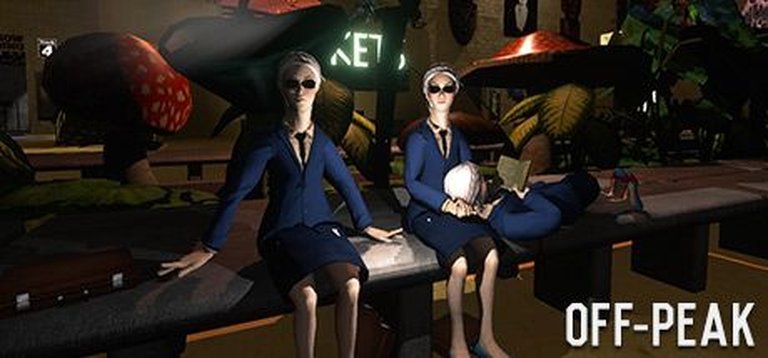
Off-Peak is a first-person graphic adventure game set in a futuristic sci-fi city, where players explore during quiet, off-peak hours to uncover narratives and solve puzzles in a free-to-play experience developed by Cosmo D Studios.
Gameplay Videos
Where to Buy Off-Peak
PC
Off-Peak Guides & Walkthroughs
Off-Peak Reviews & Reception
metacritic.com (85/100): Despite its amateurish execution Off-Peak is really worth your time, because it’s a brilliant game that tackles the problem of art’s role in modern world with rare maturity.
store.steampowered.com : Feels like a collage, a tumblr… it is great.
howlongtobeat.com (100/100): This game is quirky and weird and I need more like this all the time. I will be buying anything else from this dev. Also gave me more homesickness vibes than any other recent game based in or around or about NYC life.
Off-Peak: A Surreal Journey Through Liminal Space
Introduction: The Allure of the Unknowable
In the vast, overcrowded landscape of video games, where blockbuster sequels and live-service behemoths dominate discourse, certain titles exist in the shadows—quiet, peculiar, and utterly unforgettable. Off-Peak, a 2016 freeware adventure from the infinitesimally small Cosmo D Studios, is one such game. It is not a title that courted popularity; it asked for nothing but your time, offering in return a descent into a meticulously crafted, deeply unsettling liminal space. Its legacy is not measured in sales or awards, but in its profound, haunting weirdness—a stark antidote to the algorithmic sameness that defines much of mainstream gaming. This review argues that Off-Peak is a masterclass in atmospheric storytelling and environmental design, proving that profound narrative impact can emerge from minimalist gameplay and an unwavering commitment to a singular, bizarre vision. It is less a game to be “played” and more an experience to be absorbed, a discordant symphony of visual and auditory unease that lingers long after the station’s exit is finally found.
Development History & Context: The Vision of Cosmo D
Off-Peak is the brainchild of Greg Heffernan, operating under the banner of Cosmo D Studios, a one-man-band development outfit. The game’s conception is intrinsically linked to Heffernan’s other artistic pursuit: he is the bassist for the Brooklyn-based experimental electronic/jazz ensemble Archie Pelago. This dual identity is not a trivial footnote but the game’s foundational principle. The soundtrack, a batch of original compositions by Archie Pelago, is not an afterthought but a core component of the game’s architecture—simultaneously discordant, hypnotic, and unsettlingly organic.
Developed in Unity, Off-Peak emerged in 2016, a year saturated with genre-defining titles like Overwatch and Uncharted 4. It stood in stark contrast to that year’s polished, high-budget productions. Its release as freeware on Windows (and later Linux and Mac) immediately positioned it as a passion project, a digital curiosity offered without commercial expectation. The technological constraints were likely those of a solo developer: limited scope, simple geometry, and a reliance on atmospheric effects and sound design over graphical fidelity. Its context is the thriving mid-2010s indie scene, which had seen the walking simulator genre mature through titles like Dear Esther (2012) and The Stanley Parable (2013). Off-Peak fits into this lineage but deliberately abandons narrative clarity or philosophical pretension for pure, sensory surrealism. It is a game that asks not “What does this mean?” but “What is this?”
Narrative & Thematic Deep Dive: Fragments in the Void
Off-Peak provides no traditional plot. There is no quest log, no exposition dump, and no clear protagonists or antagonists. The narrative is a pieced-together puzzle of fragments—dialogue snippets, environmental tells, and the titular ticket scraps—all filtered through the player’s bewildered perspective.
The premise is deceptively simple: you are stranded in a vast, cathedral-like train station in an indeterminate “near future,” trying to get to Rowayton. A benignly strange man named Luuuke (with three U’s) offers you his ticket, but it has been ripped into pieces scattered throughout the station. Your ostensible goal is to find these pieces. This narrative frame, however, is merely a hook. The “story” resides in the station itself and its denizens.
The station is a non-space, a liminal zone between destinations. It contains a mobile pizza parlor, a ramen stand, a mushroom garden, and a wall that might be an aquarium or a television screen displaying one. A massive whale suspended from the ceiling hangs against a starry cosmic backdrop. These are not set pieces for a plot but fixed facts of this reality, accepted by the NPCs without comment. The dialogue is sparse, cryptic, and often循环. Characters like Luuuke speak in half-formed philosophies and non-sequiturs. The themes that emerge are not spelled out but felt: isolation in a crowd, the absurdity of transit, the uncanny valley of the familiar made strange, and a pervasive sense of waiting for something that may never come.
The ticket pieces are not just collectibles; they are narrative shards. Finding one might reveal a line of text (“The rails were originally supposed to lead to a giant black shape of Connecticut, but it was cut because it didn’t look particularly interesting or distinct”—a fascinating meta-commentary on development). Each piece reinforces the station’s status as a failed or abandoned project, a digital ghost. The ultimate “story” is the player’s own journey from confusion to uneasy acceptance, mirroring the possible fate of the station’s inhabitants: to wander these halls indefinitely, finding meaning in the endless, surreal present.
Gameplay Mechanics & Systems: The Architecture of Idleness
Off-Peak’s gameplay loop is intentionally bare, almost to the point of negative space. It is a first-person exploration simulator with three core verbs: walk, look, and interact. There is no combat, no puzzles beyond “find the thing,” no fail state, and no character progression. The “gameplay” is the act of bearing witness.
The core loop is thus: explore the station’s interconnected spaces (platforms, halls, secret passages, rooftops), press ‘E’ (or equivalent) on objects and NPCs to trigger dialogue or acquire ticket pieces, and allow the soundscape and visuals to wash over you. The only systemic pressure is the faint, ever-present pull of the objective—the ticket pieces—which serves merely to guide the player’s wanderings through the station’s carefully charted absurdity.
What makes this minimalist approach work is its unwavering commitment to tone. There is no competing mechanic to dilute the atmosphere. The Nintendo-style “collect-a-thon” premise is immediately subverted by the sheer, distracting bizarreness of the environment. You are meant to get lost, to forget the ticket, to stand and watch the “giant man play a giant piano” or stare at the art on the wall during the endless staircase ascent. The “game” is the environment’s resistance to functional meaning. The UI is nonexistent beyond a subtle cursor change, reinforcing the idea that you are not a player-character with stats, but a presence in a space. This is its innovation: a video game that primarily functions as an environmental mood piece, using the interactive medium not for challenge or story, but for immersive, first-person contemplation. Its “flaw” is also its strength—there is no traditional satisfaction, only the satisfaction of perceptual discovery.
World-Building, Art & Sound: The Symphony of the Unreal
The brilliance of Off-Peak lies in the synesthetic cohesion of its world. The art, sound, and design work in concert to create a unified experience of beautiful unease.
-
Visual Direction & World Design: The station is a masterclass in low-poly surrealism. The visual palette is dominated by desaturated reds and greys, with a hyper-realistic yet flat skybox that feels both cosmic and claustrophobic. The architecture is grandiose—vaulted ceilings, endless staircases—yet it is punctuated with jarring, mundane anachronisms (a pizza oven, a ramen stall). The famous suspended whale is a perfect example: a monumental, organic form frozen in a digital void, evoking awe and existential dread. The station feels like a dream logic cathedral, a place of transit that has forgotten its purpose. The art pieces on the walls, as noted in the Fungies review, range from entrancing to deeply disturbing, serving as static focal points that reward close inspection and contribute to the overall feeling of a curated, nonsensical museum.
-
Sound Design & Music: This is the game’s true soul. The soundtrack by Archie Pelago is not background music; it is the emotional and thematic substrate of the entire experience. As described, it is “simultaneously discordant and confusing” yet “layered with other sounds that soothe and entice you.” It uses jazzy, organic loops, glitchy electronic textures, and haunting melodies that seem to emanate from the environment itself. The sound design is equally important: the ambient hum of the station, the distant echoes, the peculiar sounds from NPCs all blend into an aural landscape that is both immersive and alienating. The music does not guide you emotionally; it reflects the station’s psyche—melancholic, curious, and faintly threatening. It is the primary driver of the game’s “horror” tag, not through jump scares, but through the sustained creation of an auditory uncanny valley.
Together, these elements construct a world that is palpably off. It is familiar in its architectural language (a train station) but utterly alien in its details and mood. You don’t explore a world to learn its story; you explore a manifest mood, and the act of exploration is the act of feeling that mood.
Reception & Legacy: The Cult of the Obscure
By any conventional metric, Off-Peak is a commercial and critical non-entity. According to MobyGames data, it has been collected by only 49 players as of this writing, with a player-average score of 4.3/5 from a mere three ratings—and zero written reviews. It exists almost entirely outside the critical discourse. There is no Metacritic score, no major publication review, and no significant sales data because, as freeware, sales are irrelevant.
Its legacy is therefore one of cult obscurity and word-of-mouth reverence. It is the kind of game discovered through lists of “weirdest Steam games” or recommendations from those who value experiential boldness over polish. It represents the purest form of the indie credo: a personal, uncompromised vision shared freely. Its influence is not seen in mechanics, but in attitude. It stands as a touchstone for developers exploring the potential of “walking simulators” to evoke emotion through pure environmental and auditory curation, rather than narrative or puzzle design. It proves that a game can have no traditional content and still be deeply engaging if its atmosphere is potent enough.
In an era where games are increasingly data-driven and player-retention focused, Off-Peak is an artifact from another philosophy: one where the game’s sole purpose is to be a specific, strange thing. Its legacy is its existence as proof of concept that such a thing can find an audience, however small.
Conclusion: A Masterpiece of the Unheimlich
Off-Peak is not for everyone. It offers no power fantasy, no clear story, and no conventional gameplay gratification. To engage with it is to accept a contract of ambiguity. Its “verdict” cannot be measured in fun or polish, but in its success as an artistic statement.
It is a definitive success. Through a minimalist framework, it achieves a powerful, lingering sense of the Unheimliche—the uncanny. The cathedral station, the whale in the cosmos, the three-U’d musician, the discordant yet beautiful score—all coalesce into an experience that feels simultaneously like a memory, a dream, and a glitch in reality. Greg Heffernan and Archie Pelago created not a game with a world, but a world that is itself the game. Its place in video game history is not on a pedestal of “best” or “most influential,” but in a special chamber dedicated to titles that expanded the medium’s capacity for pure, abstract, sensory expression. Off-Peak is a vital reminder that games can be haunted places, and that sometimes, the most profound journey is the one with no destination at all. It is a must-experience for anyone interested in the boundaries of interactive art, and a perfect, baffling, beautiful ghost in the machine of gaming.