
- Release Year: 2016
- Platforms: PlayStation 4, PS Vita, Windows, Xbox One
- Publisher: Bandai Namco Entertainment America Inc., Bandai Namco Entertainment Europe S.A.S., Bandai Namco Entertainment Inc.
- Genre: Compilation
- Average Score: 67/100
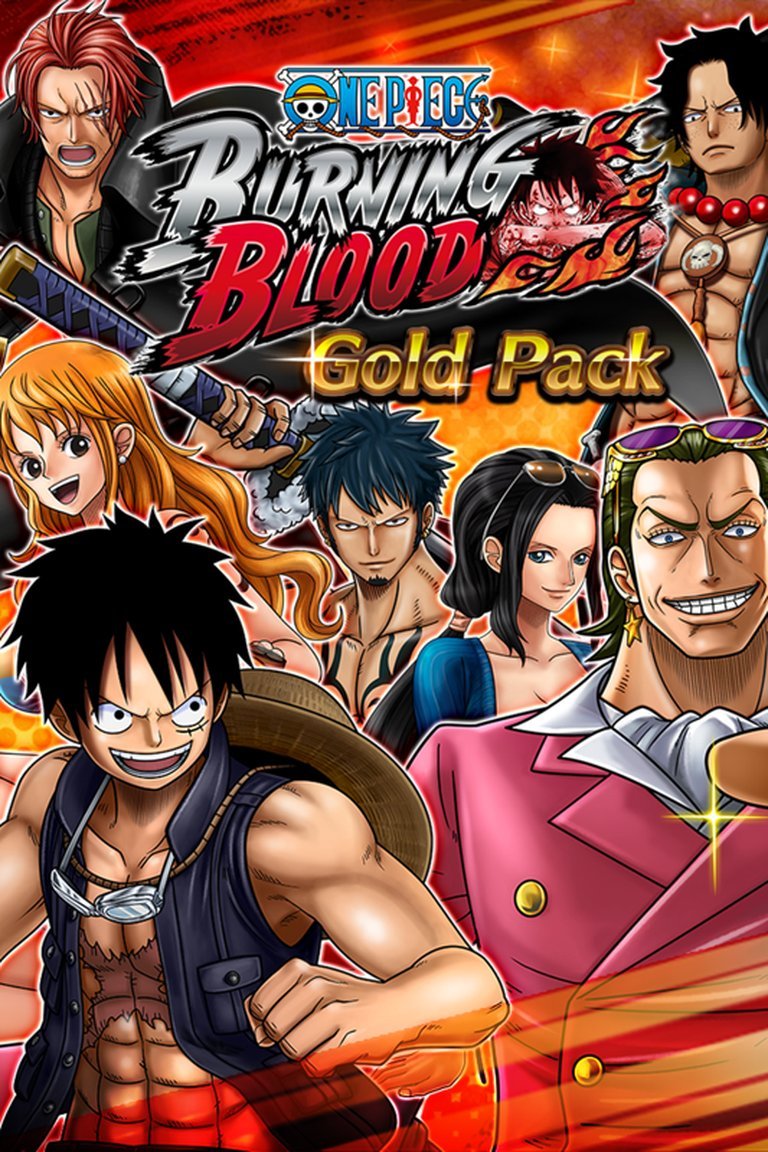
Description
One Piece: Burning Blood – Gold Pack is a comprehensive fighting game that transports players into the intense Marineford Arc from the One Piece series. Set in dynamic 3D arenas, it features team-based combat with up to three characters per side, allowing strategic switching and support attacks while harnessing iconic Devil Fruit abilities and moves from the manga and anime. This Gold Edition compilation includes the base game along with all released DLC packs—such as Golden Luffy, Luffy Pack, and multiple Wanted Packs—offering a complete package that reenacts the pivotal clash between the Marines and Whitebeard’s pirate crew from multiple perspectives.
Gameplay Videos
Where to Buy One Piece: Burning Blood – Gold Pack
PC
One Piece: Burning Blood – Gold Pack Free Download
One Piece: Burning Blood – Gold Pack Reviews & Reception
ign.com : Burning Blood prioritizes style over substance.
One Piece: Burning Blood – Gold Pack: A Fan Service Fighter in Overcrowded Waters
Introduction: The Weight of the Grand Line on a Shoulder Button
To understand One Piece: Burning Blood – Gold Pack is to understand a fundamental tension at the heart of licensed video games: the impossible task of condensing a quarter-century of mythos into interactive form. Released in 2016, this title arrived not as a singular vision, but as a crystallized moment of fan Transactionalism—a game built explicitly for those already deeply fluent in the language of Devil Fruits, Haki, and Marineford’s tragedy. The “Gold Pack” itself is not a standalone game, but the ultimate DLC (Downloadable Content) bundle for the base Burning Blood, a compilation that collects all post-launch character packs, costume bundles, and alternate versions released for the title. This review, therefore, examines the Gold Pack not in a vacuum, but as the definitive, monetized completion of a product whose very architecture was shaped by the demands of a hyper-obsessive fanbase and the commercial realities of the modern fighting game ecosystem. Its legacy is one of audacious ambition partially fulfilled, a game that swings for the decks of the Thousand Sunny but often finds itself lost in the vast, chaotic waters it sought to navigate.
Development History & Context: Arena Fighting in the Shadow of J-Stars
Developed by Spike Chunsoft, a studio with a storied history in Japanese role-playing games (Dragon Quest, Shin Megami Tensei) and the Danganronpa series, Burning Blood represented a significant pivot into the 3D arena fighter subgenre. This was not their first foray into anime crossovers—they had developed J-Stars Victory VS., a poorly received Weekly Shonen Jump crossover that laid a foundational, if rocky, template. The technological constraint was the PlayStation 4/Xbox One/PC era, a time when 3D arena fighters like Naruto: Ultimate Ninja Storm and Dragon Ball Xenoverse had carved out a lucrative niche by prioritizing spectacle and roster size over the intricate, precision-based systems of traditional 2D fighters like Street Fighter.
Bandai Namco’s vision was clear: leverage the unparalleled popularity of One Piece, then nearing its 20th anniversary and at a narrative zenith following the time-skip, to create a “pure fighting game” that authentically replicated its supernatural brawls. The “Burning Blood” moniker itself references a key One Piece concept—the intense, life-changing passion of its characters. Yet, the development cycle was fraught with the typical pressures of a licensed title. The PC version, notably, was delayed by several months (from a planned March 2016 release to September), sparking community anxiety over parity with console versions, as evidenced by Steam forum discussions where a moderator, Isshak Gravi, had to repeatedly confirm the PC port would be locked at 30 FPS and 1080p, matching the PS4. This bottleneck highlighted the resource allocation common in multi-platform licensed games: ensuring consistency across hardware often meant sacrificing the PC platform’s hallmark advantages.
The gaming landscape of mid-2016 was crowded. Street Fighter V had recently launched to criticism for its lack of content. Burning Blood’s strategy was to counter this with sheer volume: a massive roster, multiple game modes, and a story mode tackling one of the series’ most iconic arcs. The “Gold Pack” and its sibling “Gold Edition” were the logical, post-launch evolution of this strategy—a season pass model repackaged to address consumer confusion and the inherent fragmentation of DLC. It was less a creative decision and more a pragmatic response to a market where players increasingly demanded a “complete” product at launch.
Narrative & Thematic Deep Dive: The Prisoner of Marineford
The narrative core of the base game is the “Marineford Arc,” the cataclysmic “Paramount War” that serves as the emotional climax of the series’ first half. This is a masterstroke of fan service and a catastrophic misstep for accessibility. The story mode is presented through a series of vignettes, allowing players to experience the battle from the perspectives of Luffy, Whitebeard, Ace, Akainu, and other major figures. The cutscenes, fully voiced in Japanese and featuring a gorgeous, heavily inked cel-shaded art style, meticulously recreate key moments: Luffy’s desperate charge, Whitebeard’s devastating tremor-tremor powers, Ace’s tragic end.
Thematically, the mode captures the arc’s essence: the brutal cost of heroism, the corrupt rigidity of the World Government, and the shattering of Luffy’s worldview. However, this fidelity is a double-edged sword. The game assumes an encyclopedic knowledge of the One Piece canon. A newcomer would understand none of the stakes, the history between characters like Shanks and Whitebeard, or the significance of Sengoku’s resignation. The story begins in medias res at the war’s peak, offering no context for the 500+ episodes that preceded it. Conversely, for a veteran fan, the scope is frustratingly narrow. The war concludes, and the game ends. There is no exploration of the timeskip, the formation of the Straw Hat Grand Fleet, or the two years of recovery and growth. It is a masterpiece-level reenactment of a single, devastating symphony movement, with no coda. This “lose-lose” design, as noted by critics like IGN’s Henry Gilbert, defines the game’s narrative legacy: it is either an impenetrable mess or a breathtakingly specific piece of fan service, with no middle ground.
The inclusion of later-era characters like Timeskip Luffy (Gear 4) and Trafalgar Law in the roster—primarily via DLC like the “Wanted Packs”—creates a jarring dissonance. These characters, who appeared after Marineford in the manga, are presented as playable combatants in a story that ends before their canonical debut. This fractures the timeline, prioritizing roster completeness over narrative coherence, a common flaw in expansive licensed fighters.
Gameplay Mechanics & Systems: Chaos Theory in the Grand Line
Burning Blood’s combat is a 3-on-3 tag-team system set in large, polygonal 3D arenas. Each character has a standard combo, a special move tied to their Devil Fruit or fighting style, a “Haki” defensive/counter maneuver (for non-Logia users), and a support character call-in. The central strategic resource is the Burning Gauge, which fills through landing attacks and taking damage. When full, the player can activate “Awakening,” a transformative state that dramatically enhances power and alters move sets—Luffy’s Gear 4, Whitebeard’s tremor-tremor crescendo. Logia users (like Akainu or Aokiji) have a unique “Elemental Intangibility” state, making them temporarily immune to standard attacks unless struck with Haki or Conqueror’s Haki-infused blows.
This system is brilliantly thematic and deeply flawed in execution. Thematically, it perfectly mirrors the One Piece power structure. Haki as a counter to Logia invincibility is a direct, elegant translation of manga mechanics. The Burning Gauge/Awakening captures the series’ trope of characters breaking their limits at dramatic moments. Practically, however, the system suffers from the “spectacle over substance” critique common in IGN’s review. The arenas are often too large, leading to tedious chasing. The camera, while functional, lacks the precision of a 2.5D fighter, making tracking fast-moving characters difficult. The hit detection and combo system feel inconsistent; button-mashing against early AI opponents is often shockingly effective, undermining the strategic depth promised by the team-switch and support mechanics.
The character roster, touting over 40 fighters, is a case study in variety vs. depth. While the list is a who’s who of the One Piece world—from Straw Hat members to Warlords, Admirals, and even fan-voted additions like Koala—their fundamental playstyles often blur. Many characters share similar move properties, and the differences between a brawler like Luffy and a swordsman like Zoro feel more in presentation than in systemic interaction. The true tactical diversity comes from team composition: pairing a Logia user with a Haki specialist, or a fast-paced fighter with a slow, powerful support. Yet, the AI in story mode and single-player content rarely exploits these synergies, leading to simplistic bouts.
The DLC model, directly addressed by the Gold Pack, exacerbated these issues by fracturing the community’s experience. The Gold Pack (and corresponding Gold Edition) was Bandai Namco’s attempt to offer a “complete” package, bundling the base game with all “Wanted Packs” (character additions) and costume/HUD customizations. As a Steam forum moderator clarified, the Gold Edition includes all DLC planned for the game’s lifecycle, but notably excludes pre-order bonus characters. This created a two-tier system where the most dedicated fans paid a premium for completeness, while others faced a fragmented, piecemeal purchase journey—a common pain point in the mid-2010s fighting game scene.
World-Building, Art & Sound: A Faithful, If Sparse, Facsimile
Visually, Burning Blood is a triumph of stylized cel-shading. The character models are vibrant, exaggerated, and capture the unique, angular design of Eiichiro Oda’s manga art. Animations for signature attacks—Luffy’s Gum-Gum Pistol, Sanji’s Diable Jambe, Crocodile’s desert dryness—are imbued with a satisfying, impactful weight. The arenas, however, are a consistent weak point. They are generally large, flat, and sparsely decorated 3D spaces (a Marineford courtyard, a floating island, a desert plain). They serve as functional battlefields but lack the interactive elements or atmospheric detail of comparable fighters. The sense of place, so crucial to One Piece, is muted; you are fighting on locations from the series, not within them.
The sound design is robust. Character voices are provided by the original Japanese anime cast (Mayumi Tanaka as Luffy, Kazuya Nakai as Zoro, etc.), a non-negotiable for authenticity in a Japanese franchise. The soundtrack is a mix of energetic, original rock/funk tracks and soaring, dramatic cues that directly lift from the anime’s iconic scores during cutscenes. It effectively amplifies the chaotic energy of combat and the gravitas of story moments. The audio feedback—the thwack of a Gear 4 hit, the crackle of Akainu’s magma—is clear and satisfying, reinforcing the power fantasy.
Reception & Legacy: The Critic’s Scissors and the Fan’s Compass
Upon release, One Piece: Burning Blood garnered mixed-to-average reviews. On MobyGames, it holds a 67% critic average from 8 reviews, ranking #14,556 out of 27,700+ games. On OpenCritic, the Top Critic Average is 64%, with only 11% of critics recommending it. IGN scored it 6.5/10, calling it “a bit too much for the uninitiated, and a bit too little for One Piece stalwarts.” Hardcore Gamer was harsher (3/5), labeling it a “middle of the road” game. TheSixthAxis offered a more positive 7/10, praising it as “a great example of a licensed videogame.”
The critical consensus formed a clear pattern:
1. Praise for Fan Service: The roster size, authentic special moves, and cel-shaded aesthetic were universally applauded as a love letter to fans.
2. Critique of Combat & Stages: The chaotic, sometimes sloppy combat and oversized, dull stages were recurring negatives. The learning curve was seen as artificial, stemming from poor mechanics rather than deep strategy.
3. Narrative Myopia: The exclusive focus on Marineford, while epic, was universally noted as alienating to newcomers and insufficient for veterans wanting more.
User reception, particularly on Steam, tells a more nuanced story. As of the latest data, it holds a “Mostly Positive” rating (78% of 891 English reviews). Many positive reviews come from self-identified One Piece fans who acknowledge the game’s flaws but celebrate its existence as a rare, dedicated fighter for their franchise. Negative reviews often cite the poor PC port (30 FPS lock, lack of graphical options), unbalanced gameplay, and repetitive story mode. The Steam forums reveal a community deeply engaged with the game’s minutiae—debating character balance, celebrating DLC reveals, and expressing frustration over the port’s limitations.
Its legacy is paradoxical. It did not spawn a series; there has been no Burning Blood 2. It did not significantly influence the fighting game genre’s design philosophy; its 3v3 arena system was seen as a step back from the more refined team systems of Marvel vs. Capcom 3. Instead, its legacy is as a cautionary tale and a benchmark. It showed the immense commercial viability of a game made exclusively for superfans, but also the risks of assuming fan knowledge equals good design. It stands as a high-water mark for One Piece game rosters and thematic integration, but a low point for accessible, robust fighting mechanics. The Gold Pack, as the final, comprehensive product, represents the culmination of this journey—a complete museum of One Piece fighters, housed in a building with some questionable architectural choices.
Conclusion: A Treasure for the Dedicated, a Burden for the Curious
One Piece: Burning Blood – Gold Pack is not a great fighting game. By almost any objective measure of mechanical depth, stage design, and balance, it is outclassed by contemporaries and predecessors. Its combat is flashy but shallow, its stages are oversized and lifeless, and its story mode is a narrow, demanding echo of a greater narrative. Yet, to dismiss it entirely is to miss its core function: it is not a game for fighting game enthusiasts; it is a game for One Piece enthusiasts who happen to enjoy fighting games.
Its genius lies in its unapologetic specificity. The Awakening transformations, the Haki/Logia interactions, the sheer, staggering roster—these are not mechanics invented for the game, but translations of manga lore into game systems. When Gear 4 Luffy’s muscles inflate and his attacks gain new properties, it feels correct. When Blackbeard’s Dark-Dark Fruit pulls you in, it feels correct. This sense of correctness, of fidelity, is the Gold Pack’s ultimate value. For the player who has spent years with Luffy and his crew, this game is a interactive shrine, a way to be the moments they’ve watched and read.
The Gold Pack itself is the necessary, if expensive, key to that shrine. It resolves the fragmentation of the original release, offering the complete vision—all characters, all costumes, all HUDs—in one purchase. It is the definitive version for collectors and die-hards.
In the grand canon of video games, One Piece: Burning Blood will be a footnote. It is not a genre-definer like Street Fighter II or a technical marvel like Virtua Fighter 5. But within the niche ecosystem of anime-based fighters, it occupies a memorable space. It is the game that tried hardest to be One Piece, and in doing so, revealed the inherent limitations of that goal. It is a game of spectacular, Burning Blood-fueled moments, constantly on the verge of collapsing under the weight of its own ambition and the sheer volume of its source material. For that audacity, and for the joy it provides its precise, intended audience, it earns a place in the history of licensed games—not as a triumph, but as a fascinating, flawed, and fiercely passionate testament to the power of fandom.
Final Verdict: 6.5/10 – A deeply flawed fighter saved by unparalleled fan service and thematic authenticity. An essential purchase only for the most dedicated One Piece scholars.