
- Release Year: 2006
- Platforms: GameCube, PlayStation 2, Wii, Windows, Xbox 360, Xbox
- Publisher: CNEC Inc., Ubisoft Entertainment SA
- Developer: Ubisoft Entertainment Inc.
- Genre: Action
- Perspective: Third-person
- Game Mode: LAN, Single-player
- Gameplay: Action, Puzzle
- Setting: Forest, Nature
- Average Score: 66/100
Description
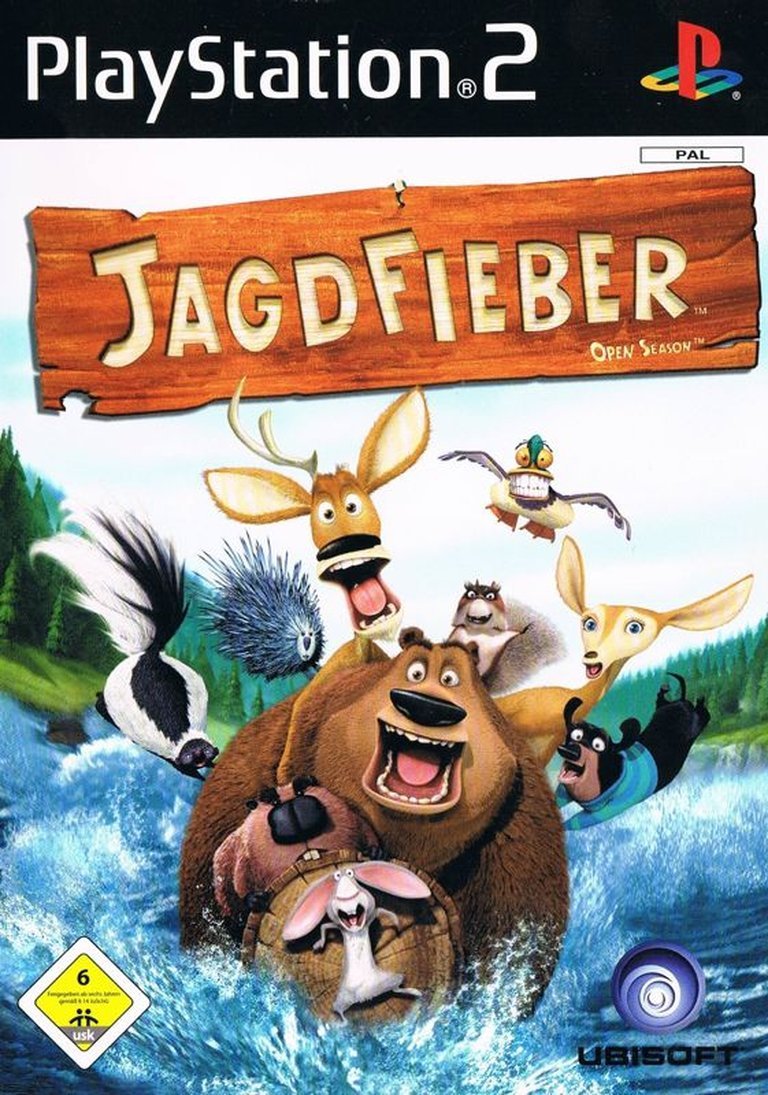
Open Season is a third-person action game based on Sony Animation Studios’ film, where players assume the roles of Boog, a domesticated bear, and Elliot, a one-horned deer. After Boog is accidentally released into the forest, he must gain the trust of woodland creatures by helping them evade hunters, solve simple puzzles using animal allies, and unlock new abilities to eventually return to civilization.
Gameplay Videos
Where to Buy Open Season
PC
Open Season Free Download
Open Season Cracks & Fixes
Open Season Mods
Open Season Guides & Walkthroughs
Open Season Reviews & Reception
metacritic.com (74/100): For players that liked the movie, or always wanted to beat up ducks, rabbits, and humans all in one package, check out Open Season. Just make sure to play it on hard mode.
imdb.com (58/100): Underdeveloped but Fun to play.
ign.com (66/100): Boog and Elliot star in this pleasing throwback to 16-bit platformers.
Open Season Cheats & Codes
PS2 (NTSC-U)
Enter the master code (all 4 lines) first, then enable individual cheats.
| Code | Effect |
|---|---|
| B4336FA9 4DFEFB79 | Enable Code (Must Be On) |
| FEC81343 383235E4 | Enable Code (Must Be On) |
| 4C347437 5B6740FF | Enable Code (Must Be On) |
| 78F60396 F426F1A3 | Enable Code (Must Be On) |
| 192A2127 437A79FA | Infinite Health |
| 682555EA 72F2B023 | Infinite Health |
| BEC4FE10 1E3DC57F | Infinite Health |
| BFA8ABBB BAE1E5B4 | Infinite Health |
| 8C1EA286 651F6036 | Infinite Health |
| 219B8332 891A10A6 | Access Wild Academy |
| 4746AF2F 4DF9C239 | Access Wild Academy |
| 736D3C35 AD3D7785 | (Wild Academy) Max Points |
| 61B87C67 EF4E7969 | (Wild Academy) Max Points |
Open Season: Review
In the crowded landscape of licensed video games, where cinematic adaptations often range from rushed cash-grabs to outright abominations, Ubisoft’s Open Season (2006) stands as a peculiar anomaly. Released across nine platforms to capitalize on Sony Pictures Animation’s animated film, this third-person action-adventure dared to subvert expectations by offering a surprisingly competent, if flawed, family-friendly experience. While it never transcended its “movie tie-in” origins, Open Season delivered a charming romp through the wilderness that resonated with younger players and nostalgic adults alike. This exhaustive analysis dissects the game’s development, narrative, gameplay, artistic merit, and enduring legacy to determine its true place in video game history.
Development History & Context
Open Season emerged from Ubisoft Montreal and Ubisoft Quebec, leveraging the Unreal Engine 2 to craft a cohesive experience across disparate platforms. The development timeline was aggressively synchronized with the film’s September 2006 release, aiming to capitalize on the movie’s momentum. This tight schedule inherently constrained the scope, leading to a linear, mission-driven structure. The creative team, led by Producer Patrick Naud and Creative Directors Chris Crowell and Gary Corriveau, prioritized faithful adaptation over innovation, focusing on replicating the film’s humor and character dynamics. Technologically, the late-2006 hardware posed limitations: the Xbox 360 and PS2 versions struggled with consistent frame rates, while the Wii port suffered from imprecise motion controls that felt tacked-on. The broader gaming landscape was dominated by triple-A titles like The Elder Scrolls IV: Oblivion and Gears of War, making Open Season a deliberate counterpoint—an accessible, low-stakes adventure designed for a family audience. Ubisoft’s strategy was clear: create a competent, kid-friendly product that could cross-sell movie tickets and merchandise, avoiding the pitfalls of earlier disastrous film-game conversions.
Narrative & Thematic Deep Dive
The game’s narrative closely mirrors the film’s plot, expanding it with playable vignettes that deepen character interactions. Players control Boog, a 900-pound domesticated grizzly voiced by Chris Williams, and Elliot, a hyperactive one-antlered mule deer voiced by Maddie Taylor. Their journey begins when Beth (Kari Wahlgren) releases Boog into the Timberline National Forest, setting off a chain of events where Elliot convinces Boog to embrace wilderness life and unite forest animals against the hunter Shaw (Darryl Kurylo). The narrative excels in its character-driven humor, particularly through Elliot’s manic energy and Boog’s reluctant heroism. Key scenes—like the duo’s outhouse rafting down rapids or the climactic battle where animals sabotage hunter camps—blend slapstick with genuine camaraderie. Thematic elements center on friendship and ecological harmony, using the animals’ rebellion against hunters as a metaphor for community solidarity. Though the story is predictable, its strength lies in how it translates the film’s voice chemistry into interactive dialogue, with Patrick Warburton reprising his role as the arrogant deer Ian and Danny Mann voicing the lovelorn hunting dog Serge. The narrative’s simplicity is its greatest asset: it avoids overcomplication, ensuring young players can follow the animal alliances without confusion.
Gameplay Mechanics & Systems
Open Season employs a mission-based structure where players complete tasks for forest animals to gain their allegiance. The core loop alternates between exploration, puzzle-solving, and light combat. Boog serves as the “muscle,” capable of roaring to scare hunters and throwing smaller animals (skunks, squirrels) to solve environmental puzzles or stun enemies. Elliot acts as the “scout,” using agility to jump inaccessible areas and lure hunters into traps. This duality creates engaging variety—Boog might throw a skunk up a hunter’s chimney while Elliot sneaks through undergrowth. The “Wild Academy” progression system rewards players with “Wild Points” for stylish actions, unlocking upgrades like enhanced roars or new animal allies. However, the gameplay suffers from repetition; objectives often devolve into linear fetch quests or simplistic hunter-scare tactics. The platforming is accessible but imprecise, with a finicky camera that struggles in dense forest environments. Multiplayer offers local co-op and versus modes in seven mini-games (e.g., Log Challenge! or Duck Chorus!), which are enjoyable for short sessions but lack depth. The Nintendo DS version stands out with its 2.5D puzzles and touch-screen controls, while the Game Boy Advance port cleverly channels Metal Slug-style action. Ultimately, the gameplay is a double-edged sword: it’s never frustrating for its target audience but rarely rises above functional.
World-Building, Art & Sound
The game’s world, Timberline National Forest, is a vibrant tapestry of pine forests, rocky mountains, and babbling rivers. Art direction emphasizes cartoonish exaggeration, with character models bursting with personality—Elliot’s lanky frame, Boog’s fluffy fur, and Shaw’s bulbous nose. Environments, while repetitive in structure, are rich in detail: hunter camps feature scattered equipment, and animal dens are cluttered with personal touches like acorn collections and feathered nests. The Unreal Engine 2 limitations are evident in texture pop-in and low-poly foliage, but the cel-shaded visuals maintain a cohesive, animated aesthetic. Sound design is a highlight: Shawn K. Clement’s score blends folksy guitar riffs with orchestral swells, perfectly capturing the wilderness atmosphere. Voice acting is uniformly strong, with Williams and Taylor delivering performances that mirror the film’s chemistry. Elliot’s frantic quips (“It’s like a roller coaster, except really, really dangerous!”) and Boog’s grumpy growls provide consistent humor. Sound effects—like the thud of a thrown squirrel or the pop of a skunk’s spray—are crisp and tactile. While the audio can’t fully elevate the gameplay, it anchors the player in the forest’s whimsical chaos.
Reception & Legacy
Open Season received mixed-to-average reviews at launch, with Metacritic scores ranging from 48 (PS2) to 72 (DS). Critics praised its child-friendly accessibility and faithfulness to the film but criticized its repetitive missions and short lifespan (typically 6-8 hours). IGN lauded the DS version as “a slick action game” but lamented the console ports’ “uninspired level design.” The Wii version was particularly panned for its “cruddy controls,” while GameSpot awarded it a 3.9/10. Commercially, it performed modestly as a tie-in, selling an estimated 0.3–0.4 million units by 2006—respectable for licensed fare but not industry-shattering. Over time, its reputation has improved among retro gaming communities, celebrated for its earnest charm and rare competence in a genre rife with failures. Handheld versions, especially the DS and GBA, are now considered hidden gems for their portable polish. The game’s legacy lies in its influence on Ubisoft’s licensed output; it proved that family-oriented games could succeed without sacrificing playability, paving the way for future titles like Ratatouille. However, it didn’t spawn a franchise beyond a 2008 sequel, and its multiplayer modes remain a footnote in party-game history. Today, Open Season is remembered as a solid, if unremarkable, entry in the annals of movie adaptations—charming, disposable, and perfectly suited to its time.
Conclusion
Open Season is a testament to the potential of licensed games when executed with care. It lacks the ambition of AAA titles but compensates with infectious charm, accessible gameplay, and a faithful adaptation of its source material. While its repetitive structure and technical limitations prevent it from being a classic, its strengths—a heartfelt narrative, endearing characters, and engaging local co-op—ensure it resonates with its intended audience. For modern players, it serves as a nostalgic reminder of mid-2000s Ubisoft’s versatility, capable of delivering both ambitious epics and lighthearted diversions. In the pantheon of film-based games, Open Season may not reach the heights of Spider-Man 2 or the depths of E.T. the Extra-Terrestrial, but it stands proudly as a competent, enjoyable adventure that deserves more than its “movie tie-in” stigma. It is, in the end, a solid romp through the woods—and sometimes, that’s more than enough.