
- Release Year: 1991
- Platforms: DOS, Macintosh, Windows 16-bit, Windows
- Publisher: Learning Co., Inc., The
- Developer: Learning Co., Inc., The
- Genre: Action, Educational
- Perspective: Side view
- Game Mode: Single-player
- Gameplay: logic, Math, Naval, Shooter, watercraft
- Setting: Aquatic, Underwater
- Average Score: 78/100
Description
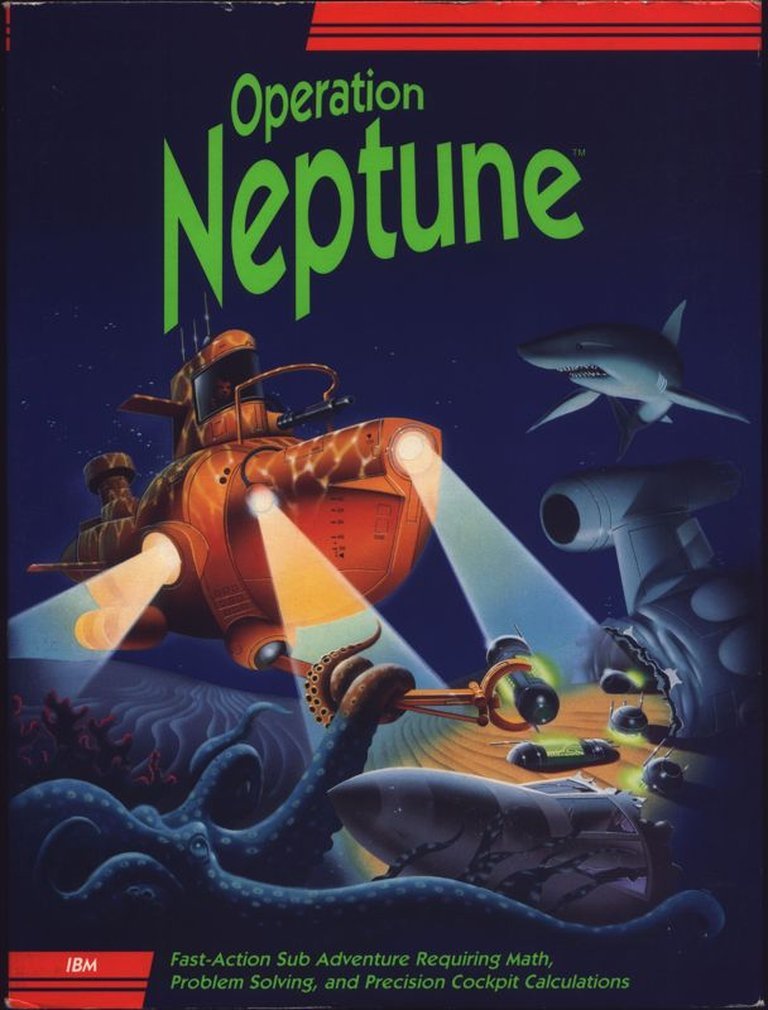
Operation Neptune is an educational action game designed for older kids, blending platform gameplay with math puzzles. Set in an aquatic environment, players navigate a submarine while solving real-world math problems involving whole numbers, fractions, decimals, ratios, and percentages. The game aims to build a strong foundation in math and problem-solving skills, with hints and customization options readily available.
Gameplay Videos
Operation Neptune Free Download
Operation Neptune Reviews & Reception
gamesreviews2010.com (80/100): Operation Neptune is an excellent educational game that combines fun and learning.
myabandonware.com : Another excellent game in The Learning Company’s outstanding ‘Super Solvers’ series.
mobygames.com (76/100): The game helps build a solid math and problem solving foundation with whole numbers, fractions, decimals, ratios, and percentages.
Operation Neptune: A Pioneering Dive into Edutainment’s Golden Age
Introduction
In the early 1990s, educational software often struggled to balance pedagogy with engagement—until Operation Neptune submerged players into a world where math problems doubled as survival tools. Developed by The Learning Company in 1991, this underwater adventure fused side-scrolling action with pre-algebra challenges, targeting children aged 9–14. Its legacy lies in redefining “edutainment,” proving that learning and arcade-inspired gameplay could coexist. This review argues that Operation Neptune remains a milestone for its innovative systems, thematic depth, and enduring influence on math-focused games—even if its technical constraints reveal its age.
Development History & Context
Studio Vision & Constraints
The Learning Company, a pioneer in educational software, sought to evolve beyond static drills with the Super Solvers series. Operation Neptune followed OutNumbered! (1990) and preceded Spellbound! (1991), anchoring a era when schools increasingly embraced PCs. Limited by early ’90s hardware (DOS floppy disks, 256-color VGA), the team prioritized clear visuals and intuitive keyboard controls over complex animations.
The Educational Gaming Landscape
In 1991, games like Math Blaster! dominated classrooms, but few merged action with curriculum-aligned challenges. Neptune stood out by contextualizing math within a thrilling narrative—a risky space capsule recovery—while competitors relied on abstract mini-games. This design mirrored The Learning Company’s ethos: “teach subtly, if not surreptitiously” (Compute! Magazine, 1992).
Narrative & Thematic Deep Dive
Plot & Environmental Themes
Players pilot the submarine Neptune to recover data canisters from the crashed Galaxy capsule, which leaked toxins threatening marine life. The story unfolds through decrypted log entries, slowly revealing a secret extraterrestrial research mission. Themes of environmental stewardship (“the fate of the world’s oceans rests in your hands!”) and scientific curiosity elevated the stakes beyond typical edutainment fare.
Characters & Dialogue
Characterization is minimal—the protagonist is a silent submarine operator—but adversaries include biologically inspired foes like pufferfish and hammerhead sharks. The friendly dolphin Zoom, who replenishes oxygen, became an iconic ally. Dialogue is sparse, with narrative delivered through mission briefings and logbook fragments, emphasizing immersion over exposition.
Gameplay Mechanics & Systems
Core Loop & Innovation
The game blends side-scrolling navigation with sudden math challenges. Players:
1. Pilot the Neptune through maze-like sectors, avoiding hazards like volcanic vents.
2. Solve contextual math problems triggered by environmental interactions (e.g., calculating ballast weights or sonar distances).
3. Manage resources: Oxygen depletes on collisions or incorrect answers, while ink pellets temporarily stun enemies.
Progression & Customization
Two campaigns—Voyager (beginner) and Expert (advanced)—adjust enemy patterns and ocean currents. Math difficulty scales across four tiers:
– Whole numbers
– Fractions/decimals
– Ratios/percentages
– Algebraic sequences
A built-in calculator and hints mitigate frustration, though critics noted the lack of joystick support and abrupt difficulty spikes (PC Junior, 1997).
UI & Accessibility
The split-screen interface pairs problem text with illustrative diagrams (e.g., bar graphs for toxicity levels). However, the DOS version’s keyboard-only controls felt archaic even in 1991.
World-Building, Art & Sound
Setting & Atmosphere
Five zones—Dragon Reef, Fossil Trench, Limestone Ridge, Sea Forest, and Hammerhead—offer distinct aesthetics, from coral vibrancy to volcanic gloom. While simplistic by today’s standards, the environments leveraged color psychology: calming blues for safe zones, ominous reds near hazards.
Visual & Audio Design
Artist Marc Ericksen’s box art (a submersible hovering over a trench) set a dramatic tone, though in-game sprites were functional rather than detailed. The soundtrack, though limited, used aquatic synth motifs to enhance immersion. Sound effects, like sonar pings and ink splatters, provided critical audio feedback.
Reception & Legacy
Launch Reception
Critics praised Neptune’s ambition: CD-ROM Today (1994) called it “a good game/learning combo,” while World Village (1997) noted its “entertaining, colorful” design but cautioned about frustration in later zones. Its MobyScore of 7.4 reflects divisive difficulty, not quality.
Long-Term Impact
Neptune proved that math could anchor an action narrative, influencing later titles like Math Rescue and Neptune Flux. Though overshadowed by Gizmos & Gadgets!, it remains a cult classic among ’90s edutainment enthusiasts. The Learning Company’s focus on real-world applications (e.g., interpreting charts) set a benchmark for STEM games.
Conclusion
Operation Neptune is a time capsule of edutainment’s golden age—a game where fractions determined survival and oceanic exploration felt heroic. While its DOS-era limitations (clunky controls, repetitive loops) show its age, its core vision—leveraging gameplay to demystify math—remains visionary. For historians, it exemplifies 1990s pedagogical innovation; for players, it’s a nostalgic reminder that learning could be an adventure. In video game history, Operation Neptune deserves recognition not just as a teaching tool, but as a pioneer in ludic education.