
- Release Year: 2009
- Platforms: Windows
- Publisher: Big Fish Games, Inc.
- Developer: Boomzap Pte. Ltd.
- Genre: Simulation
- Perspective: Top-down
- Game Mode: Single-player
- Gameplay: Business simulation, Managerial
- Average Score: 40/100
Description
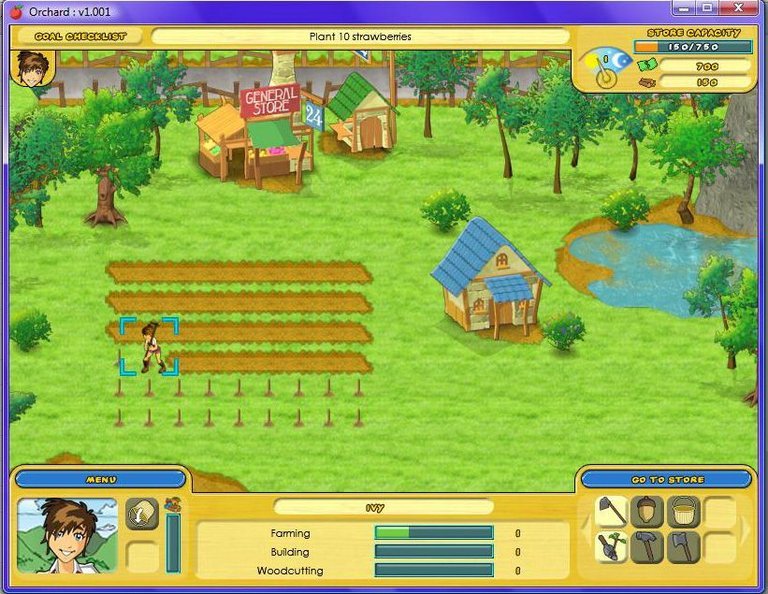
In ‘Orchard’, players escape the hustle of city life after receiving a letter from Granduncle Fred, who offers them the chance to take over his family orchard. The game is a top-down managerial simulation where players engage in rural activities such as planting crops, harvesting resources, crafting recipes, and constructing buildings. Set in a tranquil countryside, the game blends relaxation with light strategy as players nurture their orchard to success.
Where to Buy Orchard
PC
Orchard Cracks & Fixes
Orchard Guides & Walkthroughs
Orchard Reviews & Reception
metacritic.com (40/100): Orchard does have a certain Zen-like appeal, but as far as providing challenges and rewards that keep gamers coming back, it’s really lacking.
ign.com : This slow-paced farming game, while not without a certain charm in its overall presentation and plenty of specific goals to focus the player’s efforts, fails to deliver enough of a challenge to make the time you spend with it worthwhile.
Orchard: A Forgotten Gem of Casual Farming Simulations
Introduction: The Quiet Charm of a Bygone Era
In the late 2000s, the casual gaming market was flooded with time-management and simulation titles, each vying for the attention of players seeking a relaxing escape from the complexities of modern life. Among these, Orchard (2009), developed by Boomzap Entertainment and published by Majesco, emerged as a modest yet earnest entry—a game that promised the simple joys of rural life, where players could cultivate crops, craft recipes, and rebuild a family legacy. Yet, despite its charming premise and gentle gameplay, Orchard remains an obscure footnote in gaming history, overshadowed by more ambitious or mechanically deep simulations.
This review seeks to unpack Orchard in its entirety: its development context, its narrative and thematic underpinnings, its gameplay mechanics, and its place in the broader landscape of farming and tycoon games. Was it a misunderstood diamond in the rough, or a well-intentioned but flawed experiment? By examining its design, reception, and legacy, we can better understand why Orchard failed to leave a lasting mark—and whether it deserves a second look.
Development History & Context: The Rise of Casual Farming Sims
Boomzap Entertainment: A Studio Built on Casual Appeal
Boomzap Entertainment, the Singapore-based developer behind Orchard, was founded in 2006 with a focus on casual and family-friendly games. The studio had already made a name for itself with titles like The Hidden Object Show and Awakening: The Dreamless Castle, games that emphasized accessibility and relaxed gameplay. Orchard was part of Boomzap’s early portfolio, reflecting the studio’s interest in blending simulation mechanics with a lighthearted, stress-free experience.
The game’s development coincided with the peak of the casual gaming boom, a period where digital distribution platforms like Big Fish Games, iWin, and Reflexive Entertainment thrived. These platforms catered to an audience that preferred short, engaging sessions over the time-consuming commitments of AAA titles. Orchard was designed with this demographic in mind—players who wanted a farming experience without the complexity of Harvest Moon or the pressure of FarmVille.
Technological Constraints & Design Philosophy
Released in January 2009, Orchard was a Windows-exclusive title built for low-system requirements, ensuring it could run on the modest PCs of the era. The game’s top-down perspective and simple 2D sprites were a deliberate choice, prioritizing clarity and ease of play over graphical fidelity. This design philosophy aligned with the casual gaming market’s preferences, where gameplay fluidity often took precedence over visual spectacle.
Majesco Entertainment, the publisher, positioned Orchard as a “tycoon” game, though this label was somewhat misleading. Unlike RollerCoaster Tycoon or Zoo Tycoon, Orchard lacked the depth and strategic challenge typically associated with the genre. Instead, it leaned into a more meditative, progression-driven experience—one where the player’s primary obstacles were patience and resource management rather than competition or failure states.
The Gaming Landscape in 2009: A Crowded Field
By 2009, farming simulations were already a well-established niche. Harvest Moon had been a staple since the 1990s, and FarmVille (launched in June 2009) was about to revolutionize the genre with its social, free-to-play model. Orchard arrived in a transitional period, where traditional single-player farming sims were being overshadowed by more dynamic, multiplayer experiences.
Despite this, Orchard carved out a small space for itself by emphasizing crafting and recipe-based progression—a feature that would later become a cornerstone of games like Stardew Valley. However, its lack of narrative depth, shallow challenge, and repetitive structure prevented it from standing out in a market that was rapidly evolving.
Narrative & Thematic Deep Dive: The Fantasy of Rural Escape
Plot & Premise: A Letter from Granduncle Fred
Orchard’s story is minimal but effective in setting the tone. The player, a weary city dweller, receives a letter from their granduncle Fred, who has decided to retire and pass down the family orchard. The premise taps into a universal fantasy: escaping the rat race for a simpler, more fulfilling life. This narrative hook is reminiscent of Harvest Moon and Animal Crossing, where the allure of rural living is central to the experience.
However, Orchard’s storytelling is largely confined to its setup. There are no NPCs with personal arcs, no rival farmers, and no dramatic events—just the player, their workers, and the gradual expansion of the orchard. The game’s lack of narrative progression is both a strength and a weakness. On one hand, it allows players to focus entirely on the farming and crafting mechanics; on the other, it leaves the experience feeling hollow, devoid of the emotional investment that games like Stardew Valley later perfected.
Themes: Labor, Patience, and the Myth of Self-Sufficiency
At its core, Orchard is a game about labor and the rewards of patience. The player’s tasks—planting, harvesting, crafting, and selling—are all tied to the passage of in-game time, reinforcing the idea that success comes from consistent effort. The game’s lack of urgency or failure states further emphasizes this theme, suggesting that perseverance, rather than skill or strategy, is the key to prosperity.
Yet, Orchard also subtly critiques the myth of self-sufficiency. While the player starts as a lone farmer, they quickly realize that scaling up requires hiring workers, building infrastructure, and relying on external markets for ingredients like sugar and flour. This interplay between individual effort and collective labor is an interesting, if underdeveloped, thematic layer.
Characters & Dialogue: The Silent Workforce
The game’s cast is limited to the player’s hired workers, who exist primarily as functional entities rather than characters. They have no dialogue, no personalities, and no backstories—just skills that improve over time. This lack of character development is a missed opportunity, as even simple interactions could have added depth to the experience.
The absence of meaningful NPCs reinforces Orchard’s focus on mechanics over narrative, but it also makes the world feel sterile. Compare this to Stardew Valley, where the townsfolk are integral to the game’s charm, and Orchard’s silence becomes a glaring omission.
Gameplay Mechanics & Systems: The Zen of Repetition
Core Gameplay Loop: Plant, Harvest, Craft, Sell
Orchard’s gameplay revolves around a straightforward loop:
- Planting & Harvesting: Players cultivate crops like strawberries, apples, and pecans, each with different growth times.
- Crafting Recipes: Harvested goods can be turned into products like pies, jellies, and juices, which sell for higher profits.
- Expanding Infrastructure: Players build structures (bakeries, canneries, bridges) to unlock new recipes and streamline production.
- Hiring & Managing Workers: Employees automate tasks, allowing the player to focus on expansion.
This loop is simple and satisfying in the short term, but it lacks the depth to sustain long-term engagement. There are no random events, no seasonal changes, and no real risks—just a steady, predictable progression.
Combat & Challenge: The Absence of Struggle
One of Orchard’s most notable (and criticized) features is its lack of challenge. Unlike Harvest Moon, where players must balance energy, time, and relationships, Orchard imposes almost no penalties. Workers don’t require salaries, crops don’t wither, and there’s no risk of bankruptcy. The only “obstacle” is the time it takes to meet each level’s sales quota.
IGN’s Steve Butts summed it up in his review: “The design puts only the most minor obstacles in the way of the player’s success, so solving each level is more a matter of just going through the motions.” This absence of struggle makes Orchard feel more like a interactive screensaver than a game.
Character Progression & UI: Functional but Uninspired
Progression in Orchard is tied to unlocking new recipes and buildings, but the system is linear and lacks player agency. The UI is functional, with clear menus for managing workers and inventory, but it’s also barebones, lacking the polish of later farming sims.
The game’s most innovative feature—its recipe system—is underutilized. While crafting 20 different products sounds impressive, the process is largely automated once the necessary buildings are constructed. There’s little room for creativity or experimentation.
World-Building, Art & Sound: A Pastoral Aesthetic
Visual Design: Charming but Dated
Orchard’s art style is simple and functional, with bright colors and clear sprites that make it easy to distinguish between crops, buildings, and workers. The top-down perspective is reminiscent of classic Sim games, though the lack of animation detail makes the world feel static.
The game’s rural setting is pleasant but generic, lacking the personality of Animal Crossing’s villages or Stardew Valley’s Pelican Town. There are no landmarks, no seasonal changes, and no day-night cycle—just an endless, sunlit orchard.
Sound Design: A Peppy, Repetitive Soundtrack
The soundtrack, described by IGN as a “peppy string band affair,” is one of Orchard’s few standout features. The upbeat, folksy tunes fit the game’s pastoral theme, though the lack of variety means they quickly become repetitive.
Sound effects are minimal, with no ambient noises (birds, wind, etc.) to immerse the player in the world. The absence of audio feedback for actions like harvesting or selling further contributes to the game’s sterile atmosphere.
Reception & Legacy: A Game Quickly Forgotten
Critical Reception: Mixed but Largely Negative
Orchard received little critical attention, with IGN’s 4/10 review being one of the few professional assessments. Critics praised its relaxing atmosphere but criticized its lack of challenge and depth. The game’s Metascore remains “tbd” due to insufficient reviews, a testament to its obscurity.
Player reception was similarly lukewarm. While some appreciated its stress-free nature, others found it tedious and unrewarding. The game’s lack of post-launch support or updates meant it quickly faded from public consciousness.
Legacy: A Footnote in Farming Sim History
Orchard’s influence is minimal, but it’s not without historical significance. It represents an early attempt to blend crafting mechanics with farming simulations—a concept that would later be perfected by Stardew Valley and My Time at Portia. Its emphasis on recipe-based progression also foreshadowed the crafting systems in games like Oxygen Not Included and Factorio.
However, Orchard’s failure to innovate or challenge the player ensures it remains a curiosity rather than a classic. It’s a game that might have thrived in a different era—or with a more ambitious design.
Conclusion: A Relaxing but Shallow Experience
Orchard is a game of contradictions. It’s charming yet forgettable, relaxing yet repetitive, ambitious in its crafting mechanics but shallow in execution. For players seeking a stress-free farming experience, it delivers—but for those who crave depth, challenge, or narrative engagement, it falls short.
In the grand tapestry of farming simulations, Orchard is a minor thread—a game that tried to carve out a niche in a crowded market but ultimately lacked the innovation or polish to endure. It’s not a bad game, but it’s not a great one either. Instead, it’s a relic of its time, a reminder of when casual gaming was still finding its footing.
Final Verdict: 5/10 – A Gentle but Forgettable Diversion
Orchard is best suited for players who want a no-pressure farming experience. It’s a game to play in the background, not one to lose yourself in. For everyone else, there are better, deeper, and more rewarding alternatives.
Should You Play It?
– Yes, if: You enjoy ultra-casual simulations with no stress or failure states.
– No, if: You prefer games with depth, challenge, or narrative engagement.
Orchard may not be a masterpiece, but it’s a fascinating artifact—a game that tried to capture the magic of rural life but ended up feeling more like a chore than a escape.