
- Release Year: 2016
- Platforms: Windows
- Publisher: Pixel vs Pixel
- Developer: Pixel vs Pixel
- Genre: Action
- Perspective: Side view
- Game Mode: Single-player
- Gameplay: Boss battles, Combat, Health management, Item Pickup, Platform
- Setting: Fantasy
Description
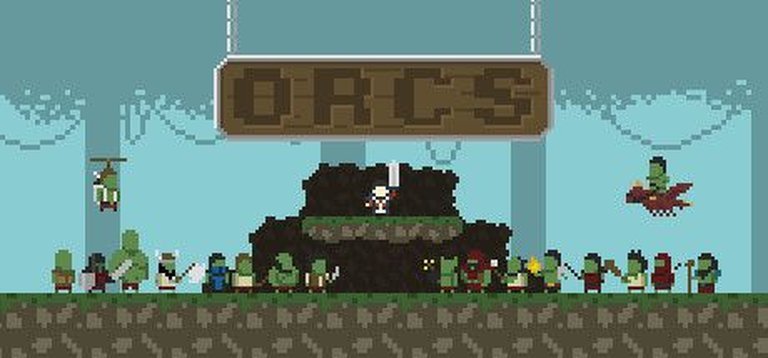
Orcs is a lo-fi 2D action platformer set in a fantasy kingdom under attack by an orc army. Players control a lone knight who must navigate 24 side-scrolling stages, using sword attacks and picking up dropped enemy weapons for one-time projectile abilities, while managing three health points and battling five bosses.
Where to Buy Orcs
PC
Orcs Free Download
Orcs Mods
Orcs (2016): A Lo-Fi Love Letter to 8-Bit Brutality
Introduction: The title says it all—or does it?
In the vast, lexicon-rich cosmos of video games, few words are as simultaneously overused and under-defined as “Orcs.” They are fantasy’s default cannon fodder, a monolithic horde of green-skinned, grunting brutes whose primary narrative function is to be slain in droves. Yet, the title Orcs—the 2016 indie platformer from Pixel vs Pixel—dares to present not an epic war, a rich lore, or a strategic command of legions, but a singular, blade-wielding knight against a seemingly endless tide of these very creatures. This stark minimalism is both its greatest statement and its most profound limitation. Orcs is not a game about the meaning of orcs; it is a game about the mechanics of killing them, distilled to a purer, more punishing form than almost any of itsinspirations. This review will argue that Orcs stands as a fascinating, if flawed, artifact of the 2010s indie scene: a game that prioritizes visceral, moment-to-moment challenge over narrative or world-building, ultimately succeeding as a tight, if sparse, mechanical exercise while failing to transcend its own premise or leave a significant cultural footprint. Its legacy is not one of innovation, but of pure, unadulterated genre fidelity.
Development History & Context: Pixel vs Pixel’s Minimalist Manifesto
The studio behind Orcs, Pixel vs Pixel, is as obscure as the game itself, with this title representing one of their few visible works. Released on May 20, 2016 for Windows, Orcs arrived on Steam via the Greenlight program—a community-driven curation system that, at the time, was both a lifeline for micro-studios and a vector for uneven quality. The game was built using Construct, a popular HTML5-based game engine prized by indie developers for its accessibility and 2D capabilities, but often associated with constraints in performance and visual depth compared to engines like Unity or Godot.
Technologically, Orcs is a deliberate retrograde statement. Its “lo-fi” aesthetic is not a bug but a feature, directly channeling the limited color palettes and chunky sprites of the NES and Sega Master System eras, with cited inspirations being the notoriously difficult gothic platformers Castlevania and Ghosts ‘n Goblins. This places it in a specific sub-niche of the “hardcore platformer” revival, alongside titles like Super Meat Boy and Celeste, but with a markedly more austere, arcade-oriented presentation. The 2016 gaming landscape was saturated with such throwbacks, but Orcs distinguished itself through its stripped-bare premise: no RPG elements, no complex story, just a knight, a sword, and a horde.
The development context suggests a passion project from a tiny team aiming to perfect a single, core loop. The choice of “Orcs” as a title is functionally descriptive rather than invested in the rich, contested fantasy history of the term (as explored extensively in the Warcraft, Elder Scrolls, and Warhammer source material). Here, “Orcs” are simply the enemy unit type, a designator of hostility. This lack of engagement with the cultural baggage of orcs is, in itself, a significant critique point the review will return to.
Narrative & Thematic Deep Dive: The Starkness of a Single-Word Plot
If the title is minimalist, the narrative is practically non-existent. The official description states: “The orc army are attacking the kingdom and a lone knight goes out to stop them.” There is no protagonist name, no kingdom name, no dialogue, no cutscenes, no lore to collect. The game is a pure action sandbox.
This vacuum is, initially, striking. In an era where even simple platformers often feature token story modes or environmental storytelling (consider the bleak, implicit tales of Limbo or Inside), Orcs offers zero diegesis. The knight is an archetype, the orcs are a faceless tide, the 24 stages are abstract environments (forests, castles, caves) with no geographical or historical coherence. The “themes” are therefore purely mechanical: perseverance, pattern recognition, and the catharsis of overcoming relentless, numerically superior force.
Contrast this with the deeply invested orc lore from the source material:
* In Warcraft, orcs are a tragic, magically-corrupted race from Draenor with clans, shamanism, and a redemptive arc from demonic slavery to a foundational pillar of the Horde.
* In The Elder Scrolls, Orsimer are a cursed elven offshoot with a complex religion (the Code of Malacath), a history of persecution, and a culture centered on strength and honor.
* In Warhammer, they are a comic, anarchic, fungus-based force of nature driven by a “Waaagh!” psychic field.
Orcs (2016) engages with none of this. Its orcs are pure Hobbesian antagonists: “solitary, poor, nasty, brutish, and short”-lived. They grunt, they swing axes, they drop said axes. The thematic weight is entirely on the player’s shoulders—the loneliness of the knight, the sheer scale of the invasion—but the game provides no narrative framework to process it. This is a zen-like void, where story exists only in the player’s mind as a justification for the violence. It’s a bold, if risky, design choice that prioritizes gameplay purity above all else, but it also renders the game emotionally inert and historically vacuous. The “orc” here is a generic monster, a pixelated placeholder.
Gameplay Mechanics & Systems: A Perfectly Honed Blade with a Dull Hilt
Orcs commits utterly to its core gameplay loop, and in this discipline, it finds its greatest strength.
Core Loop & Combat: The player controls a knight with a standard move set: run, jump, and a sword attack with a brief cooldown. The genius and defining mechanic is the disarmed enemy weapon system. Every orc (and other enemies) that carries a melee weapon (swords, battleaxes, clubs) will drop it upon death. The player can pick up this weapon, which then becomes a single-use projectile. Different weapons have different arcs and properties—a thrown battleaxe arcs gracefully over obstacles, a club might have a shorter, straighter trajectory. The player can hold only one such thrown weapon at a time.
This system creates a wonderful tactical rhythm:
1. Engage in melee, dodging attacks to build a stockpile of thrown weapons.
2. Assess the upcoming screen: are there archers on high platforms? A shielded orc behind a pit?
3. Select the appropriate thrown weapon from your inventory and unleash.
4. Repeat, managing the risk of getting hit (which costs health) versus the safety of ranged attacks.
Progression & Structure: There is no character progression. No XP, no ability upgrades, no new moves. The only “progression” is player skill and memorization. The game is divided into 24 stages (including 5 boss arenas). Death sends you back to the start of the current “segment”—typically a screen or two before your demise, not the absolute level start. This is a crucial, player-friendly concession to difficulty. Health is a mere 3 hit points, restored only by finding scarce food items (roast chickens, bread) hidden in the environment.
User Interface & Systems: The UI is ultra-minimalist: a small health indicator. The Construct engine likely handles the hitboxes and collision, which feel precise, a necessity for a game of this difficulty. The weapon pick-up indicator is clear. However, the lack of a map or any navigational aid in later levels, which become sprawling multi-screen labyrinths, can be frustrating. The “segment” checkpoint system mitigates this but doesn’t eliminate backtracking confusion.
Innovations & Flaws:
* Innovation: The single-use thrown weapon system is a brilliant, elegant twist on the “pick-up item” mechanic seen in games like Smash TV or Metal Slug. It forces constant inventory management and strategic adaptation without inventory bloat.
* Flaws:
* Repetition: With no progression, the 24 levels can feel like variations on the same core puzzle. Enemy patterns repeat (spear-thrusting orcs, archers, shielded knights), and the challenge comes from their placement, not new mechanics.
* Artificial Difficulty: Some challenges rely on tight, blind jumps or ambushes from off-screen, feeling more like punishment than skill-testing. The hitboxes can sometimes be unforgiving.
* Boss Fights: The 5 bosses are essentially larger, more complex pattern puzzles. They are satisfying to learn but lack the mechanical diversity of, say, a Mega Man boss where your weapon choice matters. The thrown weapon system is often less useful here.
* No Diversity: The knight is the only playable character. No unlocks, no alternate modes.
Orcs is a masterclass in constrained design. It takes one mechanic and explores it thoroughly across 24 stages. For players who enjoy this specific brand of precision platforming and tactical combat, it’s a gem. For those seeking variety or narrative motivation, it is a barren wasteland.
World-Building, Art & Sound: Atmospheric Skeleton, Aesthetic Skin
The game’s world is defined by absence. There are no towns, no NPCs, no lore tablets. The “kingdom” is a series of disconnected, generic fantasy archetypes: green forest, gray castle interior, lava-filled cave, skull-adorned dungeon. The atmosphere is one of desolate invasion, but this is conveyed solely through the overwhelming number of enemies and the bleak, often monochrome or duotone color schemes.
Visual Direction (2D Pixel Art): The “lo-fi” aesthetic is competently executed. Sprites are small but readable. Animations are functional: the knight’s walk cycle, the orcs’ attack stances, the arc of a thrown axe. The art style is closer to the Master System’s more reserved palette than the vibrant, detailed NES. It’s Serviceable, Not Spectacular. It serves the gameplay clarity but lacks the memorable character of a Shovel Knight or the eerie beauty of a Celeste. The backgrounds are often empty, emphasizing the gameplay area but creating a sense of visual monotony.
Sound Design: The soundtrack is a series of repetitive, looping chiptune-style melodies that adequately evoke a classic adventure but lack standout hooks. The sound effects—sword clashes, grunts, weapon whooshes—are clean and provide crucial audio feedback (the thunk of an axe hitting an orc’s head is satisfying). However, the soundscape is thin, and the lack of dynamic audio cues (e.g., distinct sounds for different enemy types beyond grunts) is a missed opportunity in a game where audio awareness is key.
The art and sound do their job: they are clear, functional, and evoke the intended era without technical flair or artistic ambition. They create a world that feels more like a debugging level than a lived-in kingdom, reinforcing the game’s purely mechanical identity.
Reception & Legacy: A Cult Curio in a Crowded Field
Orcs existed in a quiet corner of the Steam marketplace. It was not a breakout hit. On MobyGames, it has a minuscule player base (18 collectors at the time of writing) and an average score of 2.0/5 based on a single rating—a clear case of insufficient critical mass. On Steam, however, its reception is notably warmer. As of February 2026, it holds a “Very Positive” rating (81% positive) from 376 user reviews. This disconnect suggests a small, dedicated player base who discovered and championed the game, likely through word-of-mouth in hardcore platformer circles or bundles, while remaining utterly invisible to the broader critic establishment.
Its legacy is therefore as a niche title:
1. Within the “Masocore” Genre: It is cited in discussions of tough, retro platformers but rarely in “Top 10” lists, which tend to favor more innovative or polished titles like Cuphead or Celeste. It is seen as a competent, pure example of the “one-more-try” loop, but not a genre-defining one.
2. Amidst the “Orcs” Nomenclature: It exists in a long shadow cast by the Warcraft franchise’s massive cultural saturation. The term “Orcs” in gaming instantly conjures Blizzard’s verdant, shamanic Horde or the mindless grunts of Dungeon Keeper. Orcs (2016) makes no attempt to engage with this legacy, standing apart as a mechanical abstraction. It is perhaps the most literal interpretation of the word in gaming: a game where the primary noun, “Orcs,” is also the literal subject and object of all gameplay.
3. Historical Footprint: It had none. It influenced no major trends. It was not reviewed by major outlets. Its existence is a footnote in the history of Construct engine games and Steam Greenlight successes. The 2024 remasters of Warcraft: Orcs & Humans highlight the vast chasm between a culturally seminal RTS and a forgotten platformer sharing a thematic noun.
Conclusion: The Value of a Single, Sharp Idea
Orcs (2016) is not a great game by conventional measures. It has no story, no character, no innovation beyond a single clever mechanic, and a world with all the personality of a cardboard cutout. Its art is functional, its sound forgettable, and its legacy is negligible. Yet, to dismiss it entirely is to miss its point.
This is a game that understands the virtue of a single well-honed idea. The disarmed-weapon-as-projectile system is genuinely smart. It transforms every enemy kill from a simple act of removal into a tactical resource generation event. The entire game is built around the elegant question: “Which enemy’s weapon do I need for the next screen?” In an era of bloated indie games with dozens of interconnected systems, Orcs‘s purity is almost radical.
Its ultimate verdict in video game history is that of a specialist’s tool. It is not a game for everyone. It is a game for players who find joy in the tight loop of run, jump, kill, throw, repeat. For that specific audience, Orcs delivers a hard, satisfying, and focused experience. For gaming history at large, it is a curiosity—a testament to the fact that even within the most oversaturated genre (hardcore platformers) and the most overused fantasy trope (slaying orcs), there remains room for a small, clever, and utterly focused execution. It is a blade perfectly sharpened, wielded by an unknown knight in a forgotten war, a silent testament to the power of a single, well-executed idea in an world obsessed with scale and scope. Its place is not in the pantheon, but in the workshop—a reliable, if unglamorous, tool for a specific job.