
- Release Year: 2001
- Platforms: iPad, iPhone, Linux, Macintosh, tvOS, Windows
- Publisher: Aspyr Media, Inc., Ideas From the Deep, Pangea Software, Inc.
- Developer: Pangea Software, Inc.
- Genre: Action
- Perspective: Behind view
- Game Mode: Single-player
- Gameplay: Platformer, Shooter, Vehicle riding
- Setting: Futuristic, Sci-fi
- Average Score: 68/100
Description
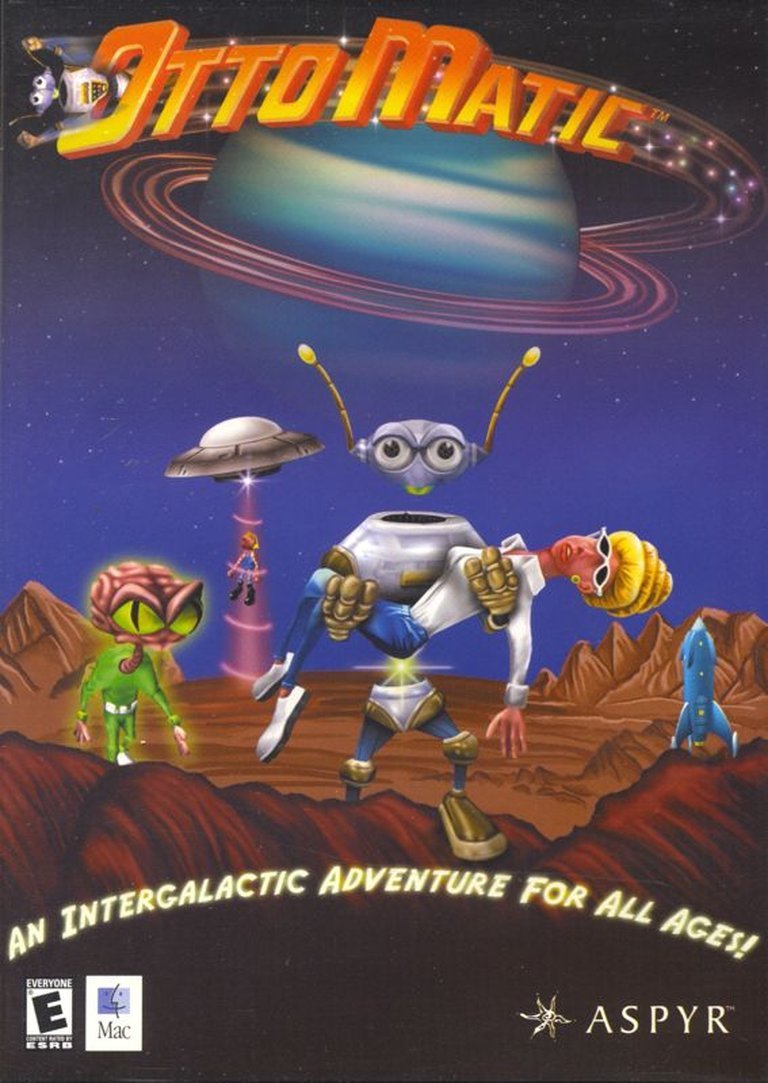
Set in 1957, Otto Matic is a sci-fi shooter where you control an Otto Matic robot police officer on a mission to rescue humans abducted by the evil Brain Aliens from Planet X. Across ten levels on Earth and various alien planets, you battle bizarre enemies like giant radioactive vegetables and alien clowns using seven weapons, collect rocket fuel, and navigate creative environments such as slimy lakes and zip lines in this behind-view action game.
Gameplay Videos
Otto Matic Free Download
Otto Matic Reviews & Reception
metacritic.com (70/100): Ahh.. Aliens, flying saucers, robots, mutant tomatoes… c’mon, it’s awesome and what more would you want in 2001?
ign.com (70/100): It’s hard to dislike Pangea’s gaming vision. The graphics are imaginative and fun, the sound is appropriate, and the gameplay is suitable for all gamers.
mobygames.com (66/100): In 1957, evil Brain Aliens from Planet X sent a fleet of flying saucers to Earth to abduct humans to other worlds as slaves to the Giant Brain.
Otto Matic Cheats & Codes
Macintosh
| Code | Effect |
|---|---|
| Hold [F10] and select the ‘Play’ option | Level select |
| Hold down F10 and press space | Bring up level cheat menu |
| Press BACK + START simultaneously on a gamepad | Bring up level cheat menu in main menu |
| Hold down a number key (0…9) and press space during copyright screen | Start on the corresponding level |
| Press [F10] + [Apple] during game play | Level skip / win level |
| Press backtick (`) and F10 | Win the level |
| Press R + B + I simultaneously | Full health and fuel |
| Press backtick (`) and F2 | Full health |
| backtick (`) and F1 | Fill rocket fuel |
| backtick (`) and F3 | Full jump jet |
| backtick (`) and F4 | Fill weapons |
| Press F8 | Bring up debug mode |
| Press backtick (`) and F9 | Warp to a point of interest in the map |
| Press backtick (`) and the Plus key on the keypad | Speed up the game |
| Press [F11] + M | Toggle music |
Otto Matic: Review
Introduction: A Galaxy of Whimsy in a Mac Gaming Universe
In the crowded annals of early 2000s gaming, few titles wear their eccentricity as proudly or as succinctly as Otto Matic. Released in December 2001 by the formidable indie studio Pangea Software, this game arrived not as a contender for graphical supremacy or narrative depth, but as a deliberate, affectionate love letter to the campy sci-fi B-movies of the 1950s. It was, in the words of one critic, “the craziest game I’ve ever come across,” a description that captures its chaotic charm. For a generation of Mac users, Otto Matic was more than a game; it was a bundled showcase, a proof of concept that the Mac could deliver vibrant, engaging 3D experiences without needing a PC. This review posits that Otto Matic stands as a fascinating, albeit flawed, artifact of a specific moment in gaming history: a time when platform exclusivity, developer idiosyncrasy, and a deeply specific aesthetic vision could converge to create a cult classic. Its legacy is not one of industry-changing mechanics, but of indelible personality, a testament to the power of a unified artistic vision overcoming technological and design limitations.
Development History & Context: The Pangea Vision on the Mac Frontier
To understand Otto Matic, one must understand its creator: Pangea Software and its founder, Brian Greenstone. In the late 1990s and early 2000s, Pangea carved out a unique niche as arguably the premier developer of high-quality, Mac-first 3D games. Titles like Nanosaur (1998), Bugdom (1999), and Cro-Mag Rally (2000) were technical showcases for Mac hardware, known for their bright, cartoonish graphics and tight, accessible gameplay. They were frequently bundled with new Apple computers, making them — and by extension, Pangea — household names among Mac users. The development of Otto Matic represented both a refinement of this formula and a bold step into a new thematic realm.
The technological context was one of rapid evolution but persistent constraints. The game was built for Mac OS 8/9 and early Mac OS X, targeting the PowerPC architecture. The Inside Mac Games preview from October 2001 highlights the ambition: using Apple’s OpenGL, Greenstone and artist Duncan Knarr aimed for “special effects such as motion blur, simulated ‘lens flares,’ glowing objects, wobbly landscapes and sophisticated animation.” This was cutting-edge for the Mac platform, pushing hardware that often lagged behind contemporary PCs. The vision was explicitly retro-futurist, drawing direct inspiration from cinematic touchstones like The Day the Earth Stood Still and Plan Nine from Outer Space. The goal was not photorealism, but a “cheerful, Nintendo-like quality,” as IGN later described it, prioritizing character and frame rate over polygon counts.
The gaming landscape for Macs in 2001 was paradoxical. While the “Macs can’t game” stereotype persisted, a vibrant independent scene thrived, with Pangea at its helm. The business model was clear: develop a flagship title, secure a bundling deal with Apple for iMacs and eMacs, and later port to Windows with partners like Ideas From the Deep (for the 2004/2005 Windows release). This strategy ensured initial visibility but also created a dependency on the Mac install base. The creative team was small and tight-knit (credited are programmer Brian Greenstone, artist Duncan Knarr, composer Aleksandar Dimitrijević, and a special thanks to ATI/Apple/Aspyr), allowing for a singular, unfiltered creative vision that would become both the game’s greatest strength and its most pointed weakness.
Narrative & Thematic Deep Dive: A Parody of Paranoia
The narrative of Otto Matic is deceptively simple but rich in its affectionate satire. The year is 1957, a peak period for Cold War anxieties and flying saucer hysteria. The antagonists are the “Brain Aliens from Planet X,” led by the eponymous Giant Brain, who are systematically abducting Earth’s citizens to transform them into slave aliens. The protagonist is Otto Matic, a member of a galactic robot police force, dispatched to thwart the invasion and rescue humanity.
This setup is a perfect scaffolding for the game’s core theme: an Affectionate Parody of 1950s B-Movie Sci-Fi. Every element of the presentation reinforces this. The human characters you rescue are direct caricatures: the pipe-smoking scientist, the buxom housewife with the “improbable Sauerkraut hairdo” (as TV Tropes notes), the clueless farmer. These aren’t just random victims; they are archetypes plucked from films like Invaders from Mars or Them!. The enemies are a menagerie of period-appropriate weirdness: giant radioactive killer vegetables (a direct nod to Attack of the Killer Tomatoes!), alien clowns, metal beasts, and insectoid praying mantises. The very planets you visit are single-biome, cartoonish extremes—Planet Snoth is a slimy, blob-filled world; Planet Rennie is a circus-themed amusement park from hell with flying saucer bumper cars.
Beneath the surface-level parody, the plot taps into deeper, era-specific fears. The Brain Aliens represent the ultimate “other”—mindless, collectivist, and intent on assimilating the individualistic American (and global) human. The forced transformation of humans into Brain Aliens, shown on the Game Over screen, is a potent metaphor for the era’s fears of communist brainwashing or loss of self to a faceless machine. Otto Matic, the silent, unflappable robot, is the ultimate agent of order—a technological guard against a technological threat. His lack of dialogue or defined personality makes him a perfect cipher for the player, but also underscores the game’s theme: in this goofy cosmic conflict, the machine is the hero, not the emotionally fraught human.
The plot’s progression—travel to eight (or ten, per the official site) planets, rescue humans, collect fuel, defeat minions, culminating in a boss fight against the Giant Brain—follows a classic serial structure, echoing the chapter-based adventures of old movie serials. The final confrontation is less a philosophical debate and more a straightforward shootout, keeping the tone firmly in the realm of action-comedy. The story’s purpose is not to be profound, but to provide a logical, humorous framework for the wildly imaginative level design and enemy encounters. It is a plot that is entirely in service to its aesthetic and gameplay.
Gameplay Mechanics & Systems: A Bag of Spilling, But a Full Bag of Tricks
Gameplay in Otto Matic is a hybrid of third-person shooter, platformer, and light puzzle-adventure, structured around discrete, point-based levels. The core loop is defined by a “Bag of Spilling” mechanic: each level begins with Otto’s rocket ship landing. Otto disembarks, the ship takes off, and the level ends only when Otto returns to the ship with sufficient rocket fuel. All collected items—weapons, health (red atoms), jump-jet fuel (green atoms), and blue atoms (a Plot Coupon required for level exit)—are converted into an “inventory bonus” score upon level completion, meaning Otto starts the next world empty-handed, save for his base health and jump reserves. This design encourages efficient, scavenging play and creates a clear, repeatable challenge for score attacks.
Combat and Weapons: The game offers seven weapon types, each suited to different enemy archetypes. The standard Ray Gun is your workhorse. The Freeze Gun (from Level 2) is a clever tool that doesn’t damage but immobilizes enemies, allowing for strategic hits or safe passage. Other weapons include spread shots, lasers, and heat-seekers. The enemy variety is one of the game’s strongest assets; with 25 types across the planets, encounters require adaptation. A giant walking vegetable might be vulnerable to explosives, while a hovering clown in a bumper-car requires speed and precision. The AI is generally straightforward but effective, with certain “Elite Mooks” (red-suited Brain Aliens) being relentless pursuers.
Level Design and Mobility: Levels are large, multi-layered affairs with a “wobbly,” warped aesthetic. Navigation is a mix of straightforward shooting, precise jumping across gaps (with the jump-jet), and environmental interaction. Pangea’s trademark variety is on full display: one moment you’re skiing on a board across a sea of toxic ooze behind a giant metal beast (“Ski behind giant metal beasts on a sea of toxic ooze!”), the next you’re riding a soap bubble across a noxious lake, or being shot out of a cannon. A highlight is the brief flying saucer pilot sequence on Planet Shebenek, offering a fun shift in perspective. A “Forced Transformation” power-up lets Otto grow to 50 feet tall, smashing through obstacles, though it’s typically time-limited.
Systems and Flaws: The point-scoring system, tied directly to human rescues and item collection, is the primary driver for completionists. However, reviews consistently identified control and camera issues as major friction points. As LudoMac noted, “the character manque de maniabilité… I often found myself shooting in the wrong direction, or jumping the wrong way! Moreover, the angle of the cameras often changes when you don’t expect it and this affects the controls.” This “Camera Screw” is a common critique in third-person games of this era, but it feels particularly acute here due to the precision required for jumping and fighting in chaotic environments. The Pocket Gamer UK and 148apps reviews of the iPhone port were even harsher, calling controls “uncontrollable” and a “dampener” on the experience. On Mac, the controls were workable but required an adjustment period. The game’s difficulty is uneven, sometimes feeling “simple in all the right ways” (Mac Gamer) and other times frustrating due to environmental hazards or surprise enemy spawns compounded by the camera.
In essence, the gameplay is a collection of clever ideas—the inventory system, the weapon variety, the set-piece vehicle sections—that are sometimes undermined by a clunky control scheme. It’s a game where the theoretical depth (using the right weapon for the job, optimizing rescue routes) is greater than the practical execution due to interface friction.
World-Building, Art & Sound: A Sonic and Visual Love Letter to the 50s
If Otto Matic has an indisputably masterful element, it is its cohesive, immersive aesthetic and sound design, which work in tandem to sell the B-movie parody premise completely.
Visual Direction: Duncan Knarr’s art is a masterclass in stylized, cartoonish 3D. The environments are not realistic but are bursting with character and color. Worlds are “single-biome” in a deliberately exaggerated way: Planet Sulak is all giant plants and swamps; Planet Deniz cleverly splits into a “Lethal Lava Land” and “Slippy-Slidey Ice World.” The warping, “wobbly” landscapes mentioned in the preview give the game a dreamlike, slightly surreal quality, as if the very ground is made of cheesy matte paintings come to life. Enemy design is where the parody sings—the Giant Brain is just a giant, floating brain in a jar; the alien clowns are menacingly jolly; the radioactive vegetables are grotesquely silly. The UI and pickups are charmingly retro: health and fuel are cartoon atoms, rocket fuel is classic red canisters, and Otto himself is a charming, boxy robot with a minimalist face.
Sound Design and Music: Aleksandar Dimitrijević’s soundtrack is arguably the game’s secret weapon. It makes heavy use of the Theremin, the quintessential electronic instrument associated with 1950s sci-fi for its eerie, wavering tones. The music is not just background noise; it is a constant, thematic reminder of the parody. It shifts from ominous, droning tracks in alien locales to more playful tunes on Earth, always maintaining that vintage sound. Sound effects are crisp and satisfying: the pew-pew of ray guns, the pop of frozen enemies shattering, the metallic clangs and whirrs of Otto’s movement. The overall audio package is “appropriate” (as IGN stated) and essential to the experience, transporting the player directly into a radio play or film serial from the era.
The synergy between sight and sound creates an atmosphere that is simultaneously nostalgic and original. It doesn’t just reference 1950s sci-fi; it constructs a living, breathing world that feels plucked from that era’s imagination. This cohesive world-building elevates the game beyond a simple collection of levels and makes exploring each new planet a genuine delight, even when the controls are fighting you.
Reception & Legacy: A Cult Classic Forged in Bundles and Ports
Otto Matic’s reception history is a tale of two (or more) platforms, revealing how context and expectations shape a game’s reputation.
Initial Launch and Mac Reception (2001-2002): As a Mac-native title, Otto Matic was a significant success. Its inclusion in the “Pangea Super Pack” and bundling with new iMacs/G4s provided immense exposure. Critically, it was well-received within the Mac community. Scores from Mac-focused publications were strong: Games4Mac (92%), Mac Gamer (85%), LudoMac (80%), Mac Addict (80%), AppleLinks (80%), and Inside Mac Games (75%). The praise consistently centered on its fun factor, creative design, family-friendly charm, and its status as a visual showcase for the platform. The common refrain was that it was “good clean fun” that didn’t overstay its welcome. The Mac’s smaller, more dedicated gaming audience appreciated a high-quality exclusive.
Windows Port and Later Mobile Ports (2004-2009+): The story changes dramatically with the Windows port by Ideas From the Deep (2004/2005) and the mobile ports (Otto Matic: Alien Invasion, 2009). Here, the game was judged against a much broader, more competitive library. IGN’s review (70% for both Mac and Windows, but the sentiment is key) perfectly encapsulates the shift: “If you have never played Bugdom, Otto Matic is an excellent introduction… For many gamers, though, there simply might not be enough motivation to play through another game that is so similar to Bugdom.” The critique of being “similar to Bugdom” highlights a perceived lack of innovation in Pangea’s formula. The Windows and mobile reviews are markedly more mixed, even negative. 7Wolf Magazine (60%) noted it was enjoyable but lacked replayability. AppVee (60%) and 148apps (40%) savaged the iPhone port’s controls, with the latter calling it “extremely pretty but suffers due to its lack of gameplay and iffy controls.” The infamous Russian review from Absolute Games (AG.ru) (12%) was a scorched-earth attack, reflecting a non-target audience’s complete dismissal.
Legacy and Modern Rediscovery: In the 2020s, Otto Matic has undergone a quiet renaissance. Its open-source re-release in September 2021 by Pangea for Windows, modern macOS, and Linux (noted on Wikipedia and MobyGames) has introduced it to preservationists and retro enthusiasts. On platforms like Metacritic and MobyGames, user reviews are sparse but fond. A 2024 user review on Metacritic calls it “truly one of the better Mac platform game[s] with some really bizarre stuff,” capturing the modern appreciation for its bizarre charm. Its cult status is secured not by sales records, but by its role as a definitive artifact of the Mac gaming renaissance of the early 2000s and its pure, unadulterated weirdness. It represents a development ethos—small team, big vision, platform-focused—that has largely vanished in the era of AAA cross-platform development.
Conclusion: An Imperfect Gem of Platform History
Otto Matic is not a perfect game. Its control scheme can be frustrating, its mission structure repetitive, and its design philosophy derivative of Pangea’s own earlier works. Judged by the metrics of modern gaming—tight combat, deep narratives, seamless control—it may fall short. But to judge it solely by those standards is to miss the point entirely.
Otto Matic is a triumph of mood, aesthetic, and creative consistency. It is a game that knows exactly what it is: a playful, whimsical, 1950s sci-fi pastiche. From the Theremin-scored soundtrack to the warped landscapes and the parade of absurd enemies, every asset serves this singular vision. Its legacy is multifaceted: it is a high-water mark for Mac-native 3D gaming of its era, a successful commercial product through bundling, a case study in the challenges of cross-platform porting, and now a preserved piece of digital history thanks to open-source release.
For the historian, Otto Matic is a vital data point. It illustrates the creative possibilities of constrained development, the power of a strong central theme to bind varied gameplay mechanics, and the profound influence of platform and bundling on a game’s initial reception and cultural footprint. It is not a lost masterpiece that changed the industry, but it is an undeniably charming, inventive, and historically significant title that remains a beloved curiosity. It earns its place not in the pantheon of the greatest games ever made, but in the gallery of the most distinctive — a quirky, flawed, and utterly unforgettable robot police adventure from a galaxy far, far away from the mainstream. For those willing to embrace its dated controls and simple goals, it offers a portal back to a time when a game could be just a wildly fun, visually inventive toy, unburdened by the weight of expectation. That, in itself, is a rare and precious thing.