
- Release Year: 1999
- Platforms: Windows
- Publisher: Infogrames Entertainment SA, Infogrames Europe SA, Infogrames, Inc.
- Developer: Appeal S.A.
- Genre: Action
- Perspective: Third-person
- Game Mode: Single-player
- Gameplay: Crafting, Exploration, Puzzle elements, Quests, Shooter, Stealth
- Setting: Futuristic, Sci-fi
- Average Score: 68/100
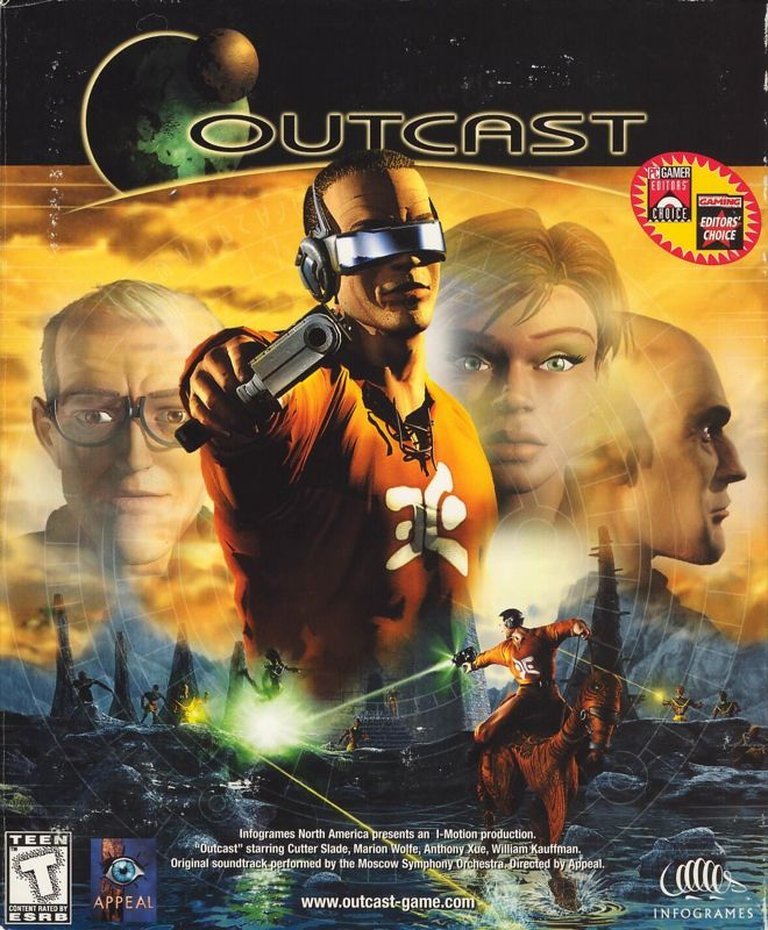
Description
Outcast is a 3D action-adventure game set in 2007, where former U.S. Navy SEAL Cutter Slade is sent to a parallel universe called Adelpha to repair a damaged probe and prevent a black hole from destroying Earth. Stranded and separated from his team, Cutter is hailed as the prophesied savior, the Ulukai, and must retrieve five sacred relics to overthrow the tyrannical Faé Rhan while navigating a richly detailed world filled with diverse landscapes, quests, and combat.
Gameplay Videos
Where to Buy Outcast
Outcast Free Download
Outcast Cracks & Fixes
Outcast Serial Keys
Outcast Patches & Updates
Outcast Guides & Walkthroughs
Outcast Reviews & Reception
metacritic.com (88/100): I played through this game 3 times. Once when it came out. Then again a decade later, and a third time a decade after that (v1.1). It still holds up great. So much heart.
en.wikipedia.org : The game was critically acclaimed and was named the “Adventure Game of the Year” by GameSpot in 1999.
imdb.com (30/100): Too unfinished to be worth checking.
gamespot.com (86/100): The story helps make even its silliest puzzle seem relevant and the game comprises an enormous world populated with interesting characters.
Outcast Cheats & Codes
PC
Type ‘HOKKUSPOKKUS’ during gameplay to enable the console. Press F12 to display the console, then enter one of the following codes.
| Code | Effect |
|---|---|
| ARSENAL | All Weapons |
| DYNAMIT | Dynamite |
| AMMO_FLOW | Infinite Ammo |
| IAMINVISIBLE | Invisibility |
| KILL_SOLDIERS | Kill All Enemies in Level |
| MONTAGNE | Teleport to Montazaar |
| FOREST | Teleport to Okar |
| MARCHES | Teleport to Okasankaar |
| VILLE | Teleport to Okriana |
| NEIGE | Teleport to Ranzaar |
| TEMPLES | Teleport to Shamazaar |
| BENNY | No Clipping Mode |
| FLY | Toggle Fly Mode |
| TRACKER | Radar |
| QUIT | Quit Game |
| POINTS | Show Points |
| POW 65553 | God Mode |
| POW [energy level] | Set energy to indicated level |
| cuttergotopos |
Advance to coordinates |
| teleport [world name] | Teleport to world |
| MEDI | Medi Pack |
| HOLO | Ubik-0A |
| TRIPWIRE | THNDR-STP33 |
| REMOTE | Clapr-T |
| weap_lev[range]_available [weapon] | Get weapon with indicated range |
| cutter_reput [number] | Set Image |
| drama_time [number] | Set Holo call timer |
| extra_points | Show points of next extra quest |
| COORDS | Toggle coordinates |
| save_game slot_[number] | Save game in indicated slot |
| load_game slot_[number] | Load save game from indicated slot |
| play [file name] | Play video file |
| HERO_MONEY | Add Zorkins |
Outcast: Review
Introduction
Released in 1999 to a world dominated by corridor shooters and cinematic action games, Outcast arrived not as a follower, but as a singular, audacious vision. Developed by the Belgian studio Appeal and published by Infogrames, this action-adventure dared to offer something radical: a vast, explorable alien world driven by narrative, environmental storytelling, and emergent gameplay, all powered by a revolutionary software rendering engine. Yet, its legacy is one of profound ambivalence. Praised as a masterpiece of world-building and technical innovation, it was simultaneously criticized for repetitive design and divisive gameplay choices. This review will dissect Outcast‘s ambitious creation, its complex execution, and its enduring, controversial place in gaming history. My thesis is that Outcast stands as a landmark title not for its perfection, but for its fearless ambition—a flawed, unforgettable masterpiece that redefined open-world design and left an indelible, if complicated, mark on the medium.
Development History & Context
The Vision of Appeal
Outcast was the brainchild of Appeal S.A., a small Belgian studio founded in 1995 by Franck Sauer, Yves Grolet, and Yann Robert. Driven by a desire to create a truly “living” alien world, they conceived a game that would prioritize exploration, character interaction, and environmental immersion over pure action. Their vision was deeply cinematic, aiming for a Hollywood-scale narrative with a score performed by a full orchestra—a rarity in 1999. As Sauer later clarified, the team sought to craft a “virtual holiday” to an alien world, a place dense with culture, history, and mystery.
Technological Constraints and Innovation
The engine powering Outcast was its most revolutionary, and controversial, aspect. Often mislabeled as “voxel-based,” it was actually a hybrid system: a ray-casting engine for landscapes (rendered as heightmaps, not true voxels) and a texture-mapped polygon engine for objects. This allowed for unprecedented outdoor scale, with sprawling vistas, dynamic weather, and effects like shimmering water reflections, depth of field, and bloom—all purely software-rendered, bypassing the 3D accelerator cards of the era. This choice was born from necessity and vision: Appeal wanted to create vast, complex worlds without the hardware limitations of polygon-based engines, which were still struggling with large-scale outdoor environments.
The cost was immense. Outcast required a then-cutting-edge Pentium III 500-600 MHz processor and 128MB of RAM to run at its peak resolution of 512×384. The engine pushed CPUs to their limits, and even on high-end systems, performance could be choppy. This technical barrier, coupled with the lack of hardware acceleration, meant Outcast looked unique but often blurry and pixelated up close. Its AI, codenamed GAIA (Game Artificial Intelligence with Agents), used distributed C++ libraries to create seemingly autonomous routines, where agents could interact, compete, and react to the player, adding depth to both enemy behavior and Talan (alien) inhabitants.
The Gaming Landscape of 1999
1999 was a pivotal year for PC gaming. The release of Valve’s Half-Life in November set a new standard for immersive, scripted action, dominating conversation and sales. Outcast launched in June, just months before Half-Life‘s explosive success. While Half-Life offered tightly focused, linear thrills, Outcast presented the antithesis: a sprawling, non-linear world driven by player agency and environmental discovery. It competed with other ambitious titles like Thief: The Dark Project and System Shock 2, but its unique selling point—the sheer scale and living world of Adelpha—set it apart. However, this very ambition, coupled with its steep hardware requirements and niche appeal, meant it struggled commercially against the juggernaut of Half-Life, selling only 12,571 copies in the US by year-end, though finding stronger footing in European markets like Germany (over 50,000 units sold).
Narrative & Thematic Deep Dive
The Plot of Two Worlds
The narrative of Outcast unfolds across two interconnected universes. In 2007, Earth scientists send a probe to a parallel universe, Adelpha, only for it to be damaged by an alien lifeform. The resulting energy backlash creates a black hole threatening Earth. Former Navy SEAL Cutter Slade is assigned to escort three scientists—William Kauffmann, Anthony Xue, and Marion Wolfe—to repair the probe and avert disaster. Upon arrival, however, Slade is separated from his team and hailed by the native Talans as their prophesied savior, the “Ulukai.” The plot thickens as Slade discovers the expedition members were scattered through time: Kauffmann arrived decades earlier and founded the Ulukai cult, while a deranged Xue, having gone mad, seized control of the Talan warrior caste, becoming the tyrant Fae Rhan. Slade’s quest thus becomes twofold: retrieve five sacred relics to overthrow Fae Rhan and reunite the Talan castes, while ultimately repairing the probe to save Earth.
Characters and Dialogue
The cast is defined by contrast. Cutter Slade is a quintessential 90s action hero—gruff, capable, and voiced by Bruce Willis’s German and French dub actors, lending him a cinematic gravitas. The Talans, however, are the heart of the narrative. A bipedal alien race with distinct “essences” (fire, earth, water, air) granting psychic abilities, they are presented with surprising cultural depth. They possess their own language, customs, and social structures, from the farming Gandha (earth) to the artisan Eluee (water) and militant Fae (fire). Yet, this depth is undermined by criticism. Many players found the Talans one-dimensional: predominantly male, obsequious, and obsessed with Slade’s “greatness.” Dialogue, while rich with alien jargon (requiring the in-game lexicon), often devolves into repetitive praise for the Ulukai or tedious fetch-quest exposition. The lack of female or child Talans, explained as living on a distant island, felt like a design shortcut, reinforcing a world populated by helpless, service-minded NPCs awaiting the white savior—a point not lost on contemporary critics who noted uncomfortable colonial undertones.
Thematic Resonance
Outcast explores themes of saviorism, cultural clash, and unintended consequences. The Ulukai prophecy satirizes the “chosen one” trope, as Slade, initially a reluctant agent of Earth, is elevated to godhood by a civilization in need. The narrative also delves into the ethics of exploration and colonialism; Slade’s “saving” of Adelpha involves toppling a local regime (however tyrannical) imposed by a human, highlighting the hubris of interfaring with alien worlds. The Talan caste system, based on elemental essences, serves as an allegory for societal division and the potential for unity against oppression. However, the execution often feels heavy-handed, with the story prioritizing epic scale over nuanced character development, reducing complex themes to simplistic good-versus-evil dichotomies.
Gameplay Mechanics & Systems
Core Loops and Exploration
Outcast‘s gameplay revolves around three interconnected loops: exploration, conversation, and combat. From the outset, players are granted unprecedented freedom. Six distinct continents—Ranzaar (snowy), Shamazaar (agricultural), Talanzaar (desert), Okasankaar (marshy), Motazaar (volcanic), and Okaar (forest)—are accessible via intercontinental portals (daokas), encouraging non-linear progression. Each region is a self-contained sandbox teeming with life: Talans farm fields, mine resources, and engage in daily routines, creating a palpable sense of a living world. Riding the indigenous beast-of-burden, the Twon-Ha, or deploying portable teleport beacons (from the F-LINK gadget) mitigates the vast distances, though traversal remains a core part of the experience.
Conversation and Quest Design
Interaction is the game’s double-edged sword. Players converse extensively with the Talans using a context-sensitive interface (left mouse button initiates dialogue). These conversations are crucial for uncovering the plot, understanding Adelphan culture, and advancing quests. However, the system is marred by repetition. Fetch quests dominate—”bring this to that,” “convince merchant X to lower prices”—often requiring tedious backtracking across continents. The reputation system, where aiding Talans improves their willingness to help, adds depth but is undermined by the NPCs’ sameness. As one MobyGames review lamented, “you are reduced to running around doing menial errands that these people are too useless to do themselves.” The alien lexicon, initially immersive, becomes a barrier, forcing players to consult the manual or in-game notes to track names, places, and items like “mon,” “daoka,” or “ris” (the Talan staple food, suspiciously like rice).
Combat and Gadgets
When combat arises, it is tactical and deliberate. Slade wields six futuristic weapons (e.g., a railgun, pulse launcher) that fire slow-moving projectiles, requiring precise aiming and constant movement to avoid return fire. Third-person is the default, but a first-person view is available. Gadgets add strategic layers: the hologram decoy creates distractions, the invisibility field allows for silent takedowns, and remote mines enable environmental traps. Enemy AI, powered by GAIA, is surprisingly advanced; soldiers flank, sound alarms, and coordinate attacks. Yet, combat is infrequent and sometimes unbalanced. Bosses like the Gorgor (a legendary dinosaur in Okasankaar) offer thrilling set-pieces, but common soldiers can feel bullet-spongy or exhibit invulnerability glitches under certain angles. A dedicated “god mode” option acknowledged the game’s difficulty, though it undermined the intended challenge.
Systems and UI
Outcast‘s UI is minimalist and functional. Two mouse buttons control everything: right-click aims, left-click handles actions (talk, jump, interact). An optional on-screen map aids navigation, and an in-game notebook tracks critical information. Resource management involves scavenging crystals, shells, and plants, which can be crafted into ammo by “recreators” or sold. However, the constant “Stable energy source—detected” prompt for nearby items became grating, cluttering the world with junk. The most unique system is the save mechanic: the Gaamsaav crystal. To save, players squeeze the crystal, which emits a visible glow and an audible sound, alerting nearby enemies. This added tension but was often seen as a gimmick, forcing players to find safe zones before saving—a stark contrast to the ubiquitous quicksaves of the era.
World-Building, Art & Sound
The Living World of Adelpha
Outcast‘s greatest triumph is its world-building. Adelpha feels less like a game level and more like a realized civilization. Each region boasts distinct ecosystems, architecture, and culture. Shamazaar’s rice paddies and pagoda-like temples evoke ancient China, while Talanzaar’s desert city of Okriana, with its bustling bazaars and towering palace, draws inspiration from Middle Eastern motifs. The Talan society, with its castes based on elemental essences, is rich with lore: the Fae warriors’ energy weapons, the Gandha miners’ perilous helidium extraction in Motazaar, and the Eluee merchants’ intricate crafts. Environmental storytelling abounds; overgrown temples in Okaar hint at a forgotten past, and the oppressive military presence in Shamazaar underscores Fae Rhan’s tyranny. This meticulous design, from the local flora to the social hierarchies, creates an unparalleled sense of place.
Artistic Vision and Visuals
The game’s visuals, powered by Appeal’s hybrid engine, are both breathtaking and flawed. Landscapes unfold in breathtaking vistas, with twin moons haunting the horizon and dynamic weather enhancing the atmosphere. Water effects, in particular, were revolutionary—translucent, rippling, and reflecting the environment with uncanny realism. Character and object models, however, suffered from the engine’s limitations. Textures were low-resolution, appearing pixelated and blurry at close range, especially indoors where perspective issues arose. The “impressionist” style of the landscapes, a byproduct of the ray-casting, gave the world a dreamy, painterly quality that some reviewers praised as “artistic” but others found muddy. Despite these shortcomings, Outcast‘s art direction was cohesive and evocative, creating an alien world that felt both alien and grounded.
Sound Design and Music
The audio elevates Outcast from a technical marvel to an emotional experience. The score, composed by Lennie Moore and performed by the Moscow Symphony Orchestra and Choir, is nothing short of epic. Sweeping orchestral themes underscore moments of wonder, tension, and triumph, adding cinematic weight to Slade’s journey. Sound design is equally impressive: the crunch of snow in Ranzaar, the lapping of water in Okasankaar, the distant chatter of Talans in Okriana—all create a vivid, immersive soundscape. Voice acting, while occasionally hampered by repetitive dialogue, is generally strong, with each Talan voice actor bringing distinct personality, even if the pool of voices is small. The integration of sound into gameplay is masterful; the Gaamsaav’s save-sound, the F-LINK’s teleport hum, and the alarm calls of enemy soldiers all serve functional and atmospheric roles.
Reception & Legacy
Critical and Commercial Reception at Launch
Upon release, Outcast was met with critical acclaim, particularly in Europe. It earned a 86% average on GameRankings and swept “Adventure Game of the Year” awards from GameSpot and Computer Gaming World. Reviewers lauded its ambition, world-building, and technical prowess. Just Adventure awarded it a perfect 100%, calling it “an absorbing alternative world,” while Eurogamer.net declared it “one of the best games I’ve played this year.” The orchestral score and living world were universally praised. However, criticism was sharp on gameplay. Fetch quests, repetitive dialogue, and technical issues (performance, low resolution) were common complaints. IGN, while praising the story, lamented the “weak, puffed up” plot and “inane” quest design. Commercially, Outcast underperformed, selling 400,000 units by 2002—a respectable niche number but a disappointment against the success of Half-Life.
Evolution of Reputation and Influence
Over time, Outcast‘s reputation has crystallized as a “flawed masterpiece.” Modern retrospectives celebrate its prescient open-world design, predating Grand Theft Auto III by two years. It’s cited as an influence on later Ubisoft titles like Far Cry and Assassin’s Creed, which similarly emphasized large-scale worlds and emergent gameplay. The game’s cult following grew, fueled by its uniqueness. Fan projects like “Open Outcast” kept the dream alive, while the original developers reacquired the IP in 2013, leading to remasters (Outcast 1.1, 2014) and a full remake (Outcast: Second Contact, 2017). The 2024 sequel, Outcast: A New Beginning, finally delivered on the franchise’s promise. Yet, the game’s divisive design—particularly its quest structure—remains a point of contention, with some players finding it tedious and others reveling in its depth.
Conclusion
Outcast is a paradox: a game of breathtaking ambition hampered by frustrating execution. It redefined open-world design with its vast, explorable alien world, pioneering software rendering, and deep lore, only to be undermined by repetitive fetch quests, technical limitations, and a protagonist complex enough to feel both heroic and a colonial caricature. Its legacy is not one of perfection, but of audacity—a landmark that pushed the boundaries of what a video game could be in 1999. As a journalist and historian, I verdict that Outcast remains an essential, if challenging, artifact of gaming history. It is a flawed dream, a testament to a studio’s fearless vision, and a reminder that true innovation often walks hand-in-hand with imperfection. For those willing to endure its quirks, Outcast offers an unforgettable journey to a world like no other—a place where ambition, for better or worse, was the ultimate star.