
- Release Year: 2002
- Platforms: GameCube, PlayStation 2, Windows, Xbox
- Publisher: Microsoft Corporation, Noviy Disk, Simon & Schuster Interactive, TDK Mediactive, Inc., TDK Recording Media Europe S.A.
- Developer: Hypnotix, Inc.
- Genre: Action, Sports
- Perspective: 3rd-person
- Game Mode: Co-op, Hotseat, Single-player
- Gameplay: Fighting, Golf
- Average Score: 72/100
- Adult Content: Yes
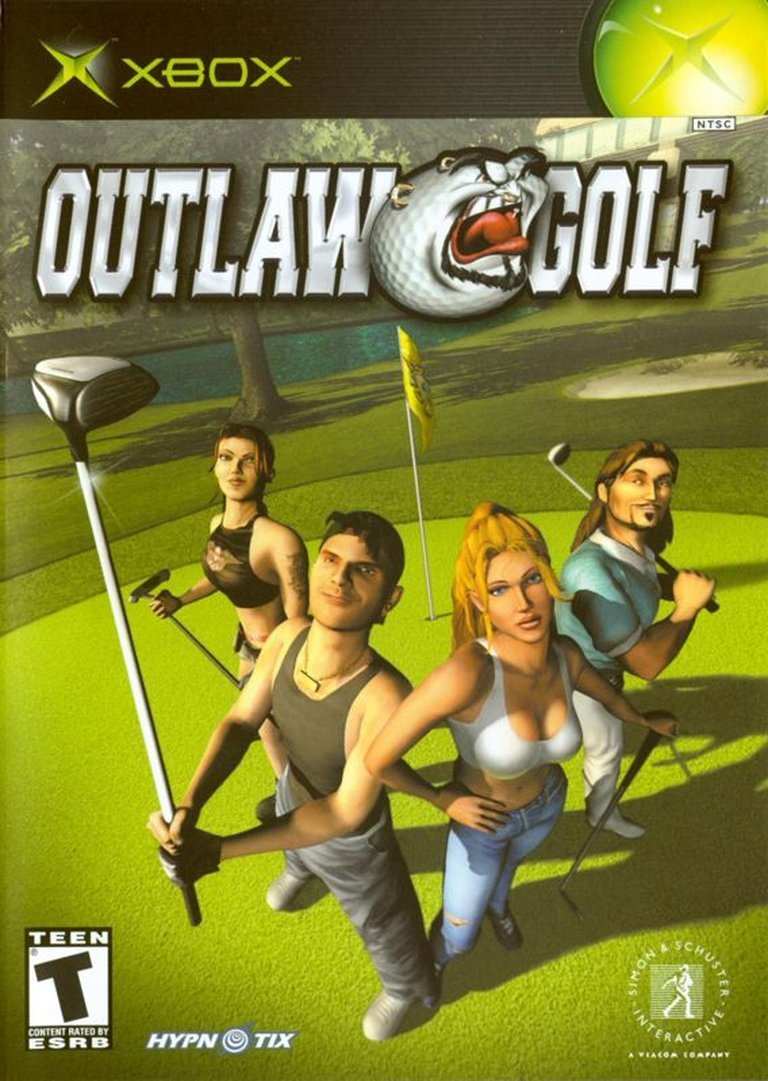
Description
Outlaw Golf twists the classic sport with over-the-top characters like lesbian strippers, wannabe rappers, and ex-cons, each paired with wild caddies, as players compete in over 30 tour events to unlock new golfers, clubs, balls, and skills via 12 mini-games. A unique composure system makes shots easier when performing well but harder during slumps—relieved by beating up your caddy—while technical analog-stick swinging, precise putting, and up to four-player multiplayer modes like stroke play, match play, and casino blend realistic golf mechanics with crude humor, sexual themes, and fighting elements.
Gameplay Videos
Outlaw Golf Free Download
Outlaw Golf Cracks & Fixes
Outlaw Golf Mods
Outlaw Golf Reviews & Reception
metacritic.com (72/100): Featuring a cast of outrageously lewd characters, Outlaw Golf has humor in bunches, but doesn’t manage enough solid golf gameplay to make it a true winner.
ign.com : tries to be a mix of both, succeeding to an extent, but falling short of golf greatness.
Outlaw Golf Cheats & Codes
Xbox
Enter ‘Golf_Gone_Wild’ as a case-sensitive player name when creating a new game. Other codes are button sequences entered by holding the specified trigger and pressing buttons at character selection or during gameplay.
| Code | Effect |
|---|---|
| Golf_Gone_Wild | Cheat mode: unlocks all courses, golfers, clubs, and events |
| Hold L + Y, Y, White, Y, Black, Y | Unlock bonus costumes |
| Hold R + Up, Up, Up, Down | Bigger ball (repeatable) |
| Hold R + Down, Down, Down, Up | Smaller ball (repeatable) |
| Hold R + Up, Left, Down, Right, Up, Left, Down, Right, X, X | No wind |
| Hold R + Black, X, Black, Black, X | Beating Token (only if none owned) |
| Hold R + White, Back, White, Black, Back | Super skill: no slice or hook, always hits at set power percentage |
GameCube
Enter ‘Golf_Gone_Wild’ as a case-sensitive player name when starting a new game. Other codes are button sequences entered by holding the specified trigger and pressing buttons during gameplay.
| Code | Effect |
|---|---|
| Golf_Gone_Wild | Unlock everything: all golfers, courses, and clubs |
| Hold L + Up, Up, Up, Down | Bigger ball (repeatable) |
| Hold L + Down, Down, Down, Up | Smaller ball (repeatable) |
| Hold L + Up, Left, Down, Right, Up, Left, Down, Right, X, X | No wind |
| Hold L + Z, X, Z, Z, X | Beating Token (only if none owned) |
| Hold R + Z, Y, Y, Y, Y, Z, Y | Bonus costumes |
PC
Enter ‘Golf_Gone_Wild’ as a case-sensitive player name when starting a new game.
| Code | Effect |
|---|---|
| Golf_Gone_Wild | Master code: unlocks all characters, clubs, and stages |
Outlaw Golf: Review
Introduction
Imagine teeing off on a golf course littered with trailer parks, toxic waste dumps, and low-flying airplanes, where your caddy isn’t a polite Scottish attendant but a punching bag for stress relief, and your fellow competitors include lesbian strippers, wannabe rappers, and ex-cons spouting profanity-laced taunts. Released in 2002 amid the Xbox’s launch-era dominance and the peak of sports simulation giants like Tiger Woods PGA Tour, Outlaw Golf by Hypnotix dared to subvert the genteel sport of golf into a raucous, adult-oriented brawl. As a cult artifact of early-2000s gaming’s “extreme sports” fad—think Happy Gilmore meets Dead or Alive Xtreme Beach Volleyball—it blended technical golf realism with crude humor, earning a devoted niche following despite middling scores. This review argues that Outlaw Golf endures not as a flawless masterpiece, but as a bold, flawed experiment in genre subversion: a hilarious party game that exposes the absurd potential of golf when stripped of its country-club pretensions, though hampered by content scarcity and technical quirks.
Development History & Context
Hypnotix, Inc., a small New Jersey-based studio founded in 1993, specialized in quirky, budget-friendly titles like the deer-hunting parody Deer Avenger series and oddities such as Panty Raider and Who Wants to Beat Up a Millionaire. By 2002, Hypnotix was pivoting to the “Outlaw” brand, a line of irreverent sports games targeting mature audiences weary of sanitized sims. Outlaw Golf, directed by Michael Cayado with executive production from Michael Taramykin, leveraged RenderWare middleware for cross-platform efficiency (Xbox first on June 12, 2002; GameCube October 30; Windows September 30, 2003; PS2 November 21, 2003 EU). Publishers like Simon & Schuster Interactive (NA) and TDK Mediactive filled a gap left by Microsoft’s Xbox push for edgy exclusives.
The era’s technological constraints shaped its ambition: Xbox’s robust hardware enabled analog-stick swinging and detailed ball physics, but Hypnotix’s modest team (65 credits, including programmers like Thomas L. Kirchner and animators like Paul Diaz) prioritized humor over scale. Gaming’s landscape was dominated by EA’s photorealistic Tiger Woods (annual juggernauts emphasizing pro authenticity) and arcade romps like Hot Shots Golf. Outlaw Golf positioned itself as the anti-sim: ESRB Teen-rated for “suggestive themes, crude humor, and violence,” it mocked golf’s elitism amid post-Grand Theft Auto III openness to adult content. Expansions like Outlaw Golf: 9 Holes of X-Mas (Blockbuster exclusives) and sequels (Outlaw Golf 2, 2004) extended its life, but Hypnotix’s 2005 acquisition by EA signaled the end of its indie streak. Vision-wise, it was a deliberate “bad attitude” antidote to realism, as per MobyGames’ official description—perfect for couch co-op in a multiplayer-hungry console generation.
Narrative & Thematic Deep Dive
Outlaw Golf eschews linear storytelling for a loose tournament progression across 30+ events, where players grind to unlock characters, clubs, balls, and skills via 12 mini-games. No epic plot binds it; instead, it’s a parade of vignettes amplifying golf’s frustrations through outlaw archetypes. The roster—10 playable golfers paired with grotesque caddies—embodies themes of subversion and catharsis: Summer (sultry stripper with ample “Autumn”) mocks sex-as-power; Ice Trey (Beverly Hills “wigger” rapper with “Fresh Fruit”) satirizes poseur culture; Harley (biker babe with boyfriend “Snake”) channels roughneck rebellion; Killer Miller (hulking ex-con with sleazy lawyer “A. Lance Chaser”) revels in post-prison aggression; Mistress Suki (dominatrix with whipped “Puddin'”) fetishizes control; others like El Suave (smarmy seducer), Trixie (spoiled brat), Doc Diggler (malpractice-prone surgeon), C.C. (tomboy brawler), and Scrummy O’Doole (soccer hooligan) round out a freakshow parade.
Dialogue crackles with Steve Carell’s deadpan announcer quips—”He’s shooting for the win… no, just kidding, he’s only shooting for par!”—and character barbs like Ice Trey’s rhymes or Harley’s threats. Themes dissect golf’s psychology: the Composure Meter literalizes real-life tilt, where success breeds confidence (shots straighten, distance boosts) and failure spirals into hooks/slices, mirroring pro meltdowns. Beating caddies—custom animations per character (e.g., Killer’s piledriver, Harley’s crowbar swings)—offers violent therapy, thematizing rage release. Crude sexual innuendo (lap dances, “undulating bodies”) and social jabs (trailer trash, environmental ruin) parody golf’s WASP exclusivity, positioning outlaws as chaotic equalizers. It’s not profound, but in mini-games and cutscenes (dances, taunts), it crafts a thematic deep dive into frustration’s absurdity, far edgier than Happy Gilmore‘s slapstick.
Gameplay Mechanics & Systems
At its core, Outlaw Golf loops traditional golf—stroke/match/skins/best ball/casino modes for 1-4 players—with “outlaw” twists, demanding precision amid chaos. The analog swing (pull right stick back for power, thrust forward for direction) is unforgiving: a hair’s deviation hooks/slices, enforcing practice (praised by players as “realistic,” akin to pros shanking). Adjust impact for spin, factor wind/physics (accurate roll on surfaces, lie adjustments minimal), and preview trajectories. Putting shines: multi-angle greens, slope grids, three-lineup attempts via X-button—easy to learn, brutal to master.
The Composure Meter innovates brilliantly: peaks from birdies/eagles (flaming perfect shots), troughs from rough/O.B. (shots wobble), scaling club distance/accuracy to simulate momentum. Low? Earn “beating tokens” (birdie rewards) for caddy QTEs—stop a bar five times for full restore, with character-specific flair (club whacks, arm-breaks). Progression unlocks via tours/mini-games (driving range, chipping contests boosting drive/control/putt stats) and gear (superior clubs/balls). UI is clean: radial menus, zoom cams track flight-to-rest, speed-up skips AI tedium.
Flaws abound: only three initial courses (Turnpike Valley’s Jersey grit, Crusty Leaf’s Southern decay, El Diablo’s desert excess) feel tame—straight par-5s lack doglegs/hazards, repeating post-unlock. Swing wears controllers (rapid flicks damage analogs); PC ports swap for clunky 3-click meters; AI waits drag solos. Multiplayer soars (2v2 co-op, Vegas wagers), but repetition kills longevity—commentary loops after 4-5 rounds. Still, physics excel (wind, bounces), blending sim depth (Links-like) with arcade flair.
World-Building, Art & Sound
Courses immerse via thematic grit: Turnpike Valley reeks Jersey (toxic exhaust, overpasses, planes); Crusty Leaf evokes Confederate backwoods (stray bullets, trailers); El Diablo scorches with blimps, amusement parks. Unlockables expand subtly, but variety lags—lush textures belie bland layouts. Visuals: cartoonish models (exaggerated physiques, 100+ costumes) pop on Xbox, with fluid swings/celebrations (lesbian pillow-fights amuse initially). Jaggies, loading pauses (golfer switches), and stiff caddy animations mar polish; GameCube’s analog orbit aids straighter shots.
Sound elevates: Carell’s sardonic wit (“Welcome to Slice-Hausen!”) and character dances/sayings infuse personality—rock/hip-hop OST fits sleaze. Effects shine (train rumbles, gallery cheers in 5.1), physics audibly satisfying (thwacks, rolls). Drawbacks: commentary/music stale quickly (toggle advised), minimal ambiance quiets sans announcer. Collectively, it builds a trashy, cathartic atmosphere—golf as outlaw rebellion, visuals/sounds amplifying irreverence over photorealism.
Reception & Legacy
Launch reception was mixed-average: MobyGames 66% critics (Xbox highs: 88% Consoles Plus, 83% Computer Bild Spiele; lows: 40% Gamekult, 0% Video Game Critic); Metacritic 72 Xbox/69 GameCube; player 3.8/5. Praised: humor/multiplayer (Game Chronicles: “sets a new high bar”), physics/swing (D Michael: “realistic quirkiness”); panned: few courses (IGN: “tame”), repetition (GameSpy: “falls flat”), controls (XBS: “lost flare”). Sold modestly (eBay now $7-35 used), spawning Holiday Golf expansions, Outlaw Golf 2 (2004, 74 Metacritic), Tennis/Volleyball. Niche influence: prefigured Golf With Your Friends-style party golf, adult humor in PGA Tour jabs; Insignia servers revive Xbox Live. Reputation evolved to cult fondness—quirky Xbox essential, critiqued for unfulfilled potential amid Tiger dominance. No industry revolution, but preserved “extreme” sports ethos.
Conclusion
Outlaw Golf masterfully weds golf’s technical rigor—analog swings, composure psychology, stellar physics—with profane humor and caddy violence, birthing a multiplayer riot ideal for post-pub laughs. Yet, sparse courses, repetitive animations/dialogue, and control quirks cap its brilliance, rendering it a rental gem over must-buy. In video game history, it claims a scrappy footnote: Hypnotix’s middle finger to sim purity, influencing irreverent sports (Worms-esque twists) and proving golf’s comedic pliability. Verdict: 7.5/10—a flawed outlaw worth resurrecting for its unapologetic swing at subversion. Rent, play with friends, beat your caddy, and chuckle at golf’s wild side.