
- Release Year: 2023
- Platforms: Windows
- Publisher: Gbrossoft
- Developer: Gbrossoft
- Genre: Action
- Perspective: Behind view
- Game Mode: Single-player
- Gameplay: Shooter
- Setting: Africa, Fantasy
- Average Score: 51/100
Description
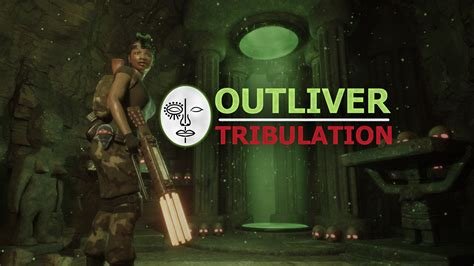
Outliver: Tribulation is an indie action-shooter from Nigerian studio GBROSSOFT that casts players as a black female special forces operator stranded in an ancient mystical temple in Africa after her team falls unconscious. Blending Souls-like difficulty with survival horror elements, the game challenges players to navigate a fantasy-reggae setting filled with puzzles, environmental threats, and enemies rooted in African mythology, all presented with third-person gameplay and an atmospheric soundtrack.
Gameplay Videos
Where to Buy Outliver: Tribulation
PC
Outliver: Tribulation Free Download
Outliver: Tribulation Reviews & Reception
whoppersbunker.com : this is a game that a fan of either or both survival horror or souls-like (but with guns) should investigate for as little as €2.
metacritic.com (26/100): The movement system is pretty bad, and the game feels very janky.
tryhardguides.com : A fascinating mess
Outliver: Tribulation: A Critical Review
Introduction: The Uncharted Realm
In an industry often accused of creative stagnation and geographical myopia, the arrival of Outliver: Tribulation from a three-person studio in Lagos, Nigeria, is an event that demands attention. It is not merely a game but a statement—a deliberate fusion of Western genre conventions (Souls-like combat, survival-horror tension) with the rich, underexplored tapestry of African, specifically Yoruba, mythology. This review posits that Outliver is a fascinating, deeply flawed, and ultimately vital artifact of indie game development. Its significance lies less in its execution—which is frequently uneven—and more in its audacious premise, its role as a pioneer for Sub-Saharan African narratives in premium gaming, and its embodiment of the resilient, resource-constrained creative spirit. It is a game that asks to be judged not on parity with AAA polished products, but on the scale of its ambition and the clarity of its cultural voice.
Development History & Context: Forging a Path Against the Odds
The Studio and the Vision
GBROSSOFT, comprising Mudathir Giwa (CEO, composer, sound engineer), Ahmad, and a third member, is a textbook example of a passionate, self-taught indie “skunkworks” operating from Lagos. Their stated mission—”to create African themed games with a global appeal”—is the driving force behind Outliver. The project, initiated in 2019, was born from a lifelong love of games (citing Nintendo classics and the original Resident Evil series as influences) and a desire to see their own cultural lore translated into interactive form.
Technological Constraints and the Engine Lifeline
Development was defined by severe financial constraints. As revealed in their detailed postmortem, the team self-funded for years, unable to afford expanded teams, outsourcing, or asset packs that would diversify their environments. This resulted in significant asset reuse, a common hallmark of limited-budget projects. The single greatest technological boon was access to Unreal Engine 5, made feasible by the Epic MegaGrant awarded in 2022. The grant provided critical hardware and allowed them to leverage UE5’s visual fidelity, which multiple reviewers note as a standout feature despite the small team. However, the engine’s power also highlighted other limitations; as one reviewer noted, the game’s visuals are “incredibly nice” in places, making the repetitive level geometry and jankier systems stand out more starkly.
The Landscape and the Niche
At its 2023 release, the market for “Souls-like” and “Survival Horror” games was crowded but formulaic, dominated by Japanese and Western studios. Outliver entered this space not as a competitor, but as an outlier. Its unique selling proposition—African mythology—was both its greatest marketing asset and a barrier to mainstream visibility. Its journey was shaped by grassroots efforts: building a community through Steam Fest demos, securing a distribution partnership with Loam (Games Industry Africa & Plug In Digital), and eventually being featured in the Epic Games Store Free Games Program and the Africacomicade/Google Play Android Port Challenge. These partnerships were not just about revenue but about overcoming the discoverability problem that plagues most indies, especially those from regions like Africa that global publishers often overlook.
Narrative & Thematic Deep Dive: The Warrior’s Trial
Plot Structure and Protagonist
The narrative is straightforward but effective. Players assume the role of Bolanle Gboyega, a Nigerian Army special forces operator. While pursuing Boko Haram insurgents, a cave-in transports her to the Realm of Tribulations, a supernatural plane governed by the ancient rituals and entities of Yoruba mythology. Her presumed goal—”to partake in an ancient ritual to regain passage”—is the engine for the game’s exploratory and combat loop. The story is delivered through a mix of environmental storytelling, item descriptions, and voiced dialog sequences with enigmatic characters she encounters in the realm.
Mythological Integration and Themes
This is where Outliver achieves its most profound success. The postmortem explicitly states the game is “steeped in ancient power” and “woven with religious significance.” The Realm of Tribulations is not a generic hellscape but a conceptual space reflecting Yoruba concepts of fate, trial, and spiritual warfare. The enemies—dubbed “Wanderers” and “Guardians”—are not mere monsters but mythological adversaries. The puzzles and trials are framed as rituals, and the “Charms” system for combat upgrades draws directly from spiritual iconography. The narrative explores themes of colonial reversal (a Black African soldier as the protagonist in a “darkest Africa” setting, but as the victim/explorer, not the colonizer), resilience, and the idea that one’s greatest battles are often metaphysical. The writing, while not award-winning prose, is respectful and intelligent in its treatment of the source material, avoiding caricature.
Character and Dialogue
Bolanle is a largely silent protagonist, her personality emerging through action and brief, functional radio chatter. The supporting cast, though limited, provides necessary exposition and tonal shifts. The voice acting, as noted in reviews, is a clear area of compromise—non-professional, serviceable but occasionally flat. This is a direct result of the three-person team’s limitations, where the project lead also served as composer and sound engineer. Despite this, the atmospheric weight of the story, especially when paired with the African-inspired soundtrack, often overcomes these performance deficits.
Gameplay Mechanics & Systems: A souls-like framework with survival horror soul
Core Loop and Combat
Outliver presents a third-person perspective where exploration, puzzle-solving, and resource management feed into intense, deliberate combat. The combat is explicitly modeled on the Souls-like paradigm: stamina management, dodge-rolls, heavy and light attacks, and punishing enemy strikes that can deplete a significant portion of health. However, it grafts on a Survival Horror shell through limited ammunition (for the primary gun), the constant threat of ambushes (“enemies blink into existence from the mist”), and a tense, atmospheric pacing. The “Charms” system allows for mild RPG progression, offering upgrades to health, damage, or stamina.
Strengths: Tension and Readability
When it works, the combat is satisfying. The need to learn attack patterns, manage resources, and position carefully creates the desired tension. The dodge mechanic, while criticized by some for animation “build-up” frames, generally offers a fair window for evasion when mastered. Boss fights, as highlighted in reviews, are the peak of this design—multi-phase encounters that demand pattern recognition and precision. The inclusion of night-vision goggles for darker sections is a smart, genre-standard touch that enhances the horror atmosphere.
Flaws: Execution and Feedback
The game’s amateurish backbone is most evident here:
* Jank and Animation: Character movement and weapon handling are described as “clunky” and “unnatural.” The animation lock when picking up items is a notorious pain point, often leading to death during frantic moments.
* Audio Design Issues: The “sound mix” is problematic. Several reviews note that audio cues for enemy attacks are either poorly implemented or misleading, causing players to misjudge threat direction. Certain sound effects are “hard on the ears,” breaking immersion.
* Boss Fight Ammunition Economy: A critical flaw, documented by Try Hard Guides, is that some boss arenas do not guarantee enough ammunition to defeat the boss if shots are missed. This can soft-lock the player, forcing a restart from a distant checkpoint—a cardinal sin in design.
* Puzzle Simplicity and Feedback: Puzzles are generally “not more difficult than standard modern video-game puzzles.” The “Warchief” update (v1.1.0.0) addressed complaints by simplifying riddle clues and adding a camera-pan feature that points toward the result of your action (e.g., an unlocked door), a crucial quality-of-life fix.
* UI and Mapping: The map is repeatedly criticized as too simplistic for a 3D space, failing to show player orientation clearly. The UI is “basic,” with lore text presented on plain boxes, lacking aesthetic polish.
Progression and Difficulty
The original single difficulty was notoriously harsh, culminating in a first boss (“Wanderer”?) that blocked many players. The Warchief update brilliantly split the game into Easy (lower enemy health/damage, longer intervals between waves) and Hard (classic challenge) modes. This decision, born directly from player feedback, is a masterclass in adaptive design and “empathy in game design,” as the postmortem states. It salvaged the game for a broader audience without betraying its core identity for challenge-seekers.
World-Building, Art & Sound: The Glimmer in the Dark
Visual Direction and Atmosphere
Powered by Unreal Engine 5, the game’s lighting and environmental art are its greatest technical achievements. The “Realm of Tribulations” features a consistent, moody aesthetic—deep shadows, ethereal glows, and cavernous, ancient architecture. Boss arenas that “open up into a starry night’s sky” are particular highlights, creating a powerful sense of the supernatural. However, this strength is undermined by severe asset reuse. The postmortem admits they “dreamed of distinct, asset-dense maps for each region” but lacked resources, leading to repetitive, sometimes confusing corridor layouts that hurt level design and navigability.
Sound Design and Music
The audio landscape is a mixed bag. The African-inspired soundtrack, composed by Mudathir Giwa, is a standout. It effectively uses traditional instruments and rhythms to root the supernatural experience in a specific cultural soil, creating a truly unique atmosphere absent from any major title. Conversely, the sound effects mixing is frequently faulted—some are uncomfortably sharp, others are poorly mixed for spatial positioning, and the aforementioned boss attack cues are often inadequate. This dichotomy perfectly mirrors the game: a visionary score struggling against a technically compromised soundscape.
Cultural Specificity as Aesthetic
The entire world-building is an exercise in cultural translation. From enemy designs that suggest ogbanje or other spirit entities to the ritualistic structure of progression, every element feels intentionally African. This is not “fantasy with a veneer of Africa”; it is a world built from the inside out. In an industry where “African-inspired” usually means a generic savannah level in a Call of Duty game, this specificity is revolutionary. The “attention to detail in the story and mythology” is the game’s soul.
Reception & Legacy: From Bargain Bin Curiosity to Cult Artifact
Critical and Commercial Reception
Outliver launched into a near-vacuum of mainstream critical attention. MobyGames has no critic reviews and only one user score. Metacritic shows a “Generally Unfavorable” user score (2.6/10 from 9 ratings), though this sample is small and likely biased toward early, frustrated adopters. Steam tells a different story: with 55 reviews (as of aggregated data), it holds a “Mostly Positive” rating (76/100 on Steambase, 80% positive for Steam purchasers). This suggests a significant divide between early adopters/Souls-hardcore and the broader audience after patches and the difficulty update.
The consensus from written reviews is a “fascinating mess” profile:
* The Criticisms (The “Mess”): Technical jank, poor UI, bad mapping, audio issues, occasional soft-locks, repetitive environments, non-remappable controls (a glaring omission), and unprofessional voice acting.
* The Praises (The “Fascination”): Unparalleled setting/mythology, strong atmospheric core, compelling lore, satisfying combat when it works, tremendous passion, and a unique identity.
Reviewers consistently conclude that the game’s strength of idea and heart outweigh its mechanical shortcomings for a certain audience—typically those curious about African narratives or willing to forgive indie flaws for originality. Its current $1.99-$7.79 price point on Steam/EGS is seen as a “virtual bargain bin” price that makes its curiosity value and unique experience a low-risk proposition.
Legacy and Influence
Outliver‘s legacy is not one of blockbuster influence but of trailblazing representation and a case study in resilient indie development.
1. Pioneering African Narrative Games: It is arguably one of the first premium, story-driven PC games from West Africa to achieve a global release. It proves there is an audience for culturally specific stories outside the Western/Japanese canon.
2. The GBROSSOFT Playbook: The postmortem is a vital document for underfunded indies. Lessons on community building via Steam Fest, iterative design based on feedback (leading to the Warchief update), and scoping down to a finishable project are universally applicable.
3. Visibility for the Africa Games Industry: Its accolades—”Debut of the Year” nominee (GIA Awards 2023), “One to Watch” (GIA 2022), IndieDB Indie of the Month, and features in showcases like The Indie Houses—have given GBROSSOFT and the wider African indie scene a platform. CEO Mudathir Giwa’s interviews (PocketGamer.biz) articulate the challenges and potential of the region, advocating for more investment and visibility.
4. Platform Expansion as a Testament: The game’s journey from PC to mobile (Google Play) via the Africacomicade port challenge, with plans for iOS, macOS, and Xbox, demonstrates a commitment to accessibility and a belief in the game’s broad appeal. The mobile version’s inclusion in “Top 10 Android releases” lists shows its port has found a new audience.
5. A Benchmark for Potential: As Try Hard Guides notes, “If the game just had a little more time in development… a little more time in the oven could easily take this game from a 5 to a 7.” It serves as a poignant “what if” and a proof-of-concept that with slightly more resources, African storytelling in AAA-ish spaces is not only possible but could be exceptional.
Conclusion: The Ritual’s Outcome
Outliver: Tribulation is not a great game by conventional metrics. Its technical execution is marred by the inescapable realities of a three-person, self-funded team. Its UI is bare, its animations are stiff, and its maps are repetitive. To dismiss it solely on these grounds, however, would be to miss its monumental importance.
It is a great idea made manifest. It is a love letter to Yoruba mythology and a scream into the void of gaming homogenization. Its moments of brilliance—the atmosphere, the unique boss designs, the cultural specificity, the genuinely engaging core combat loop—shine all the brighter because they emerge from such constrained circumstances. The developers’ transparency in their postmortem, their humble acceptance of limitations, and their devoted post-launch support (updates for Aim Assist, localization to 11 languages, multiple difficulty modes) reveal a team of exceptional integrity and passion.
In the canon of video game history, Outliver: Tribulation will not be remembered for flawless mechanics or sales figures. It will be remembered as a flag planted on a new continent. It is the game that said, “Our myths are worthy of the interactive medium,” and then built a realm to prove it, against all odds. For that ambition, for that cultural assertion, and for the undeniable thrill of its better moments, it earns its place as a crucial, cult classic milestone. It is a flawed gem, but a gem nonetheless—one that every player interested in the expanding borders of the medium owes it to themselves to experience, if only to see where the path less traveled leads. The verdict is not a score, but a recognition: Outliver: Tribulation is a landmark, and its story is far from over.
Final Score: 7/10 (As a historical artifact and cultural pioneer), 5/10 (As a pure gameplay experience). Recommendation: Essential for those interested in non-Western game narratives, African culture, or indie resilience. Approach with patience for jank.