
Description
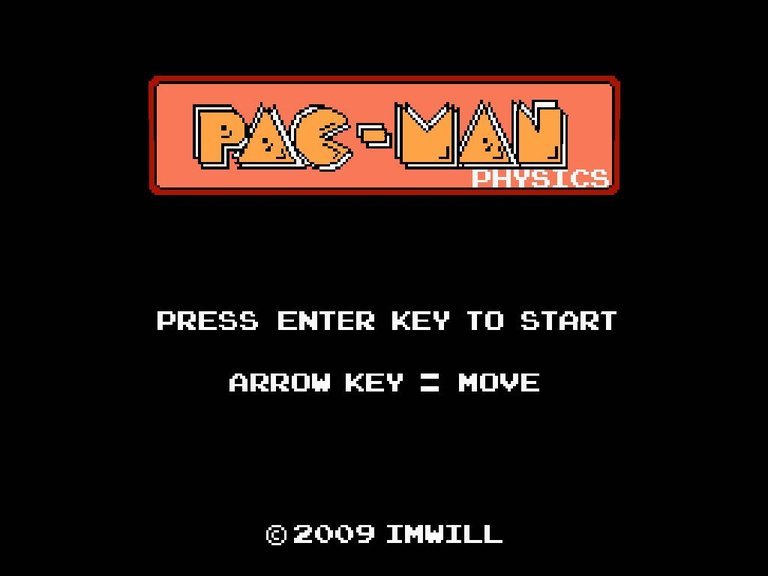
Pac-Man Physics is an experimental twist on the classic Pac-Man game, where all objects within the maze, including pellets, walls, ghosts, and Pac-Man himself, are governed by physics. This means that no fixed route can be followed, as every item can be pushed out of the way. Players must navigate this dynamic environment to collect pellets while avoiding ghosts, with power pellets creating strong gravity fields that affect all objects in unpredictable ways.
Pac-Man Physics: A Chaotic Reimagining of an Arcade Legend
Introduction
In 1980, Pac-Man revolutionized arcade gaming with its labyrinthine mazes and pursuit mechanics. Fast-forward to 2009, and Pac-Man Physics reimagines this classic through the lens of Newtonian chaos. Developed by indie creator imwill, this freeware experiment asks: What if the maze itself was alive? While not a commercial titan, Pac-Man Physics is a fascinating case study in how even minor mechanical tweaks can transform—or destabilize—a foundational gameplay loop. This review argues that Pac-Man Physics is both a playful deconstruction of arcade purity and a cautionary tale about the perils of overcomplicating perfection.
Development History & Context
The Indie Experiment
Released on January 10, 2009, Pac-Man Physics emerged during a surge of indie fangames and mods. Its creator, imwill, operated outside formal studios, leveraging accessible tools to reinterpret a cultural icon. The game’s premise—applying physics to every maze element—reflected a broader trend of “remix culture,” where hobbyists reshaped classics with modern twists (e.g., Super Mario Bros. X or Portal: The Flash Version).
Technological Ambitions
The game’s ambition was constrained by its simplicity: no complex AI or 3D rendering, but rather a straightforward subversion of Pac-Man’s static grid. By treating pellets, walls, and ghosts as malleable objects, imwill challenged the rigid rules of 1980s arcade design. However, the lack of polish—evident in its sparse UI and rudimentary collision detection—revealed the limitations of a solo developer working with minimal resources.
Narrative & Thematic Deep Dive
The Silent Story of Chaos
Like its predecessor, Pac-Man Physics lacks explicit narrative. Its “story” is emergent, driven by the tension between order and entropy. The original Pac-Man celebrated precision; here, unpredictability reigns. The ghosts, once methodical hunters, become erratic comets. Pellets scatter like leaves in a storm. Thematically, the game interrogates the illusion of control—a meta-commentary on how players project meaning onto abstract systems.
Power Pellets: Gravity as Narrative
The power pellets, which generate localized gravity fields, serve as the game’s only “plot twist.” These moments invert the maze’s logic, pulling Pac-Man and ghosts into chaotic vortices. It’s a clever metaphor for how power-ups can destabilize as much as empower, though the execution often feels haphazard rather than intentional.
Gameplay Mechanics & Systems
Core Loop: Controlled Anarchy
The foundation remains familiar: navigate a maze, eat pellets, avoid ghosts. But physics upend every interaction:
– Dynamic Maze: Walls and pellets drift when struck, creating shifting pathways.
– Ghost Behavior: Ghosts ricochet unpredictably, their movement governed by momentum.
– Power Pellet Gravity: A double-edged sword—players can exploit it to trap ghosts or accidentally fling Pac-Man into danger.
Flaws in the Formula
The physics system, while novel, lacks refinement:
– Frustrating Randomness: Skill is often overruled by RNG, as pellets cluster in inaccessible corners.
– Unresponsive Controls: Keyboard inputs struggle to manage Pac-Man’s newfound inertia.
– No Progression System: Without scoring incentives or levels, replayability hinges on novelty alone.
World-Building, Art & Sound
Aesthetic Fidelity
Visually, the game replicates Pac-Man’s iconic aesthetic—yellow protagonist, neon ghosts, blue maze—but with a sterile, minimalist edge. The lack of animations or particle effects reinforces its identity as a tech demo rather than a full-fledged successor.
Sound Design: Echoes of the Arcade
The soundscape is sparse, recycling classic Pac-Man effects (waka-waka pellets, ghost death jingles) without innovation. The silence between actions amplifies the sense of isolation, contrasting sharply with the arcade original’s frenetic energy.
Reception & Legacy
Critical Divide
Reviews were mixed:
– Clubic (50%) praised its “wacky homage” but dismissed it as “indispensably useless,” a novelty best enjoyed ironically.
– Players rated it 3.2/5, with some applauding its creativity, others lamenting its lack of depth.
Influence on the Industry
Pac-Man Physics didn’t spawn imitators, but it presaged trends like physics-driven remakes (e.g., Angry Birds) and “deconstruction” mods. Its true legacy lies in demonstrating how even minor mechanical shifts can breathe new life—or chaos—into tired formulas.
Conclusion
Pac-Man Physics is a compelling anomaly—a game that dares to ask “what if?” but struggles to answer “why?” Its experimental mechanics offer fleeting amusement, yet the lack of polish and direction prevent it from transcending its status as a quirky footnote. For historians and tinkerers, it’s a worthy case study in indie innovation. For casual players, it’s a reminder that some classics are best left unaltered.
Final Verdict: A fascinating misfire, Pac-Man Physics earns its place in gaming history not as a masterpiece, but as a testament to the joys and follies of creative tinkering.