
- Release Year: 2006
- Platforms: GameCube, PlayStation 2, PSP, Windows
- Publisher: Electronic Arts, Inc., Namco Bandai Games America Inc.
- Developer: Smart Bomb Interactive, Inc.
- Genre: Action, Driving, Racing
- Perspective: Behind view
- Game Mode: Co-op, Single-player
- Gameplay: Arcade, Automobile, Track racing, Vehicle simulator, Vehicular
- Average Score: 62/100
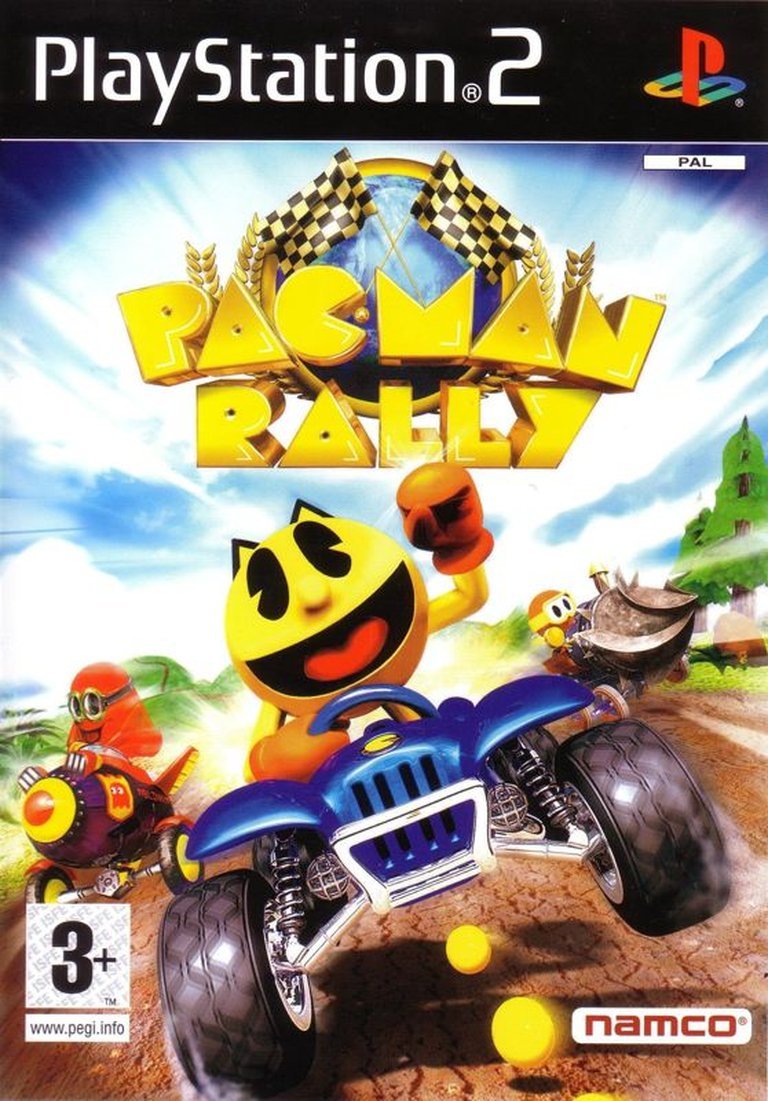
Description
Pac-Man World Rally is a kart-racing game that brings together Pac-Man and characters from previous Pac-Man titles and other Namco franchises, such as Mr. Driller and the Prince from Katamari Damacy. Players race through tracks while consuming dots, avoiding enemies, and strategically using power-ups and temporary advantages like power slides to win races and outmaneuver opponents, with the classic Power Pellet mechanic allowing Pac-Man to bite enemies.
Gameplay Videos
Pac-Man World Rally Free Download
Pac-Man World Rally Cracks & Fixes
Pac-Man World Rally Mods
Pac-Man World Rally Guides & Walkthroughs
Pac-Man World Rally Reviews & Reception
metacritic.com (54/100): The game’s simplicity, however, doesn’t give it a long shelf life, so it’s best to play live opponents.
gamespot.com : Pac-Man World Rally is a paint-by-numbers kart racer with almost zero in the way of unique qualities or challenges.
arstechnica.com : you have played it a million times before, and there are no reasons for you to pick it up over better and more-original kart racers.
gamesreviews2010.com (70/100): Overall, Pac-Man World Rally is a solid kart racer that’s worth checking out if you’re a fan of the genre.
worthplaying.com : Pac-Man World Rally is the 2006 equivalent of Chocobo Racing, the 1999 non-classic that defied both common sense and logic.
Pac-Man World Rally Cheats & Codes
PlayStation 2 (NTSC-U)
Enter the following hexadecimal codes on a CodeBreaker or GameShark disc for the PlayStation 2, or input them into the PCSX2 emulator cheat configuration. Ensure that cheats are enabled on the console before entering them.
| Code | Effect |
|---|---|
| B4336FA9 4DFEFB79 | Enables cheat mode |
| FD28AFE1 70CFED48 | Enables cheat mode |
| F249AFB2 E053279E | Enables cheat mode |
| 0ACD90B1 C731E15B | Enables cheat mode |
| D4B1A168 DFC96D27 | Unlocks the Pooka form |
| A78919AE 567A5CDE | Unlocks the Fygar form |
| 4377267C 9CFA6478 | Unlocks The Prince form |
| 800E9E83 4D75B65E | Unlocks Nightmare difficulty mode |
Pac-Man World Rally: Review
Introduction
In the vast, pixelated tapestry of video game history, few franchises command the instant recognition of Pac-Man. Created by Toru Iwatani in 1980, the insatiable yellow circle became an icon, transcending arcades to become a cultural phenomenon. Yet, by the mid-2000s, Pac-Man’s relevance had waned, reduced to a mascot for endless puzzle remakes and nostalgia collections. Into this void stepped Pac-Man World Rally in 2006—a kart-racing spin-off that promised to reignite the franchise’s competitive spark. Developed by Smart Bomb Interactive and published by Namco Bandai, it pitched Pac-Man and his ghostly rivals against a backdrop of Namco’s greatest hits. But while its core concept combined two beloved genres—racing and maze-chasing—the game’s execution reveals a complex legacy: a technically competent yet creatively bankrupt entry that echoes Mario Kart’s brilliance while failing to capture its magic. This review deconstructs Pac-Man World Rally not merely as a game, but as a cultural artifact—a product of its era, a victim of its ambitions, and a testament to the challenges of reimagining an icon.
Development History & Context
Pac-Man World Rally emerged from the ambitions of Smart Bomb Interactive, a studio founded in 2003 with a portfolio of licensed titles (including Snoopy vs. The Red Baron and the Bee Movie Game). Commissioned by Namco Hometek in October 2004, the project’s vision was clear: capitalize on the kart-racing craze epitomized by Mario Kart, but with a Pac-Man twist. Smart Bomb aimed to merge the frenetic action of kart combat with the maze-chasing mechanics of Pac-Man’s origins, creating a hybrid experience that would appeal to both nostalgic adults and younger players. Technologically, the game was ambitious, targeting the PlayStation 2, GameCube, PSP, and Windows simultaneously—a feat that strained resources. The PSP version, in particular, pushed the handheld’s limits, often struggling with frame rates as low as 15 FPS, as noted in reviews across platforms.
The gaming landscape of 2006 was saturated with kart racers. Mario Kart DS (2005) had dominated handhelds, while console players enjoyed Crash Team Racing and Sonic Riders. Nintendo’s genre blueprint was inescapable, and Pac-Man World Rally unabashedly emulated it: item boxes, power slides, and battle arenas were all lifted wholesale. However, the project faced hurdles beyond design. Namco Hometek was dissolved by the game’s release, shifting publishing duties to Namco Bandai in North America and Electronic Arts in Europe. An Xbox version, heavily promoted in early previews, was ultimately canceled, with a prototype surfacing only in 2021. This fragmentation left the game feeling rushed, its content diluted across platforms. The PSP edition, priced $10 higher, offered exclusive characters (Mappy, Mr. Driller) and tracks (like the Dig Dug-inspired Subterranean Speedway), but this only highlighted the core versions’ lack of polish. Smart Bomb’s inexperience with AAA development showed in the game’s uneven difficulty and repetitive design, underscoring how technological constraints and a crowded market stifled a potentially innovative concept.
Narrative & Thematic Deep Dive
Pac-Man World Rally boasts almost no traditional narrative, a stark contrast to the platform adventures of its Pac-Man World predecessors. Instead, the game’s “story” is conveyed through its characters and tracks—a pastiche of Namco’s history. Players select from 14 unlockable racers (16 on PSP), led by Pac-Man, Ms. Pac-Man, and their spectral nemeses Blinky, Inky, Pinky, and Clyde. Supporting cast includes Toc-Man (the robotic villain from Pac-Man World 3), Spooky (a ghostly rival), and the enigmatic Pac-Devil—a demonic, red-tinted Pac-Man on a chopper. Unlockable guest stars like Pooka and Fygar from Dig Dug, and The Prince from Katamari Damacy, celebrate Namco’s eclectic legacy, yet their inclusion feels obligatory rather than integrated. Dialogue is nonexistent; characters grunt and jibe without context, reducing interactions to cartoonish sound bytes.
Thematically, the game operates on two levels. On the surface, it champions competition and chaos—a familiar kart-racing ethos. But beneath, it explores nostalgia as commodity. Tracks like Retro Maze (a miniature Pac-Man arena) and King’s Kourse (a Katamari Damacy-themed circuit) are love letters to Namco’s past, yet they serve as set pieces rather than narrative catalysts. The Pac-Mobile transformation, triggered by collecting dots, is the game’s thematic core: it literalizes Pac-Man’s power-pellet mechanic, turning racing into a metaphor of consumption and dominance. Yet this cleverness is undermined by a lack of cohesion. The game’s tone wavers between child-friendly whimsy (e.g., Funhouse of Terror’s jack-in-the-box hazards) and Namco’s edgier history (e.g., Fygar’s fire-breathing attacks), creating a dissonant identity. Ultimately, Pac-Man World Rally prioritizes brand recognition over storytelling, using characters as avatars for competition rather than participants in a meaningful saga.
Gameplay Mechanics & Systems
At its core, Pac-Man World Rally is a Mario Kart clone reimagined through a Pac-Man lens. The core loop—racing, item collection, and combat—is familiar, but two systems inject uniqueness. The Pac-Mobile mechanic stands out: collecting Pac-Dots fills a meter, transforming the player’s kart into a chomping vehicle capable of “eating” opponents and rendering them immobile for seconds. This mirrors the original Pac-Man’s power-pellet frenzy, offering a strategic advantage that rewards aggressive dot-hoarding. Similarly, the fruit shortcut system adds depth: driving over fruit buttons activates corresponding shortcuts on the track, requiring players to balance speed with resource management. These mechanics elevate the game beyond mere kart racing, inviting tactical play that prioritizes track memorization and item timing.
The combat system, however, is less inspired. Items—dubbed “Pac-Bombs”—directly mimic Mario Kart: green bombs bounce like shells, red bombs homes in on rivals, and blue bombs target the leader. While the unlockable weapons (e.g., Sir Pac-a-Lot, a knight who flattens opponents, or the Galaga Ship, which shoots lasers) add variety, they feel tacked-on. The Guardian Meter, filled via power slides, provides a temporary shield but feels underutilized, rarely turning the tide of races. Character progression is minimal, with unlockables tied to cup victories (e.g., Fygar is unlocked by winning the Rally Cup on Hard difficulty). Stats like speed, acceleration, and steering differentiate characters, but weight classes (Light, Medium, Heavy) dominate balance, making heavyweights like Toc-Man sluggish yet resilient.
Modes are split between racing and battle. Circuit Mode (the Grand Prix) is the focus, with cups named after fruits and tracks divided into thematic groups (e.g., Cherry Cup’s pastoral Cloud Garden). Battle Mode offers five variants—Deathmatch, Free For All, Last Kart Driving, Binge (fruit collection), and Classic (dot collection)—but feels rudimentary. The PSP-exclusive challenges (Time Trials, Letter Hunt, Clockbuster) add replay value but feel incongruent with the core experience. Flaws abound: AI opponents are passive on lower difficulties, rarely using shortcuts or items aggressively, while track design relies on tired tropes (volcanic hazards, ice levels). The result is a game that’s mechanically sound but emotionally flat—competent yet devoid of the spark that makes kart racing enduringly fun.
World-Building, Art & Sound
Pac-Man World Rally’s world is a Namco theme park, where characters and environments collide in a vibrant, albeit chaotic, spectacle. The 15 tracks (16 on PSP) span diverse biomes: Molten Mountain’s lava flows, Arctic Iceberg’s caverns, and Pirate Cove’s shipwrecks. Standouts include the Classic Cup’s ode to history: Galactic Outpost (a Galaga-inspired space station), King’s Kourse (a Katamari Damacy cityscape with rolling katamaris), and Retro Maze (a miniature Pac-Man board). These tracks weave nostalgia into design—Funhouse of Terror’s jack-in-the-box hazards, for example, evoke classic arcade whimsy—yet others feel generic, like Canyon Crusade’s scorpion obstacles. The world-building is strongest in its references, weakest in its originality.
Artistically, the game leans into a cartoonish aesthetic, with bright colors and exaggerated character models. Pac-Man’s design remains faithful to his roots, while the ghosts’ 3D interpretations add personality (e.g., Spooky’s purple glow). The PSP version’s visuals are cleaner but plagued by slowdown, underscoring the compromises of multi-platform development. Sound design, however, is a highlight. The score, led by Tommy Tallarico and featuring Dweezil Zappa, remixes Pac-Man’s classic theme into upbeat, eclectic tracks that race alongside the action. Sound effects—the chomp of the Pac-Mobile, the fizz of power pellets, the thud of bombs—evoke arcade nostalgia yet feel fresh. Yet, this polish can’t mask the game’s audio-visual inconsistency: tracks like Winding Wetfield reuse textures, and the PSP’s choppy performance undermines the artistry. Ultimately, Pac-Man World Rally’s world is a love letter to Namco’s past, but it’s a collage rather than a cohesive masterpiece.
Reception & Legacy
Upon release, Pac-Man World Rally received mixed reviews, reflecting its status as a competent but unoriginal title. Aggregated scores from Metacritic highlight its mediocrity: 54/100 for PS2, 57/100 for GameCube, and 51/100 for PSP. Critics praised its Pac-Man mechanics and charm but lamented its derivative design. GameSpot called it a “paint-by-numbers kart racer,” while Eurogamer noted its “cute, charming” nature but argued it “never really wins your heart.” The PSP version fared slightly better, with Game Chronicles scoring it 76% for its exclusive content. Sales, however, were strong, with over 1 million copies sold worldwide, driven by budget pricing ($29.99 for consoles) and Namco’s branding.
In retrospect, Pac-Man World Rally’s legacy is one of footnotes. It’s rarely cited in discussions of kart-racing greats, often overshadowed by Mario Kart contemporaries. Screen Rant infamously ranked it among the “worst racing games of all time” in 2021, criticizing its lack of innovation. Yet, it endures in niche circles: fans celebrate its unlockable characters (e.g., The Prince’s inclusion) and the novelty of the Pac-Mobile. Its canceled Xbox prototype, discovered in 2021, remains a curiosity, while its mobile sequel, Pac-Man Kart Rally (2010), delisted in 2018, solidified its status as a short-lived experiment. Culturally, it reflects the mid-2000s trend of licensed kart games—games that traded originality for mass appeal. Pac-Man World Rally didn’t redefine the genre, but it preserved a slice of Namco history, proving that even a derivative product can have value as a time capsule.
Conclusion
Pac-Man World Rally is a game of dual identities: a technically polished yet creatively hollow kart racer that embodies both the potential and pitfalls of licensed gaming. Its strengths—the Pac-Mobile transformation, fruit shortcuts, and nostalgic track design—offer flashes of brilliance, reminding players why Pac-Man’s legacy endures. Yet, these innovations are drowned in a sea of familiarity, from its Mario Kart-clone mechanics to its generic AI and repetitive tracks. Smart Bomb Interactive crafted a competent experience, but one that prioritized brand recognition over ambition, leaving it as a footnote rather than a landmark.
In the annals of video game history, Pac-Man World Rally serves as a cautionary tale: even the most beloved franchises cannot thrive on nostalgia alone. It’s a game that’s fun in short bursts but forgettable in the long run, its value lying not in its gameplay but in its role as a bridge between Pac-Man’s arcade origins and his modern reimaginings. For collectors and Pac-Man purists, it’s a charming curiosity; for critics, it’s a reminder that innovation cannot be outsourced. Ultimately, Pac-Man World Rally is less a rally and more a checkpoint—a fleeting moment in the yellow circle’s journey, where speed and spectacle triumph over substance.