
- Release Year: 2004
- Platforms: Windows
- Publisher: Suricate Software
- Developer: Suricate Software
- Genre: Action
- Perspective: First-person
- Game Mode: Single-player
- Gameplay: Camera switches, Dot collection, Enemy Avoidance, Power-ups
- Setting: Underwater
Description
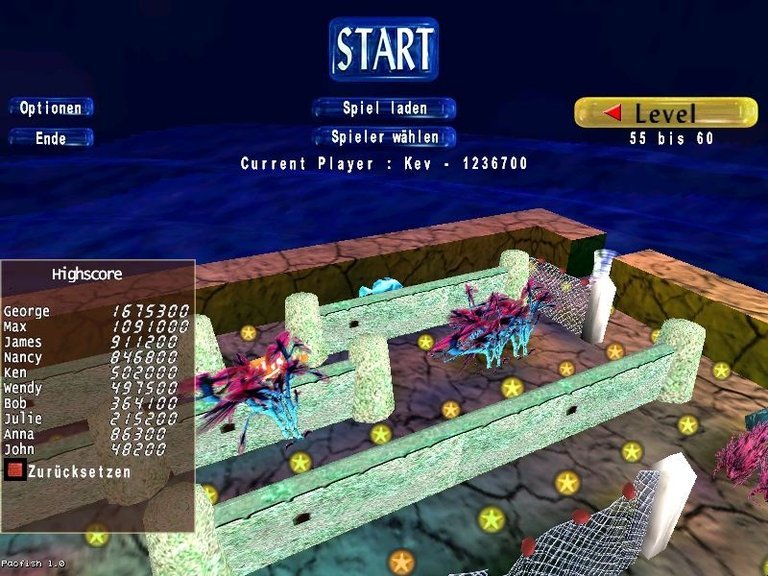
PacFish is a 2004 action game that reimagines the classic Pac-Man formula in a 3D underwater setting. Players control a fish navigating through maze-like aquatic environments, collecting dots while avoiding a variety of marine enemies such as sharks, crabs, and submarines. The game features power pellets and special items like speed-ups and snowflakes that freeze enemies, with dynamic camera angles and first-person perspectives during tunnel sections, all set against a vibrant maritime backdrop.
Where to Buy PacFish
PC
PacFish Guides & Walkthroughs
PacFish: A Sunken Relic in the Pac-Man Clone Ocean
Introduction: Echoes in the Deep
In the vast museum of video game history, certain titles serve not as masterpieces, but as crucial artifacts—cultural fossils that reveal the pressures and tendencies of their era. PacFish is one such fossil. Released in 2004, a full 24 years after Toru Iwatani’s seminal Pac-Man defined the maze-chase genre, this title from the German studio Suricate Software represents the inevitable, and often perilous, fate of a classic formula: the themed 3D reinterpretation. Its existence is a testament to the enduring, almost gravitational, pull of the original’s core loop, yet its critical reception—a scant 38% from its sole recorded critic—and its current obscurity tell a story of missed opportunities and changing times. This review argues that PacFish is not merely a bad game, but a fascinating case study in the decline of the arcade-inspired, single-mechanic filler title. It embodies the moment when the simple, elegant brilliance of Pac-Man collided with the rising complexity and graphical expectations of the new millennium, resulting in a product that feels phoned-in, charming only in its dogged, unoriginal persistence. To analyze PacFish is to dissect the very anatomy of a derivative.
Development History & Context: The Last Gasp of a Formula
The studio behind PacFish, Suricate Software, remains an obscure entity, a footnote in the German indie scene of the early 2000s. No significant legacy or subsequent notable titles are recorded in the provided sources, suggesting PacFish was likely a passion project or a quick commercial venture capitalizing on a recognizable brand. The game’s development occurred in a specific technological and market window: the waning days of the Windows 98/XP era and the rise of accessible 3D game engines.
-
Technological Constraints & Ambitions: The game was built using the 3D GameStudio engine, a tool popular with small teams and independent developers for its relative ease of use but often resulting in generic, low-poly aesthetics. PacFish’s “rich colors and graphics,” as described in its own marketing, were likely a selling point against the 2D sprites of the original, but by 2004, they already felt dated. The 3D perspective was chosen not for deep exploration, but as a superficial wrapper. The “vivid undersea world” with its “shipwrecks, lighthouses, and gently swaying sea plants” was a static diorama, a painted backdrop onto which the familiar Pac-Man template was projected. The technical innovation was minimal: the ability to switch camera angles and a first-person view inside tunnels. This wasn’t a design revolution but a cosmetic gimmick, a way to say “this is 3D” without rethinking the core spatial puzzle.
-
The Gaming Landscape of 2004: The context is damning. 2004 was a watershed year: World of Warcraft and Half-Life 2 redefined expectations for scope, narrative, and physics. PacFish, with its 72 “tricky mazes” and family-oriented arcade focus, seemed like a relic from a decade prior. The market for straightforward arcade conversions or clones was shrinking, reserved for handhelds or budget compilations. A full-priced Windows release of a Pac-Man clone with minimal modes (the sources mention only the core maze-clearing) was a hard sell. It arrived not as a fresh take, but as an echo in an increasingly crowded and sophisticated canyon.
Narrative & Thematic Deep Dive: The Void Beneath the Surface
PacFish offers a masterclass in narrative minimalism, not through artistic choice but through utter absence. The plot, such as it is, is a single sentence: a fish named PacFish lives in an undersea world and must eat dots while avoiding enemies. There are no characters, no dialogue, no lore. The “story” is purely diegetic—it exists only in the game’s setting and implied conflict.
- Thematic Analysis: The game’s only profound thematic statement is its watery setting. The ocean is not a metaphor here; it is a aesthetic substitute for the maze. The enemies—”crustaceans, sharks, sea anemones and submarines”—are not characters with motivations but simply functional archetypes (chaser, ambusher, stationary blocker) given aquatic skins. The “Magic Algae” and “Turbo Boost” are not narrative artifacts but abstract power-ups. The closest the game comes to a theme is a implied, bland “harmony with nature” vibe from its colorful, swaying plant life and “relaxing Caribbean soundtrack,” which sits in stark contrast to the violent act of consuming dots and turning enemies into “tasty fish.” This dissonance is never explored. The submarine enemy is particularly odd, introducing a man-made, industrial object into a biological food chain, a detail that hints at a deeper, unexamined narrative about pollution or intrusion that the game utterly ignores. Ultimately, the narrative is a non-entity—a thin veneer whose only function is to justify the gameplay mechanic, a stark contrast to the rich, emergent storytelling of the original Pac-Man‘s cutscenes or later maze games that built expansive lore.
Gameplay Mechanics & Systems: The Familiar Current
At its core, PacFish‘s gameplay loop is devoutly orthodox to the Pac-Man blueprint, a strength that is also its fatal weakness.
-
Core Loop & Structure: The player navigates a 3D maze from a diagonal-down bird’s-eye view (with first-person tunnel segments), collecting all floating “dots” (here, likely plankton or food pellets) to clear the level. The primary threat is contact with the patrol paths of varied enemies. Upon collecting a special power pellet (the “Magic Algae”), the enemies turn vulnerable and can be consumed for bonus points. This loop is replicated across 72 levels, with increasing complexity in maze design and enemy patterns.
-
Systems & Innovation: The game introduces two notable power-ups:
- Turbo Boost: A temporary speed increase, altering the core risk/reward calculus by allowing faster dot collection but demanding more precise turning.
- Snowflake (or similar freeze item): Temporarily halts enemies, providing a moment of safety to clear dense sections.
These are competent additions that slightly diversify strategy but do not fundamentally alter the loop’s DNA. The enemy variety is noted as key, with some having “clever” AI that “anticipates PacFish’s every move.” However, without specific AI patterns documented, this claim feels like marketing hyperbole. The transition to first-person in tunnels is a novel moment, but in a fast-paced maze game, this perspective shift likely disrupts spatial awareness rather than enhancing it.
-
Flaws & Omissions: The most glaring systemic flaw is the lack of additional game modes. There is no mention of multiplayer (competitive or co-op), time attack, puzzle modes, or a level editor. In 2004, even casual Pac-Man derivatives like Pac-Mania or Ms. Pac-Man offered more. The game is a pure, unadulterated score-attack grind with 72 increasingly difficult mazes. For a player, this becomes monotonous without new mechanics or goals to break the repetition. The “direct control” interface is standard, but the transition from 2D grid to 3D space can create imprecise movement—a critical flaw in a game where pixel-perfect navigation is paramount. The user review void on Metacritic and IMDb speaks volumes: there was no community to debate strategies or share experiences, a sign of a dead-on-arrival multiplayer-less arcade title.
World-Building, Art & Sound: A Pretty, Empty Aquarium
PacFish’s greatest strength and most pitiful weakness lie in its presentation.
-
Visual Design: The game’s world is described as filled with “rich colors and graphics” and “maritime details.” The screenshots available (though limited in the sources) confirm a low-poly, stylized aesthetic typical of early 2000s budget 3D. The palette is bright, with blues, greens, and coral hues. Environmental assets—shipwrecks, lighthouses, seaweed—are likely repeated tile sets. The atmosphere is intentionally placid and family-friendly, a direct contrast to the tension of the gameplay. This creates a bizarre cognitive dissonance: you are frantically dodging sharks in a world that looks like a serene screensaver. The art direction has zero synergy with the mechanics; the world is a passive backdrop, not an interactive or threatening space. This was a common failing in early 3D arcade translations, where the allure of the new dimension was spent on texture and model count, not on meaningful environmental gameplay.
-
Sound Design: The “relaxing Caribbean soundtrack” is a crucial detail. It directly opposes the Pac-Man theme’s iconic, urgent, repetitive chomp. By choosing a calm, melodic, likely loop-based tropical tune, PacFish undermines its own tension. The original’s music was a metronome for panic; here, the music encourages a laid-back pace that conflicts with the precise, frantic movement required. Sound effects are presumably limited to munching dots, power-up chimes, and enemy noises—all functional but forgettable. The audio design fails to create the iconic, Pavlovian link between sound and game state that defined its predecessor.
Reception & Legacy: A Blip in the Deep
PacFish arrived to near-total critical and commercial silence.
-
Launch Reception: The sole recorded critic review from neXGam is brutally succinct: it calls the game a “lieblose Kopie” (loveless copy) with “schlechter Grafik” (bad graphics), few modes, and “belanglosem Sound” (meaningless sound). The critic’s core accusation is that it lacks the “Charme” (charm) of the original arcade experience. This sums up the failure: it copied the structure but missed the soul. The game’s commercial performance is not recorded, but its status as a forgotten abandonware title, preserved only by enthusiasts on archive.org, suggests negligible sales.
-
Historical Legacy & Influence: PacFish has no meaningful influence on the industry. It did not spawn sequels (though “Miss PacFish” appears in one source as a related, possibly fan-made, title), nor did it inspire mechanics. Its legacy is purely as a cautionary tale. It represents the nadir of the “brand-apply-3D” strategy that plagued the early 2000s, where beloved 2D IPs were superficily upgraded for the new hardware without understanding what made them great. It stands in stark contrast to successful reinterpretations like Pac-Man World (1999), which added robust 3D platforming mechanics and a cohesive world. PacFish is the game you point to when discussing how not to revive a classic. Its preservation is valuable only as a historical specimen: the last gasp of the solo-developed, mechanics-only, arcade-style clone before such projects became exclusively indie darlings on Steam or mobile freemium titles.
Conclusion: Sinking Without a Trace
PacFish is a game of profound contradictions. It is technically competent in executing a basic premise but artistically and设计ically bankrupt. It is a 3D game with no spatial depth, a family title with tense gameplay, an aquatic adventure with no life. Its 72 levels are a monument to quantity over quality, a brute-force approach to content that feels like filler.
The verdict is not that PacFish is “unplayable”—its core loop is, by definition, functional. The verdict is that it is unnecessary. In 2004, with Pac-Man Championship Edition已有雏形 and the nostalgia market heating up, PacFish offered nothing new, nothing charming, and nothing memorable. It is the video game equivalent of a knock-off toy: the shape is right, the colors are bright, but the moment you pick it up, you feel the cheap plastic and know it has no soul.
Its place in history is secure, but it is a place in the basement archives, not the hall of fame. It is a sunken relic, not of sunken treasure, but of a sunken idea—the idea that a classic formula could be extended indefinitely with a simple thematic skin. The ocean of game history has silently, and rightfully, swallowed it whole, leaving only a faint ripple and a lesson for developers: charm cannot be reskinned. Innovation, or at the very least, respectful homage, is the only currency that keeps a classic afloat. PacFish is, and shall remain, permanently out of the high-score table.