
- Release Year: 2002
- Platforms: Windows
- Publisher: Alawar Entertainment, Inc.
- Developer: Alawar Entertainment, Inc.
- Genre: Action
- Perspective: Top-down
- Game Mode: Single-player
- Gameplay: Arcade
- Average Score: 60/100
Description
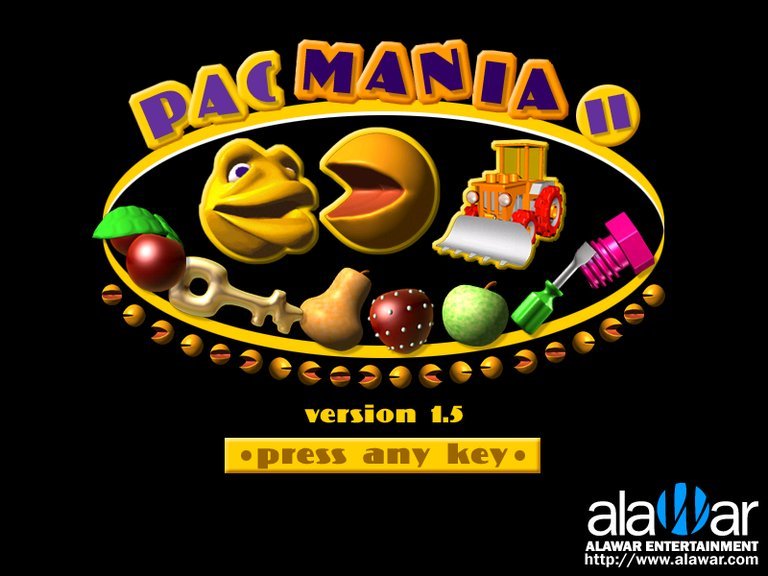
PacMania II is the fourth installment in Alawar Entertainment’s PacMania series, inspired by the classic Pac-Man. The game features three distinct modes: Classic, where players control the yellow Pac-Man against ghosts; Advanced, with a lip-shaped character facing skeletons; and CarMania, which adds a bulldozer protagonist battling cars, featuring items like fuel tanks, screwdrivers, and hearts. Each mode requires players to clear mazes of dots while avoiding enemies, using special pills to reverse the chase. Bonuses include points and extra lives via hearts, and passwords are provided every five levels for saved progress.
PacMania II Free Download
PC
PacMania II Cracks & Fixes
PacMania II Reviews & Reception
ign.com : It’s the reincarnation of the classic game that not only took arcades by storm, but has become a pop cultural icon.
myabandonware.com : If you haven’t played PacMania II or want to try this action video game, download it now for free!
sockscap64.com (60/100): PacMania II is the fourth game in the Alawar PacMania series based on the original Pac-Man.
PacMania II Cheats & Codes
PC – CLASSIC PacMania Game
Enter password at level selection
| Code | Effect |
|---|---|
| labyrinth | Level 5 |
| qwerty | Level 10 |
| happiness | Level 15 |
| goodluck | Level 20 |
| fortune | Level 25 |
PC – PACMANIA PacMania Game
Enter password at level selection
| Code | Effect |
|---|---|
| excellent | Level 5 |
| uncommonly | Level 10 |
| ideally | Level 15 |
| fantasy | Level 20 |
| perfectly | Level 25 |
PacMania II: Review
Introduction
The enduring legacy of Pac-Man, a cornerstone of arcade history born from Tohru Iwatani’s pizza-inspired epiphany in 1980, continues to spawn adaptations decades later. Among these, PacMania II stands as a fascinating, if flawed, entry in Alawar Entertainment’s prolific series. Released on March 9, 2002, this Windows-exclusive title positions itself not merely as a remake, but as a reimagining of the classic formula through a 3D lens and thematic experimentation. While it captures the nostalgic essence of “paku-paku” – the Japanese onomatopoeia for voracious eating – it introduces strategic depth through role-swapping mechanics and three distinct gameplay modes. Yet, its reliance on luck-based design and uneven difficulty prevent it from transcending its status as a curio. This review deconstructs PacMania II‘s place in gaming history, examining its development, mechanics, artistic choices, and lasting impact.
Development History & Context
PacMania II emerged from the Russian studio Alawar Entertainment, a prolific developer of casual and shareware titles known for adapting established franchises. As the fourth installment in their PacMania series (following the original 1999 release, PacMania 2D+ in 2000, and PacMania 3D in 2001), it inherited the studio’s mandate to modernize Pac-Man for new audiences while retaining its core appeal. The technological landscape of 2002 presented both opportunities and constraints: 3D graphics were feasible for PC titles but still primitive compared to contemporary console offerings. Alawar leveraged this with a low-polygon 3D engine featuring dynamic shadows and lighting, aiming for a “puppet-show with a bent to mysticism” aesthetic. The game was distributed as shareware, offering a 60-minute trial – a common model for the era – with the full version requiring a modest fee ($6.99 USD / £4.61 GBP). This strategy aligned with the burgeoning casual PC market, where accessible, bite-sized gameplay thrived alongside AAA releases. The gaming context was pivotal: Pac-Man remained a pop culture icon, licensed for over 400 products, making PacMania II a calculated attempt to capitalize on nostalgia while injecting novelty.
Narrative & Thematic Deep Dive
PacMania II adheres strictly to arcade tradition with No Plot, No Problem. There is no overarching narrative, backstory, or dialogue; the game is a pure test of reflex and strategy. However, its three modes weave distinct thematic threads:
– Classic Mode offers unadulterated nostalgia, replicating the original Pac-Man’s perpetual chase through a maze. The theme is survival against relentless, deterministic foes, embodying the timeless struggle between hunter and hunted.
– Advanced Mode introduces a gothic horror twist. The player controls “big lips” (a grotesque, disembodied maw) pursuing animated skeletons. Power-ups like bombs and skulls create a macabre atmosphere, transforming the maze into a crypt where devouring enemies becomes a dark ritual. This mode subtly explores themes of vulnerability and retribution – swallowing a “power dot” turns the hunter into prey, forcing strategic choices about when to counterattack.
– CarMania Mode, added in a 2003 update, shifts to an industrial theme. The player becomes a bulldozer crushing cars, with fuel tanks and screwdrivers representing industrial efficiency. Here, the theme is mechanistic dominance, replacing supernatural dread with a more mundane, albeit destructive, triumphalism.
The core thematic innovation lies in the role-swapping mechanic. Specific “power dots” temporarily invert the predator-prey dynamic, forcing players to confront the fleeting nature of power. This creates a constant tension: pursue points or secure a temporary advantage? As monsters respawn, the game questions whether consumption is a solution or merely a temporary respite.
Gameplay Mechanics & Systems
PacMania II deconstructs Pac-Man’s core loop – eat dots, avoid ghosts, use power pellets – through three distinct systems:
Classic Mode is a faithful recreation: the player navigates a maze as a yellow “dot muncher,” consuming pellets while evading the four iconic ghosts (Blinky, Pinky, Inky, Clyde). Power pills grant temporary invincibility, allowing players to turn the tables and consume ghosts for points. Lives are lost on contact, and extra lives (hearts) are collected. The maze design remains top-down, prioritizing clear line-of-sight for strategic ghost-avoidance.
Advanced Mode introduces significant departures:
– Character & Enemies: The player controls a pair of “big lips,” facing off against skeletons (regular, boss variants, and wall-phasing “ghosts”).
– Power-Ups & Bonuses:
– Bombs: Destroy the nearest enemy.
– Skulls: Annihilate all monsters on-screen.
– Hearts: Grant extra lives.
– Keys: Open doors but are one-use and spawn randomly. This introduces Luck-Based Mission elements; if a player exhausts keys in a level with multiple doors, progression depends entirely on RNG. As noted in All The Tropes, this creates “Fake Difficulty” in later levels (e.g., Level 24).
– Strategic Depth: The role-swapping mechanic is accentuated. Swallowing a specific dot turns all enemies into vulnerable targets for a few seconds, demanding quick decision-making: “To eat or not to eat?”
CarMania Mode (post-2003 update) reimagines the formula:
– Character & Enemies: The player is a bulldozer; enemies are anthropomorphic cars.
– Objects:
– Fuel Tanks: Points.
– Screwdrivers: Function unclear, possibly a temporary speed boost or barrier.
– Hearts: Extra lives.
– Mechanics: The maze resembles an industrial yard, emphasizing evasion over evasion. Fuel management (implied by fuel tank pickups) adds a resource layer absent in other modes.
Shared Systems:
– Scoring: Points for dots, power-ups, and consumed enemies.
– Progression: Passwords granted every five levels to resume play.
– AI: Ghosts/skeletons/cars exhibit chase behaviors, though All The Tropes notes a critical flaw: monsters do not teleport off-screen like the player, creating “nigh-impossible” situations in Advanced Mode’s later levels.
Innovative elements like 3D perspective and role-swapping are undermined by poor design choices: one-use keys and inconsistent AI create frustration rather than strategic depth.
World-Building, Art & Sound
PacMania II constructs three distinct micro-worlds through its art direction and sound design:
Visuals:
– Classic Mode: Faithfully replicates the original’s maze aesthetic but with 3D walls and dots. Shadows and lighting add depth, though the low-poly style can make distant enemies hard to discern.
– Advanced Mode: Embraces a gothic, Halloween-like theme. Skeletons feature jagged, skeletal designs, and mazes have a crumbling, crypt-like appearance. The “big lips” protagonist is a grotesque, exaggerated caricature, amplifying the mode’s macabre humor.
– CarMania Mode: Industrial concrete and metal textures dominate. The bulldozer has a bulky, utilitarian design, while cars have cartoonish, expressive faces, creating a playful, destructive tone.
The “unique atmosphere” referenced in the Internet Archive description stems from this stylistic variety. The 3D rendering, while primitive by modern standards, was ambitious for 2002, creating a tangible sense of space in the mazes.
Sound Design:
– Effects: Chomping sounds, ghost wails, and power-up activations are crisp but generic. The “paku-paku” eating sound is retained but muted.
– Music: MIDI soundtracks dominate, drawing criticism in All The Tropes for being “Suspiciously Similar Song” to real-world tracks like Michael Jackson’s “Billie Jean” and Dire Straits’ “Walk of Life.” While catchy, this reliance on familiar melodies lacks originality and can feel derivative.
The audiovisual synthesis creates distinct moods: nostalgic tension in Classic Mode, eerie dread in Advanced Mode, and chaotic fun in CarMania Mode.
Reception & Legacy
PacMania II launched with minimal critical fanfare. IGN noted its status as a “reincarnation of the classic game” but assigned no score, reflecting a lukewarm reception. User reviews on MyAbandonware are overwhelmingly positive (5/5 from 9 voters), likely driven by nostalgia and accessibility. Commercial performance remains undocumented, but its shareware model ensured steady, if unspectacular, sales in the casual PC market.
Its legacy is complex:
– Within the PacMania Series: It solidified Alawar’s formula of multi-mode remakes. The Advanced Mode, in particular, became a series staple, influencing PacMania III (2005), which added an aquatic “Aquamania” mode.
– Influence on Pac-Man Clones: Its 3D perspective and role-swapping mechanics were innovative for the early 2000s, predating similar twists in later indie titles. However, its flaws – particularly the luck-based key system – discouraged widespread emulation.
– Historical Footprint: PacMania II exemplifies the era’s wave of low-budget, shareware adaptations of classic IP. While it never achieved the cultural cachet of the original, it preserved the Pac-Man experience for a new generation of PC gamers. Its preservation on platforms like the Internet Archive ensures its survival as a piece of gaming archaeology.
Conclusion
PacMania II is a product of its time: an ambitious, technically modest adaptation of a legend that simultaneously honors and subverts its source material. Its three modes offer genuine variety, with Advanced Mode’s role-swapping and CarMania’s industrial twist providing memorable twists on the Pac-Man template. The 3D visuals and atmospheric sound design create distinct, albeit flawed, micro-worlds. Yet, the game is ultimately held back by its own design: the frustrating randomness of one-use keys and the inconsistent AI in later levels transform strategic decision-making into a test of patience rather than skill.
For historians, PacMania II is a compelling artifact – a window into the early 2000s casual PC gaming scene and the enduring appeal of Pac-Man. For players, it offers a diverting, if uneven, experience best savored in short bursts. While it lacks the polish or lasting impact of true classics, its ambition and willingness to experiment secure it a niche place in video game history. Verdict: A flawed but fascinating curio that embodies both the nostalgia and the creative risks of its era. Not a masterpiece, but an essential artifact for Pac-Man aficionados and students of game design evolution.