
- Release Year: 2011
- Platforms: Windows
- Publisher: Nordic Games GmbH
- Genre: Compilation
- Game Mode: Single-player
- Average Score: 53/100
Description
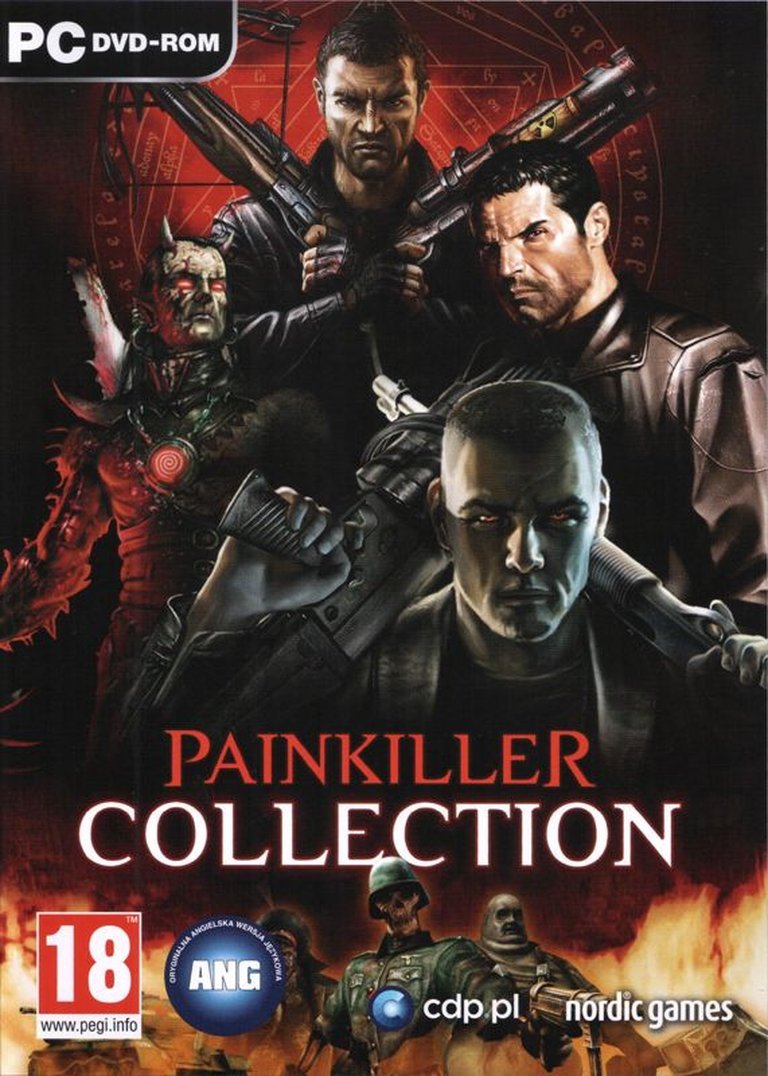
The Painkiller Collection is a compilation of first-person shooter games set in a dark, supernatural universe where the protagonist, Daniel Garner, battles through Purgatory to defeat Lucifer’s invading forces in exchange for a chance at redemption. The series is known for its fast-paced, arena-style combat, diverse monstrous enemies, and heavy metal soundtrack, with levels ranging from castles and graveyards to opera houses. The collection includes the original Painkiller (2004), its expansion Battle Out of Hell, and sequels like Overdose, Resurrection, and Redemption, each offering unique challenges and boss battles.
Painkiller Collection Cracks & Fixes
Painkiller Collection Reviews & Reception
metacritic.com (80/100): Painkiller is a fast and frenetic arena shooter that evokes the best elements of its predecessors.
metacritic.com (69/100): I’ll give Painkiller props for its imaginative weapons, sharp visuals, and visceral combat.
metacritic.com (8/100): I don’t understand the critics behind this title. The game is fast. The game is fun, the game is well optimized.
metacritic.com (3/100): It’s ‘Painkiller’ in name only — in reality, just pure rubbish wrapped in cheap nostalgia.
opencritic.com (50/100): Painkiller is a game about nothing for no one, a mediocre resurrection of a classic trying to put a new cover on an old book and hoping it still has some relevance 21 years later.
opencritic.com (65/100): Painkiller has some truly incredible weapons and powers, but not a lot to do with them.
opencritic.com (50/100): Painkiller is a shame not because it’s especially bad, but because some of the fun weapons and combat are buried beneath the dull, uninspired and repetitive mechanics.
opencritic.com (65/100): You’ll have a blast tearing through demons, laughing at the ridiculous story, and remembering why simple, over-the-top shooters still have a place in 2025.
opencritic.com (50/100): Despite its dynamic gameplay, Painkiller stumbles in every other aspect.
opencritic.com (60/100): If you’re craving the wholesale slaughtering of otherworldly beings, Painkiller has you covered despite a myriad of superior alternatives.
opencritic.com (70/100): It’s not the return fans of the series were hoping for, but that doesn’t stop it from being a decent cooperative shooter.
opencritic.com (69/100): I’ll give Painkiller props for its imaginative weapons, sharp visuals, and visceral combat.
opencritic.com (45/100): Derivative, degenerative, and largely despondent in what it offers, the completely unnecessary co-operative core of this Painkiller reboot is what sabotages its potential.
opencritic.com (50/100): The new Painkiller is a weird, unfinished hybrid – a game with a story-driven campaign that masquerades as an endgame.
nichegamer.com : Anshar’s version of Painkiller is absolutely soulless.
Painkiller Collection Cheats & Codes
Painkiller (PC)
Press ~ to display the console window, then enter one of the following codes.
| Code | Effect |
|---|---|
| PKGOD | Toggle ‘godmode’ on/off |
| PKDEMON | Toggle ‘demon morph’ on/off |
| PKWEAKENEMIES | Toggle ‘enemies get 1 hp’ on/off |
| PKALWAYSGIB | Toggle ‘excessive gibbage’ on/off |
| WEAPONSPECULAR 1/0 | Toggles ‘weapon specular’ on/off |
| PKWEAPONS | Gives all weapons |
| PKAMMO | Full ammo |
| PKHEALTH | Full health |
| PKPOWER | Full ammo/health |
| PKGOLD | Lots of gold |
| PKHASTE | Toggle haste on/off |
| PKWEAPONMODIFIER | Toggle ‘weapon modifier mode’ on/off |
| PKKEEPDECALS | Toggle ‘decals will never disappear’ on/off |
| PKKEEPBODIES | Toggle ‘bodies will never disappear’ on/off |
| MAP [map name] | Load map in multi-player mode |
Painkiller: Resurrection (PC)
While playing the game, press ~ to display the console window. Then, type one of the following codes and press [Enter] to activate the corresponding cheat function.
| Code | Effect |
|---|---|
| pkgod | God mode |
| pkhealth | Full health |
| pkweapons | All weapons |
| pkammo | Full ammo |
| pkpower | Full ammo and health |
| pkgold | Extra gold |
| pkweakenemies | All enemies have 1 HP |
| pkkeepbodies | Bodies never disappear |
| pkkeepdecals | Decals never disappear |
| pkweaponmodifier | Weapon modifier mode |
| pkhaste | Fast movement |
| pkdemon | Demon morph |
Painkiller: Redemption (PC)
While playing the game, press ~ to display the console window, then type one of the following case-sensitive codes and press [Enter] to activate the corresponding cheat function.
| Code | Effect |
|---|---|
| SV_CHEAT_GODMODE_1 | God mode |
| SV_MAX_HEALTH_1 | Full health |
| SV_MAX_AMMO_1 | Full ammunition |
| SV_EVERYTHING_1 | Full ammunition and health |
| SV_PERFECT_FINISH_1 | Level skip |
| SV_DEMON_1 | Demon mode |
| SV_MONSTERS_ALWAYS_GIB_1 | Monsters always gib |
| SV_LESS_MONSTER_HP_1 | Monsters have less HP |
| SV_KEEP_DECALS_1 | Keep decals |
Painkiller (PC) – Demo Version
While playing a game, press ~ to display the console window. Then, enter one of the following codes to activate the corresponding cheat function.
| Code | Effect |
|---|---|
| god | Invincibility |
| giveall | All weapons |
Painkiller (PC) – Recurring Evil Cheats
Press ~ (or the key above Tab) and then enter the following codes.
| Code | Effect |
|---|---|
| sv_everything_1 | All Weapons+Ammo |
| sv_demon_1 | Demon Mode |
| sv_perfect_finish_1 | Finish the level at 100% |
| sv_cheat_godmode_1 | God Mode |
| sv_max_ammo_1 | Max ammo |
| sv_max_health_1 | Max Health |
Painkiller (PC) – Additional Cheats
Press ~ (TILDE, the key above TAB) to access the console.
| Code | Effect |
|---|---|
| PKDAMAGEX2 | Toggles ‘2x damage’ on/off. Press 1 and 0 to toggle. |
| PKDAMAGE4X | Toggles ‘4x damage’ on/off. Press 1 and 0 to toggle. |
Painkiller Collection: A Retrospective on a Cult Classic FPS
Introduction
The Painkiller Collection is more than just a compilation of games—it’s a time capsule of an era when first-person shooters (FPS) were defined by raw, unfiltered adrenaline rather than cinematic storytelling or open-world exploration. Released in 2011, this collection bundles the original Painkiller (2004) and its expansions—Battle Out of Hell, Overdose, Resurrection, Redemption, and Recurring Evil—into a single package, offering players a chance to experience one of the most underrated yet influential shooters of the early 2000s. Developed by the Polish studio People Can Fly and published by DreamCatcher Interactive, Painkiller emerged during a golden age of FPS games, standing shoulder-to-shoulder with titans like Doom 3 and Half-Life 2, yet carving its own niche with a unique blend of gothic horror, over-the-top action, and a darkly humorous narrative.
This review will dissect the Painkiller Collection in exhaustive detail, exploring its development history, narrative depth, gameplay mechanics, artistic direction, and lasting legacy. We’ll examine how it pushed the boundaries of the genre, why it resonated with a dedicated fanbase, and how its influence can still be felt in modern shooters. Whether you’re a veteran of the original release or a newcomer curious about its place in gaming history, this analysis will provide a comprehensive understanding of why Painkiller remains a cult classic.
Development History & Context
The Birth of People Can Fly
Painkiller was the debut title from People Can Fly, a studio founded in 2002 by Adrian Chmielarz, a visionary designer who had previously worked on Gorky 17 at Metropolis Software. Chmielarz’s ambition was to create a “pure” FPS—a game stripped of the increasingly complex narratives and RPG mechanics that were becoming prevalent in the genre. Instead, he wanted to distill the essence of classic shooters like Quake and Doom into a modern experience, emphasizing fast-paced combat, creative weaponry, and a relentless onslaught of enemies.
The studio’s small size and independent status allowed for a degree of creative freedom that larger developers often lacked. However, it also meant working with limited resources. The game’s development spanned 18 months, a relatively short timeline for a project of its scope. To achieve their vision, People Can Fly built a proprietary engine, the PAIN Engine, which leveraged Havok 2.0 for physics, enabling dynamic interactions between the player, enemies, and environments. This engine was crucial in handling the game’s signature feature: massive, arena-style battles where hundreds of enemies could swarm the player simultaneously.
The Gaming Landscape of 2004
Painkiller launched in April 2004, a year that saw the release of several landmark FPS titles. Half-Life 2 and Doom 3 dominated headlines with their advanced graphics, immersive storytelling, and atmospheric tension. In contrast, Painkiller was unapologetically old-school. It eschewed the cinematic pacing and survival horror elements of its contemporaries in favor of unbridled chaos. While Doom 3 emphasized darkness and dread, Painkiller embraced a more flamboyant, almost cartoonish approach to violence, with bright visuals, exaggerated enemy designs, and a heavy metal soundtrack that underscored its over-the-top action.
This contrast was not lost on critics or players. Painkiller was often described as a “dumb” game, but in the best possible way—a celebration of pure, unadulterated fun. It didn’t try to be anything more than what it was: a power fantasy where the player mowed down waves of demons with an arsenal of outrageous weapons. This simplicity was both its strength and, in some critics’ eyes, its weakness. However, it resonated deeply with a segment of the gaming community that yearned for the straightforward, arcade-like shooters of the 1990s.
Technological Constraints and Innovations
Developing Painkiller on a modest budget presented significant challenges. The PAIN Engine, while capable, required careful optimization to handle the game’s ambitious enemy counts and physics interactions. The team had to balance visual fidelity with performance, ensuring that the game could run smoothly on mid-range PCs of the era. This led to some compromises, such as simpler textures and less detailed environments compared to Doom 3 or Half-Life 2. However, the engine’s ability to render large-scale battles without significant slowdown was a technical achievement in its own right.
One of the most innovative aspects of Painkiller was its use of the Havok physics system. Enemies didn’t just die—they ragdolled spectacularly, flying backward from shotgun blasts or being impaled on walls by the stake gun. This added a layer of visceral satisfaction to the combat, making each kill feel impactful. The game also introduced a unique “soul catcher” mechanic, where defeated enemies dropped souls that the player could collect to restore health or trigger a temporary “demon morph” mode, turning the player into an unstoppable force of destruction.
The Role of Modding and Community
From the outset, People Can Fly recognized the importance of the modding community. The Painkiller: Black Edition, released in 2005, included mapping and editing tools, allowing players to create their own levels and mods. This decision fostered a dedicated fanbase that continued to expand the game’s lifespan long after its initial release. Mods like Painkiller: Overdose (originally a fan project before being officially adopted) and Painkiller: Redemption (another community-driven expansion) demonstrated the game’s enduring appeal and flexibility.
The inclusion of these tools also reflected the studio’s commitment to the core principles of classic FPS games, where player creativity and community engagement were just as important as the base experience. This ethos would later influence other titles, including Bulletstorm (2011), another People Can Fly project that blended over-the-top action with a strong emphasis on player agency.
Narrative & Thematic Deep Dive
Plot Summary: A Journey Through Purgatory
Painkiller’s story is deceptively simple but effectively sets the stage for its chaotic gameplay. The protagonist, Daniel Garner, is a man who dies in a car accident alongside his wife, Catherine. While Catherine ascends to Heaven, Daniel finds himself trapped in Purgatory, a liminal space between Heaven and Hell. He is approached by Samael, an angel who offers him a deal: if Daniel can defeat four of Lucifer’s generals, he will be granted entry into Heaven and reunited with his wife.
The narrative unfolds across five chapters, each set in a different, surreal interpretation of Purgatory. These range from gothic cemeteries and haunted asylums to industrial wastelands and war-torn landscapes. Along the way, Daniel encounters a cast of characters, including Eve, a mysterious woman who provides guidance (and later reveals herself to be a fugitive from Hell), and Asmodeus, a demonic ally with ambiguous motives.
The story takes a dark turn when Daniel realizes that his mission is far from over. After defeating Lucifer, he discovers that Alastor, one of the generals he was supposed to kill, has seized control of Hell. The game’s standard ending leaves Daniel trapped in an endless battle against Alastor’s forces, while the “Trauma” difficulty ending offers a more hopeful resolution, allowing Daniel to finally reunite with Catherine in Heaven.
Themes: Redemption, Sacrifice, and the Nature of Evil
At its core, Painkiller is a story about redemption. Daniel’s journey is not just a physical battle against demonic forces but a spiritual one as well. His willingness to sacrifice his own chance at peace to continue fighting evil underscores the game’s central theme: that true heroism often requires personal sacrifice. This is reinforced by the game’s ending, where Daniel chooses to remain in Hell rather than abandon his fight, even when offered the chance to join Catherine.
The game also explores the ambiguity of morality in its depiction of characters like Eve and Asmodeus. Eve, initially presented as an ally, is later revealed to have her own agenda, while Asmodeus’s true nature remains shrouded in mystery until the final act. These twists add depth to what could otherwise be a straightforward good-versus-evil narrative, suggesting that even in a world as black-and-white as Purgatory, alliances are never entirely clear.
Dialogue and Voice Acting
Painkiller’s dialogue is sparse but effective, with voice acting that ranges from melodramatic to genuinely unsettling. Cam Clarke’s portrayal of Daniel Garner is understated, reflecting the character’s stoic determination, while John Cygan’s Samael exudes an otherworldly gravitas. Vanessa Marshall’s dual role as Catherine and Eve adds a layer of emotional complexity, particularly in the latter’s reveal as a fugitive from Hell.
The game’s writing is intentionally pulpy, leaning into its B-movie horror influences. Lines like Asmodeus’s ominous “I dig graves” are delivered with a campy flair that fits the game’s tone. While the story may not be as intricate as those in narrative-driven shooters like Half-Life 2, it serves its purpose well, providing just enough context to justify the relentless action.
The Influence of Religious and Mythological Imagery
Painkiller draws heavily from Christian mythology, particularly the concepts of Heaven, Hell, and Purgatory. However, it takes significant liberties with these themes, blending them with elements of gothic horror and dark fantasy. The game’s depiction of Hell as a fractured, war-torn landscape—littered with the remnants of human conflicts—is a particularly striking interpretation, suggesting that Hell is not just a place of punishment but a reflection of humanity’s own capacity for violence.
The inclusion of figures like Lucifer, Alastor, and Samael grounds the game in familiar mythological territory, but their portrayals are far from traditional. Lucifer, for instance, is depicted as a cunning but ultimately fallible antagonist, while Samael’s role as a guide with questionable motives adds a layer of moral ambiguity. This blending of religious iconography with original storytelling gives Painkiller a unique identity within the FPS genre.
Gameplay Mechanics & Systems
Core Gameplay Loop: Chaos and Carnage
Painkiller’s gameplay is built around a simple but addictive loop: enter an arena, fight waves of enemies, collect souls, and move on to the next challenge. The game excels in its pacing, ensuring that the player is constantly engaged without becoming overwhelmed. Each level is designed as a gauntlet of combat encounters, culminating in a boss fight that tests the player’s mastery of the game’s mechanics.
The absence of traditional health regeneration or cover systems forces the player to rely on movement, positioning, and weapon switching to survive. This creates a high-skill ceiling, where success depends on quick reflexes and strategic thinking rather than brute force. The game’s difficulty settings—Daydream, Insomnia, Nightmare, and Trauma—scale the challenge appropriately, with Trauma offering a punishing experience that rewards precision and adaptability.
Weapon Arsenal: Creativity in Destruction
One of Painkiller’s standout features is its arsenal of weapons, each with two distinct firing modes that encourage creative combat strategies. The lineup includes:
- Painkiller: A revolving saw blade that serves as the game’s signature melee weapon. It’s fast, brutal, and perfect for close-quarters combat.
- Stake Gun: Fires wooden stakes that impale enemies to walls or surfaces. Its secondary mode functions as a grenade launcher, adding versatility.
- Shotgun: Delivers devastating close-range blasts. The secondary “freezer” mode encases enemies in ice, allowing for shattering follow-up attacks.
- Electrodriver: A rapid-fire weapon that launches electrified shurikens. Its secondary mode releases an area-of-effect electrical burst, ideal for crowd control.
- Rocket Launcher: Fires explosive projectiles for high-impact damage. The secondary chaingun mode provides sustained fire for suppressing enemies.
Each weapon has a distinct feel and purpose, and mastering their use is key to surviving the game’s later levels. The lack of traditional reloading mechanics (weapons fire continuously until ammo is exhausted) keeps the action flowing, while the need to scavenge for ammunition adds a layer of resource management.
The Soul Catcher and Demon Morph
The soul catcher mechanic is one of Painkiller’s most innovative features. Defeated enemies drop glowing green souls, which the player automatically collects. These souls serve two purposes: restoring health (each soul provides a small amount) and triggering the “demon morph” when 66 souls are collected in quick succession.
Demon morph transforms the player into an invincible, super-powered demon for a brief period, allowing them to tear through enemies with ease. This mechanic incentivizes aggressive play, as collecting souls quickly often requires diving into the thick of battle. It also provides a satisfying power fantasy, giving players a temporary reprieve from the game’s otherwise relentless difficulty.
Tarot Cards and Replayability
Painkiller includes a tarot card system that adds replay value. Each level features a hidden challenge (e.g., finding all secrets or defeating enemies without taking damage) that rewards the player with a tarot card. These cards can be equipped before a level to grant temporary bonuses, such as increased damage, slower enemy movement, or enhanced soul collection.
The tarot system encourages players to revisit levels and experiment with different strategies, extending the game’s lifespan beyond its initial playthrough. It also adds a layer of customization, allowing players to tailor their approach to each level based on their preferred playstyle.
Boss Fights: Epic Showdowns
The game’s boss fights are among its most memorable moments. Each of the four generals—Necrogiant, Swamp Thing, Guardian (Saphathorael), and Alastor—presents a unique challenge that requires specific tactics to overcome. For example, the Necrogiant is a towering, slow-moving behemoth that demands constant movement and precise aiming, while Alastor’s fight is a frantic battle against waves of elite enemies.
These encounters are designed to test the player’s mastery of the game’s mechanics, often requiring quick weapon switches and creative use of the environment. The final battle against Lucifer is a climactic showdown that caps off the game’s narrative, though the true challenge lies in the post-game content, where players can tackle even tougher variants of these fights.
Multiplayer: A Nostalgic Throwback
Painkiller’s multiplayer mode is a love letter to classic FPS multiplayer, offering modes like Deathmatch, Capture the Flag, and Team Deathmatch. While it lacks the polish of modern online shooters, it captures the chaotic, fast-paced fun of early 2000s multiplayer gaming. The inclusion of modes like “Voosh” (where all players use the same randomly selected weapon) and “The Light Bearer” (featuring a persistent Quad Damage power-up) adds variety and encourages creative play.
The multiplayer was a significant factor in the game’s competitive scene, with Painkiller being featured in the Cyberathlete Professional League (CPL) World Tour in 2005. This exposure helped cement its reputation as a skill-based shooter, though its multiplayer community has since dwindled due to the rise of more modern titles.
World-Building, Art & Sound
A Gothic Nightmare: Visual Design
Painkiller’s art direction is a masterclass in gothic horror. The game’s levels are a surreal blend of decaying architecture, eerie landscapes, and grotesque enemy designs. From the crumbling cathedrals of the first chapter to the industrial hellscapes of later levels, each environment is meticulously crafted to evoke a sense of dread and wonder.
The game’s color palette is dominated by dark, muted tones, punctuated by bursts of red and orange from explosions and enemy attacks. This contrast creates a visually striking experience, where the player’s actions—whether it’s freezing an enemy with the shotgun’s secondary mode or unleashing a volley of rockets—stand out against the gloomy backdrop.
Enemy designs are equally impressive, ranging from skeletal zombies and demonic imps to towering bosses like the Necrogiant. Each enemy type has a distinct silhouette and behavior, making them easy to identify even in the heat of battle. The game’s use of Havok physics also enhances the visual spectacle, with enemies ragdolling realistically when hit by explosions or melee attacks.
Atmosphere and Level Design
The level design in Painkiller is a testament to the studio’s understanding of pacing and player engagement. Each level is structured as a series of interconnected arenas, with enemies spawning in waves that escalate in intensity. The game’s checkpoints are strategically placed to provide moments of respite, allowing players to regroup before the next onslaught.
The variety of environments is another standout feature. One level might take place in a haunted opera house, complete with eerie music and ghostly apparitions, while another could be set in a war-torn cityscape, with crumbling buildings and flickering fires. This diversity ensures that the game never feels repetitive, even as the core gameplay loop remains consistent.
Sound Design: A Symphony of Chaos
Painkiller’s sound design is a crucial component of its atmosphere. The game’s heavy metal soundtrack, composed by Adam Skorupa and Marcin Czartyński, perfectly complements its fast-paced action. Tracks like “The Painkiller” and “Morph In” are adrenaline-pumping anthems that heighten the intensity of combat encounters.
The sound effects are equally impressive, with each weapon having a distinct audio profile. The crack of the stake gun, the roar of the rocket launcher, and the hum of the electrodriver all contribute to the game’s tactile feedback, making each shot feel impactful. Enemy sounds—from the guttural growls of demons to the eerie wails of spectral foes—add to the game’s immersive horror aesthetic.
Voice acting, while not always top-tier, is serviceable and fits the game’s campy tone. The performances of Cam Clarke (Daniel Garner) and John Cygan (Samael) are particularly noteworthy, lending gravitas to the game’s more dramatic moments.
Reception & Legacy
Critical Reception: A Mixed but Positive Response
Upon its release in 2004, Painkiller received generally positive reviews, with critics praising its fast-paced gameplay, creative weaponry, and atmospheric level design. GameSpot awarded it an 8.5/10, highlighting its “eclectic variety of settings” and “satisfying combat,” while GameSpy commended its “original, muscular engine” and “vast spectacular levels.”
However, not all reviews were glowing. IGN gave the game a 7/10, criticizing its repetitive enemy encounters and lack of narrative depth. The soundtrack, in particular, was a point of contention, with IGN describing it as “generic speed metal with a techno flourish.” Despite these criticisms, Painkiller was widely recognized as a refreshing throwback to the golden age of FPS games, offering a pure, unadulterated shooting experience.
The game’s expansions received more mixed reviews. Battle Out of Hell was praised for its additional content and improved visuals, while Overdose and later expansions were criticized for their lack of innovation and technical issues. Nevertheless, the Painkiller Collection as a whole has maintained a dedicated fanbase, thanks in part to its strong modding community and enduring appeal as a cult classic.
Competitive Scene and Esports
Painkiller’s inclusion in the Cyberathlete Professional League (CPL) World Tour in 2005 was a significant milestone for the game. The CPL’s decision to feature Painkiller as its official tournament game for two seasons brought it into the spotlight of competitive gaming, where it was praised for its skill-based mechanics and fast-paced action.
The game’s multiplayer modes, particularly Deathmatch and Capture the Flag, became staples of the competitive scene, with players and clans competing in high-stakes tournaments. The release of the Painkiller: Black Edition, which included patches and updates to bring the game up to competitive standards, further solidified its place in esports history.
While Painkiller’s competitive scene has since faded, its legacy lives on in the modding community, where custom maps and game modes continue to be developed and shared.
Influence on Subsequent Games
Painkiller’s influence can be seen in several subsequent FPS titles, particularly those that emphasize fast-paced, arena-style combat. Games like Bulletstorm (2011), also developed by People Can Fly, share Painkiller’s focus on creative weaponry and over-the-top action. The 2016 reboot of Doom also bears similarities to Painkiller, with its emphasis on relentless combat and massive enemy hordes.
The game’s use of physics-based interactions and its soul catcher mechanic have also inspired other developers. The concept of collecting resources (in this case, souls) to trigger temporary power-ups has been adopted in various forms by other shooters, while the game’s emphasis on movement and positioning as key survival strategies has become a staple of the genre.
The 2025 Reboot: A New Chapter
In 2025, Painkiller received a modern reboot, developed by Anshar Studios and published by 3D Realms. This new iteration aims to reimagine the classic formula for contemporary audiences, featuring updated graphics, new weapons, and a co-op mode. While the reboot has received mixed reviews, it demonstrates the enduring appeal of Painkiller’s core gameplay loop and its place in the pantheon of classic FPS games.
Conclusion: A Timeless Classic
The Painkiller Collection is more than just a compilation of games—it’s a celebration of a bygone era of first-person shooters. In an industry increasingly dominated by open-world epics and narrative-driven experiences, Painkiller stands as a reminder of the simple joy of mowing down waves of enemies with an arsenal of outrageous weapons. Its fast-paced gameplay, creative level design, and gothic horror aesthetic have ensured its place as a cult classic, beloved by a dedicated fanbase that continues to keep the game alive through mods and community projects.
While it may not have the polish or narrative depth of modern shooters, Painkiller’s strengths lie in its purity of purpose. It is a game that knows exactly what it wants to be—a relentless, adrenaline-fueled power fantasy—and executes that vision with precision. For fans of classic FPS games, the Painkiller Collection is an essential experience, offering a glimpse into a time when shooters were defined by their gameplay first and everything else second.
Final Verdict: 8.5/10 – A must-play for fans of classic FPS games, and a testament to the enduring appeal of pure, unadulterated action.
Additional Resources
For those interested in exploring Painkiller further, here are some recommended resources:
- Modding Community: Check out the Painkiller modding scene on sites like ModDB and the Steam Workshop for custom levels, weapons, and game modes.
- Speedrunning: The Speed Demos Archive features impressive runs of Painkiller and its expansions, showcasing the game’s high-skill ceiling.
- Retrospective Videos: YouTube channels like Ahoy and GVMERS have produced in-depth retrospectives on Painkiller, analyzing its gameplay and legacy.
- Official Wiki: The Painkiller Wiki on Fandom is a comprehensive resource for lore, level guides, and enemy strategies.
Whether you’re a longtime fan or a newcomer, the Painkiller Collection offers a unique and unforgettable experience that continues to resonate with players nearly two decades after its initial release.