
- Release Year: 2000
- Platforms: Macintosh, Windows
- Publisher: Infogrames Interactive, Inc.
- Developer: Humongous Entertainment, Inc.
- Genre: art, Educational, Graphics
- Perspective: Third-person
- Game Mode: Single-player
- Gameplay: Art creation, Crafting, Storybook creation
Description
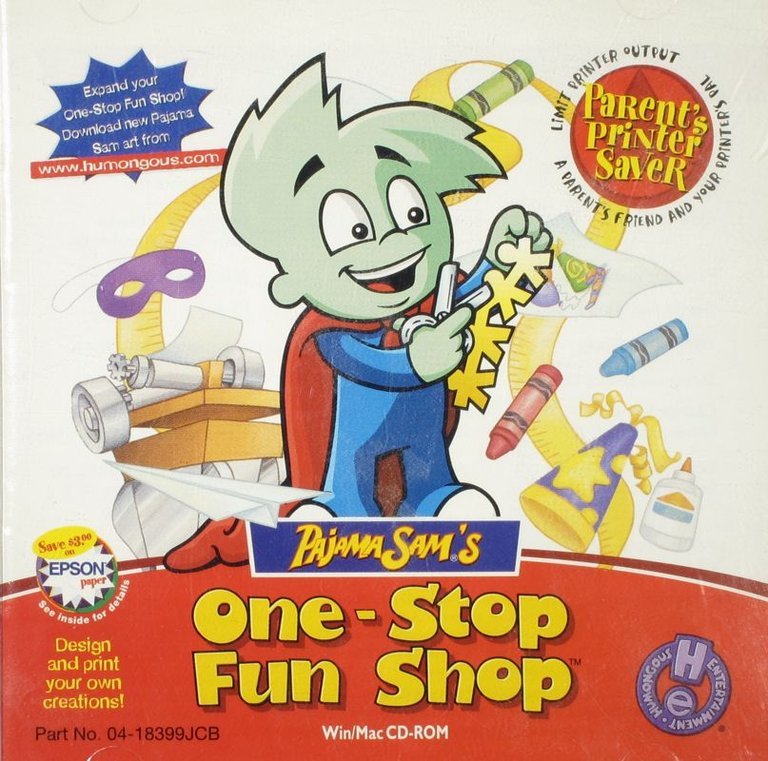
Pajama Sam’s One Stop Fun Shop is an activity center game based on the popular Pajama Sam series, designed for children to explore creative expression through printable crafts, painting tools, an interactive storybook creator, and the Sam-O-Matic. Using a library of clipart, players design and customize their own artwork and projects, which can be printed for offline play, fostering imagination and hands-on learning in a fun, character-driven setting.
Gameplay Videos
Pajama Sam’s One Stop Fun Shop Free Download
Pajama Sam’s One Stop Fun Shop Patches & Updates
Pajama Sam’s One Stop Fun Shop: A Creative Nexus in the Edutainment Renaissance
Introduction
In the pantheon of 1990s edutainment, few franchises embody the spirit of childhood imagination as vividly as Pajama Sam. While the core adventure titles like No Need to Hide When It’s Dark Outside and Thunder and Lightning Aren’t So Frightening are celebrated for their narrative-driven problem-solving, the 2000 spin-off Pajama Sam’s One Stop Fun Shop occupies a unique niche as a digital creativity workshop. Released amidst Humongous Entertainment’s golden age under Atari/Infogrames, this activity center transcends typical “print-and-play” software by integrating the series’ whimsical charm with open-ended creative tools. This review argues that One Stop Fun Shop represents a pioneering synthesis of edutainment principles and digital artistry, offering a timeless blueprint for fostering self-expression in young audiences while exemplifying the studio’s mastery of accessible, non-violent gameplay. Its legacy lies not in narrative complexity, but in its foundational role as a sandbox for generational creativity.
Development History & Context
Studio Vision and Technological Constraints
Developed by Humongous Entertainment—the studio founded by Ron Gilbert (co-creator of Monkey Island) and Shelley Day—and published by Infogrames Interactive in 2000, One Stop Fun Shop emerged from the company’s post-acquisition evolution. Following GT Interactive’s 1996 $76 million buyout and Infogrames’ subsequent acquisition, Humongous operated under increased commercial pressures, leading to a strategic pivot toward supplementary titles alongside mainline adventures. This activity center was conceived to expand the Pajama Sam brand beyond point-and-click puzzles, leveraging the SCUMM-inspired engine for lightweight, user-friendly interfaces. Technologically, it operated within the CD-ROM era’s constraints, requiring minimal system specs (Windows 95+, 16MB RAM) to ensure broad accessibility, yet its vector-based clipart library and print functionality pushed the boundaries of home creativity software of the time.
Gaming Landscape and Creative Intent
The late 1990s saw a saturated edutainment market dominated by titles like Reader Rabbit and Math Blaster. Humongous countered this trend with character-centric, story-rich experiences that prioritized emotional intelligence over rote learning. One Stop Fun Shop embodied this philosophy by positioning creativity as an educational act. As Pamela Adlon’s iconic Sam would later remind players in the series’ core adventures, “Pajama Sam always helps those in need”—and here, “helping” took the form of empowering children to design crafts, compose music, and author stories. The title’s release coincided with Humongous’ expansion into multimedia tie-ins, including books and merchandise, solidifying Pajama Sam as a multi-platform franchise for children aged 3–8. Its development was a response to parental demand for offline creative outlets amid a nascent digital boom, making it a cultural artifact bridging analog and digital play.
Narrative & Thematic Deep Dive
Framing the Creative Journey
While lacking a traditional plot, One Stop Fun Shop weaves its narrative through Sam’s invitation to players: “I finished my chores quickly and have lots of time to play with my One-Stop Fun Shop!” This framing device transforms the software into a shared imaginative space. The interactive storybook creator acts as the game’s narrative core, allowing users to construct tales using pre-rendered scenes (e.g., the Land of Darkness, World Wide Weather) and voice clips of Sam, Carrot, and Otto. Each generated story becomes a mini-adventure, reinforcing the series’ theme of agency—players aren’t just consumers of Sam’s world, but co-authors. The absence of conflict or antagonists is deliberate; here, “victory” is measured not by problem-solving, but by self-expression.
Character Cameos and Thematic Resonance
Supporting characters from the main series appear as clipart and narrators, reinforcing continuity. Carrot the nutrition expert from You Are What You Eat lends comedic voice-overs to craft projects, while Otto the boat provides sound effects for the Sam-O-Matic music composer. These cameos serve dual purposes: they reward familiarity with the franchise and subtly reinforce educational themes. For instance, using food-group clipart in crafts echoes Pajama Sam 3‘s nutritional lessons, while recycling-themed crafts in the “Weather or Not” storybook (where Sam orders “raining lollipops or socks”) echo environmental awareness from the core series. The absence of a structured plot is compensated by thematic cohesion: creativity as empowerment, play as learning, and the celebration of individuality.
Gameplay Mechanics & Systems
Core Activity Loops
One Stop Fun Shop eschews traditional gameplay for a suite of interconnected creative tools:
1. Painting Tools: A simplified vector-based painter with pre-drawn Pajama Sam backdrops and customizable palettes.
2. Printable Crafts: Templates for masks, decorations, and room ornaments, with options to add clipart and text.
3. Sam-O-Matic: A rudimentary music composer using Sam’s voice samples to generate melodies.
4. Interactive Storybook: A drag-and-drop narrative builder with branching dialogue options and character voices.
Each system operates as a sandbox. The painting tool, for example, includes a “magic brush” for auto-fill and a stamp library of series icons (e.g., Pajama Man, King the minecart), while the crafts section guides users through assembly with printable cutting guides. The storybook creator’s genius lies in its modular design: players select scenes, drag characters into frames, and record or choose dialogue from a library of Sam’s exclamations (“Oh boy!”, “Alright!”).
UI and Innovation
The interface is a masterclass in child-centric design. Large, icon-based buttons replace text, with hover animations providing audio cues (e.g., Sam’s voice confirming a tool selection). The SCUMM engine’s point-and-click simplicity ensures accessibility, though the lack of an autosave feature for storybooks is a minor flaw. Technically innovative for its era was the clipart library, which allowed digital “cut-and-paste” between activities—a precursor to modern asset-based creative software. However, the reliance on physical printing (with ink/paper costs noted by Review Corner) grounded the experience in tangible outcomes, bridging digital creation with analog play.
World-Building, Art & Sound
Visual Direction and Artistic Consistency
The game inherits the Pajama Sam series’ signature aesthetic: vibrant, hand-drawn-inspired backgrounds and a “whimsical realism” that anthropomorphizes everyday objects. The Land of Darkness’ eerie forests and MopTop Island’s food-themed locales serve as backdrops for art projects, maintaining visual continuity with the core adventures. Clipart characters—like the sentient carrot Carrot or the minecart King—are rendered in the same cel-shaded style, ensuring brand recognition. The painting tools introduce new vector-based elements, yet these blend seamlessly with scanned textures, creating a cohesive “digital storybook” feel.
Sound Design as Emotional Anchoring
Sound is pivotal to immersion. The Sam-O-Matic composer repurposes series voice clips—Sam’s “Pajama Man” catchphrases, Otto’s boat splashes—into musical loops, transforming dialogue into rhythm. Environmental sounds (thunderstorms, closet creaks) in the storybook creator evoke nostalgia, while the painting tool features lighthearted “swoosh” effects. Notably, the absence of a traditional score replaced by ambient noise emphasizes the player’s creative agency, making the software feel like a personal studio rather than a game.
Reception & Legacy
Critical Acclaim at Launch
Review Corner awarded One Stop Fun Shop a 93% score in 2000, praising its $20 price point and “good value” despite printer-supply costs. Critics highlighted its “open-ended play” and “seamless integration” of Pajama Sam charm, though some noted its niche appeal compared to narrative-driven titles. Player reviews (per MobyGames) scored it a perfect 5/5, underscoring its cult status among children and parents for fostering offline creativity.
Enduring Influence
While not a commercial blockbuster like No Need to Hide, One Stop Fun Shop laid groundwork for modern creative software like Roblox Studio and Toca Boca. Its emphasis on digital-to-analog output anticipated Maker Culture’s rise, while its storybook predated apps like Book Creator. The game remains a nostalgic touchstone, preserved on GOG.com via ScummVM and referenced in Pajama Sam retrospectives as a “hidden gem” that expanded the franchise’s identity beyond puzzles. Its legacy endures in Humongous’ ethos: that learning and joy are intrinsically linked to play.
Conclusion
Pajama Sam’s One Stop Fun Shop is not merely a spin-off but a vital artifact of edutainment’s evolution—a digital crafting table where pixels and paper coexist. By eschewing conventional game mechanics for open-ended creativity, it embodied Humongous Entertainment’s revolutionary belief that childhood empowerment stems from self-expression, not instruction. Its limitations—reliance on printing, lack of narrative depth—are overshadowed by its timeless appeal as a catalyst for imagination. In an era of screen saturation, this 2000 title remains a poignant reminder that play’s truest form is unscripted. As Sam might say, “This looks like a job for… creative freedom!” For preserving the Pajama Sam spirit beyond its adventures, and for pioneering accessible digital artistry, One Stop Fun Shop earns its place as a cornerstone of children’s interactive history.