
- Release Year: 2013
- Platforms: Windows
- Publisher: EuroVideo Bildprogramm GmbH
- Genre: Compilation
- Perspective: Top-down
- Game Mode: Single-player
- Setting: World War II
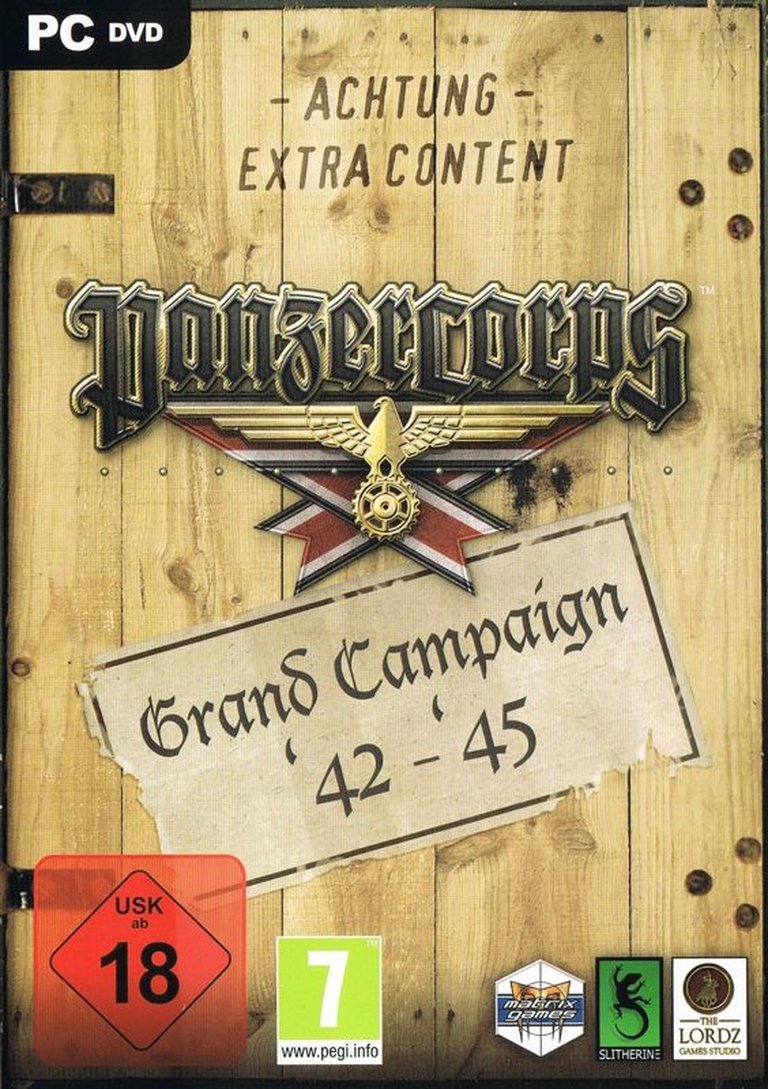
Description
Panzer Corps: Grand Campaign ’42-’45 is a comprehensive compilation of six add-on campaigns for Panzer Corps: Wehrmacht, covering the pivotal years of World War II from 1942 to 1945. The game splits strategic operations between the Western and Eastern Fronts, presenting players with historically inspired scenarios where they command German armored forces. Players navigate branching campaign paths influenced by tactical victories, engaging in turn-based combat across diverse battlefields while commanding iconic units like Panzers and infantry divisions.
Gameplay Videos
Panzer Corps: Grand Campaign ’42-’45 Patches & Updates
Panzer Corps: Grand Campaign ’42-’45 Guides & Walkthroughs
Panzer Corps: Grand Campaign ’42-’45 Cheats & Codes
PC
Press Ctrl+Alt+Shift+C to enter a cheat code.
| Code | Effect |
|---|---|
| prestige #N | Adds #N to prestige (can be negative) |
| core #N | Adds #N to core slots (can be negative) |
| aux #N | Adds #N to aux slots (can be negative) |
| sea #N | Adds #N to sea transports num (can be negative) |
| air #N | Adds #N to air transports (can be negative) |
| rail #N | Adds #N to rail transports (can be negative) |
| exp #N | Sets experience of the selected unit to #N |
| str #N | Sets strength of the selected unit to #N |
| ent #N | Sets entrenchment of the selected unit to #N |
| fuel #N | Sets fuel of the selected unit to #N |
| ammo #N | Sets ammo of the selected unit to #N |
| turns #N | Adds #N to scenario turn count. Can be negative. |
| weather #N | Sets current weather (0=clear, 1=overcase, 2=raining, 3=snowing) |
| ground #N | Sets ground state (0=dry, 1=muddy, 2=frozen) |
| fog of war | Shows enemy’s units on the map (the opponent will not see our units until he enteres this code on his turn). Entering the code again disables this mode. |
| all eqp | Allows to buy any future equipment. Entering the code again disables this mode. |
| no zoc | Disables ZOC for our units. Entering the code again disables this mode. |
| uber units | Every attack of our units completely kills the opponent. Entering the code again disables this mode. |
| turbo units | All units move at speed 50. Entering the code again disables this mode. |
| force retreat | Any attack by our units forces the enemy to retreat. Entering the code again disables this mode. |
| endscn #N | Ends current scenario with outcome #N (in campaigns 0=decisive victory, 1=marginal victory, 2=loss). |
| chess | Makes all combats play exactly as they were predicted (unless rugged defense happens) |
| reform units | All killed units move to reserve with zero strength and can be reformed before the next scen |
Panzer Corps: Grand Campaign ’42-’45: Review
Introduction
In the annals of wargaming, few franchises evoke as much reverence as Panzer General. Its 2011 spiritual successor, Panzer Corps, revitalized the hex-based WWII strategy genre with accessible mechanics and engaging combat. Yet it was the Grand Campaign ’42-’45 expansion that truly elevated the experience from a series of standalone scenarios into an epic, interconnected odyssey. This compilation—encompassing six DLC campaigns spanning 1942–1945—transforms the player into a Wehrmacht commander navigating the brutal realities of the Eastern and Western Fronts. While its scale is monumental, the expansion reveals both the genius of its design and the limitations of its aging framework. This review argues that Grand Campaign ’42-’45 is a definitive wargaming achievement, delivering unparalleled strategic depth despite occasional repetition and technical constraints.
Development History & Context
Grand Campaign ’42-’45 emerged from the collaborative efforts of The Lordz Games Studio (developers), Slitherine (publisher), and Flashback Games. Released in 2013 as a compilation of prior DLC, it built upon the 2011 base game’s success by answering a clear community demand: a cohesive, large-scale WWII campaign. Technologically constrained by the original Panzer Corps engine, the team focused on scenario diversity and narrative continuity rather than graphical overhauls. The gaming landscape of 2013 saw a resurgence of niche WWII strategy titles, with Panzer Corps occupying a unique space—accessible enough for newcomers yet deep enough for veterans. This expansion capitalized on that niche by offering unprecedented replayability through branching paths and persistent unit rosters, a direct response to contemporary criticisms of the base game’s fragmented campaigns.
Narrative & Thematic Deep Dive
The campaign’s narrative is anchored by the Eastern Front’s descent into attrition. Starting in March 1942, players command a core force tasked with repelling Soviet offensives and advancing toward Stalingrad. Key scenarios like Kharkov ’42 and Sevastopol Siege mirror historical turning points, but the campaign thrives on player-driven divergence. A decisive victory in Voronezh might unlock a high-stakes assault on Stalingrad, while a marginal victory could reroute forces to the Caucasus. This branching structure creates emergent stories—heroes gaining heroic traits through combat, elite units surviving from 1941 to 1945, and core forces evolving into personalized arsenals. Thematically, the game captures the futility of German overextension. Late-game scenarios like Escape from Stalingrad and the ’45 East Front force players to confront retreat and defeat, juxtaposed with earlier fantasies of triumph. Dialogue is sparse but effective, with mission briefings emphasizing the weight of command: “The fate of the Reich rests on your shoulders.”
Gameplay Mechanics & Systems
Grand Campaign ’42-’45 refines Panzer Corps’ core loop through three key innovations:
-
Branching Campaign Trees:
- Each campaign (e.g., ’43 East, ’44 West) splits into parallel paths based on victory conditions. A Decisive Victory in Stalingrad Docks might unlock the Kursk scenario, while a Marginal Victory forces a fallback to Kotelnikovo.
- The Steam guide by pglew visualizes these paths, revealing up to 70 unique scenarios across the longest campaigns.
-
Persistent Core Force:
- Units, heroes, and prestige earned in prior campaigns carry over into subsequent ones. A Tiger tank surviving from ’42 becomes a veteran with upgraded armor in ’44.
- New players can start any campaign with a preset force, but the true reward lies in continuity.
-
Scenario Design & Objectives:
- 15 scenarios per campaign introduce asymmetric goals: Buzinovka Depot requires protecting supply trains, while Ilovlya demands halting Soviet river crossings.
- Urban combat in Stalingrad Ruins penalizes reckless movement, incentivizing tactical finesse.
Flaws emerge in AI predictability and scenario repetition. Late-game East Front scenarios often devolve into attritional slogs against Soviet armor swarms, while the West Front’s ’42–43 branch offers more creative freedom. The UI, functional but dated, lacks modern conveniences like unit grouping.
World-Building, Art & Sound
The game’s historical authenticity is its greatest strength. Maps recreate landmarks like the Volga River and Sevastopol’s coastal defenses, with terrain affecting movement and cover. Art adopts a stylized top-down view, prioritizing clarity over realism—Tiger tanks and Soviet T-34s are immediately recognizable despite simplified models. Sound design anchors the atmosphere: artillery thuds punctuate turns, while the Stalingrad Ruins soundtrack features haunting piano melodies. The soundtrack’s militaristic themes escalate with campaign difficulty, mirroring the war’s crescendo. Modding community additions (e.g., Modern Conflicts Mod) later enriched visuals, but the base game’s art remains serviceable for its era.
Reception & Legacy
Upon release, Grand Campaign ’42-’45 was hailed as a masterclass in wargaming design. Critics praised its scale and branching narratives, though some lamented the East Front’s repetitive late-game phases. Community forums reveal passionate debates: players like cerberusiv laud the US Corps DLC for innovative scenarios, while others argue the Grand Campaign East “feels like a grind” as Soviet reinforcements overwhelm players. Commercially, the compilation fueled the success of the Panzer Corps Gold edition, which bundled all expansions into a definitive package. Its legacy endures through influential design choices: the persistent core force mechanic became a staple of modern wargames (e.g., Field of Glory 2), and the branching campaign model inspired titles like Order of Battle. Today, it remains a benchmark for accessible yet deep WWII strategy.
Conclusion
Panzer Corps: Grand Campaign ’42-’45 is more than an expansion—it is a monument to wargaming ambition. By stitching together six campaigns into a single, player-driven narrative, it revitalized the Panzer General legacy for a new generation. While its aging engine and repetitive late-game scenarios limit its accessibility, the joy of nurturing a core force from 1942 to 1945 and navigating history’s pivotal moments is unmatched. For strategy enthusiasts, this compilation is not merely recommended; it is essential—a time capsule of how turn-based warfare can blend history, choice, and consequence into an unforgettable odyssey. Its place in video game history is secure: a brilliant, flawed, and endlessly replayable testament to the enduring appeal of hex-and-counter warfare.