
- Release Year: 2011
- Platforms: Macintosh, Windows
- Publisher: Big Fish Games, Inc
- Developer: GameInvest, S.A.
- Genre: Adventure
- Perspective: 1st-person
- Game Mode: Single-player
- Gameplay: Hidden object, Puzzle
- Setting: City, New Orleans
- Average Score: 60/100
Description
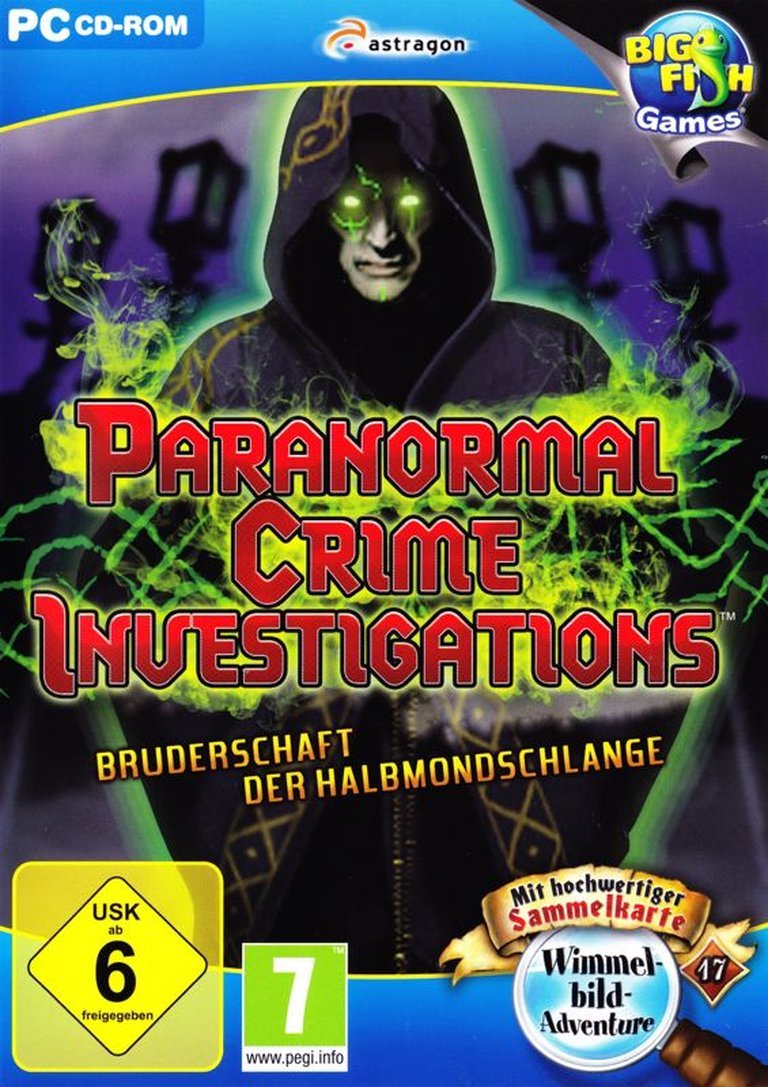
Paranormal Crime Investigations: Brotherhood of the Crescent Snake is a casual puzzle adventure game where players assume the role of a forensics investigator in New Orleans, tasked with solving a series of eerie murders linked to an ancient cult attempting to summon a monstrous snake deity. Combining forensic science with supernatural elements, the game features hidden object puzzles and mini-games themed around both investigative techniques and voodoo rituals, as players uncover clues left by the slain Guardians of the Light with the aid of the enigmatic Madame Oracleaux.
Gameplay Videos
Paranormal Crime Investigations: Brotherhood of the Crescent Snake Guides & Walkthroughs
Paranormal Crime Investigations: Brotherhood of the Crescent Snake Reviews & Reception
jayisgames.com (60/100): The mix of hidden object scenes, puzzles, and crime scene investigations is good, if a little heavy on the hidden object areas.
mobygames.com (60/100): Players Average score: 3.0 out of 5
Paranormal Crime Investigations: Brotherhood of the Crescent Snake: A Comprehensive Retrospective
Introduction: A Hidden Gem in the Shadows of New Orleans
Paranormal Crime Investigations: Brotherhood of the Crescent Snake (2011) is a game that exists in the liminal space between obscurity and cult appreciation. Developed by GameInvest, S.A. and published by Big Fish Games, it is a first-person adventure that blends forensic investigation with occult horror, set against the rich, atmospheric backdrop of New Orleans. At first glance, it appears to be another casual hidden-object game (HOPA) in a market saturated with similar titles. However, beneath its unassuming surface lies a game that daringly attempts to fuse hardboiled detective storytelling with Lovecraftian horror, all while experimenting with mechanics that bridge the gap between scientific inquiry and supernatural dread.
This review aims to dissect Brotherhood of the Crescent Snake in its entirety—its development, narrative ambition, gameplay innovations, and the reasons it remains a fascinating, if flawed, artifact of early 2010s adventure gaming. While it may not have achieved mainstream acclaim, its bold thematic choices and mechanical experimentation deserve a closer look, especially in an era where the lines between casual and hardcore gaming continue to blur.
Development History & Context: The Rise of the Hybrid HOPA
The Studio and the Vision
GameInvest, S.A., a Portuguese studio, was not a household name in 2011, but it was part of a growing wave of European developers specializing in hidden-object puzzle adventures (HOPAs). The genre, which had exploded in popularity in the late 2000s, was dominated by titles like Mystery Case Files and Dark Parables, games that prioritized accessibility, short playtimes, and a mix of hidden-object scenes and light puzzles. Brotherhood of the Crescent Snake was an attempt to elevate the formula by integrating a stronger narrative backbone, a more immersive setting, and a unique blend of forensic and occult mechanics.
The game’s creative director and lead writer, José João G. Proença, envisioned a title that would stand out in a crowded market. In interviews and developer notes, Proença emphasized the importance of authenticity in setting and lore. New Orleans, with its deep roots in voodoo, jazz, and Gothic architecture, was the perfect crucible for a story about a secretive cult resurrecting an ancient snake deity. The game’s title itself—Brotherhood of the Crescent Snake—evokes the mystique of secret societies and the serpentine symbolism prevalent in occult traditions, from the Ouroboros to the biblical serpent.
Technological Constraints and Design Philosophy
Released in 2011, Brotherhood of the Crescent Snake was built using Adobe Flash and designed for Windows and Macintosh platforms. The technical limitations of the era meant that the game had to rely on pre-rendered 2D backgrounds and static animations, a far cry from the 3D environments of contemporary adventure games like L.A. Noire (also released in 2011). However, the developers leveraged these constraints to create a stylized, painterly aesthetic that reinforced the game’s eerie atmosphere.
The UI design was another area of innovation. The PCI (Paranormal Crime Investigations) Field Kit, a glowing briefcase in the bottom-right corner of the screen, served as the player’s hub for analyzing evidence. This was a departure from the typical HOPA inventory system, which often relegated item management to a simple bar at the bottom of the screen. The PCI Kit was not just a storage device but an interactive tool—players would drag glowing items into it to trigger mini-games that simulated forensic analysis, such as matching molecular structures or tracing magical symbols. This mechanic was a clever way to thematize the gameplay, making the player feel like a paranormal investigator rather than a passive observer.
The Gaming Landscape in 2011
The year 2011 was a pivotal one for adventure games. On one end of the spectrum, telluric, narrative-driven experiences like The Witcher 2 and Deus Ex: Human Revolution dominated the AAA space. On the other, the casual gaming market was booming, thanks to digital distribution platforms like Big Fish Games, Steam, and mobile app stores. HOPAs were a staple of this market, appealing to an audience that wanted short, engaging experiences with minimal learning curves.
Brotherhood of the Crescent Snake straddled these two worlds. It was marketed as a casual game, complete with a Collector’s Edition that included bonus chapters, wallpapers, and a soundtrack. Yet, its narrative complexity and mechanical depth set it apart from its peers. It was a game that respected its players’ intelligence, assuming they would be invested in its lore and willing to engage with its puzzles beyond the usual “find the hidden teapot” fare.
Narrative & Thematic Deep Dive: A Tale of Cults, Guardians, and Cosmic Horror
Plot Summary: The Crescent Snake Awakens
The game opens with a grisly murder in New Orleans during Mardi Gras. The victim, a young man, bears glowing runic tattoos and a mysterious iron star—clear signs that this is no ordinary homicide. The player assumes the role of a forensic investigator (whose name and backstory are deliberately vague, reinforcing the everyman protagonist trope) tasked with uncovering the truth behind the killing. Early on, the investigator crosses paths with Madame Oracleaux, a voodoo priestess who serves as both ally and exposition device. She reveals that the murder is the work of the Brotherhood of the Crescent Snake, an ancient cult seeking to summon their monstrous deity by sacrificing the Guardians of the Light—a secretive order of scholars and artists who have opposed the Brotherhood for centuries.
The narrative unfolds across three main chapters, each focusing on a different aspect of the investigation:
1. Chapter 1: The Brotherhood – The player gathers initial evidence, uncovers the cult’s symbols, and learns about the Guardians.
2. Chapter 2: The Iron Stars – The hunt for four iron stars (artifacts tied to the Brotherhood’s rituals) intensifies, leading the player through New Orleans’ underbelly.
3. Chapter 3: The Crescent Snake – The final confrontation with the cult, involving ancient coins, a cursed bell, and a ritual to prevent the snake god’s resurrection.
The Collector’s Edition adds a bonus chapter, which follows a Brotherhood fugitive and delves deeper into the cult’s hierarchy, providing additional lore and closure.
Themes: Science vs. Superstition, Light vs. Darkness
At its core, Brotherhood of the Crescent Snake is a duality-driven narrative. The game constantly juxtaposes:
– Science and the Supernatural: The player’s forensic tools (fingerprint analysis, chemical tests) are pitted against voodoo rituals, dark magic, and eldritch symbols. The PCI Field Kit is the physical manifestation of this conflict—a scientific device that can also analyze magical residues.
– Order and Chaos: The Guardians of the Light represent knowledge, art, and scholarship, while the Brotherhood of the Crescent Snake embodies fanaticism, destruction, and cosmic horror. The cult’s goal—to summon a snake god—is a classic Lovecraftian trope, evoking the indifference of the universe to human suffering.
– New Orleans as a Character: The city is not just a setting but a living, breathing entity. From the jazz clubs of the French Quarter to the haunted cemeteries of St. Louis, every location is steeped in history and superstition. The game’s writers clearly did their research, incorporating real-world voodoo practices, local legends, and architectural landmarks into the narrative.
Characters: Archetypes with Depth
While Brotherhood of the Crescent Snake does not boast the character depth of a Disco Elysium or The Wolf Among Us, its cast fulfills their roles effectively within the constraints of the genre:
– The Investigator (Player Character): A silent protagonist, allowing the player to project themselves into the role. The lack of voice acting (a common limitation in HOPAs of the era) is mitigated by the strong environmental storytelling.
– Madame Oracleaux: The mysterious mentor archetype, akin to Twin Peaks’ Log Lady or Constantine’s Papa Midnite. She provides cryptic hints, magical tools, and lore dumps, serving as the player’s guide through the supernatural underworld.
– Officer Zach: A skeptical cop who represents the rational world’s resistance to the paranormal. His presence grounds the story, reminding the player that not everyone believes in snake gods.
– The Brotherhood of the Crescent Snake: A faceless, fanatical cult, their members clad in hooded robes and speaking in ritualistic chants. Their lack of individuality reinforces their role as agents of an ancient, inhuman force.
Dialogue and Writing: A Mixed Bag
The game’s writing is its strongest and weakest aspect. On one hand, the lore is rich and immersive, with codex entries, newspaper clippings, and environmental details that flesh out the world. The puzzle descriptions and item examinations are particularly well-written, often dripping with Gothic atmosphere:
“The symbols etched into the victim’s arm pulse with an eerie glow, as if alive. The PCI Field Kit hums—this is no ordinary ink.”
On the other hand, the character dialogue can be stiff and expository, a common pitfall in HOPAs. Madame Oracleaux, in particular, often delivers monologues that feel more like quest logs than natural conversation. The game’s lack of voice acting (likely due to budget constraints) further exacerbates this issue, making some interactions feel clinical rather than dramatic.
Gameplay Mechanics & Systems: Forensic Investigation Meets Occult Puzzles
Core Gameplay Loop: Investigate, Analyze, Solve
Brotherhood of the Crescent Snake follows a non-linear investigative structure, where the player:
1. Explores locations (streets, cemeteries, jazz clubs) for clues and interactive objects.
2. Collects items (some hidden in hidden-object scenes, others in plain sight).
3. Analyzes evidence using the PCI Field Kit, which triggers mini-games.
4. Solves puzzles to progress the story, often involving symbol matching, chemical mixing, or lock-picking.
The game avoids strict linearity, allowing players to tackle objectives in multiple orders. For example, gathering the ingredients for a moss solvent might require visiting a lakehouse, a museum, and a magic shop in any sequence. This design choice encourages exploration and reduces frustration, a rarity in HOPAs, which often railroad players through rigid sequences.
The PCI Field Kit: A Stroke of Genius
The PCI Field Kit is the game’s most innovative mechanic. It serves three key functions:
1. Inventory Management: Stores collected items, with glowing objects indicating they need analysis.
2. Evidence Analysis: Dragging an item into the kit triggers a mini-game that simulates forensic or magical examination. For example:
– Molecular Matching: Aligning floating particles to identify a substance.
– Symbol Tracing: Drawing runes to decipher a cult’s markings.
– Chemical Mixing: Combining ingredients to create potions.
3. Case Log: A database of clues, suspect profiles, and lore entries, accessible via a monitor interface.
This system elevates the gameplay beyond typical HOPA fare. Instead of merely finding a key to open a door, the player might need to:
– Collect a fingerprint from a corpse.
– Analyze it in the PCI Kit to identify the victim.
– Use that information to unlock a new location or dialogue option.
The mini-games are repetitive (the same molecular matching puzzle appears multiple times), but they reinforce the game’s themes and make the player feel like a detective.
Hidden-Object Scenes: A Necessary Evil
Like most HOPAs, Brotherhood of the Crescent Snake relies heavily on hidden-object scenes (HOS), where the player must find items from a list within a cluttered environment. These scenes are marked by sparkles, a controversial design choice that some players love (for reducing pixel-hunting) and others despise (for breaking immersion).
The game attempts to innovate within this formula:
– Interactive HOS: Some items require an extra step (e.g., opening a box to reveal a hidden object).
– Combined Items: Collecting all parts of an object (e.g., a shovel handle and spade) triggers an automatic combination.
– Non-Linear Triggering: Certain HOS only appear after completing puzzles elsewhere, encouraging backtracking.
However, the sheer volume of HOS can become tedious, especially in the later chapters, where they feel like padding to extend playtime.
Puzzles: A Mix of Clever and Cliched
The game’s puzzle design is a mixed bag:
– Standout Puzzles:
– The Bell Tower Runes: A symbol-matching puzzle that requires logical deduction to align rotating rings.
– The Organ Music: A musical puzzle where the player must replicate a melody on a pipe organ.
– The Snake Grabber: A logic-based challenge where snakes must be removed in the correct order.
– Weak Puzzles:
– Repeated Molecular Matching: The same particle-catching mini-game appears at least five times, with only cosmetic changes.
– Sliding Tile Puzzles: Overused and lacks creativity compared to the game’s stronger offerings.
The difficulty curve is inconsistent. Some puzzles (like the hopscotch code) are brutally obscure, while others (like the scarecrow assembly) are trivially easy. The skip function (available after a short wait) mitigates frustration but also undermines the game’s challenge.
Combat and Character Progression: Notably Absent
Brotherhood of the Crescent Snake is not an action game, and it does not feature combat or traditional character progression. The player’s only “tools” are their wits, the PCI Kit, and occasional items like a snake grabber or sedative darts. This absence is not a flaw—the game is pure investigation—but it may disappoint players expecting more interactivity beyond puzzles and HOS.
World-Building, Art & Sound: Crafting an Atmosphere of Dread
Setting: New Orleans as a Gothic Playground
The game’s greatest strength is its sense of place. New Orleans is not just a backdrop but a character in its own right, with each location dripping with atmosphere:
– Café du Globe: A Mardi Gras street littered with confetti, masks, and a corpse—the perfect introduction to the game’s tone.
– Madame Oracleaux’s Magic Shop: A cluttered, candlelit den of voodoo dolls, potions, and occult tomes.
– The Cemetery: A Gothic labyrinth of crumbling tombs, glowing runes, and eerie statues.
– The Cathedral: A decaying church with stained glass depicting eldritch horrors and a bell tower hiding dark secrets.
The attention to detail is impressive. The developers researched New Orleans’ architecture, voodoo culture, and local myths, incorporating elements like:
– The Iron Stars: Based on real-world voodoo protective symbols.
– The Crescent Snake: A fusion of the Ouroboros and Louisiana’s serpent legends.
– The Guardians of the Light: Inspired by historical secret societies like the Rosicrucians.
Visual Design: Stylized and Moody
Given the technical limitations of 2011, the game’s art direction is remarkably effective. The pre-rendered 2D backgrounds are hand-painted with a dark, watercolor aesthetic, evoking the work of Edward Gorey or Tim Burton. The character designs are stylized but expressive, with exaggerated shadows and uncanny facial features that enhance the horror tone.
The UI is functional but unremarkable, with the PCI Field Kit being the only standout element. The inventory system is standard for the genre, though the glowing items (indicating they need analysis) are a nice touch.
Sound Design: Jazz, Chants, and Silence
The audio experience is minimalist but effective:
– Ambient Soundtrack: A mix of jazz, eerie chants, and dissonant strings that shifts dynamically based on location. The cathedral scenes feature choir-like humming, while the cemetery is accompanied by distant whispers.
– Sound Effects: The PCI Kit’s mechanical whirring, the crunch of footsteps on gravel, and the distant tolling of a bell all contribute to the immersion.
– Voice Acting: Nonexistent, which is a double-edged sword. While it saves on budget, it also robs the game of emotional weight during key moments.
The lack of voice acting is the biggest missed opportunity. A well-voiced Madame Oracleaux could have elevated the narrative, making her cryptic dialogue feel more ominous and engaging.
Reception & Legacy: A Cult Classic in the Making?
Critical and Commercial Reception
Paranormal Crime Investigations: Brotherhood of the Crescent Snake was not a commercial juggernaut, but it found a niche audience among HOPA enthusiasts and Lovecraftian horror fans. On MobyGames, it holds a player score of 3.0/5 (based on a single rating), indicating mixed but generally positive reception. Reviews from casual gaming sites like JayIsGames praised its atmosphere, puzzles, and narrative ambition, though some criticized its repetitive mini-games and lack of voice acting.
The Collector’s Edition (which included bonus chapters, wallpapers, and a soundtrack) was well-received, with many players considering the extra content essential to the full experience.
Influence and Legacy
While Brotherhood of the Crescent Snake did not spawn a franchise or redefine the HOPA genre, its innovations had a subtle but lasting impact:
– The PCI Field Kit inspired similar interactive inventory systems in later HOPAs, such as Dark Parables: The Swan Princess (2012) and Grim Facade: The Red Cat (2013).
– Its blend of forensic and occult themes paved the way for games like The Secret Order series, which also mixed detective work with supernatural horror.
– The non-linear structure and environmental storytelling were ahead of their time, foreshadowing the narrative design of later indie adventures like The Vanishing of Ethan Carter (2014).
Today, Brotherhood of the Crescent Snake is remembered fondly by a small but dedicated fanbase. It is not a masterpiece, but it is a bold, ambitious game that dared to be different in a genre often criticized for stagnation.
Conclusion: A Flawed but Fascinating Investigation
Paranormal Crime Investigations: Brotherhood of the Crescent Snake is not a perfect game, but it is a compelling one. It succeeds where it matters most:
– Atmosphere: New Orleans has never felt more alive in a video game, with its jazz, voodoo, and Gothic decay rendered in striking detail.
– Narrative Ambition: The Lovecraftian horror and duality of science vs. superstition give the story weight and depth rare in HOPAs.
– Mechanical Innovation: The PCI Field Kit is a brilliant fusion of gameplay and theme, making the player feel like a paranormal detective.
However, it stumbles in areas that prevent it from achieving greatness:
– Repetitive Puzzles: The overuse of molecular matching and sliding tiles grows tedious.
– Stiff Dialogue: The lack of voice acting and expository writing weaken character interactions.
– Hidden-Object Overload: The sheer number of HOS feels like padding in the later chapters.
Final Verdict: 7.5/10 – A Cult Classic Worth Investigating
Brotherhood of the Crescent Snake is not for everyone. Players seeking fast-paced action or deep character drama will be disappointed. But for those who appreciate atmospheric storytelling, clever puzzle design, and a love letter to New Orleans’ dark side, it is a hidden gem waiting to be discovered.
In the pantheon of adventure games, it may not sit alongside Grim Fandango or The Longest Journey, but it carves out its own niche—a moody, intelligent, and occasionally brilliant experiment in blending genres and themes. For that alone, it deserves to be remembered.
Recommended for:
– Fans of Lovecraftian horror and occult mysteries.
– Players who enjoy atmospheric, narrative-driven HOPAs.
– Those who appreciate innovative mechanics in casual games.
Avoid if:
– You dislike hidden-object scenes or repetitive puzzles.
– You prefer voice-acted, cinematic adventures.
– You want a game with combat or RPG elements.
Paranormal Crime Investigations: Brotherhood of the Crescent Snake is a testament to what HOPAs can achieve when they dare to be ambitious. It is a game that lingers, like the echo of a jazz trumpet in a haunted New Orleans alley—faint, but unforgettable.