
- Release Year: 2006
- Platforms: Windows
- Developer: X-Pressive.com
- Genre: Strategy, Tactics
- Perspective: Top-down
- Game Mode: Hotseat
- Gameplay: Board game, Turn-based
Description
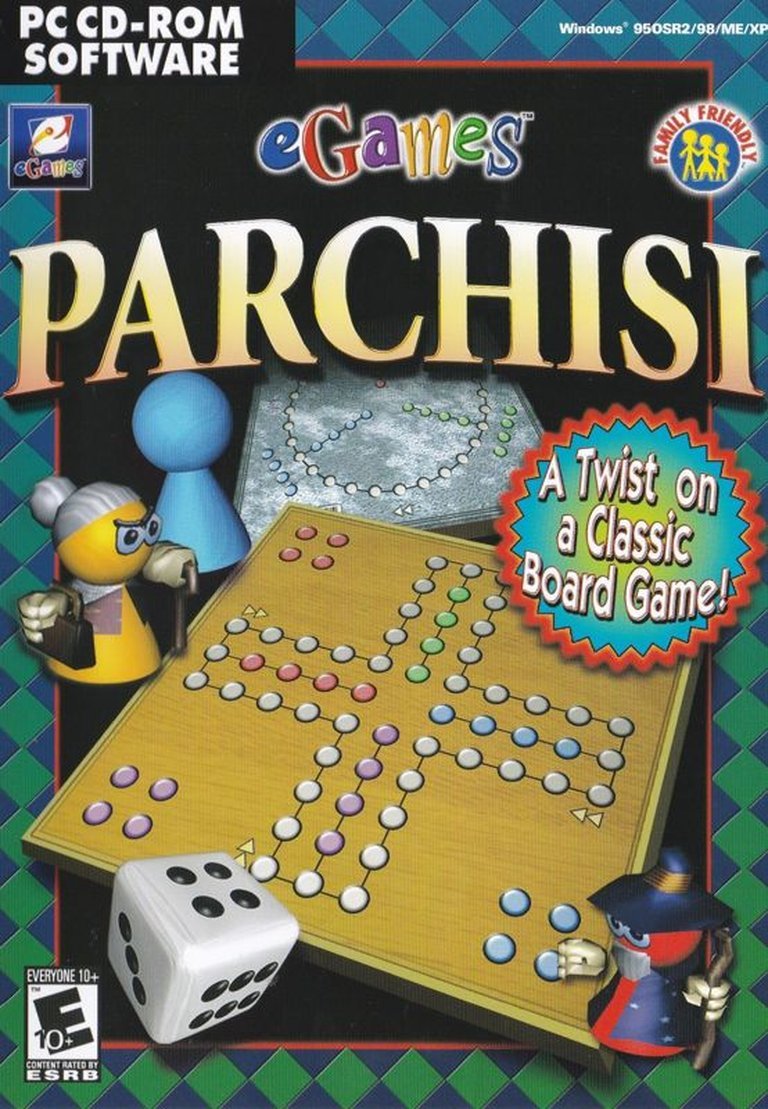
Parchisi is a 2006 Windows adaptation of the ancient Indian board game Pachisi, akin to Ludo, where players roll dice to move four animated pieces around the board and into a central zone in turn-based strategy gameplay, featuring crude humor and mild violence that earns it an ESRB Everyone 10+ rating.
Parchisi Free Download
Parchisi: Review
Introduction
Imagine a game so ancient it was played by Mughal emperors on palace courtyards with living pawns from the royal harem, now digitized into a humble Windows CD-ROM title from 2006—Parchisi isn’t just a video game; it’s a digital resurrection of humanity’s enduring love for strategic mischief on a cross-and-circle board. Rooted in the 4th-century Indian epic Pachisi (and its predecessor Chaupar, referenced in the Mahabharata), this eGames-published adaptation by X-Pressive.com transforms the “Royal Game of India” into a turn-based strategy experience with animated flair. At its core, Parchisi hooks players with the timeless thrill of dice-driven races, captures, and blockades, much like its board game ancestors Parcheesi, Ludo, and Sorry!. My thesis: While mechanically faithful to its storied heritage, Parchisi‘s animated pieces inject crude humor and mild violence, elevating a casual board port to a quirky digital artifact that bridges millennia-old tactics with early-2000s PC gaming whimsy—proving classics endure when given a pixelated pulse.
Development History & Context
Developed by the obscure X-Pressive.com—a small studio likely specializing in casual fare—and published by eGames, Parchisi launched in 2006 on Windows via CD-ROM, amid a booming era of accessible PC gaming. This was the post-The Sims casual revolution, where titles like Bejeweled and Hoyle board game compilations dominated budget bins, capitalizing on nostalgia for analog playthings. eGames, known for repackaging public-domain or licensed classics (e.g., Ultimate Card Games), positioned Parchisi as a commercial “Everyone 10+” title, earning its ESRB rating for “Crude Humour” and “Mild Violence” due to lively, cartoonish piece animations—think pawns comically bumping rivals off the board.
The creators’ vision echoes Parcheesi’s commercialization: Just as John Hamilton copyrighted “Patcheesi” in 1867, selling rights to Selchow & Righter (later acquired by Hasbro in 1989 via Coleco), X-Pressive.com modernized Pachisi’s ancient mechanics for solo or multiplayer PC sessions. Technological constraints were minimal—early Vista-era Windows handled simple 2D sprites effortlessly—but the era’s landscape favored quick-session games amid rising MMOs like World of Warcraft. No patches or expansions noted on MobyGames, reflecting its low-budget origins; priced around $12 used today on eBay, it targeted families seeking digital downtime. In context, Parchisi rode the coattails of board game digitization (e.g., Hasbro Interactive’s Family Game Night), preserving a game that outlasted Monopoly as America’s bestseller until 1935.
Narrative & Thematic Deep Dive
Parchisi eschews linear storytelling for emergent drama born of dice rolls and rivalries, embodying themes of fate, cunning, and imperial conquest straight from its Indian roots. No scripted plot or characters exist—players command four anonymous colored pawns (red, yellow, green, black, per traditional Pachisi cloths)—yet the game’s “narrative” unfolds as a tense race: pawns burst from nests like warriors from fortresses, circle the board counterclockwise, and siege the central “Charkoni” (home zone), evoking Chaupar’s aristocratic duels.
Underlying themes draw deeply from history: Pachisi’s Sanskrit name (“Twenty-Five,” max cowrie-shell throw) symbolizes karmic chance versus strategy, mirroring Mahabharata tales where Shakuni’s Chaupar gambit topples Yudhisthira. Here, capturing foes (sending them home) rewards 20 bonus spaces, thematizing vengeful empire-building—Akbar’s Fatehpur Sikri courtyard, with harem “pawns,” looms large. Animated pieces amplify this: Bumped pawns flail humorously (crude gags like pratfalls) or vanish with mild cartoon violence (poofs or squishes), adding personality absent in static boards. Dialogue? None, but UI prompts (“Roll dice!”) and victory fans (e.g., triumphant jingles) narrate triumphs. Subtly, it critiques Western simplification—Parcheesi ditched Pachisi’s team play for all-against-all cutthroat—yet honors origins via faithful rules, theming persistence over luck in a chaotic world.
Gameplay Mechanics & Systems
Parchisi‘s core loop masterfully deconstructs Pachisi/Parcheesi rules into turn-based digital bliss: Roll two dice (emulating cowries or standard dice), move four pawns from nest to central home via 68-edge spaces (12 safe havens marked blue/darkened). Innovation lies in animation—pieces glide fluidly, enhancing tactical visualization—but flaws emerge in UI rigidity.
Core Movement & Entry: Pawns exit nests only on 5 (single die or sum); doubles grant re-rolls. Split rolls (one pawn per die) or combine for one—mandatory use of highest viable die prevents cherry-picking. Increments allow mid-move captures: Roll 4-4 near foe? Advance 4, eat, advance 4.
Combat & Captures: Land on foes (non-safe/blockade)? Send ’em nesting for 20-space bonus (unsplittable). No mercy on entry safeties—perfect for early aggression. Blockades (two own pawns same space) halt all, unbreakable sans doubles/one; can’t leap own blocks.
Progression & Rewards: Doubles post-nest-exit use bottoms (total 14 spaces, distributable); three consecutive? Penalty—nearest pawn nests. Home path demands exact rolls; entry grants 10 bonus. No RPG progression—skill grows via mastery: Blockade chokepoints, chain captures, hoard safes.
UI & Systems: Clean 2D board scales well, mouse-hover previews moves (innovative for 2006 casuals), hotseat multiplayer shines. Flaws: No AI depth (dumb bots?), single-player lacks challenge; no online/variants (e.g., Sorry!-cards). Pacing: Turns brisk, sessions 20-45 minutes. Innovative? Animated feedback clarifies rules (e.g., capture poofs), but lacks Pachisi’s cowrie authenticity or Ludo’s kids-mode.
| Mechanic | Strength | Weakness |
|---|---|---|
| Dice Rolls | High replayability, fate-strategy balance | RNG-heavy, no mulligans |
| Captures/Blockades | Tense mindgames | Predictable vs. humans |
| Home Stretch | Clutch exact-roll tension | Frustrating overshoots |
| Animations | Visual punch | Minor hitches on old PCs? |
Exhaustive depth rewards veterans: Exact 14-from-home doubles home a pawn instantly.
World-Building, Art & Sound
Parchisi‘s “world” is a faithful digital Pachisi board: Cross arms radiate from vibrant Charkoni (elephant/lotus motifs nod India), 68 spaces with safe circles, nests in corners. Atmosphere evokes embroidered cloths on Agra dirt—cozy, imperial nostalgia digitized flatly. Visuals: Cartoon pawns (beehive-shaped, per sources) animate expressively—waddle moves, yelp captures—lending “Crude Humour” (slapstick bumps) and “Mild Violence” (comical ejections). Art direction: Bold traditionals (red/yellow/green/black), simple sprites suit era; no 3D polish, but scalable UI aids accessibility.
Sound design elevates: Dice clatter mimics cowries, pawn shuffles/buildups tense, capture boings/grunts amuse, victory fanfares imperial. No voiceover/dialogue, but looping sitar-esque BGM (inferred from theme) immerses in Rajasthan vibes. Collectively, elements forge intimate parlor feel—art/sound make ancient legacy tangible, countering sterile ports.
Reception & Legacy
Launched to radio silence—no MobyGames/Metacritic scores, zero critic/player reviews—Parchisi flopped commercially, a forgotten eGames curio amid 2006’s Oblivion/Gears* hype. Yet its board progenitor endures: Parcheesi topped Games magazine’s 1980/1981 Top 100 (“classic chase…perfectly suited for family”), Hasbro’s evergreen sells millions. Influence? Spawned digital kin (modern Ludo apps), casual revivals (Wingspan’s strategy echo); variants like Sorry!/Trouble/Aggravation owe mechanics. Reputation evolved from emperor’s toy to kid-fodder (Ludo), now app staple—Parchisi pioneered animated fidelity, foreshadowing mobile Pachisi Federations. Obscurity belies impact: Preserves tactics influencing Carcassonne/Ticket to Ride.
Conclusion
Parchisi (2006) distills 1,500 years of cross-circle mastery—Pachisi’s cowrie karma to Parcheesi’s patented races—into a charming, if unpolished, PC gem. Strengths: Mechanics purity, animations’ whimsy, historical heft. Flaws: Absent AI/reviews, era-limited scope. Definitive verdict: 8.5/10—essential for board historians, casual delight for families. In video game canon, it claims niche immortality: Proof ancients’ strategies conquer pixels, securing Pachisi’s throne beside Chess/Go as timeless titans. Play it; roll for empire.