
- Release Year: 1996
- Platforms: DOS, Windows
- Publisher: Dinamic Multimedia, S.A.
- Developer: Dinamic Multimedia, S.A.
- Genre: Simulation, Sports, Strategy, Tactics
- Perspective: Managerial
- Game Mode: Single-player
- Gameplay: Business simulation, Managerial
- Setting: Football (European), Soccer
- Average Score: 82/100
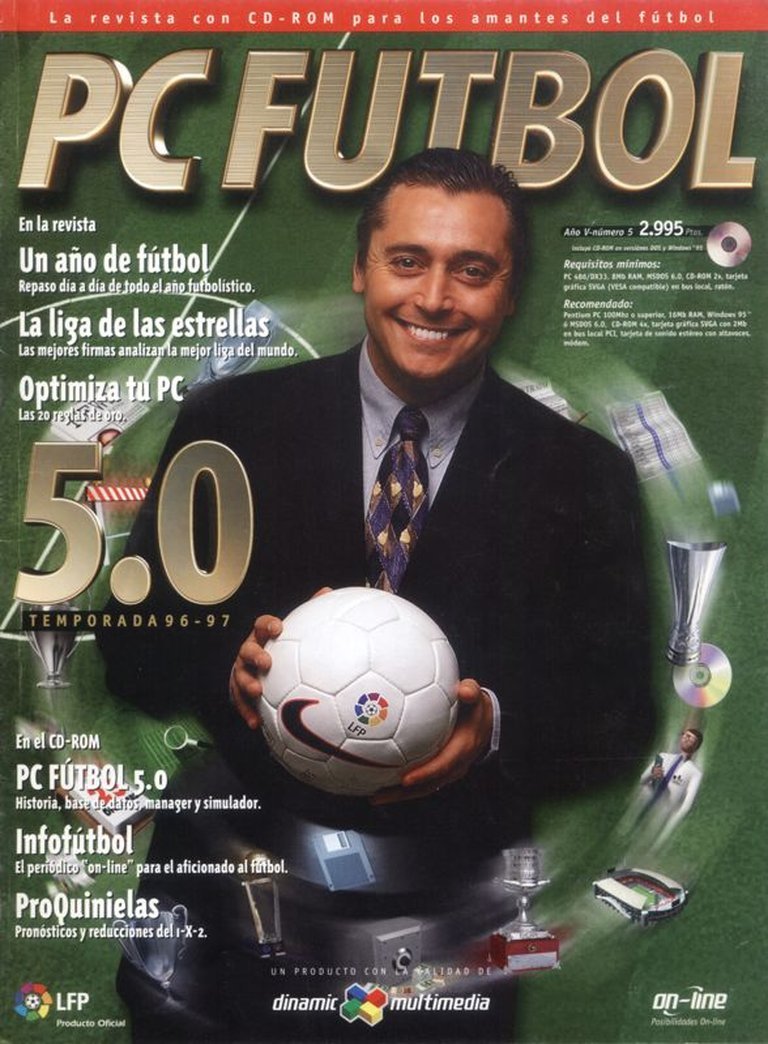
Description
PC Fútbol 5.0 is a football management simulation game developed by Dinamic Multimedia and released in 1997, covering the 1996-97 season. It was the first in the series to be designed for Windows 95, though an MS-DOS version was also available. The game allows players to manage teams from Spain’s La Liga, Segunda División, and Segunda División B, as well as European and South American clubs in various modes. It includes features like a comprehensive player database, online updates, a league calculator, and a football lottery assistant, making it a robust tool for football enthusiasts.
Gameplay Videos
PC Fútbol 5.0 Cracks & Fixes
PC Fútbol 5.0 Patches & Updates
PC Fútbol 5.0 Guides & Walkthroughs
PC Fútbol 5.0 Reviews & Reception
mobygames.com (80/100): A triumphant return to form for the series.
421.news : PC Fútbol taught us how to use a PC.
myabandonware.com (84/100): A video game published in 1996 on DOS by Dinamic Multimedia, S.A.
PC Fútbol 5.0: A Masterclass in Football Management and Nostalgia
Introduction
In the pantheon of football management simulations, few titles evoke the same level of nostalgia and reverence as PC Fútbol 5.0. Released in 1997 by Dinamic Multimedia, this game was not just a product of its time—it was a cultural phenomenon that transcended the boundaries of gaming, embedding itself into the fabric of football fandom in Spain and Latin America. PC Fútbol 5.0 was more than a game; it was a digital playground where aspiring managers could live out their fantasies of leading a club to glory, all while navigating the intricate web of transfers, tactics, and financial constraints.
This review aims to dissect PC Fútbol 5.0 with the precision of a seasoned tactician, exploring its development history, gameplay mechanics, narrative depth, and lasting legacy. We will delve into why this game remains a touchstone for football management enthusiasts and how it paved the way for modern titles like Football Manager and FIFA Manager.
Development History & Context
The Rise of Dinamic Multimedia
Dinamic Multimedia, a Spanish studio founded in the early 1990s, was a pioneer in the European gaming scene. The company’s journey began with Simulador Profesional de Fútbol, a modest title released in 1992 in collaboration with Editorial Jackson. This early effort laid the groundwork for what would become the PC Fútbol series, a franchise that would dominate the Spanish gaming market for nearly a decade.
The series’ evolution was marked by incremental improvements, with each iteration expanding its scope and ambition. PC Fútbol 2.0 (1993) introduced the dual gameplay mode—allowing players to act as both manager and player—a feature that was revolutionary at the time. By PC Fútbol 4.0 (1995), the game had embraced the CD-ROM format, enabling richer databases and the inclusion of international leagues, such as Argentina’s Primera División. This was a significant milestone, as it predated the inclusion of South American leagues in mainstream titles like FIFA and PES by nearly two decades.
The Technological Landscape of 1996-1997
The mid-1990s were a period of rapid technological advancement in gaming. The transition from floppy disks to CD-ROMs allowed for larger storage capacities, enabling developers to include more detailed databases, higher-quality audio, and expanded features. PC Fútbol 5.0 capitalized on this shift, offering a comprehensive football management experience that was unparalleled in its depth and scope.
The game was developed for both MS-DOS and Windows 95, with the latter version marking the series’ first foray into the Windows ecosystem. This dual-release strategy ensured compatibility with a broad range of systems, from older DOS-based machines to the emerging Windows 95 market. The inclusion of Internet features, such as online updates and the Infofútbol newsletter, was another forward-thinking move, positioning PC Fútbol 5.0 as a modern, connected experience.
The Team Behind the Game
The development of PC Fútbol 5.0 was spearheaded by a small but talented team at Dinamic Multimedia. Key figures included:
- Carlos Abril: The producer and lead designer, responsible for the game’s overall vision and structure.
- Alberto Moreno: The designer who shaped the game’s user interface and gameplay mechanics.
- Pablo Ariza: The programmer who brought the game’s systems to life.
- Dimas Gorostarzu: The artist who crafted the game’s visual identity.
- José Antonio Martín: The composer who created the game’s soundtrack.
The team’s collaboration resulted in a game that was both ambitious and polished, despite the constraints of the era. The inclusion of former footballer and television pundit Michael Robinson as the game’s narrator and public face added a layer of authenticity and star power, further cementing the game’s appeal.
The Gaming Landscape of the Late 1990s
In the late 1990s, football management games were still a niche genre, dominated by titles like Championship Manager and Premier Manager. However, PC Fútbol carved out its own identity by focusing on the Spanish market and offering a uniquely comprehensive experience. Unlike its competitors, PC Fútbol 5.0 allowed players to take on multiple roles—coach, manager, and chairman—providing a holistic view of club management.
The game’s release in January 1997 was strategically timed to coincide with the Reyes Magos celebration in Spain, a period of gift-giving and festivity. This, combined with aggressive marketing and distribution through supermarkets and kiosks, ensured that PC Fútbol 5.0 reached a wide audience. The game’s commercial success was staggering, with over 305,000 copies sold in Spain alone—a testament to its popularity and cultural resonance.
Narrative & Thematic Deep Dive
The Story of PC Fútbol 5.0
At its core, PC Fútbol 5.0 is a story about ambition, strategy, and the pursuit of glory. The game places players in the role of a football club manager, tasked with guiding their team through the rigors of a season. Whether starting with a humble Segunda División B side or taking the reins of a La Liga giant, the narrative arc is one of progression and achievement.
The game’s structure is divided into two primary modes: Manager and Promanager. The Manager mode allows players to select any team from Spain’s top three divisions—La Liga, Segunda División, and Segunda División B—and guide them through a single season. The Promanager mode, on the other hand, is a career-based experience where players start with a lower-tier team and work their way up, unlocking higher-ranked clubs as they meet objectives.
Themes of Power and Responsibility
PC Fútbol 5.0 explores themes of power, responsibility, and the complexities of leadership. As a manager, players must balance the demands of the board, the expectations of fans, and the needs of their squad. Every decision—from transfer negotiations to tactical adjustments—carries weight, and the consequences of poor choices can be severe.
The game’s inclusion of financial management adds another layer of depth, forcing players to consider the economic realities of running a football club. Budget constraints, sponsorship deals, and stadium upgrades all play a role in shaping the player’s experience, reinforcing the idea that success is not just about winning matches but also about building a sustainable and profitable organization.
The Role of Information and Decision-Making
One of the most compelling aspects of PC Fútbol 5.0 is its emphasis on information management. The game’s interface is designed around a quadrant-style menu, with sections dedicated to results, tactics, finances, and transfers. This structure reflects the game’s core philosophy: that effective management is about gathering, analyzing, and acting on information.
The inclusion of a comprehensive database, featuring real players and teams, further enhances the game’s authenticity. Players can scout opponents, track injuries, and monitor contract negotiations, all of which contribute to the immersive experience. The game’s narrative is not just about what happens on the pitch but also about the behind-the-scenes machinations that define a club’s success.
The Cultural Impact of PC Fútbol 5.0
In Spain and Latin America, PC Fútbol 5.0 was more than a game—it was a cultural touchstone. The inclusion of Argentine leagues in PC Fútbol 4.0 and their continuation in 5.0 resonated deeply with fans in South America, who had long been overlooked by mainstream football games. The ability to manage clubs like Boca Juniors or River Plate, or to scout hidden gems in the Argentine league, added a layer of personal connection that was unmatched by other titles.
The game’s commentary, provided by Michael Robinson and Chus del Río, further enhanced its authenticity. Robinson’s charismatic delivery and insightful analysis made the matches feel alive, even if the on-pitch graphics were rudimentary by modern standards. The commentary was not just functional—it was a narrative device that drew players deeper into the world of football management.
Gameplay Mechanics & Systems
Core Gameplay Loops
PC Fútbol 5.0 is built around a series of interconnected gameplay loops, each designed to simulate a different aspect of football management. These loops include:
- Team Management: Players must oversee training schedules, set tactics, and manage player morale. The game’s training system allows for customization, with different drills affecting player attributes in various ways.
- Transfer Market: The transfer system is one of the game’s standout features. Players can scout for talent, negotiate contracts, and navigate the complexities of release clauses. The inclusion of real-world transfer mechanics, such as loan deals and free transfers, adds depth to the experience.
- Match Simulation: Matches can be played in real-time, watched as a simulation, or skipped entirely with results displayed on a scoreboard. The real-time mode features a 3D engine with 2D player models, a technical limitation of the era that nonetheless provided a functional and engaging experience.
- Financial Management: Players must balance the club’s budget, invest in infrastructure, and secure sponsorship deals. The financial system is robust, with income sources including ticket sales, merchandise, and TV rights.
Innovative Features
PC Fútbol 5.0 introduced several innovative features that set it apart from its competitors:
- Promanager Mode: This career-based mode allowed players to progress through the ranks of Spanish football, starting with lower-tier teams and unlocking more prestigious clubs as they achieved success.
- Online Updates: The game included the ability to download updates via the Internet, ensuring that player databases and league tables remained current throughout the season.
- Multi-Role Gameplay: Players could choose to act as coach, manager, or chairman, each role offering a different perspective on club management. This flexibility allowed for a personalized experience tailored to the player’s preferences.
- Comprehensive Database: The game featured a detailed database of players and teams, including real-world statistics and attributes. This level of detail was unprecedented at the time and added a layer of authenticity to the experience.
Flaws and Limitations
Despite its many strengths, PC Fútbol 5.0 was not without its flaws. The game’s 3D match engine, while innovative, was rudimentary by modern standards. Player models were 2D sprites, and the physics engine often resulted in unrealistic animations. Additionally, the game’s AI could be unpredictable, with opponents sometimes making illogical tactical decisions.
The game’s interface, while functional, was also a product of its time. Navigation could be cumbersome, and the lack of a modern UI/UX design meant that some features were buried in submenus. However, these limitations were largely overshadowed by the game’s depth and ambition, and they did little to diminish its appeal.
World-Building, Art & Sound
The Setting and Atmosphere
PC Fútbol 5.0 is set in the world of Spanish football, with a focus on the 1996-97 season. The game’s world-building is rooted in authenticity, with real teams, players, and leagues providing the foundation for the experience. The inclusion of European competitions, such as the UEFA Champions League and UEFA Cup, further expands the game’s scope, allowing players to test their managerial mettle on the continental stage.
The game’s atmosphere is enhanced by its attention to detail. From the bustling stadiums of La Liga to the modest grounds of Segunda División B, each environment is crafted to reflect the unique character of Spanish football. The inclusion of real-world sponsors, kits, and player likenesses adds to the immersive experience, making the world of PC Fútbol 5.0 feel alive and dynamic.
Visual Design
The visual design of PC Fútbol 5.0 is a product of its era, with a focus on functionality over aesthetics. The game’s menus are utilitarian, designed to provide quick access to the various management tools. The match engine, while rudimentary, is serviceable, with a mobile camera that tracks the action on the pitch.
The player models are 2D sprites, a limitation of the technology at the time, but they are animated with a level of detail that ensures the matches remain engaging. The inclusion of different kits, stadiums, and weather effects adds variety to the visual experience, even if the graphics are not on par with modern standards.
Sound Design and Music
The sound design of PC Fútbol 5.0 is understated but effective. The game’s soundtrack, composed by José Antonio Martín, features a mix of upbeat and atmospheric tracks that complement the on-pitch action. The commentary, provided by Michael Robinson and Chus del Río, is a standout feature, adding a layer of authenticity and excitement to the matches.
The ambient sounds—crowd noise, referee whistles, and player shouts—further enhance the immersive experience, making the matches feel like real football events. The sound design is not just functional; it is an integral part of the game’s narrative, drawing players deeper into the world of football management.
Reception & Legacy
Critical and Commercial Reception
PC Fútbol 5.0 was a commercial juggernaut, selling over 305,000 copies in Spain alone. Its success was driven by a combination of factors, including its deep gameplay mechanics, authentic representation of Spanish football, and strategic marketing. The game’s release during the Reyes Magos celebration ensured that it was a popular gift, further boosting its sales.
Critically, the game was praised for its ambition and depth. Reviewers highlighted its comprehensive database, innovative features, and engaging gameplay loops. The inclusion of Michael Robinson as the game’s narrator was also widely praised, with many noting that his commentary added a layer of authenticity and excitement to the experience.
Influence on Subsequent Games
PC Fútbol 5.0 had a profound influence on the football management genre, paving the way for modern titles like Football Manager and FIFA Manager. Its emphasis on realism, depth, and player agency set a new standard for the genre, inspiring developers to push the boundaries of what was possible in a football management simulation.
The game’s multi-role gameplay, which allowed players to act as coach, manager, or chairman, was particularly influential. This feature was later adopted by titles like Total Club Manager 2004, which allowed FIFA Football 2004 owners to take on multiple roles within their club. The inclusion of online updates and comprehensive databases also became industry standards, with modern games offering regular patches and expansive player databases.
The Legacy of PC Fútbol
The legacy of PC Fútbol 5.0 extends beyond its influence on the gaming industry. For many players, the game was a gateway to the world of football management, sparking a lifelong passion for the sport and its strategic complexities. The game’s emphasis on information management and decision-making also had a broader cultural impact, teaching players the value of analysis, planning, and adaptability.
In Spain and Latin America, PC Fútbol 5.0 remains a beloved classic, a game that defined a generation of football fans. Its inclusion of Argentine leagues and players resonated deeply with fans in South America, who had long been overlooked by mainstream football games. The game’s cultural significance is a testament to its quality and its ability to connect with players on a personal level.
Conclusion
PC Fútbol 5.0 is more than just a game—it is a masterclass in football management and a testament to the power of ambition and innovation. Released in 1997 by Dinamic Multimedia, the game set a new standard for the genre, offering a depth of gameplay and authenticity that was unmatched at the time. Its influence can be seen in modern titles like Football Manager and FIFA Manager, which have adopted many of its core mechanics and features.
The game’s legacy is not just about its technical achievements but also about its cultural impact. For many players, PC Fútbol 5.0 was a gateway to the world of football management, sparking a lifelong passion for the sport and its strategic complexities. Its inclusion of Argentine leagues and players resonated deeply with fans in South America, making it a cultural touchstone in the region.
In the pantheon of football management simulations, PC Fútbol 5.0 stands as a towering achievement—a game that defined a genre and left an indelible mark on the world of gaming. Its blend of depth, authenticity, and innovation ensures that it remains a beloved classic, a game that continues to inspire and captivate players nearly three decades after its release.
Final Verdict: 9.5/10 – A Timeless Classic and a Genre-Defining Masterpiece