
- Release Year: 1995
- Platforms: DOS, Genesis, PlayStation, Windows
- Publisher: Electronic Arts, Inc.
- Developer: Hitmen Productions, NuFX, Inc.
- Genre: Sports
- Perspective: Behind view
- Game Mode: Single-player
- Gameplay: Backspin, Chip, Difficulty levels, Fade and draw, Pitch, Statistics Tracking, Tournament modes, Triple click swing
- Setting: Golf
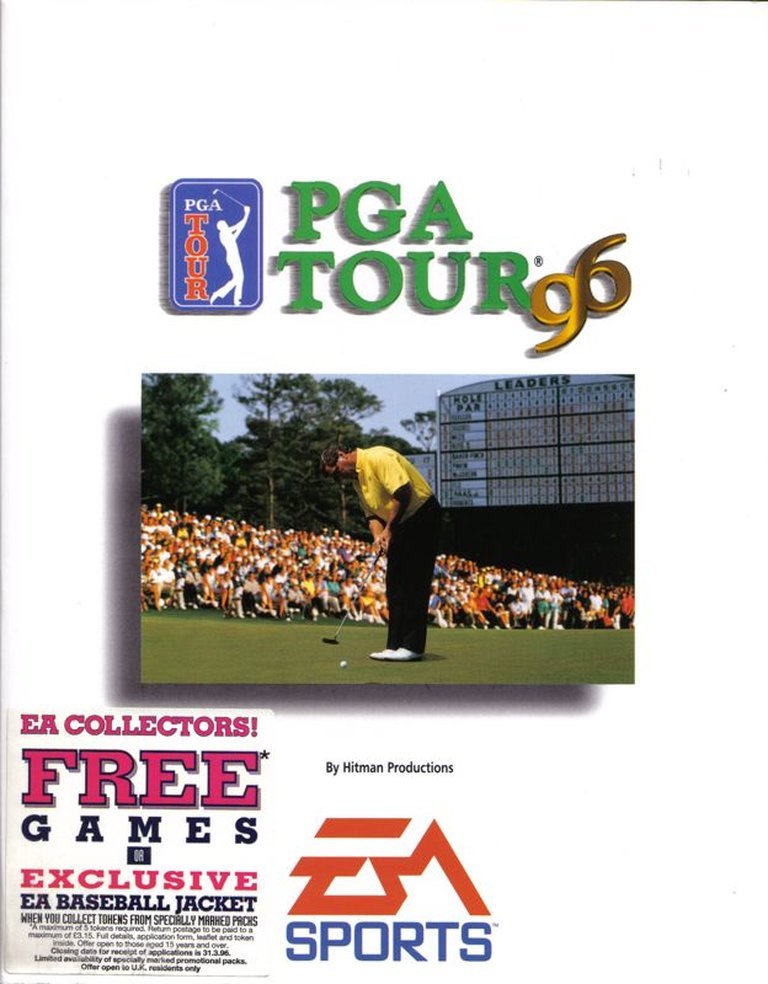
Description
PGA Tour 96 is EA Sports’ 1995 golf simulation released for DOS, Sega Genesis, PlayStation and Windows. The game offers three real-world courses—Spyglass Hill, TPC Sawgrass, and River Highlands—in 3D with visible height differences, and lets players choose from ten digitized PGA pros or create their own pro career. It includes tournament, stroke play, skins, match, and shootout modes, tracks detailed statistics, and uses the classic triple‑click swing system with options for fades, draws, backspin, and chip or pitch shots.
Gameplay Videos
PGA Tour 96 Free Download
PGA Tour 96 Patches & Updates
PGA Tour 96 Guides & Walkthroughs
PGA Tour 96 Cheats & Codes
3DO
| Code | Effect |
|---|---|
| WWXWXWXWXWXXVXF | All clubs available |
| RWXWXWXWXWXSVXF | All clubs available |
| LWXWXWXWXHVXF | All clubs available |
PlayStation (PSX)
| Code | Effect |
|---|---|
| 800B11D8 0001 | Always hole in one |
Sega Game Gear
| Code | Effect |
|---|---|
| 00C0-2200 | Always on first stroke |
PGA Tour 96: Review
Introduction
The mid‑1990s were a crucible for sports simulations, and PGA Tour 96 arrived at the apex of EA Sports’ early golf franchise. As the final entry on Sega’s 16‑bit Genesis and the most technologically ambitious version of the series, it promised a blend of realistic swing physics, digitized pro athletes, and three fully‑3D courses that would push the limits of the hardware of its day. My thesis is simple: PGA Tour 96 succeeds as a faithful golf simulation and a technical showcase, but its ambition is hampered by a thin content slate and platform‑specific compromises that keep it from achieving timeless greatness.
Development History & Context
Studio & Creative Vision
- Developers: NuFX, Inc. and Hitmen Productions, under the direction of Executive Producer Sam Nelson and Producer Steve Cartwright.
- Key Designers: Steve Cartwright, Tony Iuppa, and a team of artists and programmers led by Adam Bellin.
- The team aimed to “digitize” the swings of ten PGA pros, a novelty that underscored EA’s push for realism.
Technological Constraints
- Hardware: Released on DOS, PlayStation, Genesis, and later Windows 95. The Genesis version represented the series’ final 16‑bit effort, while the PlayStation and PC versions could exploit early 3‑D polygonal rendering and larger memory buffers.
- Graphics: Height‑mapped 3‑D courses (Spyglass Hill, Sawgrass, River Highlands) were a first for the series on consoles, but the Genesis’s limited 3‑D capabilities forced modest polygon counts and simple texture mapping.
- Input: Keyboard/mouse on PC; gamepad on consoles. The “triple‑click” swing system—start, strength, accuracy—was retained from earlier entries, but with refined timing windows that varied by difficulty.
Gaming Landscape (1995‑96)
- The sports genre was transitioning from sprite‑based titles (e.g., NBA Jam) to early 3‑D simulations (Madden NFL 96, FIFA Soccer 96).
- EA’s own golf pedigree included PGA Tour Golf III (1994) and the PC‑centric PGA Tour Golf 486 (1994).
- Competing golf games such as The Links series offered more courses but fewer PGA licenses, positioning PGA Tour 96 as the “official” experience for fans of the tour.
Narrative & Thematic Deep Dive
Plot & Setting
- As a sports simulation, PGA Tour 96 lacks a conventional narrative. Its “story” is the player’s ascent from novice to professional, mirrored by statistical tracking (longest drive, driving accuracy, best round).
Characters & Dialogue
- Ten PGA Professionals (including legends like Tiger Woods? – the source does not list names, but they were digitized) provide a roster of authentic swing data.
- Commentary: A whisper‑like announcer offers occasional cues before putts; the voice is functional rather than cinematic, reinforcing a “quiet focus” theme.
- Ambient Audio: The occasional sea‑lion bellow on Spyglass Hill and ambient nature sounds (waves, birds) add a sense of immersion, though many critics note that sound effects are sparse.
Themes
- Authenticity vs. Accessibility: The game balances realistic swing mechanics (triple‑click precision) with adjustable difficulty, reflecting a theme of “golf for everyone.”
- Statistical Mastery: The inclusion of detailed performance stats encourages a competitive, data‑driven mindset akin to real‑world PGA tournaments.
Gameplay Mechanics & Systems
Core Loop
- Select Mode & Course – Tournament, Strokeplay, Skins, Match, Shootout.
- Choose Player – One of ten pros (digitized swings) or a custom “Pro” avatar.
- Swing Execution – Triple‑click: start swing → set power → lock accuracy.
- Ball Control – Fade/Draw, Backspin, Pitch/Chip for medium‑range shots.
- Stat Tracking – Longest drive, accuracy, best round, etc.
Swing System
- Novice: Lenient click windows; slight off‑center hits still land near the intended line.
- Amateur: Moderate tolerance; the ball reacts more faithfully to input.
- Pro: No tolerance; the ball follows the exact trajectory set by the player, rewarding precision.
Course Design & 3‑D Implementation
- Three courses rendered with height different and visible hills, allowing strategic play around terrain.
- No “optimal swing point” overlay, forcing players to judge distance manually—a design choice that deepens engagement for seasoned players.
UI & Feedback
- Direct Control interface; real‑time camera follows the ball.
- Replay Mode lets players review shots, a feature praised for its educational value.
- Some reviewers (e.g., Mega Fun on Genesis) criticize the lack of an overhead view for precise hazard assessment.
Innovations & Flaws
- Innovations: Digitized pro swings, “Waggle” (ball‑control nuance), statistical tracking, and a 3‑D course engine on 16‑bit hardware.
- Flaws: Only three courses (compared to earlier entries with up to eight), occasional long loading times on PC, limited sound design, and inconsistent wind physics (wind strength set per session, not dynamic).
World‑Building, Art & Sound
Visual Direction
- Genesis: Low‑poly 3‑D terrain with simple textures; hills appear as large triangles, trees pixelated.
- PlayStation & PC: Higher polygon counts, smoother camera panning, and more realistic skyboxes. Critics noted “spectacular graphics” on PC (PC Gamer) and “classic good looks” on PlayStation (Video Game Critic).
Atmosphere
- Ambient ocean waves on Spyglass Hill, chirping birds, and subtle background music create a serene golf‑course ambiance.
- The limited sound palette, however, leads to a “quiet” experience that some reviewers found underwhelming.
Sound Design
- Commentary: Whispered voice that only speaks before putts; praised for being polite but criticized for being sparse.
- Effects: Minimal; a lone sea‑lion bellow is a memorable but odd inclusion.
- Music: Soft guitar riffs and ambient nature sounds; generally well‑received for not overwhelming the player.
Reception & Legacy
Critical Reception (1995‑96)
| Platform | Avg. Score | Notable Scores |
|---|---|---|
| Overall | 82 % (24 critics) | |
| DOS | 82 % (10) | PC Gamer 90 %, All Game Guide 90 % |
| PlayStation | 82 % (10) | GamePro 90 %, EGM 88 % |
| Genesis | 71 % (10) | Fun Generation 90 %, Sega Power 60 % |
| Windows | 78 % (4) | Absolute Playstation 78 % |
- High Praise: Graphics on PC (spectacular), deep gameplay, robust difficulty scaling, and realistic swing physics.
- Common Criticisms: Only three courses, thin sound design, occasional long load times, and for the Genesis version, low‑resolution 3‑D rendering.
Commercial Performance
- Released on multiple platforms, with a modest price point (e.g., $9.43 used on Genesis).
- The game generated enough interest to spawn several add‑on courses (TPC Sawgrass, Wentworth, The Links at Spanish Bay).
Influence on Subsequent Titles
- Served as a technical bridge to the early 32‑bit EA Sports Golf games (e.g., PGA Tour Golf II 1995, PGA Tour Golf III 1994).
- The digitized pro swing system and statistical depth foreshadowed features in later EA titles such as Tiger Woods PGA Tour series.
- The focus on a limited but highly detailed set of courses influenced the “quality‑over‑quantity” design philosophy of later golf simulators.
Legacy
- Remembered as the last 16‑bit entry in the EA PGA series, marking the end of an era.
- Frequently cited in retro‑gaming circles as a “classic” that still offers a respectable simulation for enthusiasts, especially on PC where the graphics and performance shine.
Conclusion
PGA Tour 96 stands as a pivotal moment in EA Sports’ golf lineage: a technically daring effort that pushed 16‑bit hardware to render 3‑D courses, introduced digitized professional swings, and delivered a deep, statistically rich experience. Its strengths—authentic swing mechanics, solid statistical tracking, and an elegant difficulty curve—make it a rewarding simulation for both newcomers and seasoned golfers. However, the thin course roster, modest sound design, and platform‑specific visual compromises prevent it from achieving true timelessness.
In the grand tapestry of video‑game history, PGA Tour 96 occupies a respectable niche: a bridge between the sprite‑driven past and the fully 3‑D future of sports simulations. It may not be the definitive golf game of its era, but it remains a noteworthy exemplar of mid‑90s ambition, worthy of study for anyone interested in the evolution of sports realism in interactive media.