
- Release Year: 2002
- Platforms: Windows
- Publisher: Bas de Reuver
- Developer: Bas de Reuver
- Genre: Sliding block, Strategy, Tactics, Tile puzzle
- Perspective: Top-down
- Game Mode: Single-player
- Gameplay: Sliding block puzzle
Description
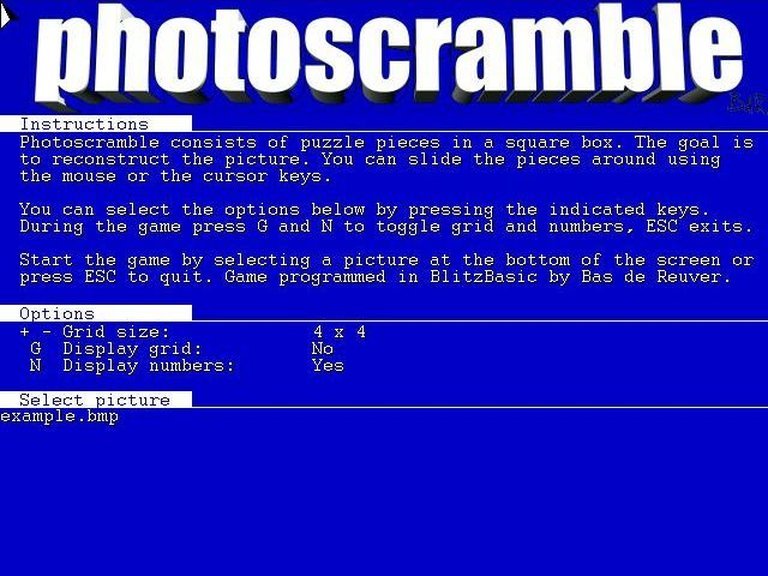
Photoscramble is a freeware sliding block puzzle game released in 2002 for Windows. Players can use any .bmp image to create puzzles ranging from a 3×3 grid to a 15×15 grid, making it a customizable and engaging single-player experience. The game was programmed by Bas de Reuver and is known for its turn-based, direct control interface.
Photoscramble: Review
A Hidden Gem of Customizable Puzzles in the Early 2000s Indie Scene
Introduction
In the shadow of blockbuster franchises like Grand Theft Auto and Halo, the early 2000s also birthed modest, experimental titles that sought to personalize the gaming experience. Photoscramble (2002), a freeware sliding-block puzzle game by Dutch developer Bas de Reuver, is one such hidden artifact. Designed for Windows, this minimalist title allowed players to transform their own photos into playable puzzles—a novel concept at the time. While lacking the polish and fanfare of its contemporaries, Photoscramble carved a niche as a charming, user-driven diversion. This review explores how its simplicity and customization options hinted at a future where player agency and indie experimentation would flourish.
Development History & Context
Photoscramble emerged during a transitional era for PC gaming. The early 2000s saw major studios investing in 3D graphics and cinematic storytelling, while freeware developers like de Reuver leveraged accessible tools like Blitz Basic to experiment with niche ideas. As the sole programmer, de Reuver focused on modular design: the game could adapt any .bmp image into a puzzle, with grid sizes ranging from 3×3 to 15×15.
This DIY ethos aligned with the burgeoning freeware scene, where small-scale projects thrived outside commercial pressures. However, Photoscramble faced stiff competition from flashier titles, including Tetris clones and browser-based puzzles. Its lack of marketing and reliance on word-of-mouth limited its reach, but for those who discovered it, the game offered a unique value proposition: personalized gameplay.
Narrative & Thematic Deep Dive
As a puzzle game, Photoscramble lacks a traditional narrative. Instead, its “story” is defined by the player’s choices. By importing personal photos—whether family portraits, vacation snapshots, or abstract art—users imbue the game with emotional resonance. Completing a puzzle becomes an act of rediscovery, as scrambled fragments coalesce into familiar images.
Thematically, the game celebrates creativity and ownership. Unlike pre-designed puzzles, Photoscramble hands authorship to the player, foreshadowing later trends in user-generated content (e.g., Super Mario Maker). This approach also carries a subtle meta-commentary: life, like a puzzle, is a collage of fragmented moments waiting to be reassembled.
Gameplay Mechanics & Systems
Core Loop
The objective is straightforward: rearrange tiles to reconstruct the original image. Players click adjacent tiles to swap them, using a trial-and-error approach. The difficulty scales with grid size, making the game accessible to casual players while offering depth for enthusiasts.
Innovations
- Custom Image Support: The ability to use personal photos was revolutionary for its time, predating modern apps like Jigsaw Puzzle Dreams.
- Adjustable Grids: Flexible sizing catered to varying skill levels.
Flaws
- Limited Features: No undo button, timers, or scoring systems.
- UI Sparsity: The barebones interface feels utilitarian, lacking visual flair.
Controls
Keyboard-only inputs feel archaic by today’s standards, but they reflect the game’s minimalist ethos.
World-Building, Art & Sound
Photoscramble’s “world” is whatever the player envisions. The absence of predefined art or music shifts focus to the user’s creations, resulting in a deeply intimate experience. However, this also highlights the game’s technical limitations:
– Visuals: Pixelated rendering struggles with high-resolution images.
– Sound: No audio feedback diminishes immersion.
Despite these shortcomings, the game’s reliance on personal imagery fosters a unique emotional connection rarely seen in puzzle titles of its era.
Reception & Legacy
No critical reviews or sales data exist for Photoscramble, underscoring its obscurity. Yet its legacy lies in pioneering customization—a concept later embraced by indie darlings like Infinite Canvas and The Gardens Between. While Bas de Reuver’s other projects (e.g., Blitz Basic demos) remained similarly under the radar, Photoscramble stands as a testament to the creativity of early-2000s hobbyist developers.
Conclusion
Photoscramble is neither a masterpiece nor a footnote. It occupies a middle ground: a quaint, inventive experiment that empowered players to redefine the puzzle genre on their own terms. Today, it serves as a reminder of gaming’s grassroots potential—where a single developer, armed with rudimentary tools, could craft something uniquely personal. For collectors of oddities and puzzle aficionados, it remains a worthwhile curiosity. For everyone else, it’s a fascinating relic of indie gaming’s nascent years.
Final Verdict: Photoscramble is a charming, if unpolished, time capsule—a game that dared to ask, “What if the puzzle was you all along?”