
- Release Year: 2014
- Platforms: Windows
- Publisher: Arvi Teikari
- Developer: Arvi Teikari
- Genre: Action
- Perspective: Diagonal-down
- Game Mode: Single-player
- Gameplay: Arcade
- Average Score: 84/100
Description
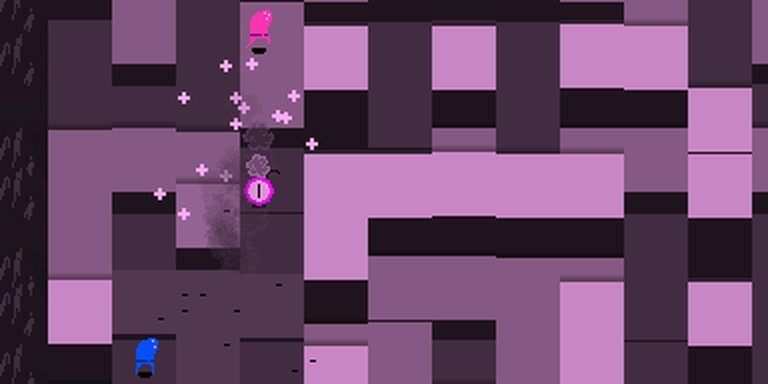
Pilari is a fast-paced 2D arcade action game released in 2014 for Windows, featuring competitive two-player deathmatches with destructible terrain. Players battle using bombs—both standard and powerful charged variants—to destroy environments and launch themselves toward opponents to deal damage. Developed by Arvi Teikari using Multimedia Fusion 2, the game emphasizes direct controls and chaotic multiplayer fun, blending strategic bomb placement with dynamic platforming mechanics.
Pilari Reviews & Reception
verticalslicegames.com (98/100): Critics Recommend
Pilari: An Arcade Anomaly of Physics and Fury
In the crowded pantheon of indie multiplayer experiments, Pilari (2014) stands as a forgotten curio — a bomb-fueled, hotseat brawler born from a 48-hour game jam that dared to ask: “What if Pong had terrain destruction and rocket-jumping?” Developed solo by Finnish polymath Arvi “Hempuli” Teikari, whose later works like Baba Is You would redefine puzzle design, Pilari remains a fascinating footnote in the evolution of local multiplayer chaos. This review excavates its minimalist brilliance, technical constraints, and why this asymmetrical bomberman-parkour hybrid still deserves a cult audience.
Development History & Context: The No More Sweden Crucible
Studio & Vision:
Born during the No More Sweden 2014 game jam, Pilari exemplified the Scandinavian indie ethos of “mechanic-first” design. Arvi Teikari — operating as a one-man-army pre-Environmental Station Alpha acclaim — sought to create “a two-player deathmatch with bombs and destructible terrain” using accessible tools. Eschewing narrative pretense, the title (Finnish for “Pillar”) refers to the game’s dynamic verticality. As Teikari later admitted, the goal was strictly “janky fun” — a rapid prototype testing physics-driven improvisation.
Technological Constraints:
Built in Clickteam Fusion 2.5, Pilari leveraged the engine’s 2.5D capabilities for destructible tilemaps. Hardware limitations of 2014-era PCs dictated lo-fi visuals: chunky pixel art (likely 320×240 resolution) and procedurally generated sound effects via sfxr, creating a deliberately retro aesthetic. The absence of networking code — intentional due to jam time constraints — cemented its identity as a sofa-competitive experience, nostalgically channeling pre-Xbox Live Mario Kart sessions.
2014 Gaming Landscape:
Released July 20, 2014, Pilari emerged during a gold rush of indie MP experiments. That same year saw Nidhogg (dueling fencing) and TowerFall Ascension (archery arena) refine local versus chaos. Yet Pilari’s physics-goofiness aligned closer to Gang Beasts’ slapstick — a delightful antithesis to AAA’s cinematic obsessions. Teikari’s wry self-deprecation (“forgotten among my other games”) undersells its significance: Pilari reflects indie devs’ freedom to explore interactions too bizarre for boardrooms.
Narrative & Thematic Deep Dive: Silence as Statement
Plot & Characters:
Pilari is gloriously anti-narrative. Two unnamed, monochromatic sprites (distinguished solely by Player 1/2 hues) battle in abstract voids dotted with floating platforms. No backstory, no princesses to rescue — pure ludic abstraction. This minimalism sharpens focus: players project personalities onto avatars (Is the red blob a vengeful anarchist? Is blue a stoic tactician?), turning each match into emergent theater.
Thematic Resonance:
In its refusal to justify conflict, Pilari becomes an unintentional commentary on gaming’s competitive id. Thematic weight emerges via mechanics as metaphor:
– Destructible Terrain: Victory demands reshaping the battlefield — an allegory for adaptability.
– Bomb Charging: Holding Q/Control to “overload” explosives introduces risk/reward tension.
– Collateral Launches: Accidentally blasting oneself mirrors real-world overconfidence.
Teikari’s anarchic sandbox echoes existentialism: we create meaning through action, not exposition.
Gameplay Mechanics & Systems: Controlled Chaos
Core Loop:
Matches unfold in best-of rounds where players (using WSAD/Arrow keys) maneuver to drop bombs (Q/Control) that:
1. Destroy terrain, creating new pathways.
2. Propel fighters via knockback — direct contact with foes deals damage.
3. Overloaded via charge mechanic (holding the bomb key) for delayed, high-yield blasts, disable simultaneous detonations.
Innovations & Flaws:
– Rocket Jumping 2.0: Using bomb explosions to launch oneself toward opponents rewards Newtonian creativity. A well-timed diagonal blast becomes a kamikaze lunge.
– Strategic Depth: Limiting players to two active bombs encourages tactical spacing — trapping foes becomes chess with dynamite.
– Jank as Feature: Collision detection quirks and floaty physics (due to Fusion 2.5’s limitations) create slapstick unpredictability.
UI/Control Issues:
– Hotseat Growing Pains: Lacking online play limits accessibility post-2014.
– Input Conflict: Shared keyboard controls (Player 1: Arrows/Shift/Ctrl, Player 2: WSAD/Tab/Q) spark accidental “friendly fire” button presses.
– No Tutorial: First-time players fumble bomb charging mechanics.
World-Building, Art & Sound: Jam-Band Aesthetics
Visual Direction:
Pilari’s art — crafted in MS Paint-tier sprites — embraces “deliberately ugly” charm. Neon characters (red vs. blue) clash against gradient backdrops ranging from sulfurous yellows to void-like blacks. Destructible blocks shatter into satisfying pixel shrapnel, while knockback animations exude weightless absurdity.
Atmosphere:
The game channels arcade-id energy — a neon-drenched fever dream between Bomberman’s simplicity and Super Smash Bros.’ kineticism. Abstract arenas (lacking even HUDs) focus attention on kinetic improvisation.
Sound Design:
Sfxr-generated blips — crunchy explosions, tinny jump effects — mirror Game Boy-era minimalism. Silence dominates otherwise, amplifying bomb blasts as narrative punctuation.
Reception & Legacy: Obscurity’s Shadow
Launch Reception:
No formal reviews exist — unsurprising for a free jam-game. Player impressions praised its “physics-based insanity” but lamented sparse content (no AI, two maps). MobyGames’ incomplete entry (“No MobyScore… Wanted: Description”) underscores its obscurity.
Retrospective Re-Evaluation:
Modern analysis positions Pilari as a cult object in Teikari’s oeuvre — a prototype for his later mastery of systems-driven design (Baba Is You’s rule-breaking). Its DNA resurfaces in:
– Heave Ho (2019): Collaborative physics slapstick.
– Boomerang Fu (2020): Local MP mayhem.
– Duck Game (2014): Shared anarchic spirit.
Though uncredited, Pilari’s “bomb propulsion” mechanic prefigured Fortnite’s impulse grenades and Rocket League’s ballistic aerial play.
Conclusion: A Janky Time Capsule Worth Excavating
Verdict:
Pilari isn’t a “great” game by conventional metrics. Limited scope, technical jitters, and no online support anchor it to 2014. Yet as a raw artifact of indie audacity, it shines. Between its risk-reward bomb mechanics and emergent physical comedy, this 16mb experiment distills the joy of creation unchained by market pressures. Teikari would refine his craft — but here, in this forgotten jam submission, lies the spark that ignited a puzzle-iconoclast.
Play it at LAN parties. Embrace the chaos. And remember: some pillars hold up cathedrals; others are just fun to blow up.
Final Score: ☆☆★★★ (2.5/5) — Imperfect, but historically vital. A must-play for indie archivists.
[Download *Pilari for free on Hempuli’s website. Requires local friend.]*