
- Release Year: 2010
- Platforms: Linux, Macintosh, Windows
- Publisher: Octoshark Studios
- Developer: Octoshark Studios
- Genre: Action
- Perspective: First-person
- Game Mode: Online PVP
- Gameplay: Blocking, Melee Combat, Parrying, Ranged options, Special abilities
- Setting: Caribbean, Medieval, Sea pirates
- Average Score: 100/100
Description
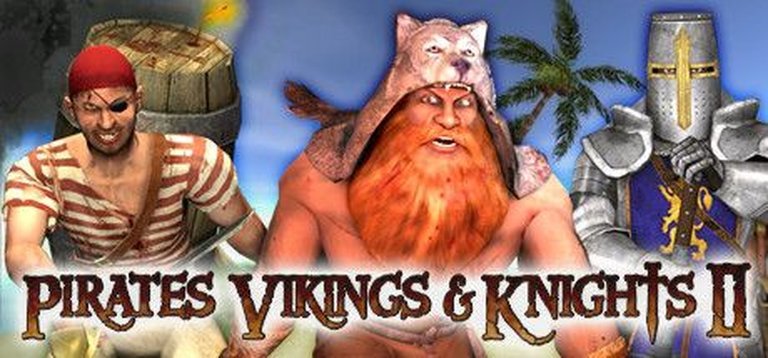
Pirates, Vikings & Knights II is a multiplayer first-person action game where players join one of three themed teams—Pirates, Vikings, or Knights—to compete in objective-based PvP battles across diverse environments inspired by medieval castles, Caribbean islands, ancient temples, and snowy landscapes. With class-specific abilities, directional melee combat involving strikes, blocks, and parries, and modes like Booty, Territory, and Team Deathmatch, the game emphasizes tactical three-way conflicts rooted in glory, treasure, and dominance, developed from a long-running mod into a full release.
Gameplay Videos
Where to Buy Pirates, Vikings & Knights II
PC
Pirates, Vikings & Knights II Mods
Pirates, Vikings & Knights II Guides & Walkthroughs
Pirates, Vikings & Knights II Reviews & Reception
metacritic.com (100/100): An amazing hidden gem !
Pirates, Vikings & Knights II Cheats & Codes
PC
Enter these console commands in the game console to set up auto-jump.
| Code | Effect |
|---|---|
| alias j1 “+jump; wait 70; -jump; wait 10; j2;” alias j2 “wait 10; j1;” bind v j1 |
Enables automatic jumping when the V key is pressed. |
Pirates, Vikings & Knights II: The Unlikely Sovereign of Chaotic Melee
In the vast, often-fleeting landscape of multiplayer mods and community-driven games, few stories are as improbable or as enduring as that of Pirates, Vikings & Knights II. To understand its place in history is to understand a rare artifact: a total conversion mod that not only survived the volatile ecosystem of the Source engine but actively evolved within it for nearly eighteen years, finally emerging from its “permanent beta” status only in 2025. It is a game built on a premise of gleeful absurdity—Caribbean buccaneers clashing with Norse berserkers and plate-armored knights—yet beneath its silly surface lies one of the most mechanically nuanced, skill-rewarding, and frankly revolutionary melee combat systems ever implemented in a first-person shooter. This review will argue that PVKII is not merely a beloved curio but a pivotal, if under-acknowledged, stepping stone in the evolution of class-based, objective-driven PvP combat. Its legacy is twofold: as a masterpiece of modding tenacity and as a precursor to the tactile, direction-aware combat that would later define games like Chivalry: Medieval Warfare and For Honor.
1. Introduction: An Absurd Premise, A Lasting Foundation
The thesis is simple yet profound: Pirates, Vikings & Knights II is a game whose historical significance vastly outweighs its mainstream recognition. It took the chaotic,Three-way team fight concept of its obscure GoldSrc predecessor and transmuted it through the potent capabilities of Valve’s Source engine into a deeply systematic, remarkably balanced, and endlessly replayable competitive experience. Its genius lies in the marriage of a proudly ridiculous theme—” rampant silliness and absurd title,” as PC Gamer UK noted—with a combat engine of surgical precision. The game’s journey from aJanuary 2007 beta to its August 2025 1.0 release is a saga of community passion, technological adaptation, and a steadfast refusal to abandon a radical idea. This review will dissect how its development history shaped its design, how its mechanics created a unique skill ceiling, and why its warm, chaotic heart continues to beat in the Steam Workshop and dedicated servers of a fiercely loyal player base.
2. Development History & Context: The Mod That Wouldn’t Die
Origins and the “Maidens and Mayhem” Interlude
The story begins not with PVKII, but with its predecessor. The original Pirates, Vikings and Knights was a GoldSrc mod created by three UC Berkeley students. As the PVKII Wiki reveals, an immediate attempt to remake it on the incoming Source engine, titled Pirates, Vikings and Knights: Maidens and Mayhem, faltered. The project was abandoned in the face of the new technology, but its dream persisted. Many of those developers migrated to a proper sequel, recognizing the Source SDK’s potential for a total conversion.
The Source Engine Crucible (2006-2010)
Development on PVKII proper began around 2004-2006, immediately following the release of Half-Life 2 and its SDK. The team—a small, distributed collective credited with 150 people across art, programming, and design—built almost everything from scratch: models, textures, animations, and a custom combat system layered atop the Source framework. The first public beta dropped on January 1, 2007, featuring just three foundational classes: the Pirate Skirmisher, Viking Berserker, and Knight Heavy Knight. This bare-bones launch was a proof-of-concept for the core melee paradigm.
The Beta 2.0 release on February 7, 2008 was a watershed moment. It added three new classes (Pirate Captain, Viking Huscarl, Knight Archer), fundamentally reworked the melee system to be more responsive, and introduced new maps and modes. This update drew significant coverage from outlets like PC Gamer UK and IGN’s Planet Half-Life, which praised the “well polished and balanced” experience and “awe inspiring visuals” achieved on the Source engine.
Steamworks Integration and the Long Tail (2008-2025)
A pivotal strategic move came on October 14, 2008: the team announced version 2.3 would migrate to the then-new Orange Box version of the Source engine, unlocking advanced graphical effects. Crucially, it would be integrated into Steamworks, allowing seamless distribution and patching directly through Steam. The game officially launched on Steam in February 2010, though it retained its “beta” moniker. This period saw the addition of voice acting (a major production value bump), the Sharpshooter and Man-at-Arms classes, and continued community map support. However, as the PVKII Wiki candidly notes, development slowed as core members faced real-world commitments. PVKII became a celebrated “part-time project,” known for long gaps between updates. This very fact—survival through sheer community love and iterative, volunteer effort—is central to its legend.
The 1.0 Milestone: Culmination or Catharsis?
The announcement of version 1.0 on August 8, 2025, after 6,500+ days, was therefore seismic. It was not a commercial launch but a ceremonial completion. The update added the long-awaited fourth Pirate class, the Buccaneer, alongside new maps, modes, balance passes, and the formal end of the beta label. The developers dedicated the release to a fallen team member, ZeroTron, framing it as a tribute as much as a technical milestone. The 1.0 release was the mod’s final, definitive statement, cementing a roster of 12 classes and a suite of mature features after a development cycle longer than most entire game franchises.
3. Narrative & Thematic Deep Dive: Lore of an Anachronistic Free-For-All
PVKII’s narrative is deliberately threadbare, existing primarily as a playful justification for its anachronistic warfare. There is no overarching campaign or story mode. Instead, lore is conveyed through environmental storytelling and flavor text.
The Cursed Chest & The Captain’s Log
The most substantial narrative piece is the “Captain’s Log” on the PVKII Wiki. It details the history of a mysterious, cursed treasure chest—stolen from a Northumbrian monastery by Vikings in 793 AD, later appearing in King John’s treasury, and now lost at sea in 1717. This log frames the in-game “Booty” mode’s objective (capturing treasure chests) as a centuries-old struggle for this artifact. It imbues the silly combat with a ghost of epic, cross-temporal stakes. The chest’s curse explains why otherwise honorable knights, brutal Vikings, and pragmatic pirates would all murderously pursue it.
Thematic Tension: Absurdity vs. Authenticity
The game’s core theme is a deliberate cognitive dissonance. On one hand, it presents itself with a straight face: historically-inspired armor, accurate weapon types (cutlasses, bearded axes, longswords), and environments (snowy Viking forts, tropical pirate coves, medieval keeps). On the other, it revels in pure cartoon chaos. The Viking Berserker enters a bloodlust, the Knight Man-at-Arms’ special attack is flatulence, the Pirate Captain commands a parrot that pecks enemies, and the Assassin can see through walls. This juxtaposition creates a unique tone: a “cathartic fun” experience, as user reviews often state, where the gravitas of medieval combat is undercut by ridiculous special effects. The theme is not historical accuracy, but historical whimsy—a playground where the aesthetics of the past collide with the logic of a Saturday morning cartoon.
4. Gameplay Mechanics & Systems: The Precision Behind the Pandemonium
This is PVKII‘s true monument. Its systems are a masterclass in deep, accessible design that prioritizes player skill and team synergy.
Core Combat: The Directional Paradigm
The game’s signature innovation is its gesture-based melee system. Unlike the simple left-click swings of most FPS games of its era, PVKII required players to move the mouse in a specific direction before clicking to determine the strike arc (overhead, horizontal, thrust). Correspondingly, blocking and parrying involved moving the mouse in the opposite direction of an incoming attack at the moment of impact.
* Parry: A perfectly timed, directional block against a melee attack staggers the attacker, leaving them vulnerable. This created a high-skill “rock-paper-scissors” moment: feint, parry, riposte.
* Shield Blocking: Classes with shields (Huscarl, Heavy Knight) could simply hold right-click to absorb frontal damage, trading precision for security.
* Charge Attacks: Holding left-click charged a swing for more damage and reach but left the player immobile, creating a risk-reward dynamic.
This system, as the PVKII Wiki states, made PVKII “among the earliest known examples of in-depth hand-to-hand combat,” predating Age of Chivalry by over six months. It demanded spatial awareness, prediction, and manual dexterity, turning every skirmish into a tense, physical chess match.
Class Design: Asymmetric Balance and Rock-Paper-Scissors
The 12-class roster (finalized in 2025) is a study in elegant asymmetry. Each team has a distinct strategic identity:
* Pirates: Gadgeteers and skirmishers. High mobility, ranged firepower (pistols, blunderbusses, rifles), and disruptive tools (parrots, kegs, grappling hooks). They excel at harassment and picking off isolated targets.
* Vikings: Brute force and resilience. Slow but devastating two-handed axes, powerful shields, and innate toughness (Berserker bloodlust). They dominate sustained frontal engagements.
* Knights: Balanced specialists. The Heavy Knight is the tank, the Archer the dedicated ranged, the Man-at-Arms and Assassin are agile, hit-and-run fighters. They are the most versatile but lack the extreme specializations of the other teams.
Every class has a Special Ability (often called an “ultimate”) that charges by dealing/receiving damage. These are game-changers: the Captain’s explosive cannonball, the Bondi’s volley of exploding arrows, the Assassin’s wall-hack and instant kill. This design encourages aggressive play to build charge, creating cyclical tension between using the ability for impact and conserving it for a crucial moment.
Game Modes: Objective Diversity
The variety of modes prevents monotony and tests different team skills:
* Booty (Capture the Flag): The flagship mode. Teams steal chests and defend them in a base zone. More chests held accelerate the capture timer, creating frantic multi-front battles.
* Territory (King of the Hill): A pure control-point struggle emphasizing area denial and stacked pushes.
* Objective Push: Map-specific goals (e.g., pushing a cart, destroying a structure), adding narrative context to the fighting.
* Trinket Wars: A “infection” style mode where only the trinket-holder scores, creating a constant, high-value assassination target.
* Competitive: The 2v2/3v3/4v4 format, stripping the game down to pure, balanced team combat, highlighting the core mechanics.
Innovations and Flaws
* Innovations: The seamless integration of ranged and melee is exceptional. Ranged attacks are powerful but leave users vulnerable to melee rushes, and shields can block projectiles. This creates a constant tactical interplay. The “rock-paper-scissors” class balance—Pirate gadgets beat Viking brute force, Viking strength breaks Knight formations, Knight versatility counters Pirate trickery—holds up remarkably well for a community-balanced game.
* Flaws: The game’s greatest weakness is its new player experience. The tutorial is minimal, and the depth of the melee system is opaque. A new player will die repeatedly without understanding why—was it a parry they didn’t see? A feint? A class mismatch? This steep cliff contributes to the low player counts cited in many modern reviews and VaporLens analysis. Additionally, some class specials (notably the Man-at-Arms’ fart) are gimmicky and feel out of place against the otherwise grounded combat. Balance has also been a perennial issue, with periodic reworks acknowledging certain classes being over- or under-powered.
5. World-Building, Art & Sound: A Source Engine Gem
Visual Design and Atmosphere
For a 2007 mod running on the 2004-era Source engine (later updated), PVKII was consistently praised for its visual fidelity. IGN’s review highlighted its “awe inspiring visuals” and “fantastic” models. The art style strikes a perfect balance: character models are exaggerated but not cartoony; armor is detailed, weapons are textured and weighty. Environments are the true stars. Maps like “Temple” (Aztec ruins), “Norway” (snowy fjord with longboats), “Caribbean” (tropical beaches and ports), and “Castle” (detailed stone fortifications) are not just backdrops but carefully chokepointed arenas designed for the game modes they host. The use of the Source engine’s lighting and particle effects (fire, smoke, explosions) gives battles a visceral, smoky quality. The 2025 1.0 update added “enhanced animations,” smoothing out the somewhat stiff 2007-era movements.
Sound Design: The Soul of Chaos
The sound design is integral to the feedback loop and comedic tone.
* Weapon Impacts: Swings have a satisfying whoosh and thwack, parries a sharp clang. The weight of a Viking axe versus the snap of a pirate’s flintlock is distinct.
* Character Voices: Each class has a suite of taunts, battle cries, and death sounds. The Viking’s roar, the Knight’s medieval “huzzah,” the Pirate’s “yarrr” are iconic. The addition of full voice acting in a post-Steam update greatly enhanced this.
* The Parrot: This is not just a gimmick; it’s a sonic landmark. The Pirate Captain’s parrot squawking and pecking is instantly recognizable and, as PC Gamer UK famously quipped, “in hot competition with the gravity gun for best video game weapon ever.” It provides crucial audio feedback for a disruptive tool.
* Music: As IGN noted, the soundtrack features “some of the best mood setting music to be had in a video game.” It dynamically shifts between tense, drum-heavy Viking themes, swashbuckling pirate melodies, and solemn knightly chants, perfectly underscoring the anachronistic conflict.
6. Reception & Legacy: Cult Classic and Mechanical Trailblazer
Contemporary Reception (2007-2010)
Critical reception was consistently positive, focusing on its originality and polish for a mod. Mod DB called it “fun and imaginative” with a “colorful, vivid graphical style,” though early criticism noted “repetitive and shallow” melee that would be addressed in Beta 2.0. PC Gamer UK and IGN’s reviews of the 2008 update were effusive, praising the redesigned melee system’s “potential” and the game’s overall “well polished and balanced” state. Player uptake was significant, with over 6.5 million player minutes per month on Steam by February 2008, a massive figure for a non-Valve mod.
Long-Term Reputation and Player Scores
Its reputation has only solidified over time. On Steam, it holds a “Very Positive” rating (88%) from over 6,100 reviews. User consensus repeatedly highlights: “enduring fun,” “deep combat,” “perfect for when you just want to mess around,” and “one of the greatest Half-Life 2 mods to date.” The primary criticisms, mirrored on sites like VaporLens and Metacritic, are the chronic update delays and the resulting small, dying server populations. As one Metacritic user succinctly stated: “Only real problem I have with the game is how long the developing team takes to put out updates.”
Industry Influence: The Quiet Pioneer
PVKII‘s influence is subtle but profound. It stands as a direct mechanical predecessor to several landmark titles:
1. Chivalry: Medieval Warfare (2012): Developed by the same studio (Torn Banner) that created Age of Chivalry, itself a Source mod inspired by PVKII‘s melee. Chivalry‘s directional attacks, momentum-based swings, and class-based objective play are a direct evolution of the systems PVKII pioneered in 2007.
2. For Honor (2017): While far more complex, For Honor‘s entire “rock-paper-scissors” guard stance combat system—reading opponents, directional blocking/attacking—echoes the foundational principles PVKII established a decade prior. The three-faction setup (Samurai, Vikings, Knights) also feels like a conscious, evolved homage.
3. The class-based, objective-driven FPS genre owes a debt to PVKII‘s successful fusion of Team Fortress 2‘s class roles with a focused, skill-based melee combat layer, all within a three-team ecosystem that prevented stalemates.
It demonstrated that a mod could sustain a dedicated community for over a decade, proving the viability of long-term, passion-project development on a major game engine.
7. Conclusion: A Flawed Masterpiece Forged in the Fires of Modding
Pirates, Vikings & Knights II is a paradox. It is a game born of absurdity that demanded serious skill. It was a technical showcase trapped in the beta label for 18 years. It is extolled as a classic by thousands yet struggles to fill a single server.
Its definitive verdict is this: it is the most influential melee combat mod ever made, a critical link in the chain connecting Quake‘s arena combat to the tactical fencing of For Honor. Its systems—directional attacks, parries, class specials, and three-way objectives—were not merely copied but became vocabulary for later designers. The 2025 1.0 release is not a rebirth but a formal canonization of a beloved text.
The flaws are undeniable: the new player barrier is immense, the graphical sheen has aged (though the art direction remains charming), and the update schedule was a source of justified frustration. Yet, to play PVKII even today is to engage with a combat engine of remarkable purity. The clang of steel, the thud of an axe, the squeak of a parrot, the roar of a crowd as a Berserker carves through a line of Knights—these moments are timeless. It is a testament to the power of a clear, compelling vision pursued relentlessly by a community. Pirates, Vikings & Knights II is more than a game; it is an 18-year-long argument for the artistic and historical value of the multiplayer mod, and it won that argument with every parry, every captured chest, and every player who, against all odds, kept coming back for more. It is, and will likely remain, the undisputed king of chaotic, three-way, historically-adjacent mayhem.