
- Release Year: 2014
- Platforms: Linux, Macintosh, Windows
- Publisher: Nordic Games GmbH
- Genre: Special edition
- Game Mode: Online PVP, Single-player
- Average Score: 63/100
Description
Planetary Annihilation (Collector’s Edition) is a real-time strategy game set across procedurally generated planetary systems, where players command armies to conquer multiple worlds, defend territories, and even weaponize asteroids or destroy entire planets. Developed by industry veterans behind Total Annihilation and Supreme Commander, the game features large-scale battles, resource management, and multi-front warfare, with matches ranging from quick skirmishes to epic, multiplayer conflicts spanning entire solar systems.
Planetary Annihilation (Collector’s Edition) Patches & Updates
Planetary Annihilation (Collector’s Edition) Mods
Planetary Annihilation (Collector’s Edition) Guides & Walkthroughs
Planetary Annihilation (Collector’s Edition) Reviews & Reception
metacritic.com (62/100): Overall this game does what it set out to do, and it does it well, giving both veterans of the series and new players a chance to experience some of the original magic of Total Annihilation, while keeping it fresh and extensive enough to create new battles and new war stories on a galactic scale to tell around the Real-Time Strategy campfire.
ign.com : Planetary Annihilation’s biggest problem is one of usability – and not the manageable one that comes along with being a spiritual successor to Total Annihilation and Supreme Commander, which are both large-scale real-time strategy games with complex economies.
spacesector.com : Planetary Annihilation harkens back to the style of RTS such as Total Annihilation and Supreme Commander, and even some of the original developers of Total Annihilation are present in the development team of Planetary Annihilation.
thehyperbolicgamer.com (65/100): Planetary Annihilation is among the first and second generation of highly successful Kickstarter games to achieve official release status. Unfortunately, unlike it’s generational peer Divinity: Original Sin, I find myself wishing they didn’t release yet.
Planetary Annihilation (Collector’s Edition): A Monumental Yet Flawed Masterpiece of Scale and Strategy
Introduction: The Promise of Galactic Conquest
Planetary Annihilation (Collector’s Edition) is a game that dares to dream on a cosmic scale. Released in 2014 by Uber Entertainment—a studio founded by veterans of Total Annihilation and Supreme Commander—it promised to redefine the real-time strategy (RTS) genre by expanding the battlefield from mere continents to entire solar systems. The Collector’s Edition, a lavish physical and digital package, arrived as both a celebration of this ambition and a testament to the game’s tumultuous development journey. Yet, beneath its grand vision lies a title that is as frustrating as it is fascinating—a game that pushes the boundaries of scale but stumbles in execution, leaving players to grapple with its brilliance and its flaws in equal measure.
This review will dissect Planetary Annihilation in exhaustive detail, exploring its development history, narrative depth (or lack thereof), gameplay mechanics, artistic direction, critical reception, and lasting legacy. By the end, we will determine whether this game is a bold evolution of the RTS genre or a cautionary tale of ambition outpacing polish.
Development History & Context: A Kickstarter Odyssey
The Birth of a Vision
Planetary Annihilation was conceived as a spiritual successor to Total Annihilation (1997) and Supreme Commander (2007), two games that redefined large-scale RTS gameplay. The project was helmed by Jon Mavor, who had previously worked as the lead programmer on Supreme Commander and the graphics engine developer for Total Annihilation. Mavor’s vision was clear: to create an RTS where battles could span entire solar systems, with players commanding armies across multiple planets, moons, and asteroids. The game’s art direction, led by Steve Thompson (another Total Annihilation and Supreme Commander veteran), embraced a low-poly, “boxy” aesthetic that evoked the retro-futurism of classic sci-fi.
The game’s development began in earnest around 2009, but it wasn’t until August 2012 that Uber Entertainment revealed Planetary Annihilation to the public. Rather than seeking traditional investor funding, the studio turned to Kickstarter, launching a campaign with a modest goal of $900,000. The pitch was simple: a next-generation RTS that would allow players to wage war on a planetary scale, with features like procedural planet generation, orbital combat, and the ability to weaponize celestial bodies.
The Kickstarter Phenomenon
The Kickstarter campaign was a resounding success. Within five days, the project had raised $450,000, and by the campaign’s conclusion on September 14, 2012, it had amassed over $2.2 million from Kickstarter backers, with an additional $101,000 raised via PayPal. This made Planetary Annihilation the 11th Kickstarter project to surpass $1 million, a milestone that underscored the pent-up demand for a true successor to Total Annihilation.
The campaign’s stretch goals were equally ambitious. At $1.1 million, naval units and water-heavy planets were unlocked. At $1.3 million, gas giants and orbital platforms were added. At $1.5 million, metal planets—capable of being transformed into planet-killing superweapons—were introduced. The $1.8 million goal unlocked the “Galactic War” mode, a meta-campaign where players could conquer star systems, while the $2 million goal secured a full orchestral soundtrack. The final stretch goal, at $2.1 million, promised a behind-the-scenes documentary.
The Road to Release: Early Access and Delays
The development process was marked by transparency and community engagement. Alpha access was granted to high-tier backers in June 2013, followed by a Steam Early Access release later that month. The beta phase began in September 2013, with all Kickstarter backers gaining access by November. However, the road to the full release was not smooth. The game’s original launch window was pushed back to early 2014, and when it finally released on September 5, 2014, it was met with mixed reactions.
One of the most significant challenges was the game’s technical performance. Despite the studio’s claims that the engine could support up to one million active units, players reported severe slowdowns during large-scale battles, especially in late-game scenarios. The lack of a single-player campaign and the absence of a proper tutorial further exacerbated frustrations. Many critics and players felt that the game had been rushed to market, with core features either missing or underdeveloped.
The Collector’s Edition: A Physical Tribute
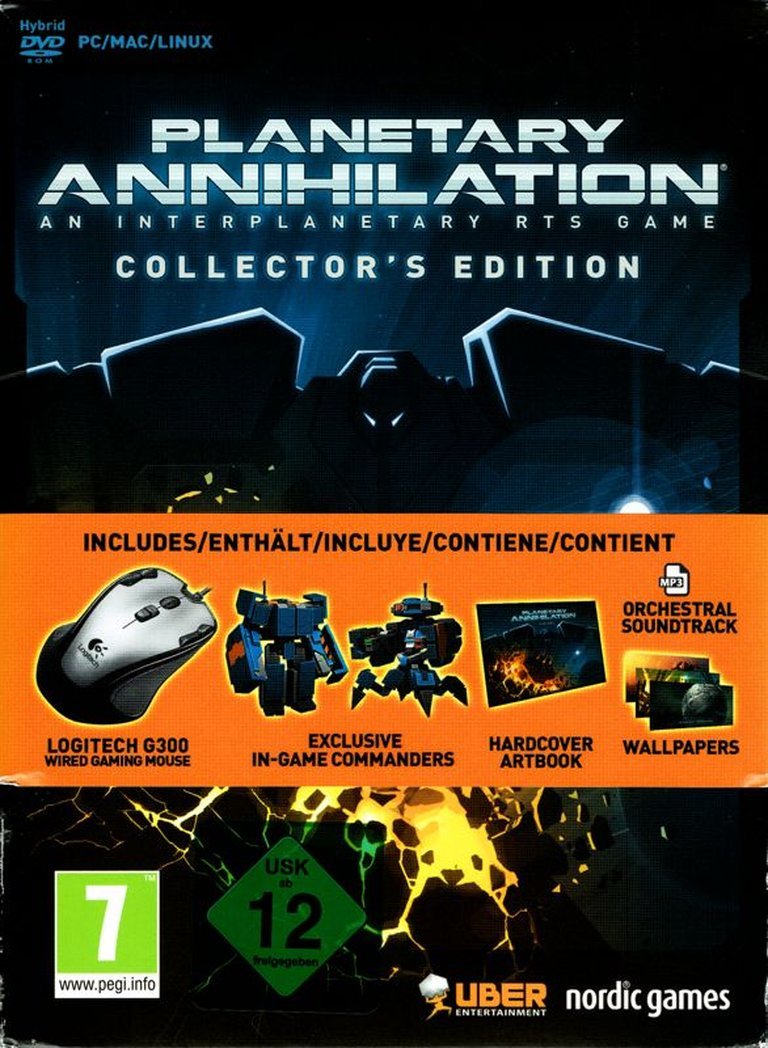
The Planetary Annihilation (Collector’s Edition), released on September 30, 2014, was a physical tribute to the game’s Kickstarter roots. Published by Nordic Games GmbH, the package included:
- A European boxed version of the main game, complete with the soundtrack and an online key to unlock the “Gamma” commander.
- A hardcover artbook showcasing the game’s distinctive visual style.
- A Logitech G300 Wired Gaming Mouse, branded for the game.
- An additional online key to unlock the “Galyx” commander.
This edition was a nod to the game’s backers, many of whom had invested heavily in the project’s success. It also reflected the studio’s commitment to delivering a premium experience, even as the game itself struggled to meet expectations.
Post-Launch Evolution: Titans and Beyond
In August 2015, Uber Entertainment released Planetary Annihilation: Titans, a standalone expansion that addressed many of the base game’s shortcomings. Titans introduced 21 new units, including five massive “Titan” class units, as well as multi-level terrain, a bounty mode, and an improved tutorial. The expansion was gifted for free to original Kickstarter backers, a gesture that underscored the studio’s gratitude to its early supporters.
In 2018, the rights to Planetary Annihilation and Titans were acquired by Planetary Annihilation Inc., a new company formed by original developers and Kickstarter backers. Under this new stewardship, the game continued to receive updates, balance changes, and seasonal events. The original Planetary Annihilation was delisted from Steam in September 2018, with Titans becoming the definitive version of the game.
Narrative & Thematic Deep Dive: The Hollow Core of a Cosmic War
The Excuse Plot: A Thin Veneer of Lore
Planetary Annihilation is not a game driven by narrative. Unlike its spiritual predecessors, which featured faction-based storytelling (Total Annihilation‘s ARM vs. CORE, Supreme Commander‘s UEF vs. Cybrans vs. Aeon), Planetary Annihilation offers little in the way of a cohesive plot. The game’s official description provides a cryptic backstory:
“Did I have a name? Yes, that I did remember. I was designated as Dominus. I struggled to repair parts of my memory core that would tell me more, but I soon discovered it would take more than a few nanoseconds to do so. In the meantime, I began to explore the world I found myself on. It was not long until I found others like myself. I repaired and reactivated those that I could, but there were far more that could not be saved. Those that could be helped were able to access memories that I could not or simply did not have. Some kind of battle had taken place here long ago, judging by chemical analysis readings of the air and soil that showed traces of artificial radioactive isotopes. That meant nuclear detonation.”
This fragmentary lore suggests a post-apocalyptic scenario where ancient robotic commanders, abandoned after a long-forgotten war, have reactivated and resumed their conflict. The game’s factions—initially placeholder names like “Pax Machina,” “Legonis Machina,” “The First Empire,” and “Imperium”—were eventually named by Kickstarter backers, but their distinctions are purely cosmetic. There are no unique units, technologies, or playstyles tied to these factions, rendering them little more than color-coded armies.
Themes: Annihilation as a Design Philosophy
The game’s title is its most overt thematic statement: Planetary Annihilation is about destruction on a cosmic scale. The ability to weaponize asteroids, collide planets, or activate the “Annihilaser” (a Death Star-like superweapon) underscores the game’s obsession with apocalyptic spectacle. This theme is reinforced by the game’s visual and auditory design, which emphasizes the sheer scale of the conflict.
However, the game’s thematic depth is undermined by its lack of narrative context. Unlike Supreme Commander, where factional ideologies and backstories added weight to the warfare, Planetary Annihilation treats its conflict as an abstract exercise. The commanders—giant, cybernetic warlords—are devoid of personality or motivation beyond their role as the player’s avatar. The absence of a single-player campaign or even a rudimentary story mode further exacerbates this issue, leaving players to project their own narratives onto the game’s mechanical framework.
The Galactic War Mode: A Missed Opportunity
The “Galactic War” mode, unlocked as a stretch goal during the Kickstarter campaign, was intended to provide a meta-layer of strategy. In this mode, players conquer star systems, unlock new technologies, and engage in a persistent conflict across multiple battles. However, the mode’s execution is lackluster. The “strategic” layer is superficial, with little meaningful choice in system conquest. The technology unlocks are randomized, leading to frustrating scenarios where players might lack the tools needed to overcome a particular challenge.
Worse still, the mode’s lack of a save feature means that any progress lost due to a crash or disconnect is irreversible. This design choice, combined with the mode’s repetitive structure, makes Galactic War feel like an afterthought rather than a fully realized experience.
The Absence of Factional Identity
One of the most glaring omissions in Planetary Annihilation is the lack of asymmetrical factions. In Total Annihilation and Supreme Commander, factional differences were central to the gameplay experience. Total Annihilation‘s ARM and CORE factions had distinct unit rosters and strategic philosophies, while Supreme Commander‘s three factions (UEF, Cybrans, Aeon) offered unique technologies and playstyles.
Planetary Annihilation, by contrast, features a single, homogeneous tech tree. While the game boasts a wide variety of units—ranging from Tier 1 bots and vehicles to Tier 2 orbital platforms and naval vessels—there is no meaningful differentiation between players. This lack of asymmetry robs the game of strategic depth, as every match devolves into a mirror match where victory is determined by execution rather than creative problem-solving.
The Role of the Commander: A Hero Unit in a Faceless War
The Commander unit is the linchpin of Planetary Annihilation‘s gameplay. A towering, 10-meter-tall mech, the Commander serves as the player’s avatar, capable of constructing buildings, deploying units, and wielding the devastating “Uber Cannon.” The loss of the Commander results in an immediate defeat, making their survival paramount.
Yet, despite their central role, Commanders are devoid of personality. Unlike Supreme Commander‘s faction leaders (e.g., the UEF’s Colonel Jackson, the Cybrans’ Dr. Brackman), Planetary Annihilation‘s Commanders are interchangeable, distinguished only by their cosmetic designs. This lack of character undermines the game’s attempts to create a compelling narrative framework, reducing the conflict to a mechanical exercise rather than a dramatic struggle.
Gameplay Mechanics & Systems: The Triumph and Tragedy of Scale
Core Gameplay Loop: Economy, Expansion, and Extermination
At its heart, Planetary Annihilation is a classic RTS with a focus on macro-level strategy. The gameplay revolves around three core pillars:
-
Economy Management: Players must harvest metal and energy to fuel their war machine. Metal is extracted via Metal Extractors, while energy is generated through Solar Arrays, Energy Plants, and other structures. The game employs a “streaming economy” system, where resources are deducted in real-time rather than upfront, allowing for more flexible production queues.
-
Territorial Expansion: Players must claim and defend territory across one or more planets. Factories produce units, while defensive structures (turrets, walls, anti-air cannons) protect key installations. The game’s procedural planet generation ensures that no two battles are alike, with each world featuring unique biomes, terrain, and resource distributions.
-
Military Dominance: The ultimate goal is to destroy the enemy’s Commander. This can be achieved through direct assaults, orbital bombardments, nuclear strikes, or even planetary collision. The game’s unit roster is divided into Tier 1 and Tier 2 categories, with Tier 2 units offering greater firepower and versatility at a higher cost.
Unit Diversity: A Double-Edged Sword
Planetary Annihilation boasts an impressive array of units, spanning multiple domains:
- Land Units: Tier 1 vehicles (e.g., the “Ant” light tank) and Tier 2 bots (e.g., the “Bluehawk” assault bot) form the backbone of ground forces. Specialized units, such as flame tanks and mobile artillery, provide tactical flexibility.
- Air Units: Fighters, bombers, and transport aircraft dominate the skies. The lack of a hard unit cap means that players can field massive air fleets, though this can lead to performance issues.
- Naval Units: On water-heavy planets, players can deploy destroyers, battleships, and submarines. However, naval combat is often overshadowed by the game’s focus on land and orbital warfare.
- Orbital Units: Satellites, orbital lasers, and space fighters extend the battlefield into the void. Orbital defense platforms (e.g., the “Umbrella”) can intercept incoming threats, while orbital fabricators allow for off-world production.
- Superweapons: The game’s late-game arsenal includes planet-killing devices like the Annihilaser (activated via Catalyst structures on metal planets) and the Halley Engine, which can redirect asteroids into enemy worlds.
While this diversity is impressive on paper, the lack of factional asymmetry means that every player has access to the same tools. This homogeneity reduces strategic variety, as matches often devolve into races to Tier 2 dominance rather than nuanced tactical engagements.
The Commander: A High-Risk, High-Reward Unit
The Commander is the most critical unit in Planetary Annihilation. Capable of constructing buildings, deploying units, and wielding the Uber Cannon, the Commander is both a builder and a warrior. However, their destruction results in an immediate loss, making their protection a top priority.
The Commander’s Uber Cannon is a powerful weapon, capable of dealing massive damage to enemy structures and units. However, its slow rate of fire and limited range make it situational rather than game-changing. The Commander can also self-destruct in a nuclear explosion, a tactic known as “ComBombing” in the community. While this can be devastating in the early game, later patches reduced the explosion’s damage, making it less viable as a strategy.
Multiplanetary Warfare: The Game’s Defining Feature
The ability to wage war across multiple planets is Planetary Annihilation‘s most innovative and ambitious feature. Players can conquer new worlds, establish orbital defenses, and even weaponize celestial bodies. The game’s procedural generation ensures that each solar system is unique, with planets ranging from Earth-like worlds to lava-covered hellscapes.
However, this feature is also the game’s greatest weakness. Managing multiple fronts is a logistical nightmare, especially given the game’s clunky UI and lack of multi-monitor support. The camera system, which requires constant rotation to track units on a spherical planet, further complicates matters. Players often find themselves struggling to maintain situational awareness, particularly in large-scale battles.
The Annihilaser and Other Superweapons: Spectacle Over Strategy
The Annihilaser is the ultimate superweapon in Planetary Annihilation. Activated by constructing five Catalyst structures on a metal planet, the Annihilaser can destroy entire worlds with a single shot. While this is undeniably spectacular, it is also a double-edged sword. The time and resources required to activate the Annihilaser often mean that the game is already decided by the time it is fired. Additionally, the destruction of a planet removes it from the game, eliminating potential resources and strategic positions.
Other superweapons, such as the Halley Engine (which allows players to redirect asteroids) and the Ragnarok Titan (which can destroy a planet via a core-drilling missile), suffer from similar issues. While they are visually impressive, their strategic utility is limited, often serving as a last-resort option rather than a viable path to victory.
AI and Multiplayer: A Tale of Two Experiences
Planetary Annihilation‘s AI is competent but unremarkable. In skirmish mode, the AI can provide a decent challenge, expanding aggressively and fielding diverse armies. However, it suffers from predictable behaviors, such as over-reliance on certain unit types or poor pathfinding. The Galactic War mode’s AI is particularly lackluster, often failing to mount a meaningful defense or exploit strategic opportunities.
Multiplayer, on the other hand, is where Planetary Annihilation shines. The game’s large-scale battles, procedural maps, and deep economic mechanics make for intense, unpredictable matches. However, the lack of a proper matchmaking system and the game’s steep learning curve can make it difficult for new players to break into the community. The absence of a single-player campaign or robust tutorial further exacerbates this issue, leaving players to rely on community guides and trial-and-error to master the game’s complexities.
Performance and Technical Issues: The Elephant in the Room
Planetary Annihilation‘s most significant flaw is its technical performance. Despite the studio’s claims that the engine could support up to one million active units, the game suffers from severe slowdowns during large-scale battles. Late-game scenarios, where hundreds of units clash across multiple planets, can bring even high-end systems to a crawl. The game’s lack of a save feature—even in single-player modes—compounds this issue, as players are forced to endure these performance issues without the option to pause or save their progress.
The game’s netcode is also problematic. Multiplayer matches are plagued by desyncs, lag, and disconnections, particularly in large-scale battles. The lack of a proper replay system or spectator mode further limits the game’s competitive potential.
World-Building, Art & Sound: A Cosmic Canvas
Procedural Planet Generation: A Double-Edged Sword
Planetary Annihilation‘s procedural planet generation is one of its most impressive technical achievements. Each solar system is unique, with planets featuring distinct biomes, terrain, and resource distributions. Earth-like worlds boast forests, deserts, and polar regions, while lava planets and ice worlds offer more extreme environments. Moons and asteroids provide additional strategic opportunities, serving as staging grounds for orbital assaults or weapons of mass destruction.
However, the procedural generation is not without its flaws. The game’s planets are often unrealistically small, with some moons barely larger than a typical RTS map. This “Baby Planet” effect can undermine the game’s sense of scale, making the conflict feel more like a skirmish than a galactic war. Additionally, the lack of handcrafted maps means that some generated worlds can be unbalanced, with resources clustered in ways that favor certain strategies over others.
Visual Design: Retro-Futurism Meets Low-Poly Aesthetics
Planetary Annihilation‘s art style is a deliberate throwback to the low-poly, “boxy” aesthetics of Total Annihilation and early Supreme Commander. The game’s units and structures are angular and utilitarian, evoking the industrial brutality of a robotic war machine. This design choice is both a strength and a weakness. On the one hand, it gives the game a distinctive, retro-futurist identity. On the other, it can feel dated, particularly when compared to more modern RTS titles like StarCraft II or Company of Heroes 2.
The game’s visual effects are more impressive. Explosions are spectacular, with nuclear detonations and planetary collisions rendered in cinematic detail. The dynamic lighting system, which accounts for the rotation of planets and the position of the sun, adds a layer of immersion, as does the game’s particle effects, which include everything from laser fire to orbital debris.
Sound Design: A Symphony of Destruction
Planetary Annihilation‘s soundtrack, composed by Howard Mostrom, is a bombastic orchestral score that underscores the game’s epic scale. Tracks like “Preservation” feature Latin chanting and sweeping melodies, evoking the grandeur of a cosmic conflict. The sound effects are equally impressive, with the roar of engines, the crackle of laser fire, and the thunderous explosions of planetary collisions creating a cacophony of destruction.
However, the sound design is not without its issues. The game’s unit voices are minimal, with most commands conveyed through generic robotic bleeps and bloops. The lack of distinct factional voices or unit-specific audio cues further undermines the game’s attempts to create a immersive experience.
Atmosphere: The Loneliness of a Robotic War
Planetary Annihilation is a game that revels in its own spectacle. The ability to weaponize planets, collide moons, and unleash orbital lasers creates a sense of awe that few RTS titles can match. However, this spectacle is often undercut by the game’s mechanical, almost sterile presentation. The lack of narrative context, factional identity, or unit personality means that the conflict feels abstract rather than dramatic.
The game’s atmosphere is further diluted by its technical issues. The constant camera rotation required to track units on a spherical planet can be disorienting, while the game’s performance problems can shatter the illusion of a seamless, large-scale battle. The result is a game that is as frustrating as it is impressive, a title that promises the thrill of galactic conquest but often delivers a slog of logistical headaches.
Reception & Legacy: A Mixed Bag of Triumph and Disappointment
Critical Reception: Praise for Ambition, Criticism for Execution
Planetary Annihilation received a mixed reception upon its release. Critics praised the game’s ambitious scope and innovative multiplanetary warfare but criticized its technical issues, lack of polish, and underdeveloped single-player content.
-
IGN (4.8/10): Rob Zacny’s review was particularly scathing, calling the game “a poor pretender to Supreme Commander‘s crown.” Zacny criticized the game’s clunky interface, lack of a save feature, and underwhelming AI, concluding that “a cool idea about robot armies battling across an entire solar system breaks apart when the realities of controlling multiple worlds at the same time set in.”
-
PC Gamer (60/100): Emanuel Maiberg acknowledged the game’s potential but lamented its technical issues and steep learning curve. “I know there’s a great, massive RTS beneath all these issues,” Maiberg wrote. “I’ve seen glimpses of it when everything works correctly, but at the moment I can’t recommend Planetary Annihilation without a warning that it’s bound to disappoint and frustrate.”
-
Eurogamer (6/10): Quintin Smith praised the game’s scale but criticized its lack of strategic depth. “Strategy takes a backseat to speed, efficiency, and swarming your opponents,” Smith wrote, noting that the game’s focus on macro-level play often came at the expense of tactical nuance.
-
Rock, Paper, Shotgun: Brendan Caldwell was more positive, calling Planetary Annihilation “a slick, modernised RTS, engineered from the ground up to appeal to the fast-paced, competitive, hotkey-loving esports crowd.” However, Caldwell also acknowledged the game’s flaws, particularly its lack of a proper tutorial and its technical issues.
Commercial Performance: A Niche Success
Planetary Annihilation was not a commercial blockbuster, but it found a dedicated niche audience. The game’s Kickstarter success ensured a strong initial player base, and the Titans expansion helped to sustain interest in the years following its release. However, the game’s steep learning curve, technical issues, and lack of mainstream appeal limited its broader success.
The game’s delisting from Steam in 2018, followed by the transition to Planetary Annihilation Inc., marked a turning point in its commercial trajectory. While the original game is no longer available for purchase, Titans continues to receive updates and support, ensuring that the game remains relevant in the RTS community.
Legacy: A Flawed but Influential Experiment
Planetary Annihilation‘s legacy is a complex one. On the one hand, it is a flawed experiment, a game that promised the moon (or rather, the destruction of the moon) but often struggled to deliver on its ambitions. On the other, it is a bold and innovative title that pushed the boundaries of the RTS genre, introducing mechanics and ideas that have yet to be fully explored by other developers.
The game’s influence can be seen in subsequent titles like Ashes of the Singularity and Zero-K, both of which attempt to capture the large-scale, multi-domain warfare that Planetary Annihilation pioneered. However, neither of these games has fully replicated the cosmic spectacle of Uber Entertainment’s vision.
Planetary Annihilation also serves as a cautionary tale for crowdfunded games. While its Kickstarter campaign was a resounding success, the game’s troubled development and mixed reception highlight the challenges of delivering on ambitious promises. The game’s post-launch evolution, including the Titans expansion and the transition to Planetary Annihilation Inc., demonstrates the importance of ongoing support and community engagement in sustaining a niche title.
The Collector’s Edition: A Niche Within a Niche
The Planetary Annihilation (Collector’s Edition) is a fascinating artifact of the game’s development history. Released at a time when physical PC game collections were becoming increasingly rare, the Collector’s Edition was a lavish tribute to the game’s Kickstarter backers. Its inclusion of a hardcover artbook, a branded gaming mouse, and additional commander unlocks reflected the studio’s commitment to delivering a premium experience.
However, the Collector’s Edition is also a reminder of the game’s niche appeal. With only two players on MobyGames listing it in their collections, it is clear that the edition was aimed at a small, dedicated audience rather than the broader market. This niche status is both a strength and a weakness, as it ensures a passionate fanbase but limits the game’s commercial potential.
Conclusion: A Game of Cosmic Scale and Human Flaws
Planetary Annihilation (Collector’s Edition) is a game of contradictions. It is a title that dares to dream on a cosmic scale, offering players the ability to wage war across entire solar systems, weaponize planets, and unleash apocalyptic superweapons. Yet, it is also a game that stumbles in its execution, plagued by technical issues, a lack of polish, and a narrative framework that feels hollow and underdeveloped.
At its best, Planetary Annihilation is a thrilling, spectacle-driven RTS that captures the grandeur of galactic conquest. The ability to collide planets, activate the Annihilaser, or field massive armies across multiple worlds is a rush that few games can match. The game’s procedural planet generation, deep economic mechanics, and multi-domain warfare create a sense of scale and complexity that is both intimidating and exhilarating.
At its worst, Planetary Annihilation is a frustrating, unpolished experience that struggles to live up to its ambitions. The game’s clunky UI, performance issues, and lack of a proper tutorial make it inaccessible to casual players, while its homogeneous factions and underdeveloped single-player content limit its strategic depth. The absence of a save feature, even in single-player modes, is a glaring oversight that undermines the game’s potential for long-form campaigns.
The Collector’s Edition is a fitting tribute to the game’s Kickstarter roots, offering a physical celebration of Planetary Annihilation‘s grand vision. However, like the game itself, it is a niche product aimed at a dedicated audience rather than the broader market.
Final Verdict: A Flawed Masterpiece
Planetary Annihilation (Collector’s Edition) is not a game for everyone. It is a title that demands patience, perseverance, and a willingness to overlook its flaws in pursuit of its cosmic spectacle. For those who are willing to invest the time and effort, it offers a unique and rewarding experience, one that pushes the boundaries of the RTS genre in ways that few games have attempted.
However, for those seeking a polished, accessible, or narrative-driven experience, Planetary Annihilation will likely disappoint. Its technical issues, lack of factional asymmetry, and underdeveloped single-player content make it a difficult game to recommend without significant caveats.
In the pantheon of RTS games, Planetary Annihilation occupies a unique and contradictory space. It is neither a classic like Total Annihilation nor a modern masterpiece like StarCraft II. Instead, it is a flawed but fascinating experiment, a game that dares to dream big but often struggles to deliver on its promises. For that reason, it is a title that deserves to be remembered—not as a failure, but as a bold and ambitious attempt to redefine the boundaries of the genre.
Final Score: 7.5/10 – A Flawed but Ambitious Masterpiece
Planetary Annihilation (Collector’s Edition) is a game that will frustrate as often as it thrills, but for those who can see past its flaws, it offers a glimpse of what the RTS genre could become. It is a title that demands to be experienced, if only to appreciate the sheer audacity of its vision.