
- Release Year: 2004
- Platforms: Windows
- Publisher: magnussoft Deutschland GmbH
- Developer: magnussoft Deutschland GmbH
- Genre: Puzzle
- Perspective: Side view
- Game Mode: Co-op, Single-player
- Gameplay: Tile matching
Description
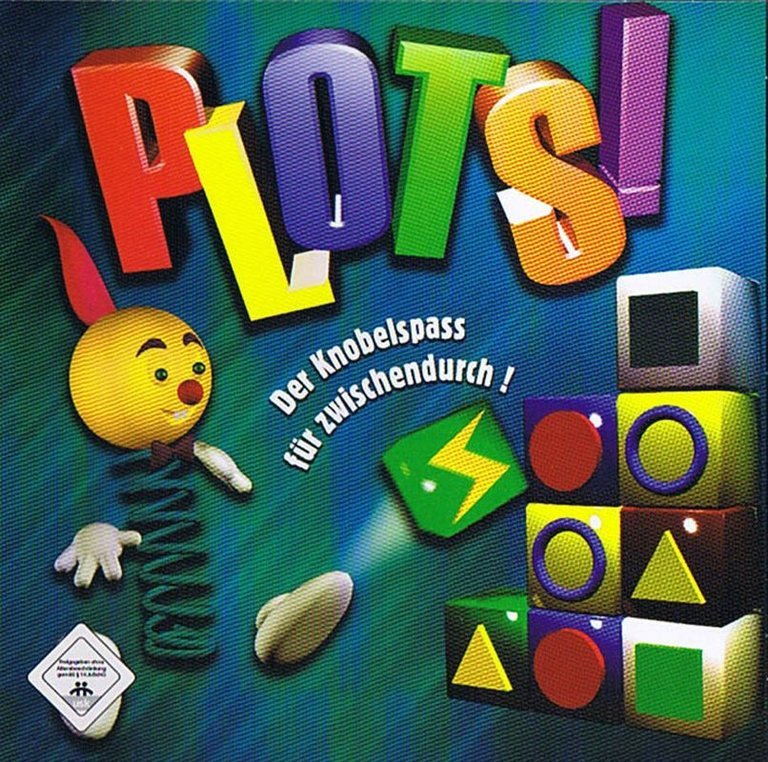
Plots! is a remake of the classic 1991 puzzle game where players control a vagrant, bipedal jack-out-of-the-box with a clownish appearance, aiming to match tiles to clear levels. The tile-matching gameplay penalizes poor decisions with lost lives—three strikes end the game—and features enhanced 3D visuals for the character, tiles, and complex stage backgrounds, supporting both single-player and two-player modes.
Plots!: A Monument to Minimalism in the Tile-Matching Pantheon
Introduction: The Ghost in the Machine of Puzzle Game History
In the vast, meticulously catalogued museum of video game history, certain titles exist as spectral presences—entries with dates, credits, and genre tags, but hauntingly devoid of critical discourse, player memory, or cultural reverberation. Plots! (2004), developed and published by the German studio magnussoft Deutschland GmbH, is one such ghost. It is not a game that failed; it is a game that vanished. A remake of the obscure 1991 title Plot’s, this Windows-only puzzle game represents a curious nadir of minimalist design, existing at the precise intersection of a fading 2D puzzle paradigm and the emergent 3D casual boom of the mid-2000s. This review does not seek to rehabilitate Plots! as a lost classic—the evidence for such a claim does not exist. Instead, it uses the game as a critical lens to examine a specific evolutionary dead-end in puzzle game design, the economic realities of niche European development in the early 2000s, and the profound narrative vacuum that can exist even within a genre built on abstract engagement. My thesis is this: Plots! is a perfectly functional, utterly forgettable artifact whose greatest significance lies in what it lacks—a compelling hook, character depth, world-building, and any meaningful reception—thereby illustrating the absolute baseline of what constitutes a “game” versus a “meaningful experience” in the contemporary understanding of the medium.
Development History & Context: The Quiet Labor of magnussoft
To understand Plots!, one must first understand its creator. magnussoft Deutschland GmbH, operating simply as “magnussoft,” was a small German developer active from the late 1990s through the late 2000s. Their portfolio, glimpsed through MobyGames credits, reveals a pattern: a steady output of puzzle games (Klix!, Bomb Wuzel 2, Packs Revenge) and casual fare, often for the German domestic market and international budget PC bins. This was the era before the global indie explosion, when “casual” was not a celebrated genre but a commercial stratum often filled by small European studios producing derivative, low-cost titles for retail shelves and early digital distributors.
The 2004 release window is crucial. It followed the explosive success of Bejeweled (2001) and pre-dated the mobile tsunami catalyzed by Candy Crush Saga (2012). The tile-matching puzzle genre was being standardized, and Plots! arrived not as an innovator but as a me-too product attempting a visual facelift. The source material states it is a remake of the 1991 original Plot’s (itself part of a series that would later include Rolf Kaukas Fix & Foxi: Plot’s 3 in 2007). This lineage points to a long-term, low-stakes franchise maintained by a single studio, likely for contractual or IP-retention reasons rather than passionate artistic revival.
Technologically, the shift from the original’s presumed 2D sprite-work to the 2004 version’s “three dimensional” spring-man and tiles with “a little depth” represents the most minimal possible 3D transition. This was not a leap into full 3D space but a superficial polygonal sheen over a fixed/flip-screen, isometric foundation—a common, cost-effective aesthetic upgrade for budget titles of the period. The technological constraint was not hardware limitation but financial one: magnussoft could not afford a true gameplay innovation, so they invested in a cosmetic one. The gaming landscape of 2004 was dominated by thearrative ambitions of Half-Life 2, KotOR, and World of Warcraft. For Plots! to exist in this context is to highlight the vast chasm between the industry’s cinematic, story-driven aspirations and the silent, mechanistic production of puzzle fodder for a niche, non-English-speaking market.
Narrative & Thematic Deep Dive: The Plot That Wasn’t
Here, the review must confront the titular irony. The game is called Plots!, yet according to all available documentation—the MobyGames description, the credits, the absence of any reviews or fan discussion—it possesses no narrative plot whatsoever. The player controls a “vagrant bipedal jack-out-of-the-box that has a more clownish complexion.” This is not a character; it is an aesthetic descriptor. There is no motivation, no backstory, no dialogue, no world. The “plot” is the literal, mechanical plot of the tile-matching puzzle grid.
This absence is, in itself, a profound design choice worthy of analysis. While the source literature on game narrative—from the “Holy Trinity” of Plot, Character, and Lore (Pixune) to the emphasis on “player agency” and “meaningful choices” (Fantha Tracks, Indie Dev Games)—posits narrative as the cornerstone of engagement, Plots! stands as a refutation. It is a pure, unadulterated ludic experience. The “hook” (Indie Dev Games) is not a mysterious event or emotional appeal, but the sterile, immediate satisfaction of a color-match. There are no characters to develop, no conflict to establish, no world to build. The “theme” is efficiency, pattern recognition, and spatial reasoning. It is the antithesis of the “emotional depth” and “thematic resonance” championed in modern narrative design guides.
One could argue its thematic simplicity is its statement: a rejection of narrative baggage in favor of pure gameplay. Yet, unlike the celebrated minimalist storytelling of Celeste (where mechanics are metaphor) or Journey (where environment conveys narrative), Plots! offers no such synthesis. Its clownish protagonist is not integrated into the mechanics; the 3D model is a superficial garnish on a 2D puzzle. The game does not use its form to comment on its content. It simply is. In the pantheon of puzzle games, it represents the “Gameplay-Only” pole, a stark contrast to the narratively-rich “Puzzle-Platformers” like Portal or Baba Is You, where the puzzles are the story. Plots! has no such ambition. Its plot is a void, and in that void, we see the absolute minimum threshold for what the industry once considered a sellable product.
Gameplay Mechanics & Systems: The Tile-Matching Treadmill
The core loop is described with brutal simplicity: “attempting to match tiles to clear a level.” The failure condition—”If you use your tiles poorly you’ll have to start over, this will cost you a life, when you’ve done this three times the game ends”—reveals a punishing, archaic design. This is not the gentle, cascading failure state of modern match-3 games, but a hard, life-based reset. It suggests a design philosophy rooted in arcade rigor (lives, restarting a stage) rather than the casual, Zen-friendly flow that would come to dominate the genre.
The “two player mode remains the same as well” is a tantalizing but frustratingly vague detail. Was it competitive? Cooperative? A simple score attack? The source provides no clue. This lack of detail underscores the game’s opacity. There is no innovation in the core mechanic described; it is a direct descendant of the “tile matching puzzle” lineage stretching from Tetris (shape-based) to Puzzle Bobble (color/shoot-based) to Bejeweled (swap-based). Where Plots! fits in this spectrum is unclear from the text. The action of “matching” implies a Bejeweled-style swap, but the isometric, fixed-screen perspective and “stages” suggest a more static, grid-based challenge perhaps akin to Klax or Dr. Mario. Without gameplay footage or a detailed review, we are left to imagine a competent but unoriginal implementation of a crowded formula.
The systems are nonexistent beyond the life counter. There is mention of no power-ups, no special tiles, no progressive mechanics, no character progression. The “spring man” is purely an avatar; he does not gain abilities. The “levels” are presumably static puzzles with increasing complexity, but there is no sense of a “progression system” as understood in modern games. The UI is inferred to be minimal, focused on the grid and a life counter. In the context of 2004, this was already a generational step behind the more polished, feature-rich casual puzzle games appearing on platforms like Game Boy Advance (Puzzle League) and PC (Zuma). Plots! feels like a game designed in a vacuum, or more accurately, a game designed by a small team with no awareness of genre evolution, merely iterating on their own 13-year-old formula.
World-Building, Art & Sound: The Illusion of Depth
The source is generous in describing the visual upgrade: “Your spring man is now three dimensional and your tiles seem to have a little depth to them as well. Stages and backgrounds also look a bit more complex.” This is the entire artistic thesis. The shift from 2D sprites to low-polygon 3D models was a common, inexpensive way to make a budget game look “current-gen” in the early 2000s. The “vagrant bipedal jack-out-of-the-box” with a “clownish complexion” suggests a whimsical, perhaps slightly off-putting mascot—a far cry from the charming, marketable icons like Lumines‘s “Lumi” or Bejeweled‘s gems. This character speaks to a specific European, perhaps German, sensibility for quirky, slightly grotesque mascots (see also: the Worms series, though with far less charm).
The “isometric” perspective and “fixed / flip-screen” views are a limiting choice. It prevents the dynamic camera work becoming standard and confines the player’s view, potentially creating visibility issues in later, more complex puzzles. The “complex” backgrounds are likely detailed static images, but without environmental storytelling (a key pillar of immersive world-building per Games Learning Society), they are mere decoration. There is no lore to embed, no culture to depict, no history to hint at. The world is a series of disconnected, pretty backdrops for abstract grids.
Sound design is mentioned only in the credits: “Music Egon Maase.” We know nothing of the soundtrack. It could be triumphant, eerie, or generic MIDI. Its role in setting mood or reinforcing gameplay is unanalyzable. In a genre where sound is crucial for feedback (the click of a match, the whoosh of a clear), this silence is deafening. The overall atmosphere, therefore, is one of sterile, unengaging abstraction. The game creates no sense of place, no emotional tone, no immersive pull. It is a puzzle placed in a graphical container, and the container is described as “a bit more complex” than its predecessor—not a ringing endorsement.
Reception & Legacy: The Sound of One Hand Clapping
The critical and commercial reception of Plots! is a perfect vacuum. Metacritic lists a “Metascore” of “tbd” with “Critic reviews are not available yet.” User reviews are nonexistent (“Be the first to rate and review this product”). MobyGames shows a “Moby Score” of “n/a” and is “Collected By” only 3 players as of the latest data. This is not a game that was panned; it is a game that was ignored. It received no press coverage, inspired no community discourse, and left no trace on the aggregate review sites that define modern perception.
Its commercial performance is equally invisible. It was published by magnussoft itself, a tell-tale sign of a low-budget, low-expectation release, likely sold in German software aisles or as a bargain-bin import. It had no impact on the puzzle genre. The evolution of storytelling in video games (videogameheart.com) charts a course from Pong to The Last of Us, entirely bypassing Plots! and its ilk. The genre’s evolution moved toward richer narratives ( Puzzle Quest, The Witness) or deeper mechanical integration (Portal), leaving pure, narrativeless grid-matches like Plots! as a forgotten tributary.
Its legacy is confined to a single, sad footnote on MobyGames: a 2004 remake of a 1991 game, followed by a 2007 sequel tied to a German comic property (Rolf Kaukas Fix & Foxi). This suggests the Plots! brand had just enough residual recognition in its home market to warrant a final, likely contractually obligated, sequel. After 2007, the series and the studio fade into silence. Plots! did not influence Candy Crush. It did not inspire an indie darling. It is not cited in “best of” lists for puzzle games. Its legacy is the quiet cessation of a minor franchise, a data point proving that most games do not echo through history; they are simply data entries—46475 on a long list.
Conclusion: A Terminal Case of Mediocrity
Plots! (2004) is not a bad game. It is, by all functional definitions, a game. It has rules, a fail state, a clear objective, and interactive input. But in the landscape of an art form that, as of 2025, is celebrated for its capacity for “emotional resonance,” “player agency,” and “immersive world-building,” Plots! is a profound nullity. It is the gaming equivalent of a blank canvas—not because it invites projection, but because it has nothing to say.
It fails every test of modern narrative design: no hook, no character, no conflict, no theme, no meaningful choice, no pacing, no climax, no resolution. It is a pure mechanics-first, story-zero experience in an era where the industry was loudly announcing that story was the mechanics. Its world-building is a graphical afterthought. Its art is a dated 3D veneer. Its sound is anonymous. Its reception was a void. Its legacy is a series termination.
To place Plots! in video game history is to place it in the “long tail of obscurity.” It is a testament to the fact that countless games are made, sold in small numbers, and promptly erased from collective memory. It represents the absolute minimum viable product for a commercial game release in 2004: a renamed remake of an older title with a superficial visual upgrade, built with no ambition beyond recouping a modest development cost. It is a ghost in MobyGames’ machine, a title that validates the very need for critical review and historical preservation by embodying the sheer volume of forgettable software that constitutes the medium’s foundation. In the end, Plots! has no plot, and its history is one of profound, unremarkable silence. It is not a game to be rediscovered, but a case study in how a game can be perfectly functional yet existentially empty.