
- Release Year: 1998
- Platforms: Windows
- Publisher: Sierra On-Line, Inc., Sold Out Sales & Marketing Ltd.
- Developer: Yosemite Entertainment
- Genre: Strategy, Tactics
- Perspective: Diagonal-down
- Game Mode: LAN, Online PVP, Single-player
- Gameplay: Breaching, Evidence Collection, Negotiation, Real-time tactics, Team Management
- Setting: City, Contemporary, Los Angeles
- Average Score: 68/100
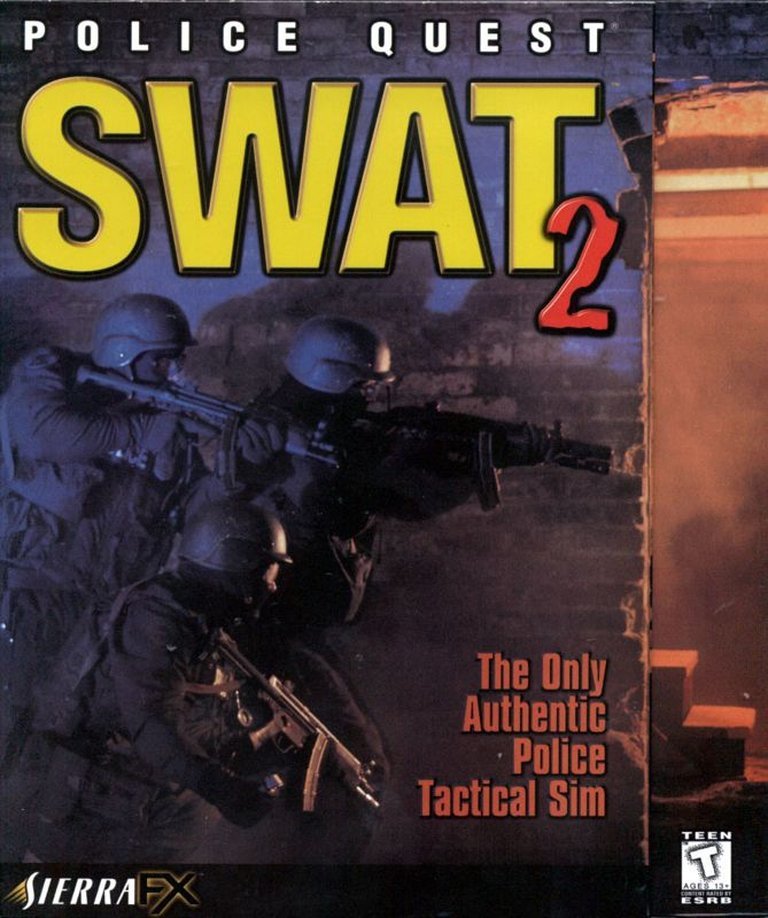
Description
Police Quest: SWAT 2 is a real-time tactical game set in contemporary Los Angeles, where players lead either a LAPD SWAT team or terrorist factions through high-stakes crisis scenarios like hostage rescues and bomb defusals. Featuring an isometric perspective, the game emphasizes strategic planning, strict rules of engagement, and authentic law enforcement or criminal tactics in a crime-focused narrative.
Gameplay Videos
Where to Buy Police Quest: SWAT 2
PC
Police Quest: SWAT 2 Free Download
Police Quest: SWAT 2 Reviews & Reception
mobygames.com (68/100): Too far ahead of its time to be fun, even with the simplified procedures
Police Quest: SWAT 2 Cheats & Codes
PC
Type ‘los’ during gameplay to toggle line of sight.
| Code | Effect |
|---|---|
| los | Toggles line of sight, making all characters visible. Disables arrests and other actions while active. |
Police Quest: SWAT 2: A Sculpted Hyperrealism – The Ambitious, Flawed Bridge Between Simulation and Spectacle
Introduction: The Tactical Pioneer Stuck in the Mud
In the late 1990s, the video game landscape was fracturing along genre lines. First-person shooters were capturing the mainstream imagination, real-time strategy was dominating the PC space, and immersive sims were still a nascent dream. Into this environment, Sierra On-Line, a studio historically synonymous with narrative-driven adventures, launched one of the most authentically tense and mechanically demanding tactical experiences of its era: Police Quest: SWAT 2. Released in July 1998, it was not merely a sequel but a radical genre pivot, abandoning the interactive movie format of its immediate predecessor for a complex, isometric, real-time tactics engine. Its thesis was audacious: to simulate the intense, procedural, and often mundane reality of modern SWAT operations with a fidelity that bordered on the pedagogical. This review argues that SWAT 2 is a monumental, deeply conflicted artifact—a game that is simultaneously ahead of its time in its systemic ambition and tragically sabotaged by its own commitment to authenticity and a clumsy, punitive interface. It is a flawed masterwork, a bridge between the Sierra adventure legacy and the tactical shooter future, whose profound influence is often overlooked because of the very obstacles that made it so compelling to a niche but dedicated audience.
Development History & Context: From Adventures to Armored Tactics
The game’s development context is a study in franchise evolution and industry transition. Developed by Yosemite Entertainment, a Sierra subsidiary, the Police Quest series had undergone a significant metamorphosis. The first three games (1987-1991) were classic Sierra point-and-click adventures designed by former LAPD officer Jim Walls, focusing on procedure and narrative. The fourth and fifth titles (Open Season and the original SWAT) were designed by former LAPD Chief Daryl F. Gates and shifted toward a more cinematic, FMV-driven “interactive movie” format. SWAT 2, then, represents the final departure, helmed by lead designer Susan Frischer and lead programmer Victor Sadauskas, who eschewed the adventure template entirely for a bespoke real-time tactics engine.
This shift was catalyzed by several factors. First, the rising popularity of squad-based tactics games like X-COM: UFO Defense (1994) and Jagged Alliance (1995) demonstrated the appeal of micro-management and strategic planning. Second, and more critically, the real-world events of the early 1990s loomed large. As the Wikipedia entry and multiple reviews note, many missions were directly inspired by the 1997 North Hollywood shootout—a brutal, 44-minute firefight where outgunned LAPD officers faced off against two heavily armed bank robbers—and the 1992 Los Angeles riots. This was not abstract violence; it was recent, televised trauma that demanded a serious, procedural response. The development team’s proximity to Gates, who served as a consultant and appears in-game as an advisor (a “Creator Cameo”), guaranteed a deep well of authentic procedure, from rules of engagement (ROE) to negotiation protocols.
Technologically, the game was built for the Windows 95/98 era, utilizing an isometric, pre-rendered 3/4 view. This perspective, while limiting in terms of field of view, provided a tactical overview that became a staple of the genre. The engine supported a significant number of units on screen, a dynamic day-night cycle, and a complex AI system described by user Kasey Chang as using “sort-of fuzzy logic.” The ambition was clear: create a living, reactive sandbox where every decision—from the weapon you issue to the way you breach a door—had cascading, realistic consequences. However, this ambition was shackled to the technological constraints of 1998. The AI, while “smart,” was often opaque; the interface, built for depth, became a labyrinth; and the real-time nature, intended to create tension, frequently devolved into frantic, unplayable chaos unless the player滥用 the game’s slow-motion time-scale feature.
Narrative & Thematic Deep Dive: Cults, Conspiracies, and the Thin Blue Line
SWAT 2’s narrative is its most celebrated and under-analyzed aspect. It is a story of institutional conflict told through two diametrically opposed lenses, a narrative structure far more sophisticated than the typical “cops vs. robbers” dichotomy.
The SWAT Campaign: The Burden of the Badge
Players assume the role of LAPD Chief John De Souza, a 36-year veteran (as noted in the manual), directing SWAT operations from a strategic command screen. His lieutenants are the seasoned Sergeant Griff Markossian and the pragmatic negotiator Sergeant Mike Alvarez. The campaign begins with seemingly disparate calls—domestic disputes, bank robberies, a strip mall riot—but slowly coalesces around a rising threat: the Five Eyes, a cult-like, “transcendentalist left-wing terrorist militia” led by the enigmatic Bashō and his ruthlessly pragmatic second-in-command, Dante.
The narrative’s genius lies in its procedural storytelling. Mission briefings, debriefings, and the evolving criminal database gradually unveil a conspiracy that reaches into the highest echelons of Los Angeles politics. The Mayor of Los Angeles is ultimately revealed as corrupt, a narrative touchstone that reflects Daryl Gates’ own well-documented clashes with real-life Mayor Tom Bradley (a piece of trivia noted on MobyGames). The personal cost is heavy; the death of Sergeant Markossian during the Five Eyes’ retaliatory assault on the Parker Center is a pivotal, emotional blow that personalizes the conflict. The campaign culminates not in a simple victory, but in a messy, three-way shootout at a Topanga Canyon warehouse, followed by a dramatic airport chase. The “Golden Ending,” achievable only by collecting all scattered evidence pieces (a notoriously random and obtuse process), exposes the full conspiracy and results in the Mayor’s downfall and De Souza’s heroic retirement. Fail to gather that evidence, and the game ends with De Souza being forced into early retirement—a “Turn in Your Badge” scenario that underscores the game’s theme that procedure and evidence are as vital as firepower.
The Terrorist Campaign: The Philosophy of Destruction
Playing as Dante, the Five Eyes lieutenant, offers a radically different, morally inverted experience. Here, the narrative explores the ideology and internal dynamics of a domestic terrorist cell. Bashō is a fascinating antagonist: a philosopher-terrorist who weaves “persuasive language, dogma, and bad poetry” (as the manual states) into his manifestos. He abhors drugs (due to his son’s addiction) and, in a chilling “Even Evil Has Standards” moment, criticizes the killing of children. His philosophy is a “Scam Religion,” a cult built on directing the rage of society’s outcasts—Vietnam veterans, disgruntled rednecks, anarchists—toward violent ends.
The terrorist campaign’s story is one of exploitation and betrayal. Dante’s missions involve bombing government buildings, distributing manifestos, and kidnapping for ransom or recruitment. The narrative twist is that Bashō’s ultimate goal is a “Prison Break”; he manipulated the entire Five Eyes organization to rescue him from custody. When this succeeds, he betrays Dante, leading to the final, chaotic Mêlée à Trois at LAX: SWAT, Bashō’s faction, and Dante’s faction all converging on the same escape plane. Dante’s victory—disbanding the Five Eyes and fleeing to a tropical island—is presented as a cynical, yet pragmatic, retirement from a failed revolution. This campaign doesn’t glorify terrorism; it dissects its mechanics, its recruitment, and its inevitable, self-consuming internal conflicts.
Thematic Synthesis: Legitimacy vs. Efficacy
The core thematic tension is between legitimacy and efficacy. The SWAT campaign is a constant exercise in constrained efficacy: you have the best training, equipment, and public support, but you are shackled by the ROE (“only take down threatening suspects,” “save hostages first, police second”). Your success is measured by how you win. The terrorist campaign is about unconstrained efficacy: your goal is completion, regardless of cost. Basho’s mantra is results, even if it means sacrificing his own people. The game’s dual structure forces the player to inhabit both sides of this philosophical divide, making a profound statement about the nature of violence and the state’s monopoly on it.
Gameplay Systems & Mechanics: The Grueling Architecture of Control
The gameplay of SWAT 2 is where its legacy is most profoundly mixed—a brilliant, convoluted, and often punishing simulation.
Pre-Mission Phase: The Logistics of Force
Before every mission, players enter a planning stage. For SWAT, you have a stable roster of officers (including the legendary Sonny Bonds as a playable mook, a “Previous Player-Character Cameo” with top-tier stats). For the Five Eyes, you must recruit from a pool of available “volunteers,” who range from competent ex-military to barely-functional lowlifes, reflecting the terrorist group’s rag-tag nature.
The budgeting and equipment system is deeply detailed. Each officer can be certified in roles: Element Leader, Sniper, Explosives, EMT, or K9. Equipment is vast: MP5s, shotguns, M1911s, Desert Eagles (for terrorists), tear gas launchers, flashbangs, battering rams, door breach charges, rappel gear, gas masks, and EMT kits. Crucially, as noted in user reviews, ammunition is infinite (a simplification that breaks realism), but specialized gear like flashbangs and grenades is limited. This forces meaningful trade-offs: do you give your element leader a ram or a shotgun? Does your sniper take a pistol for emergencies? The SWAT campaign punishes overspending; poor mission ratings hurt your budget, and bankruptcy ends the game. The terrorist campaign has a tighter, more mercenary budget.
Tactical Phase: The Dance of Real-Time
The core loop is isometric, real-time tactics. You select elements (color-coded 5-man teams for SWAT, 3-man cells for terrorists) and issue move, arrest, and fire commands. The skill system is key. Each character has Marksmanship (weapon proficiency) and Cross-Training (equipment use). SWAT officers additionally have Certification skills. A high-skill sniper can spot enemies through walls; a certified EMT can stabilize wounds; a leader can keep the squad cohesive. This creates a “Management RPG” layer where your most valuable asset is a well-rounded officer like Jeff Buchanan or Sonny Bonds.
The game’s signature mechanic is its negotiation and escalation system. During SWAT missions, a phone icon flashes, connecting you to Negotiator Lt. Alvarez. He updates you on the suspects’ mindset. You can authorize “throw phones” (armored cell phones tossed to barricaded suspects) to prolong negotiations. Shots fired inside? Negotiations are dead; you must assault immediately. Suspects make demands—food, getaway cars—which come from your budget. This creates a brilliant tension: spend money to avoid a firefight, or save cash for better gear? The system is praised in reviews as “seldom seen in any media, much less games.”
Breaching and Clearing: The Tactical Microcosm
Clearing a room is a multi-step ballet. First, breach: use a ram on a locked door or a door breach charge for a bigger effect. Next, deploy: do you toss a flashbang first (stunning enemies) or a tear gas canister (forcing surrender but risking suffocation in tight spaces)? Then enter: your assaulters must move in, maintain “slice the pie” pie-slicing maneuver (a real SWAT term), and arrest, not kill. The interface for this is the game’s greatest flaw. As Kasey Chang details, activating the ram requires multiple clicks: select officer, open inventory, activate ram, select “door entry mode,” click door. Then coordinate the flashbanger. This clumsy, multi-layered interface is the single biggest barrier to enjoyment. Combined with the rule that a selected unit will not move if fired upon (a design choice Sierra called “maintaining player control” that players universally derided as “Artificial Stupidity”), it creates a frantic, micromanagement hellscape.
The AI: Brilliantly Opaque
The AI for NPCs (suspects and hostages) is revolutionary for its time, using “fuzzy logic” to create unpredictable, reactive behavior. Suspects might surrender immediately, or they might open fire the moment they see you. They might retreat with a hostage and barricade a door, or they might just start shooting. Hostages might cower, or, as Ruben van der Leun惊喜ly witnessed, a hostage might defend themselves, knocking down a suspect. This dynamism is the game’s core strength, making each playthrough unique. However, its opacity is a weakness. As Kasey Chang notes, “Zone of View rules are unclear,” and terrorist AI in particular is “too smart,” making it impossible to reliably predict. The SWAT AI’s refusal to autonomously open doors or take cover when shot at while selected is a consistent frustration.
Mission End and Evidence: The Cruel Arbitrator
The most infamous design choice is the instant mission end. The moment the last suspect is neutralized/arrested and the last hostage is freed, the mission concludes—automatically. There is no grace period to search for evidence. This turns evidence collection (required for the SWAT campaign’s Golden Ending) into a frantic, mid-combat priority. You must secure a dropped pistol or drug bag during the firefight, or it vanishes. This is narratively absurd (real police secure a scene after it’s clear) but thematically rigid: procedure must be followed at all times, even in the heat of battle. It is a punishing, “Gotcha!” mechanic that epitomizes the game’s struggle between simulation and playability.
World-Building, Art & Sound: A Gritty, Consciously Un-Cinematic LA
SWAT 2 presents a vision of Los Angeles that is the antithesis of the glamour usually associated with the city. The isometric graphics, using pre-rendered sprites and environments, are detailed but deliberately drab. Locations are based on real LA: strip malls, suburban homes, the Parker Center, LAX, Topanga Canyon. The color palette is muted—browns, grays, concrete—emphasizing the grim, procedural nature of the work. There is no heroic wide shot; the camera is locked at a commanding, detached angle, reinforcing the player’s role as a commander, not a grunt.
The sound design is functional and atmospheric. The soundtrack by Jason Hayes and Chance Thomas, including the theme “Just Another Day in L.A.,” is serviceable but, as reviews note, can become “grating after a while.” The real audio stars are the voice clips and sound effects. The crisp reports of the MP5, the thud of a battering ram, the pop of a flashbang, the cough of a suspect through a gas mask—these are not sensationalized; they are reportage. The voice acting for negotiator Alvarez and the mission debriefings (often delivered by a stern, unseen superior) is flat, professional, and utterly un-embellished, which perfectly suits the game’s tone.
The UI is a dense layer of windows: the main isometric view, a detailed minimap, a status window for selected units showing health, stamina, and carried gear, and inventory management screens. This “cockpit” feel makes the player feel like a SWAT commander huddled over a command console, but it also contributes massively to the perceived “clumsiness.” The sheer number of clicks required for basic actions is a constant source of friction.
Reception & Legacy: The Cult Classic That Paved the Way
Upon release, SWAT 2 received mixed-to-positive reviews, with an aggregate score of ~68-70% (GameRankings). Critics were sharply divided. Game Revolution’s 91% review hailed it as a deep, rewarding experience for those willing to endure its learning curve. Computer Gaming World’s 70% called it “the best law-enforcement sim yet,” acknowledging its flaws. The negative press was fierce. GameSpot’s 5.7/10 lambasted the “frustrating command system” and wished it were turn-based. German magazines like PC Action (51%) and PC Games (48%) criticized the “unübersichtlichkeit” (unclearness) and “schwerfällige Steuerung” (clumsy controls). The Adrenaline Vault’s 60% review perfectly captured the central conflict: “It feels too much like an instructional aid… it’s just not that much fun.”
Commercially, it was a success, selling over 400,000 copies by late 1999, proving there was a market for deep tactical sims. Its legacy, however, is complex.
- The Bridge to SWAT 3 and 4: The game’s most direct legacy is as the painful, necessary prototype. As the Wikipedia entry notes, the sequel, SWAT 3: Close Quarters Battle (1999), “took out all the boring parts and went to full 3D,” directly addressing SWAT 2‘s most criticized elements: the isometric view, the cumbersome interface, and the obtuse AI. The move to a first-person, command-based tactical shooter (inspired by games like Rainbow Six) was a direct response to the frustrations of SWAT 2. The core systems—elements, ROE, negotiation, evidence—were refined and made playable.
- A Niche Ancestor: For modern tactical shooters and immersive sims (Ready or Not, Zero Hour, even aspects of Grand Theft Auto V’s heists), SWAT 2 is a grandfather. Its insistence on non-lethal takedowns, evidence collection, and strict procedures foreshadowed the “play your way” philosophy of later titles, albeit with a hard, punitive edge.
- The “Too Real” Sim: It stands as a cautionary tale about the limits of simulation. Its AI, while advanced, was unpredictable to the point of frustration. Its interface demanded mastery akin to a professional toolkit. Its reward structure punished deviation from a narrow procedural path. This made it a cult object for masochistic strategists but a barrier to mainstream adoption. The user reviews on MobyGames capture this dichotomy: one praises its “different ways a mission can play out” and random AI, while another laments it being “too far ahead of its time to be fun.”
- Historical Document: As explored in the Police Quest Wikipedia article, the series was part of Sierra’s effort to create “responsible” games with a social conscience, inspired by Jim Walls’ police background. SWAT 2, with its direct engagement with the North Hollywood shootout and LA riots, is the most serious and grounded installment—a gritty document of its era’s anxieties about police militarization and domestic terrorism.
Conclusion: The Grueling, Glorious Imperfect Sim
Police Quest: SWAT 2 is not a “fun” game in the conventional sense. It is often frustrating, obtuse, and punishingly difficult. Its interface is a relic of a bygone era of PC complexity, its AI a black box of erratic brilliance, and its procedural demands can feel arbitrary. Yet, to dismiss it on those grounds is to miss its monumental achievement.
It is a game that trusted its players with a staggering degree of systemic depth and moral complexity. It dared to model negotiation as a core gameplay pillar. It gave players control over the minutiae of a SWAT team’s logistics—from certification to equipment—in a way few games have since matched. Its dual campaign structure remains a masterstroke of narrative design, allowing players to understand both sides of a tactical conflict in a way that is philosophically rich, not merely mechanically mirrored.
Its place in history is that of a pivotal, flawed prototype. It was the last gasp of Sierra’s adventure-era ambition in the tactical space, a game so committed to its hyperrealist vision that it broke under the weight of its own aspirations. It failed as a broadly accessible “game,” but succeeded as a rigorous, often terrifying, simulation of tension and procedure. For those willing to conquer its steep learning curve, SWAT 2 offers a unique, unmatched experience: the sensation of truly commanding a crisis, where every second, every equipment choice, and every shot fired echoes with the weight of real-world consequence. It is a game that demands respect, even as it incites rage. And in that contradictory space—between awe and exasperation—lies its enduring, niche genius. Its spirit lives on, streamlined and accessible, in the DNA of every tactical shooter that followed, a testament to the fact that sometimes, to build the future, you must first get gloriously, frustratingly stuck in the mud.