
- Release Year: 2003
- Platforms: Windows
- Publisher: Unknown
- Developer: Unknown
- Genre: Educational, Music, rhythm
- Perspective: First-person
- Game Mode: Single-player
- Gameplay: Editing, Recording, Singing, Uploading
- Setting: Modern
- Average Score: 41/100
Description
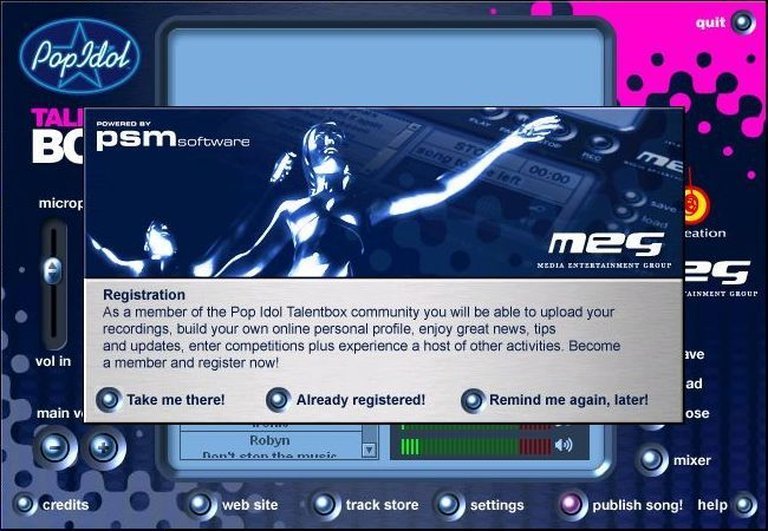
Pop Idol: TalentBox is a 2003 educational music/rhythm game for Windows, inspired by the UK TV show Pop Idol. Players use a bundled microphone to record and edit their singing performances of instrumental covers of popular songs, then upload them to the game’s website for voting. The game includes ten tracks (plus bonus songs) displayed in a media player with lyrics, though the online community aspect was discontinued by 2005.
Pop Idol: TalentBox Reviews & Reception
en.wikipedia.org (41/100): Pop Idol received “generally unfavorable” reviews for its PC and PS2 versions.
bbc.com : The game starts with a couple of audition rounds and eventually onto eliminator heats and then the final.
Pop Idol: TalentBox Cheats & Codes
PC
Enter the codes as passwords to unlock the associated bonus.
| Code | Effect |
|---|---|
| 6CK | New costumes |
| HTH4 | New costumes |
| 6QR | 3 new songs |
| Z999 | 3 new songs |
GBA
Enter the codes as passwords to unlock the associated bonus.
| Code | Effect |
|---|---|
| HTH4&6CK | Unlock additional costumes |
| Z999&6QR | Unlocks last 3 practice songs |
| 2999&6QR | Unlocks last 3 practice songs |
| %999&6QR | Four new costumes |
| HPF3&6CK- | Final 28 costumes |
| ZGRL&6GM | All costumes |
| ZRVW&6LP | Unlock a bonus |
Pop Idol: TalentBox – A Forgotten Relic of Early 2000s Music Gaming
Introduction: The Curious Case of a Game That Never Sang
In the annals of video game history, few titles are as fascinatingly flawed—or as swiftly forgotten—as Pop Idol: TalentBox. Released in 2003 by Codemasters, this Windows-exclusive karaoke game was a bold attempt to capitalize on the meteoric rise of Pop Idol, the British reality TV phenomenon that birthed a global franchise. Yet, unlike its television counterpart, TalentBox failed to leave a lasting impression. It was a game that promised stardom but delivered little more than a clunky, short-lived experiment in interactive entertainment.
This review seeks to unearth Pop Idol: TalentBox from the dustbin of gaming history, examining its development, mechanics, cultural context, and legacy. Was it a pioneering effort in music gaming, or merely a cynical cash-in on a fleeting trend? And why, despite its obscurity, does it warrant our attention today?
Development History & Context: Riding the Reality TV Wave
The Birth of a Franchise
Pop Idol debuted on ITV in 2001, created by Simon Fuller and produced by 19 Entertainment. The show’s format—auditions, judge critiques, and viewer voting—was revolutionary, blending the drama of talent competitions with the interactivity of telephone and text voting. Its success was immediate: the first series finale drew over 13 million viewers, and winner Will Young’s debut single, Evergreen, became the fastest-selling UK single of the decade. The show’s cultural impact was undeniable, launching the careers of Gareth Gates, Darius Danesh, and others, while turning Simon Cowell into a household name.
By 2003, Pop Idol was a licensing goldmine. The franchise had already spawned international adaptations (American Idol, Australian Idol), merchandise, and even a board game. A video game tie-in was inevitable.
Codemasters’ Gambit
Enter Codemasters, a British publisher with a long history of budget-friendly titles, from Micro Machines to TOCA Touring Car Championship. The company had dabbled in music games before (e.g., Music 2000 for the PlayStation), but Pop Idol: TalentBox was its first foray into the burgeoning karaoke genre.
The game was developed in-house, with a key gimmick: it included a USB microphone, allowing players to record their performances and upload them to an online platform for voting. This was a novel concept in 2003, predating the social media-driven karaoke apps of today. However, the execution was hamstrung by the technological limitations of the era.
Technological Constraints
- Hardware Limitations: The game required a Windows PC with a CD-ROM drive and a microphone input—hardly cutting-edge, but not universally accessible. The microphone itself was a basic, low-quality device, ill-suited for capturing nuanced vocal performances.
- Internet Dependency: The online voting system was ambitious but flawed. Players had to register on the Pop Idol: TalentBox website (launched July 3, 2003), which was shuttered by 2005, rendering the game’s core feature obsolete.
- Audio Quality: The tracks were instrumental covers by Rythm & Jazz Production, not the original recordings. While this avoided licensing issues, it stripped the game of the authenticity that made the TV show compelling.
The Gaming Landscape in 2003
Pop Idol: TalentBox arrived at a time when music games were still finding their footing. Guitar Hero wouldn’t debut until 2005, and SingStar was a year away. The market was dominated by niche titles like Karaoke Revolution (2003) and Dance Dance Revolution (1998), which focused on rhythm mechanics rather than vocal performance.
Codemasters’ decision to emphasize recording and online sharing was forward-thinking, but the game lacked the polish and accessibility of its competitors. It was, in many ways, a victim of its own ambition.
Narrative & Thematic Deep Dive: The Illusion of Stardom
The Plot: A Virtual Audition
Pop Idol: TalentBox positioned itself as a digital audition for the Pop Idol TV show. Players created a virtual singer, selected a song from the game’s limited tracklist, and recorded their performance using the included microphone. The recordings could then be uploaded to the game’s website, where they were (theoretically) voted on by other players.
There was no overarching story or character development. The “narrative” was purely aspirational: the player was a contestant vying for virtual fame. The game’s structure mirrored the TV show’s format—auditions, heats, finals—but without the drama, judges, or live audience.
Characters and Dialogue: The Absence of Personality
The game featured no original characters or dialogue. The only “personalities” were the real-life Pop Idol contestants referenced in the tracklist (e.g., Will Young’s Evergreen). The lack of judges, hosts, or even a virtual audience made the experience feel hollow. Unlike later music games (Rock Band, The Voice), TalentBox offered no feedback, no critiques, and no sense of progression beyond uploading a recording.
Themes: The Commodification of Fame
Pop Idol: TalentBox was a product of its time, reflecting the early 2000s obsession with instant celebrity. The game’s core theme was the democratization of fame—anyone could be a pop star, regardless of talent. This was both its appeal and its downfall.
- Aspirational Fantasy: The game tapped into the same dreams that fueled the TV show’s success. Players could imagine themselves as the next Will Young or Gareth Gates, even if their singing was subpar.
- Disposable Culture: The game’s ephemeral nature—its reliance on a now-defunct website—mirrored the fleeting fame of many Pop Idol contestants. Like the show’s one-hit wonders, TalentBox was designed to be consumed quickly and discarded.
- Interactivity as Illusion: The online voting system created the illusion of community, but in reality, it was a shallow mechanic. There were no leaderboards, no rewards, and no lasting recognition for players.
Gameplay Mechanics & Systems: A Flawed Experiment
Core Gameplay Loop
- Character Creation: Players selected a generic avatar (with limited customization options) and chose a song from the game’s tracklist.
- Recording: Using the included microphone, players sang along to the instrumental track while the game displayed lyrics on-screen.
- Uploading: Recordings were saved to the player’s PC and could be uploaded to the Pop Idol: TalentBox website.
- Voting: Other users could listen to and vote on recordings, though the system was poorly moderated and quickly abandoned.
Combat? More Like Button-Mashing
Unlike rhythm games that required precise timing (Guitar Hero, Dance Dance Revolution), TalentBox had no gameplay mechanics beyond singing into a microphone. There were no note charts, no scoring system, and no penalties for poor performance. The game was, essentially, a digital karaoke machine with an online component.
Character Progression: Nonexistent
There was no progression system. Players couldn’t unlock new songs, outfits, or venues. The only “reward” was the satisfaction of uploading a recording—a feature that became useless once the website shut down.
UI and UX: Clunky and Unintuitive
The game’s interface was barebones, with a simplistic media player for playback and recording. Navigation was cumbersome, and the lack of visual feedback made it difficult to gauge performance quality.
Innovative or Flawed?
- Innovative: The idea of recording and sharing performances online was ahead of its time, foreshadowing platforms like Smule and TikTok.
- Flawed: The execution was hamstrung by poor audio quality, a lack of gameplay depth, and an over-reliance on a short-lived online component.
World-Building, Art & Sound: A Hollow Facsimile
Setting and Atmosphere
Pop Idol: TalentBox had no “world” to speak of. The game took place entirely within a sterile media player interface, with no virtual stages, audiences, or judges. The only visual elements were the lyrics display and a basic recording meter.
Visual Direction: Minimalist to a Fault
The game’s aesthetics were functional but uninspired. The character avatars were rudimentary, and the UI was devoid of personality. There were no animations, no stage effects, and no attempt to replicate the glitz of the TV show.
Sound Design: A Missed Opportunity
The game’s soundtrack consisted of 10 instrumental covers of pop hits (e.g., I’m Outta Love, Sex Bomb) and two bonus tracks (Evergreen and two instrumentals). The covers were competent but lacked the energy of the originals. The absence of vocal tracks meant players had to sing a cappella, which often led to discordant performances.
The microphone’s poor audio quality further diminished the experience. Recordings sounded tinny and distorted, making it difficult to enjoy even the best performances.
Reception & Legacy: A Footnote in Music Gaming History
Critical Reception: Largely Ignored
Pop Idol: TalentBox received little critical attention upon release. It was overshadowed by higher-profile music games like Karaoke Revolution and dismissed as a cheap cash-in. The few reviews that existed were lukewarm, praising the concept but criticizing the execution.
Commercial Performance: A Niche Product
The game’s sales figures are unknown, but it’s safe to assume it was a minor release. The inclusion of a microphone may have boosted initial interest, but the lack of replay value and the demise of the online component likely led to quick abandonment.
Legacy: A Cautionary Tale
Pop Idol: TalentBox is remembered, if at all, as a curiosity—a failed experiment in interactive karaoke. Its legacy lies in what it attempted rather than what it achieved:
– Pioneering Online Sharing: The game’s online voting system was a precursor to modern social karaoke apps.
– The Limits of Licensing: The use of instrumental covers highlighted the challenges of licensing in music games.
– The Fragility of Online Features: The game’s reliance on a now-defunct website serves as a reminder of the risks of online-dependent gameplay.
Influence on Later Games
While TalentBox itself had no direct successors, its concepts influenced later titles:
– SingStar (2004) refined the karaoke game formula with better audio, scoring, and multiplayer features.
– Rock Band (2007) and Guitar Hero: World Tour (2008) expanded on the idea of virtual performances with full-band gameplay.
– Mobile apps like Smule (2012) and TikTok (2016) democratized music sharing, fulfilling TalentBox’s original vision on a global scale.
Conclusion: A Game That Never Found Its Voice
Pop Idol: TalentBox was a product of its time—a hastily assembled tie-in to a cultural phenomenon that burned bright and faded fast. It was ambitious in its attempt to blend karaoke with online interactivity, but its execution was fatally flawed. The game’s reliance on a short-lived website, its lack of gameplay depth, and its subpar audio quality doomed it to obscurity.
Yet, there’s something poignant about TalentBox. It was a game that dared to dream big, even if it couldn’t deliver. In an era where music games have become polished, multi-million-dollar productions, TalentBox stands as a reminder of a time when the industry was still figuring out how to turn singing into gameplay.
Final Verdict: Pop Idol: TalentBox is a fascinating failure—a game that tried to bottle the magic of Pop Idol but ended up as little more than a digital karaoke machine with a broken online component. It’s not a game worth revisiting, but it’s one worth remembering as a cautionary tale in the history of music gaming.
Score: 2/10 – A noble experiment, but one that never hit the right notes.