
- Release Year: 1991
- Platforms: Amiga, Atari ST, DOS, FM Towns, Genesis, Macintosh, PC-98, Sharp X68000, SNES, Windows
- Publisher: Bullfrog Productions, Ltd., Electronic Arts, Inc., Imagineer Co., Ltd., Virgin Games, Ltd.
- Developer: Bullfrog Productions, Ltd.
- Genre: Strategy, Tactics
- Perspective: Diagonal-down
- Game Mode: LAN, Single-player
- Gameplay: God game, Real-time strategy
- Setting: Classical antiquity, Fantasy
- Average Score: 82/100
Description
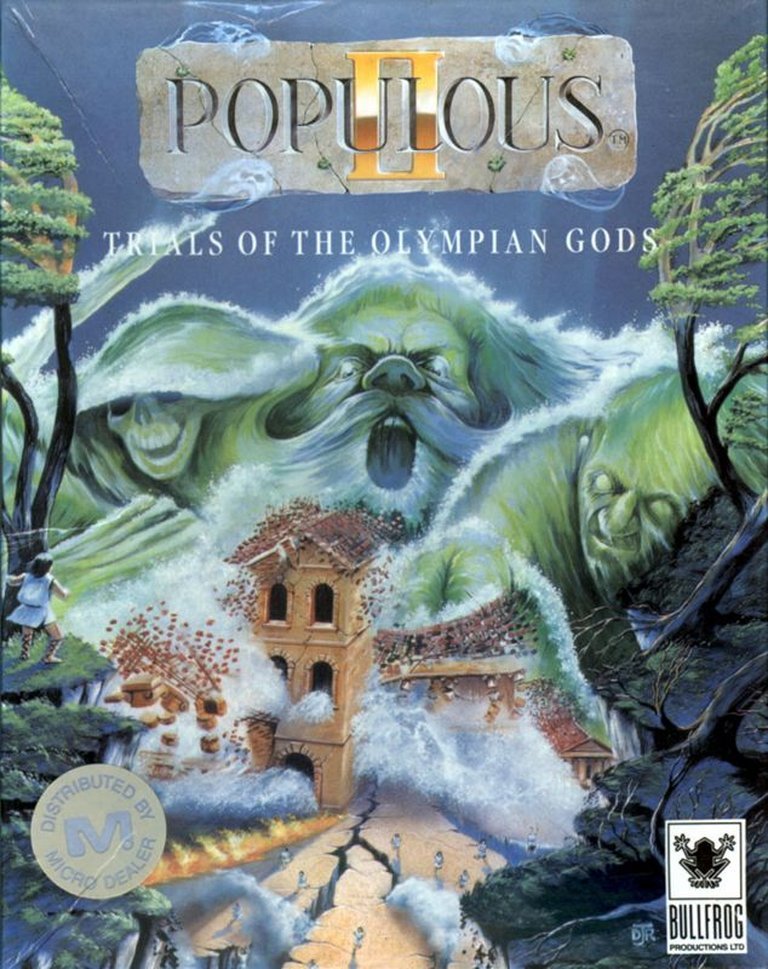
Populous II: Trials of the Olympian Gods is a real-time strategy god game set in a fantasy realm inspired by Greek mythology, where players embody a demigod challenging the Olympian pantheon. By shaping landscapes, casting over 60 diverse miracles like earthquakes and summoned creatures, and guiding human followers to expand faith and eliminate rivals, the player progresses through trials against deities, culminating in a showdown with Zeus.
Gameplay Videos
Where to Buy Populous II: Trials of the Olympian Gods
Populous II: Trials of the Olympian Gods Free Download
Populous II: Trials of the Olympian Gods Guides & Walkthroughs
Populous II: Trials of the Olympian Gods Reviews & Reception
gamesreviews2010.com : One of the greatest god games ever created.
ign.com : One of the most beloved strategy games of all time.
Populous II: Trials of the Olympian Gods Cheats & Codes
PC
Load a character at the ‘Create Your Deity’ screen and enter the following codes as a password to enable the corresponding effect. For Full Energy, when you now return to the ‘Conquest’ menu and enter the name of the last level you played, gameplay will resume with full energy.
| Code | Effect |
|---|---|
| ADKISCIESNTPDIDN | Invincibility |
| KOPOJAEEMEJMNMFAMEON | Maximum Power |
| DKNPJAEEMEJMNMFAFDOD | Full Energy |
Amiga
Enter codes at the password prompt or ‘Choose your Deity’ screen.
| Code | Effect |
|---|---|
| ADKITAKDVGZLRGWZ | Maximum everything |
| ADKIUCMCZNDIFINL | Maximum power in all areas of godly control |
| ADKIUCKBZNZEFIWX | Maximum everything |
| ADKITDMEVQDPXWTN | Maximum everything |
| MUSIC | Different music and special effects when clicking on the writing that goes round the game area |
Super Nintendo (Europe)
Use Game Genie or a compatible cheat device.
| Code | Effect |
|---|---|
| D16F-4D0D | Reset To See The Ending |
| 7E0357:09 | Infinite Exp |
| 7E0309:10 | Infinite Mana |
| 7E0309:07 | Power-Ups Not Required, Just Spam Spells! |
Populous II: Trials of the Olympian Gods: Review
Introduction
Imagine wielding the thunderbolts of Zeus, summoning volcanoes to swallow enemy tribes, or transforming your followers into mythical heroes like Achilles or Samson—all from an isometric perch above a sprawling, malleable world. Released in November 1991 on the Amiga, Populous II: Trials of the Olympian Gods built on its groundbreaking predecessor to deliver one of the most ambitious god games ever created, inviting players to ascend Olympus by battling the Greek pantheon. As the sequel to Bullfrog Productions’ 1989 phenomenon Populous, which sold millions and popularized the “god game” genre, Populous II expanded the formula with unprecedented divine powers, RPG-like progression, and a mythological narrative. Its legacy endures as a pinnacle of early real-time strategy innovation, blending territorial conquest, environmental manipulation, and strategic micromanagement into a divine power fantasy. My thesis: While not flawless—plagued by balance issues and repetition—Populous II masterfully evolves the god game into a genre-defining epic, influencing everything from Black & White to modern 4X titles, and remains a testament to Peter Molyneux’s visionary design.
Development History & Context
Bullfrog Productions, the British studio founded by Peter Molyneux and Les Edgar in 1987, was already a rising star by 1991, fresh off Populous‘s monumental success. Molyneux, the lead designer and programmer alongside Glenn Corpes, envisioned Populous II as a “total rewrite” rather than a mere expansion—rejecting code reuse to avoid it feeling like “just a data disk.” Development kicked off in March 1991 for the Amiga, mere months after Populous wrapped playtesting, drawing lessons from prior titles: Flood for fast screen rendering, Powermonger for database-driven design, and Populous for core programming.
The era’s technological constraints shaped the game profoundly. Amiga’s 512KB-1MB memory limits forced sprite compression and reduced animations on lower-spec machines; Molyneux noted 1MB systems got “more animation.” UI challenges arose from expanding powers from Populous‘s eight to 29-60 (depending on platform), necessitating categorization (earth, fire, water, air, plants, people/war/creatures) despite Molyneux’s preference for full accessibility. Icons were optimized for mouse efficiency, with frequent powers nearest the screen edge. Graphics began with Molyneux’s prototypes, refined by Gary Carr and Paul McLaughlin using DPaint 3 and Corpes’ custom editor for in-game testing. Sound, by Charles Callet (with Les Edgar on FX), arrived late due to Molyneux’s perfectionism—digitized effects emphasized destruction, while music tempo shifted with action intensity.
The 1991 gaming landscape was RTS nascent: Populous (1989) had birthed god games, but competitors like SimCity focused on building, not conquest. Consoles lagged (Genesis/SNES ports in 1992-93), and PCs battled hardware fragmentation. Publishers Electronic Arts backed Bullfrog’s ambition, releasing amid hype from demos. A data disk, Populous II: The Challenge Games (1992), added 500 Japanese mythology maps and puzzle challenges, extending replayability. Ports proliferated (Atari ST, DOS, Genesis as Two Tribes, SNES, etc.), but Amiga remained definitive for fluid 17fps performance.
Narrative & Thematic Deep Dive
Populous II weaves a compelling mythological odyssey absent in its vague predecessor. You play a demigod—Zeus’ mortal-born progeny—vying for Olympus’ Pantheon. Zeus tasks you with Trials: sequential battles against 32+ Olympians (e.g., Mars/Ares for war, Aphrodite for seduction, Dionysus for revelry), escalating to heroes and Zeus himself. Victory advances your rank, unlocking powers; defeat loops you back modestly. No overt dialogue exists—communication is divine, via booming narrations and follower chants—but themes pulse through gameplay.
Core narrative arc: Prove divinity via dominance. Followers build from a single soul using “papal magnets” (attractors), erecting huts → buildings → cities → castles, generating manna (faith-energy). Themes exalt godhood’s burden: micromanage tribes or watch them perish; wield miracles ethically? Greek pantheon adds flavor—Aphrodite/Dionysus posed dev challenges, translated as charm/plague effects. Biblical/Greek/Celtic inspirations infuse powers (e.g., plagues, colossi). Subtext critiques power: indestructible monsters (Medusa, Colossus) spawn at 75% map control, punishing overreach. Progression mirrors RPG ascent—lightning-bolt experience allocates to categories, customizing your deity (fire specialist? Balanced pantheon?). Player reviews praise the “well-planned” Greek backdrop, battling “Mars or Zeus himself,” elevating abstract conquest to epic myth. Yet, repetition dilutes drama; AI gods share tactics despite names, making late Trials feel rote.
Gameplay Mechanics & Systems
At its heart, Populous II refines real-time god simulation: no unit micro, but landscape/population shaping via point-and-click. Core loop: Spawn on isometric maps (1000 total, procedural variants), raise/lower land for flat space, magnetize followers to build (huts breed population; wildmen convert via proximity). Manna fuels 60+ powers: Earth (raise/lower/walls, heroes like Atlas); Fire (lightning, firestorms, ghost); Water (whirlpools, tidal waves, Poseidon); Air (whirlwinds, tornadoes, Icarus); Plants (fungus via Conway’s Game of Life—genius Easter egg); People/War/Creatures (plagues, knights, dragons, Achilles/Samson heroes). Defensive/supportive options (invisibility, heal) balance destruction.
Combat emerges organically: Followers clash at borders; heroes rampage; miracles tip scales. Victory: 100% enemy wipeout or attractor capture. Progression unlocks via performance—flawless wins skip maps (up to 5+ ahead). Customize via XP bolts enhancing power efficacy/cost. UI shines: Logical mouse icons, genius overview map, speed sliders. Skirmish/custom gods offer replay; multiplayer (1-2P modem/null-modem) pits deities head-on.
Innovations elevate it: RPG god-building adds depth; dynamic monsters force adaptation; manna economy demands population balance. Flaws persist: Unbalanced maps (e.g., lone follower on ocean rock—no land-raise manna? Suicide); repetitive AI (gods fight identically); tedious endgame exploits weak powers. Pathfinding frustrates—followers circle uselessly. Still, tactics evolve: Wall enemy attractors, fungus-trap paths, hero-rush. Reviews laud superior design/tactics over Populous I, though length (1000+ levels) fatigues.
World-Building, Art & Sound
Isometric worlds evoke classical antiquity: Terraformed islands (swamps, marshes, oceans) dotted with Greek-style buildings (columns, domes). Detailed terrain—craggy peaks, verdant plains—supports vertical strategy; scrolling is buttery. Visuals leap from Populous: Higher-res (Amiga 320×256+), colorful sprites (gendered followers hustle-build), spectacular miracles (lightning skeletons, volcano eruptions, ash piles). Animations pop—cartoonish lightning, fungus evolution.
Atmosphere immerses: Destructive scale awes; manna bar pulses with faith; % control triggers monsters (Colossus rampages indiscriminately). Sound design excels: Digitized FX (thunder cracks, wave crashes) underscore chaos; Callet’s score—tribal chants, escalating tempo—builds tension. Ports vary (DOS faster, Genesis pointer finicky), but Amiga/SNES shine. Collectively, elements forge godlike omnipotence, marred only by repetition.
Reception & Legacy
Launch acclaim was thunderous: MobyGames aggregates 89% critics (Amiga 91%, e.g., CU Amiga 97%: “game of the nineties”; Amiga Format 95%: “game of the year”). Awards: Amiga Joker Best Strategy 1992 (readers); Power Play Best 1991; ST Format #8 Atari ST ever. Players score 3.9/5 (74 ratings)—praise upgrades/tactics/Greek theme; gripes: length, unbalance (“impossible” maps), repetitious AI/endgame. Commercially, it sold robustly (bundled in EA packs), ports extended life to 2011 Steam/GOG re-releases.
Reputation evolved: Early “best ever” hyperbole tempered by Populous: The Beginning (1998), but endures as god-game benchmark. Influenced Molyneux’s oeuvre (Black & White, Godus), RTS (terrain powers in Age of Empires), 4X (divine progression). Genre pioneer: Fungus Life sim, hero summons prefigure Warcraft. Modern ports (DOSBox) revive it, though some lament missing Amiga sounds. Legacy: Bullfrog’s peak, proving god games scalable.
Conclusion
Populous II: Trials of the Olympian Gods distills divine hubris into 1000 tactical crucibles, refining Populous‘ spark into a bonfire of innovation—vast powers, god customization, mythological ascent—despite balance pitfalls and grind. Bullfrog’s ambition shines through era constraints, cementing its place as a god-game cornerstone, essential for strategy historians. Verdict: 9/10—A timeless Olympus conquest, flawed yet eternally replayable. Divine intervention demands you play it.