
- Release Year: 1990
- Platforms: Amiga, Atari ST, DOS, FM Towns, Macintosh, TurboGrafx CD, Windows
- Publisher: Electronic Arts, Inc., Hudson Soft Company, Ltd., Imagineer Co., Ltd., Ocean Software Ltd.
- Developer: Bullfrog Productions, Ltd.
- Genre: Compilation, God game
- Perspective: Top-down
- Game Mode: Single-player
- Gameplay: Strategy, Turn-based, World manipulation
- Setting: Fantasy, Mythological
- Average Score: 81/100
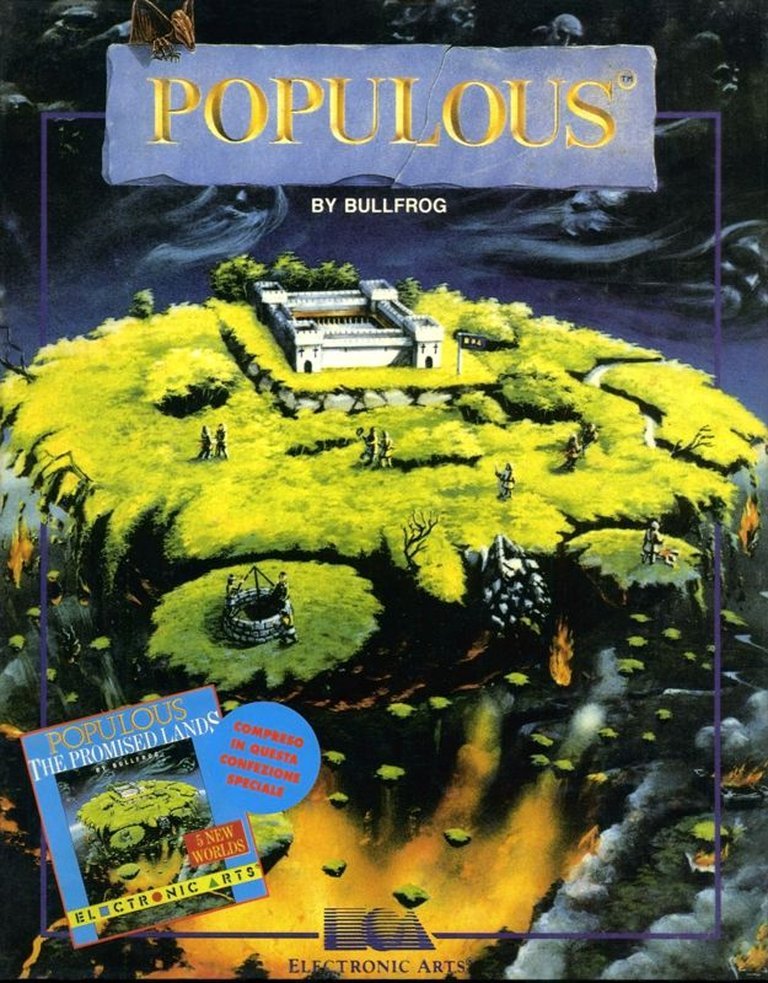
Description
Populous / Populous: The Promised Lands is a pioneering god game compilation where players assume the role of a deity guiding followers to dominate rival civilizations. Set in a dynamic, terrain-sculpting world, the game combines divine powers with strategic planning to reshape landscapes, command loyalists, and overthrow enemy deities. The bundle includes the original revolutionary 1989 base game Populous and its expansion The Promised Lands, which introduces new scenarios and challenges across diverse platforms like DOS, Amiga, and Windows.
Gameplay Videos
Where to Buy Populous / Populous: The Promised Lands
PC
Populous / Populous: The Promised Lands Free Download
Populous / Populous: The Promised Lands Guides & Walkthroughs
Populous / Populous: The Promised Lands Reviews & Reception
gamepressure.com (81/100): the official add-on to Populous, a strategy game released by Electronic Arts in 1989 and the first major success of the British studio Bullfrog
lemonamiga.com : Populous is an absolute evergreen and can be mentioned in the same breath as classics such as Will Wright’s Sim City, DMA Design’s Lemmings or Westwood’s Dune II: The Battle for Arrakis
Populous / Populous: The Promised Lands Cheats & Codes
Populous – The Beginning (PC)
Press Tab+F11 to open the console, type “Byrne”, then use the key combinations listed below to activate cheats.
| Code | Effect |
|---|---|
| Tab + F1 | Grant more mana |
| Tab + F2 | Grant free spells |
| Tab + F3 | Unlock all buildings |
| Tab + F4 | Unlock all spells |
| Tab + F5 | Grant maximum mana |
| Hold Tab, press F1, type “byrne”, hold Tab, press F4 | Unlock all buildings (advanced sequence) |
| Hold Tab, press F1 twice, type “byrne”, hold Tab, press F3 | Unlock all spells (advanced sequence) |
| Hold Tab, press F1 twice, type “byrne”, hold Tab, press F2 | Grant free spells (advanced sequence) |
| Hold Tab, press F1 twice, type “byrne”, hold Tab, press F5 | Grant maximum mana (advanced sequence) |
| Hold Tab, press F1 twice, type “byrne”, hold Tab, press F1 | Grant more mana (advanced sequence) |
Populous – The Beginning (Sega Master System/SG‑1000 Mark III)
| Code | Effect |
|---|---|
| MORINGHILL | Teleport to Level 0010 |
| BADACON | Teleport to Level 0016 |
| BUGQUEEND | Teleport to Level 0019 |
| BINOZOND | Teleport to Level 0022 |
| QAZITORY | Teleport to Level 0025 |
| SUZALOW | Teleport to Level 0030 |
| HURTLOPLAS | Teleport to Level 0033 |
| CALOZBOY | Teleport to Level 0036 |
| BURMPAL | Teleport to Level 0041 |
| BILADOR | Teleport to Level 0044 |
Populous – The Beginning (SNES)
Enter the following Game Genie codes into your SNES controller to activate cheats.
| Code | Effect |
|---|---|
| T2M1SH5L4 | Unknown effect |
| SH1DG453T | Unknown effect |
| H3RTYD5R | Unknown effect |
| H5BS5DP1L | Unknown effect |
| S1DW2L4R | Unknown effect |
| L5W5ZM4T | Unknown effect |
| C5R4LD | Unknown effect |
| B2N3H5L4 | Unknown effect |
| M2NQ34L1S | Unknown effect |
| B2LD2L5W | Unknown effect |
| Q1ZD4P1L | Unknown effect |
| M5R14R | Unknown effect |
| L1P5G52NG | Unknown effect |
| B1D2K4T | Unknown effect |
| R2NG1SB1R | Unknown effect |
| W41VC4L1S | Unknown effect |
| B3GVL5N | Unknown effect |
| C1LS5D2CK | Unknown effect |
| M2MW2LJ5B | Unknown effect |
| J5SGB2NG | Unknown effect |
| K2LL4T | Unknown effect |
| E513B1R | Unknown effect |
| SC5Q342LL | Unknown effect |
| SW1D2T5RY | Unknown effect |
| N2MD42CK | Unknown effect |
| H1M5XJ5B | Unknown effect |
| B3R5G5L2N | Unknown effect |
| V4RY2K43L | Unknown effect |
| D531SP2L | Unknown effect |
| SH2C42LL | Unknown effect |
| F3TYT5RY | Unknown effect |
| S3ZS5D5RD | Unknown effect |
| T2MK5PC5N | Unknown effect |
| SH1DGBL2N | Unknown effect |
| H3RT43L | Unknown effect |
| H5B3P2L | Unknown effect |
| S1DQ34L36 | Unknown effect |
| L5WD2H2LL | Unknown effect |
| C5R415RD | Unknown effect |
| B2N5XC5N | Unknown effect |
| Q1Z1S4ND | Unknown effect |
| B2L2K4B5Y | Unknown effect |
| M5RC4L3G | Unknown effect |
| L1PTH2LL | Unknown effect |
| B1DQ1ZD5N | Unknown effect |
| R2NGK5PM1R | Unknown effect |
| W41VGB5LD | Unknown effect |
| B3G4B5Y | Unknown effect |
| C1L34ND | Unknown effect |
| M2MQ34M4 | Unknown effect |
| J5SMPP4RT | Unknown effect |
| K2LL41D5N | Unknown effect |
| BINMEOUT | Unknown effect |
| SC55G5H1M | Unknown effect |
| SW12K45ND | Unknown effect |
| N2M1SM4T | Unknown effect |
| H1MP4M4 | Unknown effect |
| MINGBDON | Unknown effect |
| HAMINMAR | Unknown effect |
| D53K5PD5R | Unknown effect |
| SH2GBH1M | Unknown effect |
| DOUPEBAR | Unknown effect |
| SHIOZER | Unknown effect |
| HURTIKEING | Unknown effect |
| SH1DMPH5L4 | Unknown effect |
| TIMOMAR | Unknown effect |
| H5B5XD5R | Unknown effect |
| SCOMPHILL | Unknown effect |
| SWAHIPMET | Unknown effect |
| KILLQAZED | Unknown effect |
| B2NP4LD | Unknown effect |
| M2NTH5L4 | Unknown effect |
| MORINCON | Unknown effect |
| NIMLOPILL | Unknown effect |
| BILTHILL | Unknown effect |
| RINGOXMET | Unknown effect |
| WEAVEAED | Unknown effect |
| R2NGH2PT | Unknown effect |
| BADOGOOND | Unknown effect |
| IMMOCON | Unknown effect |
| HOBMEILL | Unknown effect |
| M2M5G52CK | Unknown effect |
| SHADKOPEN | Unknown effect |
| CORQAZME | Unknown effect |
| E51P4T | Unknown effect |
| SADGBOND | Unknown effect |
| LOWINLOW | Unknown effect |
| QAZLOPICK | Unknown effect |
Populous / Populous: The Promised Lands: Review
Introduction
In the pantheon of video game innovation, few titles loom as large as Populous, the 1989 god-game progenitor that redefined interactive power fantasies. Developed by Bullfrog Productions and masterminded by Peter Molyneux, this seminal work didn’t just create a genre—it gave players dominion over digital life itself. Bundled with its expansion The Promised Lands, this compilation represents a divine mandate for strategy enthusiasts and historians alike. This review examines how a modest British studio, constrained by late-’80s technology, birthed a legendary franchise while analyzing its enduring influence, thematic depth, and mechanical brilliance—flaws and all.
Development History & Context
Studio Genesis and Vision
Bullfrog Productions, founded in 1987 by Peter Molyneux and Les Edgar, operated from a converted dentist’s office in Surrey, England. Fresh from the middling success of Fusion and Druid II, the team sought a revolutionary concept. Molyneux’s eureka moment emerged from artist Glenn Corpes’ experimentation with isometric landscapes—a perspective popularized by Zaxxon and Knight Lore but unexplored in strategy contexts. The vision? To cast players not as pawns but as omnipotent deities shaping civilizations.
Technological Constraints and Ingenuity
With a paltry £20,000 budget and 16-bit hardware limitations (Amiga, Atari ST, DOS), Bullfrog faced daunting challenges. Procedural terrain deformation demanded creative optimization; the solution was an abstracted elevation system where land could be raised/lowered in tile-based increments. The now-iconic isometric view, while pioneering, caused Molyneux motion sickness during testing. Development relied on crude prototyping—Lego blocks simulated terrain manipulation, though water physics tests famously flooded the office.
Industry Landscape
1989’s gaming sphere prioritized arcade ports and platformers (Super Mario Bros., Prince of Persia). Strategy games like SimCity (1989) existed but lacked real-time dynamism. Electronic Arts, sensing a niche, signed Bullfrog despite Molyneux deeming their royalty terms “atrocious” (10% rising to 12% after a million sales). The gamble paid off: Populous moved four million copies, becoming EA’s cash cow and establishing Bullfrog as industry luminaries.
Narrative & Thematic Deep Dive
Plot as Abstract Mythos
Populous intentionally eschews linear narrative. Players embody an unnamed deity guiding followers against a rival god across 500 procedurally generated “worlds.” Victory requires converting terrain and annihilating敌对信徒, evolving from humble terraformer to wrathful manipulator. The expansion, The Promised Lands, amplifies this minimalism with five surreal landscapes—Wild West, Block Land (Lego-inspired), Silly Land (alien), Bit Plains (digital), Révolution Française—each reskinning assets without narrative context.
Themes of Creation and Morality
The game’s brilliance lies in emergent storytelling. As a divine arbiter, players juggle creation (raising land for settlements) and destruction (summoning volcanoes). This duality echoes mythological tropes: benevolent versus vengeful gods, ecological order versus cataclysm. The Promised Lands complicates this with cultural caricatures—French revolutionaries, Native Americans—risking reductiveness but emphasizing gameplay as the true narrative driver.
Gameplay Mechanics & Systems
Core Loop: Terraforming and Mana
At its heart, Populous is a real-time strategy god-sim. Players manipulate terrain to create habitable land while managing “mana”—divine energy gained from follower count. Basic powers (raise/lower land) escalate to cataclysms: earthquakes, floods, Armageddon. Each level demands tactical foresight: flattening terrain grants building space, but excessive alteration can isolate followers.
Expansion Nuances
The Promised Lands introduces aesthetic variety but no mechanical innovations. Silly Land’s alien followers attack aggressively, demanding faster mana accumulation—effectively a difficulty tweak. Block Land’s Lego aesthetic delights, while Bit Plains’ digital theme (floppy disk houses, mouse cursor “papal magnet”) showcases Bullfrog’s wit.
UI and Controls
The interface remains remarkably intuitive: an isometric viewport bordered by clickable icons for powers, with terrain edited via mouse drags. Critics praised its elegance, though PC controls suffered without mouse support (later patched). The expansion’s CD-ROM iterations (TurboGrafx-CD, FM Towns) added redbook audio but faced criticism for repetitive tracks.
Flaws and Repetition
With 500 near-identical levels, monotony creeps in. Later stages demand grinding mana reserves, exposing the shallow progression. ST Format quipped that the expansion felt “more gimmick than serious attempt” but conceded its budget price justified inclusion.
World-Building, Art & Sound
Isometric Ingenuity
Bullfrog’s art direction prioritized clarity over realism. Followers resemble animated chess pieces, while settlements evolve from huts to castles—all legible on period CRT monitors. The Promised Lands amplifies whimsy: Révolution Française replaces knights with guillotine-wielding revolutionaries, and Bit Plains parodies early computing.
Atmospheric Audio
Rob Hubbard’s chiptune score (Amiga) merges sacred chorales with pulsating synths—a divine contrast to David Hanlon’s crunchy SFX (earthquakes crackle, floods whoosh). The CD ports’ orchestral arrangements, however, loop jarringly, per Retro Replay critiques.
Modding and Community
Bullfrog encouraged player creativity via Populous World Editor, allowing custom maps and sprites—a proto-modding toolkit that extended relevance.
Reception & Legacy
Launch Acclaim and Critique
Upon release, Populous earned rapturous praise: Computer Gaming World called it “unbelievably addictive,” awarding it 1990 Strategy Game of the Year. Critics lauded its originality but noted repetitive late-game loops (Games International: 2/5). The Promised Lands garnered mixed-to-positive reviews (MobyGames aggregate: 84% critics, 4.2/5 players), praised for novelty but dismissed as non-essential.
Cultural Impact
The game birthed the god-game genre, influencing Black & White, Dungeon Keeper, and modern titans like Civilization. Molyneux’s design ethos—player-as-creator—permeates indie darlings (Terra Nil, Worldbox).
Longevity and Re-Releases
GOG.com and Steam reissues (via DOSBox) preserve its legacy, while Populous DS (2008) modernized terraforming for touchscreens. The scheduled 2025 archival update on MobyGames underscores its historical reverence.
Conclusion
Populous / Populous: The Promised Lands is less a flawless masterpiece than a foundational artifact—a digital Excalibur pulled from the stone of 16-bit innovation. Its expansion fascinates as a time capsule of Bullfrog’s audacity, even if it prioritizes reskins over revolution. For historians, it remains indispensable; for players, its deliberate pace and archaic interfaces may challenge modern sensibilities. Yet as the god-game genre’s primordial deity, Populous demands veneration: a testament to how constraint breeds genius, and how virtual worlds can make gods of us all. Verdict: A divine cornerstone of gaming history, essential but imperfect.