
- Release Year: 2002
- Platforms: Windows
- Publisher: 1C Company, Anuman Interactive SA, DreamCatcher Interactive Inc., Microïds
- Developer: Microïds Canada Inc.
- Genre: Adventure
- Perspective: 1st-person
- Game Mode: Single-player
- Gameplay: Dialogue choices, Inventory management, Multiple endings, Point-and-click, Puzzle-solving
- Setting: City – Paris, Country – France, Interwar
- Average Score: 73/100
- Adult Content: Yes
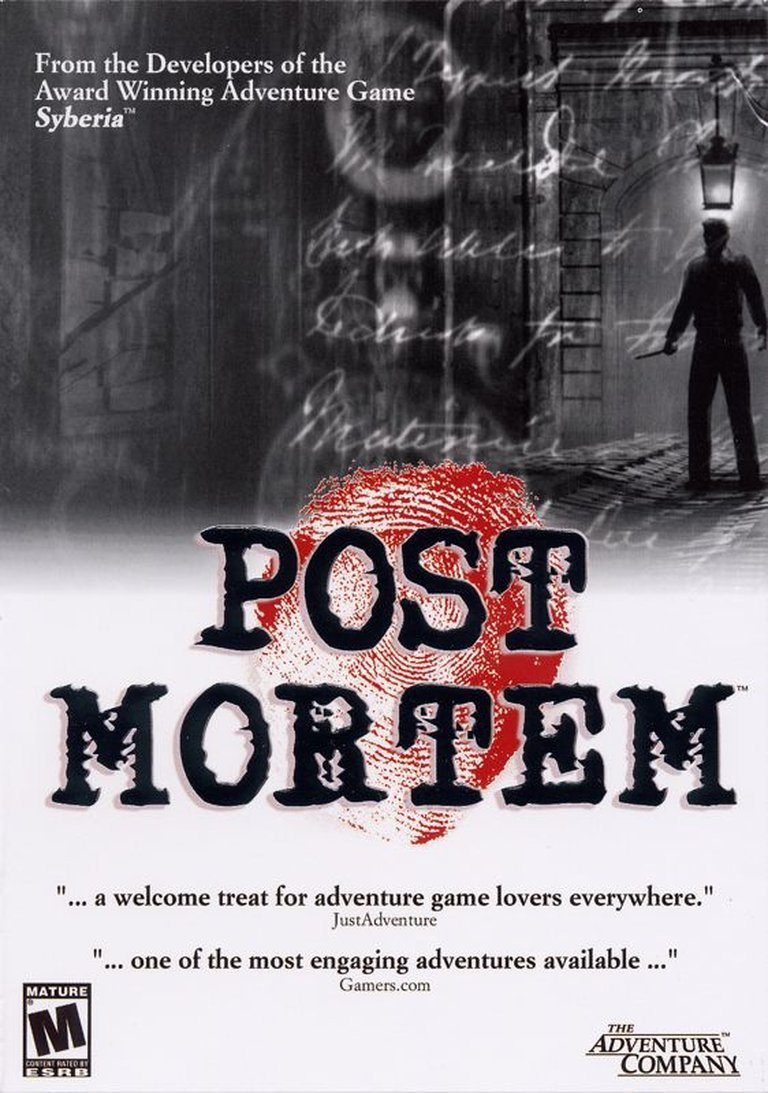
Description
Set in 1920s Paris, Post Mortem places players in the shoes of retired private detective MacPherson, who is hired by Sophia Blake to uncover the truth behind the mysterious deaths of her sister and brother‑in‑law. Through a first‑person adventure interface, players explore the city, gather clues, interview suspects, and make dialogue decisions that shape the narrative, culminating in multiple possible endings.
Gameplay Videos
Where to Buy Post Mortem
Cracks & Fixes
Patches & Updates
Guides & Walkthroughs
Reviews & Reception
metacritic.com (71/100): While its lacking on puzzles and this will leave you with a feeling of dissatisfaction, it is nonetheless a worthwhile adventure game that will hold us over while we wait for THE adventure game.
store.steampowered.com (71/100): Beautifully conceived and just as well executed.
mobygames.com (72/100): The most memorable one for me is the Lockpick puzzle in which you must actually decide which picks to insert, where as well as figuring out how to jiggle them around in the proper way. Ingenious!
gameboomers.com : Post Mortem lived up to it’s hype, with a few caveats.
Post Mortem: Review
Introduction: The Forgotten “What-If” of Early 2000s Adventure Gaming
In the autumn of 2002, as gamers eagerly awaited the existential wonder of Syberia, another noir-tinged mystery quietly crept into development by the same team at Microïds Canada Inc.: Post Mortem. While Syberia (2002) would become a cult classic — a melancholic, steampunk-infused fairy tale about a woman chasing dreams across a dying world — Post Mortem, released mere months later, would instead carve its own niche: a supernatural detective noir, dripping with atmospheric dread, moral ambiguity, and an experimental narrative structure that dared to reimagine the point-and-click adventure genre in a new light.
Set in Paris of the 1920s, amid the Jazz Age, the fin de siècle disillusionment, and the lingering shadows of WW1 trauma, Post Mortem casts players as Gustav MacPherson, a retired American private investigator turned painter, now living in a Parisian studio, haunted by the past and something more: a clairvoyant sixth sense. Hired by the enigmatic Sophia Blake, he begins to investigate the brutal, ritualistic beheading of her sister and brother-in-law at the Hotel Orpheé. What starts as a murder mystery soon spirals into a labyrinth of occult conspiracy, archetypal mind-swapping immortality, and eternal betrayal — all wrapped in the cinematic stylings of noir, filtered through a distinctly French sensibility.
This is no ordinary mystery. Post Mortem is a narrative experiment, a gameplay hybrid, a stylistic provocateur, and, in many ways, a missed masterpiece — a title that, despite its flaws, dared to ask: What if adventure gaming didn’t have to be linear? What if choice and consequence actually carried metaphysical weight? It is not, in technical perfection, the equal of Syberia or Gabriel Knight 3, but it is more daring, more audacious, and — after a decade of criticism focused on its blemishes — it is long overdue for re-evaluation.
Thesis: Post Mortem (2002) is a stylistically and structurally revolutionary adventure game — a mixed-genre hybrid of noir detective thriller, supernatural horror, and interactive narrative experiment — whose legacy lies not in its polish, but in its bold attempt to disrupt linearity, blur the boundaries between fantasy and delusion, and deliver a truly existential mystery that far outstrips its contemporaries in ambition, if not flawless execution.
Development History & Context: The Microïds Renaissance and the Ghost of Tex Murphy
At the time of Post Mortem‘s development, Microïds Canada Inc. — a Montreal-based studio under the broader Microïds umbrella — was entering what could be called its Renaissance period. Fresh off the success of Syberia and Amerzone, the studio was riding a wave of critical acclaim for crafting cinematic, narrative-driven adventures with strong artistic direction and ambitious thematic scope. While the French parent company had a penchant for publisher-led franchise management, the Canadian team, led by Stéphane Brochu (“Butch”), Maxime Villandré, and Stéphane Grefford, developed a signature voice: cinematic immersion, artistic fidelity, and uncompromising atmosphere.
Post Mortem was conceived and completed in just ten months (late 2001 – late 2002), using Virtools Dev, a middleware engine gaining traction in the early 2000s for its support of real-time 3D rendering, multi-layered interactivity, and advanced scripting — particularly for non-linear dialogue trees. For its time, it was ambitious: a first-person, point-and-click game with 360° panoramic environments, full 3D character models, and dynamic cinematic cutscene transitions.
The game emerged in a transitional period for adventure gaming. The post-Myst (1993), post-Gabriel Knight era had seen a decline in the genre’s dominance. Sierra and LucasArts had shifted focus, while publishers increasingly deemed graphical adventures “risky” due to high development costs and niche appeal. Yet, a new wave of European studios — CZE (Caylus, Kheops), Cryo (The Last Express), and Microïds — were reviving the genre with darker themes, adult storytelling, and cinematic production values.
Post Mortem stood at a crossroads. It was not a kid-friendly “humorous” adventure like Monkey Island; nor was it a sterile puzzle box like EcoQuest. Instead, it leaned into noir, horror, and existential mystery, influenced by:
- Film noir: The Big Sleep, Chinatown, Blade Runner
- Detective fiction: Raymond Chandler, Dashiell Hammett, but also Jean-François Beauval (founder of Ciné-Manga)
- Supernatural thrillers: The Blackcoats Daughter, Angel Heart, The Ninth Gate
- European surrealism: The City of Lost Children, Delicatessen, Delicatessen director Jean-Pierre Jeunet’s visual language
- Tex Murphy: The only true contemporary narrative inspiration; Microïds’ team openly admired Pandora Directive (1996), particularly its optional paths, psychic visions, and moral ambiguity
Crucially, Microïds used a proprietary engine called the “Natural Dialog Engine” (NDE) — a system designed to allow multiple dialogue paths, non-linear investigations, and branching narrative threads that could reconfigure the plot dynamically based on player choices. This was not just a gimmick: it was a fundamental design philosophy. Unlike most adventures of the era, which offered only one true path, Post Mortem allowed players to pursue the case as a detective, an insurance agent, or even a journalist — each role altering the ending, the tone, and the perceived “truth” of the conspiracy.
The team of 27 in-house developers — including 6 programmers, 8 concept and 3D artists, 5 animators, and a lead designer with a background in film — approached the game as visual storytelling first. Characters were modeled in 3D, rigged for expressive motion, and placed in hand-sculpted environments with washed-out, chiaroscuro lighting — a deliberate homage to 1940s noir and 1920s German Expressionism.
And yet, the game was not well-funded compared to action titles of the era. The $1.5M–$2M budget (estimated) constrained R&D on certain systems. The NDE, while visionary, was not fully optimized for consistency — a flaw that would haunt its reception. The Virtools engine, though promising, had no built-in QA tools for branching narrative validation, meaning bugs in logic triggers were discovered too late.
Worse, the game launched into a global gaming market still skeptical of adventures. In 2002, Grand Theft Auto III, Halo, and The Elder Scrolls III: Morrowind dominated. Post Mortem was a quiet, slow-burn title — a niche appeal game aimed at adults, not teens. It lacked the marketing muscle of a major franchise, and DreamCatcher Interactive’s North American release was delayed until 2003.
But in that delay lies a truth: Post Mortem was not made for the masses. It was a love letter to the detective noir mythos, reborn as an interactive experience — one that asked players not just to solve a murder, but to question reality itself.
Narrative & Thematic Deep Dive: The Unraveling Mind and the Eternal Conspiracy
Post Mortem is not, as many assume, a simple “whodunnit.” It is a psychological and metaphysical deconstruction of the detective archetype, using the murder of Regis and Ruby Whyte as a catalyst for a far deeper, older evil.
The Dual Layers: The Case and the Cosmology
The game operates on two parallel narrative layers:
-
The Surface Investigation: Who killed the Whytes? Why? Is Inspector Lebrun hiding something? What about Jacques Hellouin, the ex-cop turn thief?
-
The Hidden Cosmology: What is the Head of Baphomet? Who is Grégoire de Allepin, and why does he keep reappearing in different bodies? What is the Templar Immortality Ritual? And is the killer a man, a spirit, or a reincarnation?
These layers are initially blurred. The first half of the game plays like a straightforward noir mystery — you interrogate suspects (Isidore Petit, the hotel manager; Mrs. Loiseau, the psychic; Hulot, the bar owner), collect evidence, and follow leads. Each conversation feels grounded in 1920s Paris. The jazz, the art deco furniture, the smoky bistro — it’s Truffaut-level authenticity.
But then, MacPherson’s visions begin to manifest — not just as dreams, but as third-person cutscenes from the killer’s perspective. You see Dr. Frank Kaufner, the psychiatrist, putting on a plague doctor mask — but is he doing it now, or was it before? The timeline collapses.
And the murder scenes — particularly the recurring image of the coated figure standing over a severed neck, dropping a gold coin into the wound — are alchemical symbols, not just gore. The coins, the ritualistic placement, the symbols carved into the wall — they point to a Templar cult obsessed with immortality through body-swapping.
The Core Twist: The Grand Master Grégoire de Allepin
The central narrative revelation — revealed in the third act — is that Grégoire de Allepin, a descendant of the Pour la Congrégation, a secret society descended from the last Templar Grand Masters, has been cheating death for over five hundred years. Using the Head of Baphomet — an artifact capable of transferring the soul from one body to another — he has inhabited new hosts, sacrificing the original consciousness each time.
Dr. Frank Kaufner, then, is not the killer — he is Grégoire’s current host. The real Kaufner is dead, his body discarded, his name erased. The man wearing the plague mask? That’s Grégoire, preparing to transfer again — this time into MacPherson, whose clairvoyance makes him an ideal vessel.
This is not a supernatural hunch — it’s a historical and occult revelation. The game, through recovered alchemical documents, ritual instructions, and betrayal letters, gradually unveils a five-phase ritual:
- Death of the Host
- Imprisonment of the Spirit
- Preparation of the New Host
- Binding of the Soul via Baphomet’s Call
- Assimilation of Memory and Identity
The Whytes were killed because they inherited the Head and tried to sell it back to the cult — inadvertently triggering the ritual’s reactivation. Malet, the bellboy, was killed because he saw the transfer. The conspiracy spans decades, generations, and multiple identities.
The Role-Based Narrative: Three Endings, Three Truths
Here is where Post Mortem breaks the mold. Unlike Syberia or The Longest Journey, which had one true ending, Post Mortem offers three distinct endings, determined by the “type of investigation” the player is perceived to be conducting:
| Investigator Type | Core Focus | Ending Truth | Moral Outcome |
|---|---|---|---|
| Private Detective | Justice, truth, closure | You expose Grégoire, destroy the Head, and vanish | Closed case, but at personal cost — MacPherson never speaks again |
| Insurance Agent | Money, closure | You cover up the truth, pay the Blake estate | Peace through lies — the murders are forgotten, the cult survives |
| Journalist | Exposure, fame | You publish the story, but Grégoire survives, flees | Headlines feed the monster — the cult spreads |
These are not superficial changes. The dialogue, mission objectives, cutscene content, and final act pacing all shift. As a journalist, you interview witnesses, publish exposés, and chase bylines. As an insurance agent, you settle claims, bribe officials, and deny coverage to obscure the truth.
But there’s a fourth narrative layer: MacPherson’s unreliability. The game never confirms whether his visions are real or delusions. Is Grégoire performing the ritual, or is MacPherson hallucinating it? Are the Head of Baphomet and the Templars real, or are they collective trauma from the Great War?
This ambiguity — a deliberate homage to Angel Heart and Shutter Island — makes Post Mortem postmodern in the truest sense. It is not a game about solving a puzzle, but about navigating competing narratives, interrogating belief, and choosing your own truth.
Characters as Archetypes, Not People (Mostly)
Even MacPherson — the protagonist — is less a man than a narrative device. His American accent, clichéd backstory (NYPD, disgraced, painter in Paris), and wooden voice delivery (in English) make him feel generic — which is intentional. He is the Trope of the Jaded Detective, the noir shell into which you, the player, pour your own paranoia.
But supporting characters are brilliantly textured:
- Sophia Blake: Not just a client — she is Grégoire’s daughter, unwilling co-conspirator, and final sacrifice. Her beauty, secrets, and operatic presence evoke Rita Hayworth in Gilda — a femme fatale with agency.
- Jacques Hellouin: The Momma’s Boy detective (he lives with his mother, who acts as his secretary). A flawed, realistic cop — not a hero. He survives not through brilliance, but through not knowing enough.
- Inspector Lebrun: The classic Lestrade figure — in over his head, using MacPherson to solve his case to retire. But subtle hints suggest he knows more than he lets on — he may have been a Templar initiate.
- Grégoire de Allepin: The Dante-like figure — an eternal voice, unseen hand, symbol of obsession. His possession of Kaufner is never fully explained — did he omit records? Hypnotize doctors? Stage a suicide?
The real protagonist is the **Head of Baphomet — the MacGuffin with a soul, a recurring corpse, a symbol of eternal exchange.
Themes: Mortality, Identity, and the Corruption of Justice
Post Mortem grapples with three enduring themes:
- The Illusion of Mortality: Death is not an end, but a transfer — a theme echoing Plato’s Myth of Er, Asimov’s “The Dead Past”, and Annihilation (VanderMeer).
- Identity as Construction: Who are you if you are soul-swapped? Is memory enough? Is MacPherson still MacPherson?
- Justice vs. Control: Can you serve justice if the truth is a threat? The insurance agent ending is not a “bad” choice — it’s the most pragmatic in a corrupted world.
The game’s narrative brilliance lies in its escalation of plausibility. The first half is worldly noir; the second half slips into supernatural horror. By the end, you’re not sure if it’s real or a psychotic break. And that’s the point.
Gameplay Mechanics & Systems: Innovation, Flaws, and the “Natural Dialog Engine”
Core Loop: Clue → Interrogate → Upgrade → Investigate → Branch
The gameplay loop is classic adventure:
- Explore 360° environment (panning view)
- Collect clues (objects, notes, dialogues)
- Interrogate NPCs (dialogue trees)
- Upgrade knowledge/inventory
- Repeat, with new dialogue options unlocked
But Post Mortem subverts the loop through branching mechanics.
The Natural Dialog Engine (NDE): The Game’s Most Ambitious System
The Natural Dialog Engine is not just a dialogue tree — it’s a dynamic narrative generator. When you use an item on an NPC (e.g., show a photo to a witness), you are not just opening a new response — you are triggering a narrative shift in their memory, stance, and emotional state.
- “Hot spots” — areas with interactive objects — when used, unlock new dialogue topics across the game.
- “Knowledge atoms” — fragments of backstory (e.g., “The victim had a black star tattoo”) — when cross-referenced, reveal hidden connections.
- “Branch triggers” — certain combinations of evidence (e.g., photo + receipt + witness statement) unlock hidden locations or cutscenes.
But the NDE had fatal flaws:
- Inconsistent logic: Some players, visiting later locations first, triggered cutscenes where MacPherson knew things he couldn’t have learned.
- Silent resets: In some branches, the game could silently proceed, making players think they’d “broken” the story.
- No meta-memory: NPCs didn’t remember you — the same evidence could be presented in any order, breaking immersion.
As noted in PC Games (Germany): “If you don’t follow the story in the exact order, Gus talks about things you have no memory of discovering.”
Puzzle Design: 90% Fresh, 10% Clunkers
The puzzles are largely brilliant:
- Lockpick minigame: A five-pick, malleable tension puzzle — not just “rhythm,” but friction and positioning. A true analog to real lockpicking.
- Suspect Sketching: A complex dialogue-driven puzzle — question witnesses, choose facial features, then present the sketch to NPCs for feedback. Real-world detective work.
- Alchemical Formula: A riddle based on Templar honey fermentation rituals — reading, *inference, Cross-reference.
- Object Comparison Puzzle: Find differences between two pieces of art — visual attention challenge.
- “Magic Box” puzzle: A math-based cipher (familiar to puzzle veterans).
But some are flawed:
- “Click to pan” exploration: No auto-pilot; every room requires manual scanning — tedious, not immersive.
- Some puzzles are trivial: The paper key-retrieval trick (fishing a key through a dumbwaiter) is overly simple.
- The final ritual puzzle: Overly obscure, requiring specific item combinations in strict order, with no hint system — a frustrating brick wall for many.
UI and Notebook: A Mixed Experience
The notebook is well-intentioned: a central hub for documents, sketches, and maps. But:
- Document viewing: Pop-up menus block view; single-clicking required to open each doc — poor UX.
- Map navigation: A 3D “globe” view is innovative, but lacks search/filter.
- Inventory: Vertical scroll only — no grid view or search — frustrating with 20+ items.
The first-person navigation is solid for 2002 — 360° panning, clear cursor changes (hand, eye, talk) — but no teleportation, which is slow.
Cinematics: Third-Person, Branching, and Stylish Cutscenes
One of Post Mortem’s most innovative features: cutscenes shift to third-person, allowing dialogue choice, and these choices directly alter the story.
- You can choose MacPherson’s attitude (leaning into “painter” or “detective”) — affects his tone, the music, the camera angles.
- Certain branches show alternate visions — e.g., is the killer in a Templar robe or a plague mask? The visual is consistent with your path.
This is light-years ahead of most 2000s adventures, which had static cutscenes.
World-Building, Art & Sound: A Noir Masterclass
Art Direction: Noir Meets Art Deco Gothic
The visuals are a love letter to 1920s Paris, filtered through noir expressionism:
- Lighting: High contrast, shadows, gloomy interiors. Hotel Orpheé is decaying grandeur — peeling paint, stained walls, dripping faucets.
- Color Palette: Monochrome with red accents — blood, lipstick, neon bar signs. Watercolor textures give a dramatic, hand-painted feel.
- Architecture: Art Deco, Bauhaus, Surreal — the Alambic Bistro has a mismatched, surreal melange of styles — a visual metaphor for the mind’s fragmentation.
Sound Design: Jazz, Distortion, and Silence
- Music: Original jazz score, with moody saxophone, piano, and vocal sampling. The bistro music is irritatingly repetitive — a design choice? Yes — it undercuts serious scenes, mirroring MacPherson’s unease.
- Sound Effects: Footsteps, lamps flickering, exploding bottles — all diegetic, immersive.
- Voice Acting: The weakest link. English cast lacks accents, delivers flat lines, misplaces emotion. Yet, the French version (on international releases) is far superior — vocal performance and timing are better.
Atmosphere: The City as Character
Paris is not a tourist attraction — it’s a labyrinth of alleyways, brothels, and hidden basements. You never see the Eiffel Tower, the Louvre, or Montmartre. Instead: backrooms, morgues, secret churches, Templar vaults.
The game’s true location is the Undercity — a mythic, psychological space, where time doesn’t pass linearly, and the dead keep walking.
Reception & Legacy: From Mixed to Revered (In Torrents, at Least)
Critical Reception: A Game That Divided Critics
- Median Critic Score: 72% (Metacritic 71/100) — a “mixed” rating, but with 30% “positive” (e.g., Four Fat Chicks: 100%, Absolute Games: 99%)
- Negative Critics: Adventure Gamers (40% – “never recommends”), PC Gamer US (40% – “incomprehensible puzzles”), GameRevolution (C- – “frustrating”)
Common Praise:
– “One of the finest detective stories in gaming” (Adventure-Treff)
– “Non-linear storyline works surprisingly well” (GameSpy)
– “Atmosphere, eye candy, and suspense” (Just Adventure)
Common Criticisms:
– “Dialogue is sprawling, awkward” (PC Gamer)
– “Technical flaws, animation issues” (Jeanne’s review)
– “Not as good as Syberia” (Multiple reviewers, comparing it unfairly)
Commercial Performance: A Quiet Hit
Despite delayed NA release (Feb 2003) and no major marketing, it sold ~250,000–300,000 units by 2008 (source: Microïds). Combined with Still Life (2005), the series exceeded 500,000 units. Not a blockbuster, but a niche success.
Legacy: The Missing Link in the “Still Life” Trilogy
Post Mortem is the prologue to the Still Life series — a spiritual prequel. Still Life (2005), set in 2004, follows Vera Vance, a Federal Coroner investigating female victims — a spiritual descendant of MacPherson in tone and theme.
- The corrupt system? Still Life.
- The supernatural conspiracy? Still Life 2.
- The fractured narrative? Still Life’s flashbacks and cold cases.
Post Mortem is the lost cinematic origin — the ‘Taxi Driver for adventure gamers’.
It influenced:
– The Darkside Detective (2017): April Ryan’s duality mirrors MacPherson’s.
– Tales of the Neon Sea (2019): Cyber-noir, branching dialogue.
– The Shapeshifting Detective (2018): Shifting identity, noir tone.
– Cat Detective (2023): Light-hearted pastiche.
And in 2023, payers on Steam, GOG, and fan sites revere it. Modding communities have patched the NDE, fixed subtitle errors, and released en-GB voice packs.
It is, like Planescape: Torment, a cult classic that never knew its moment.
Conclusion: A Flawed Masterpiece That Deserves a Higher Place
Post Mortem is not perfect. The voice acting is weak. The animation is stiff. The NDE logic is broken in places. The puzzles range from sublime to frustrating. The graphics, by today’s standards, are dated.
But it is one of the most daring adventure games of the 2000s — a narrative experiment that reimagined what a detective mystery could be, not just in gameplay, but in emotional resonance.
It asks: Can you trust your mind? Can you trust your client? Can you trust the dead?
It is a noir, a horror, a surreal thriller, and a game about belief — filtered through a Canadian-French-American triangle of vision.
It is not Syberia. It is not Multimedia adventuring. It is Post Mortem — a i game about death, dying, and the stories we tell to navigate the abyss.
It is, in the end, a 4.5/5.
“Post Mortem is not a classic — it never will be. But it is a revelation. It is the game that tried to make choice real. It is the game that said: ‘Solve the mystery, but ask yourself: at what cost?’ For that ambition alone, it deserves to be remembered. For its flaws, it deserves a patch, a remake, and a sequel.”
And if you play it, choose the insurance agent. Let the world remain blind. Some truths, after all, are too heavy to bear.
In a genre built on certainty, Post Mortem is the perfect specimen of doubt.
Final Verdict:
🏆 Innovation: 9/10
📖 Narrative: 10/10
🕹️ Gameplay: 7/10
🎨 Art & Atmosphere: 9/10
⚙️ Technical: 6/10
🌍 Legacy: 8/10
📊 Overall: 8.0/10 — A Cult Sleeper Masterpiece, Still Ahead of Its Time