
- Release Year: 2003
- Platforms: Windows
- Publisher: Uwisoft
- Developer: Uwe Härtel
- Genre: Board game, Peg solitaire, Puzzle
- Perspective: Top-down
- Game Mode: LAN, Online PVP, Single-player
- Gameplay: Board game, Turn-based
Description
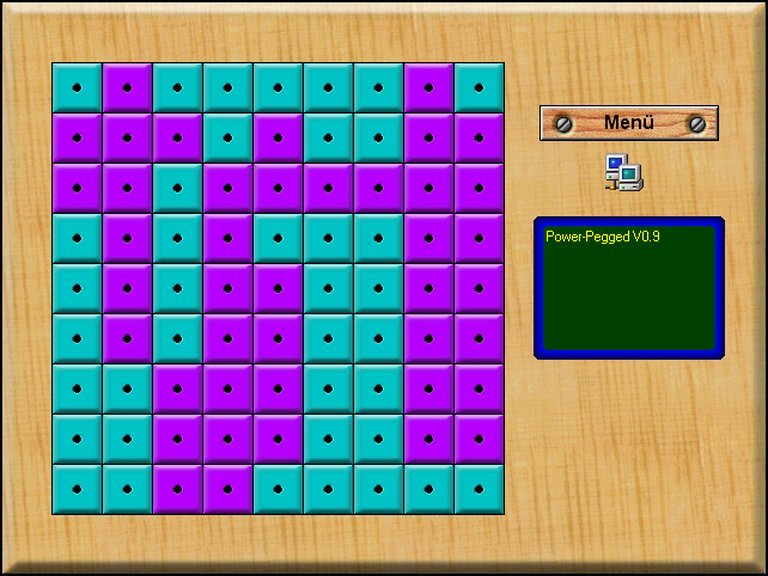
Power Pegged is a turn-based puzzle board game that challenges players to remove all but one game piece by executing horizontal or vertical jumps. Starting with a single empty space, each jump creates a new empty slot while removing the pieces involved. Players must strategize to avoid being trapped in a position with no further moves. The game caters to both solo puzzle-solving and multiplayer competition, where the objective is to force the opponent into a losing position. Additionally, a Level Editor is included for creating custom levels.
Power Pegged Reviews & Reception
retro-replay.com : Power Pegged delivers addictive gameplay and limitless replay value.
Power Pegged: Review
Introduction
In the crowded landscape of 2003’s gaming landscape—dominated by epic RPGs like Star Wars: Knights of the Old Republic, visceral shooters like Call of Duty, and open-world masterpieces like The Legend of Zelda: The Wind Waker—a quiet anomaly emerged. Power Pegged, released as freeware by German developer Uwe Härtel, distilled video game design into its purest form: a single, elegant puzzle mechanic. While contemporaries bloated their experiences with cinematic cutscenes and sprawling narratives, Härtel crafted a digital distillation of the centuries-old peg solitaire board game, transforming it into a cerebral duel against logic, time, and human opponents. This review examines Power Pegged not as a minor curiosity, but as a testament to the enduring power of minimalist design and emergent gameplay. In an era obsessed with graphical fidelity and narrative ambition, Härtel’s creation remains a paragon of ludic purity—a game where every move is a sentence, and the board is a universe.
Development History & Context
The Solo Visionary and Technological Constraints
Power Pegged stands as a singular achievement, developed entirely by Uwe Härtel—its sole credited creator across 11 projects. Released in October 2003 for Windows, it was born from a confluence of influences: the timeless appeal of peg solitaire (a logic puzzle dating back to the 17th century), the freeware movement flourishing on early-2000s PC shareware sites, and the technological limitations of the era. Running on Windows 95 with DirectX 7.0 compatibility, the game eschewed 3D acceleration in favor of top-down, flip-screen visuals—a choice that prioritized clarity over spectacle. The fixed-screen grid and mouse-only input reflect its board-game heritage, mirroring the tactile simplicity of physical peg boards while abstracting them into digital space.
The Gaming Landscape of 2003
The year 2003 was a turning point for the industry. Console gaming was dominated by the PlayStation 2’s library, which included narrative-driven epics like Final Fantasy X-2 and action-packed titles like SoulCalibur II. PC gaming saw the rise of online multiplayer in EverQuest Online Adventures and the tactical depth of Silent Storm. Against this backdrop, Power Pegged was an act of deliberate counterprogramming. While AAA studios invested millions in cinematic cutscenes and voice acting, Härtel’s freeware model—distributed via his Uwisoft website—focused on accessibility and longevity. The game’s turn-based pacing and minimalist aesthetic were a direct response to the increasingly frenetic pace of mainstream gaming, offering a haven for players seeking mental challenge over sensory overload. Its multiplayer support—via LAN, null-modem cable, and internet—further positioned it as a communal experience, leveraging the burgeoning online culture of the time to extend its replayability.
Narrative & Thematic Deep Dive
The Absence of Story as a Strength
Power Pegged deliberately abandons traditional narrative structures, a choice that elevates its thematic resonance. There are no characters, dialogue, or overarching plot—only a board, pegs, and the player’s intellect. This absence is not a void but a canvas for emergent storytelling. Each session becomes a micro-drama of cause and effect: a single misjudged jump spirals into a cascade of dead ends, while a perfectly planned sequence culminates in the solitary, triumphant peg. The game’s “story” is one of spatial reasoning and temporal consequence, echoing themes of fate versus free will.
Multiplayer as Psychological Arena
In two-player mode, this narrative potential explodes. Mirrored boards transform the game into a silent chess match, where every move telegraphs strategy to an opponent. The unspoken tension—reading an opponent’s intent, predicting their traps, or baiting them into a corner—forges a narrative of rivalry and psychological warfare. As Retro Replay notes, multiplayer cultivates “a sense of rivalry and camaraderie that few narrative engines can match.” A match isn’t won or lost; it’s a chapter in an ongoing dialogue between players, with each board state a cliffhanger.
The Level Editor as User-Created Lore
The included Level Editor transcends utility, becoming a tool for communal storytelling. By designing puzzles, players become both architects and authors, crafting scenarios that embody personal philosophies of challenge or fairness. A level riddled with asymmetric dead ends might represent a designer’s love for ruthless puzzles, while an elegant, symmetrical board could reflect a pursuit of aesthetic purity. These user-generated levels form an ever-evolving canon of player-driven narratives, where each uploaded puzzle is a shared story waiting to be solved.
Gameplay Mechanics & Systems
Core Loop: The Dance of Elimination
Power Pegged’s genius lies in its simplicity. The board starts peppered with pegs save for one empty square. Players jump a peg horizontally or vertically over an adjacent peg into the empty square, removing the jumped piece. The goal: reduce the board to a single peg. This mechanic—borrowed from peg solitaire—becomes a complex web of possibilities. Early levels introduce small grids (e.g., 3×3) to teach the rules, but soon escalate to sprawling, asymmetric layouts where spatial awareness is paramount. A single miscalculation can strand the player, as Retro Replay warns: “one wrong jump can strand you in an inescapable dead end.”
Strategic Depth Through Constraint
The game’s brilliance emerges from its ruleset. Horizontal/vertical jumps only (no diagonals) and the mandate to jump over a piece create a domino effect of consequences. Each move reshapes the board’s topology, opening or closing pathways. This turns the game into a dynamic puzzle of resource management: pegs are both currency (for removal) and obstacles (blocking future jumps). The turn-based pacing amplifies this, forcing players to mentally simulate future moves before committing. As the difficulty scales, levels introduce “limited maneuvering spaces” (Retro Replay), turning what seems like a simple puzzle into a spatial labyrinth.
Multiplayer: Competitive Logic
Two-player mode transforms the solitary puzzle into a duel. Players take turns on mirrored boards, aiming to trap their opponent in a state with no valid moves. This mode introduces bluffing and foresight: Should you advance your position, sacrificing short-term gains to limit your rival? Or create a trap, forcing them into a corner? The split-screen display ensures transparency, heightening the psychological stakes. A match can swing on a single move—the removal of a critical peg that leaves an opponent with no options.
Level Editor: Infinite Possibilities
The editor democratizes design. Drag-and-drop peg placement, adjustable grid sizes, and real-time testing allow for intricate puzzle-crafting. Players can create “elegant solutions” (Retro Replay) or fiendishly complex traps, then share them online. This extends the game’s lifespan indefinitely, as community challenges replace developer-designed content. The interface’s simplicity—no scripting or complex logic—democratizes creation, making it accessible to novices while offering depth for seasoned designers.
World-Building, Art & Sound
Visual Minimalism: Function as Form
Power Pegged’s aesthetic is a masterclass in restraint. The top-down view uses a fixed-flip-screen grid, reminiscent of classic board games like Chess or Go. Pegs are rendered with subtle shading and polished edges, ensuring clarity against backgrounds of “soft wood tones or sleek stone textures” (Retro Replay). The color palette is monochromatic: dark pegs against light backgrounds (or vice versa), eliminating distractions. Animations are equally purposeful: a smooth arc for jumps, a brief glow on successful removal, and a satisfying “click” as pegs settle. This visual economy underscores the game’s focus on gameplay, not spectacle.
Sound Design as Tactile Feedback
Audio reinforces gameplay without overwhelming. A gentle “pop” accompanies peg removal, providing sonic confirmation of a move’s impact. Pegs landing emit a light “click,” grounding abstract logic in physicality. These sounds are understated but essential—they turn spatial reasoning into a sensory experience. In multiplayer, silence becomes a narrative tool; the absence of music forces players to focus on the board’s state and their opponent’s tension.
The Board as World
The game’s “world” is the grid itself—a microcosm of order and chaos. Each level’s layout tells a story: symmetrical boards suggest mathematical purity, while asymmetric designs imply controlled chaos. The absence of backgrounds or characters redirects attention to the puzzle’s geometry, making the board the sole protagonist. This abstraction is the game’s strength; it invites players to project meaning onto the grid, interpreting it as a battlefield, a laboratory, or a universe.
Reception & Legacy
Launch and Critical Silence
Upon release in October 2003, Power Pegged garnered little mainstream attention. Metacritic’s “Best Games of 2003” list—dominated by titles like The Legend of Zelda: The Wind Waker and Grand Theft Auto: Double Pack—ignored it entirely. Similarly, the MobyGames reviews page remains empty, reflecting its status as a niche title. However, its freeware model and multiplayer focus cultivated a dedicated community. Sites like SocksCap64 praised its system requirements (Windows 95/DirectX 7.0), noting its accessibility on low-spec machines. Retro Replay later lauded its “addictive gameplay and limitless replay value,” while Game Classification highlighted its audience appeal (ages 12–25) and strategic depth.
Legacy in Puzzle Design
Power Pegged’s influence lies in its embodiment of “pure puzzle” design. It prefigured modern minimalist games like Super Hexagon (2012) and Untitled Goose Game (2019), which prioritize mechanics over narrative. The level editor, in particular, foreshadowed user-generated content (UGC) in titles like LittleBigPlanet (2008) and Minecraft (2009), though on a smaller scale. Its multiplayer duels echo competitive puzzle games like Puyo Puyo Tetris (2014), proving that turn-based logic could sustain high-stakes engagement.
Historical Footnote in the Freeware Era
As a freeware title from the early 2000s, Power Pegged belongs to a lineage of PC shareware classics (e.g., Duke Nukem 3D’s demo era). Its distribution via Uwisoft and MobyGames reflects a time when indie developers relied on grassroots platforms. While it never achieved the cultural footprint of The Sims or World of Warcraft, it remains a vital artifact of the freeware movement—a testament to how a single mechanic, in the right hands, can outlast AAA juggernauts.
Conclusion
Power Pegged is a paradox: a game with no story, yet one that tells countless tales; a product of 2003’s technological constraints, yet timeless in its design. Uwe Härtel’s creation strips gaming to its essence—rules, logic, and human ingenuity—proving that depth can emerge from simplicity. Its multiplayer duels and user-generated levels create a living world of emergent narratives, where every board is a new story waiting to be written. While its minimalist aesthetic and niche audience precluded mainstream acclaim, its legacy endures in the DNA of modern puzzle design. In an era of bloated epics, Power Pegged stands as a quiet masterpiece—a reminder that the most profound games are often the ones that speak not with words, but with the elegant geometry of a single, perfectly executed jump.