
- Release Year: 1999
- Platforms: Windows
- Publisher: Albion Sp. z o.o.
- Developer: Albion Sp. z o.o.
- Genre: Educational
- Perspective: Point and select
- Game Mode: Single-player
- Gameplay: logic, Math, Pre-school, toddler
- Setting: Futuristic, Sci-fi
Description
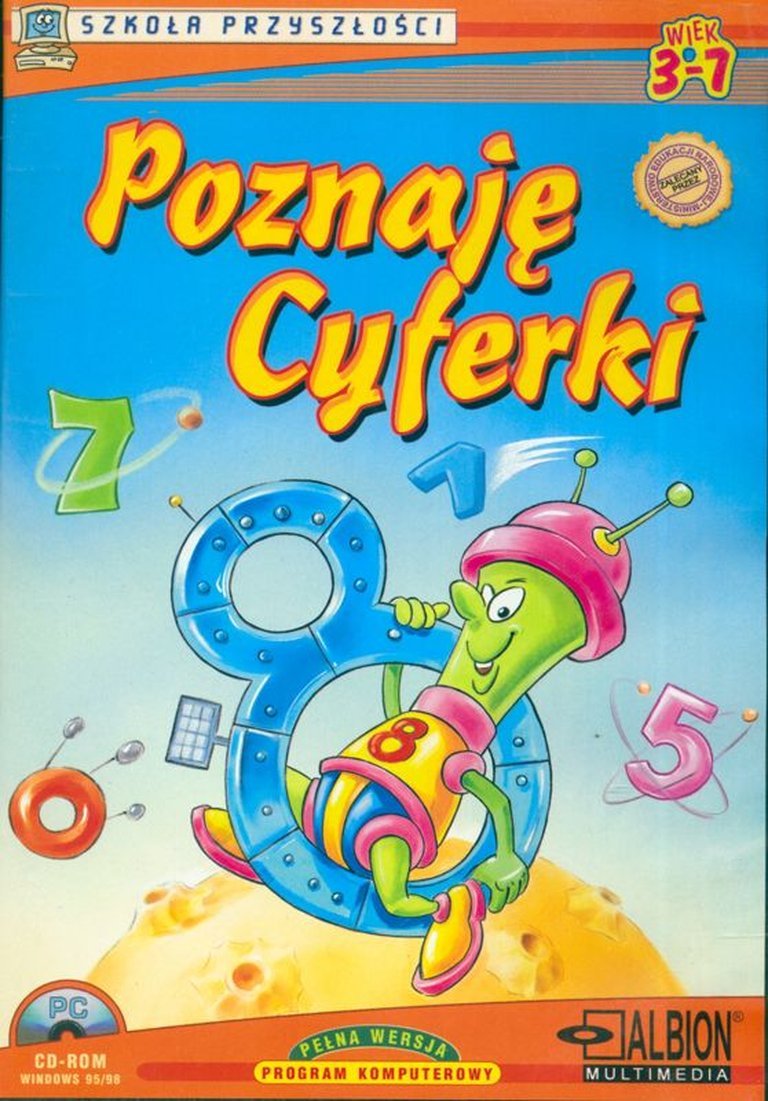
Poznaję Cyferki (I’m Learning Digits) is an educational math game designed for preschool-aged children, set in a vibrant sci-fi star system populated by friendly aliens. Players explore different planets, each offering unique math-themed puzzles such as finding hidden digits, counting items, sequencing numbers, and coloring activities. With the help of Albionek, an alien guide, children earn digits for solving puzzles, and collecting all digits unlocks a celebratory song, making learning both fun and rewarding.
Poznaję Cyferki: A Deep Dive into Poland’s Forgotten Edutainment Gem
Introduction: The Unsung Hero of Early Childhood Edutainment
In the late 1990s, as the video game industry hurtled toward the 3D revolution, a quiet but significant niche flourished: educational software for young children. Amidst the flashy polygons of Final Fantasy VIII and the gritty realism of Half-Life, Poznaję Cyferki (“I’m Learning Digits”) emerged as a humble yet innovative title designed to teach preschoolers the fundamentals of mathematics. Developed and published by Poland’s Albion Sp. z o.o. in 1999, this Windows-based edutainment game remains a fascinating artifact of its time—a blend of whimsical sci-fi storytelling, intuitive gameplay, and pedagogical design.
While Poznaję Cyferki may not have the name recognition of The Oregon Trail or Reader Rabbit, its approach to early childhood education through interactive play was ahead of its curve. This review will explore the game’s development context, its narrative and thematic depth, gameplay mechanics, artistic direction, and its lasting—if understated—legacy in the edutainment genre.
Development History & Context: Poland’s Edutainment Pioneers
The Studio: Albion Sp. z o.o.
Albion Sp. z o.o. was a Polish developer and publisher that operated primarily in the late 1990s and early 2000s, focusing on educational and family-friendly software. While not as prolific as Western contemporaries like The Learning Company or Humongous Entertainment, Albion carved a niche in the Polish market with titles like Poznaję Cyferki and Pacman (a 2001 adaptation of the arcade classic). Their games were often characterized by bright, accessible visuals and a strong emphasis on educational value, tailored to young audiences.
The studio’s output reflects the broader trends of the late 1990s, when CD-ROM-based edutainment software was booming. Games like JumpStart and Math Blaster dominated the Western market, but Albion’s work catered specifically to Polish children, offering localized content that resonated with its audience.
Technological Constraints & Design Philosophy
Released in 1999, Poznaję Cyferki was built for the Windows platform, leveraging the CD-ROM’s storage capacity to deliver a multimedia experience. The game’s technical specifications were modest by modern standards, but its design was optimized for the hardware of the era:
– Point-and-click interface: A staple of late ’90s educational software, ensuring accessibility for young children.
– 2D visuals: While 3D gaming was on the rise, Poznaję Cyferki embraced a colorful, cartoonish aesthetic that was both visually engaging and performance-friendly.
– CD-ROM distribution: The game’s 98 MB footprint (as seen in abandonware archives) suggests a mix of pre-rendered graphics, audio, and simple animations.
The developers’ vision was clear: create an engaging, non-intimidating environment where children could learn basic numeracy skills through play. The sci-fi setting—a distant star system populated by friendly aliens—was an inspired choice, blending the familiar (counting, coloring) with the fantastical (space exploration, alien guides).
The Gaming Landscape of 1999
1999 was a pivotal year in gaming history. The industry was transitioning from 2D to 3D, with landmark titles like Half-Life, Unreal Tournament, and Shenmue pushing technological boundaries. Meanwhile, the edutainment genre was thriving, with companies like Broderbund and Knowledge Adventure releasing titles that combined learning with interactive storytelling.
In Poland, the gaming market was still developing, with many studios focusing on localization or original IP tailored to local audiences. Poznaję Cyferki fit neatly into this ecosystem, offering a homegrown alternative to imported edutainment software. Its release on CD-ROM also aligned with the growing accessibility of personal computers in Polish households, making it a viable tool for parents and educators.
Narrative & Thematic Deep Dive: A Whimsical Journey Through Numbers
Plot & Setting: Math in a Sci-Fi Wonderland
Poznaję Cyferki transports players to a vibrant, alien star system where each planet serves as a hub for mathematical puzzles. The premise is simple yet effective: the player, a young Earthling visitor, is guided by a friendly alien named Albionek, who acts as both tutor and companion. The game’s narrative is minimal but purposeful—every solved puzzle earns the player a digit, and collecting all digits unlocks a celebratory song.
The sci-fi setting is more than just window dressing; it serves as a metaphor for exploration and discovery, framing mathematics as an adventure rather than a chore. This approach aligns with constructivist learning theories, which emphasize learning through exploration and play—a philosophy that Poznaję Cyferki embodies.
Characters & Dialogue: The Role of Albionek
Albionek, the alien helper, is the game’s most memorable character. Serving as an in-game tutor, he provides instructions, encouragement, and feedback, ensuring that young players never feel lost or frustrated. His presence is crucial for several reasons:
– Accessibility: Albionek’s guidance makes the game approachable for preschoolers who may not yet be proficient readers.
– Positive reinforcement: His cheerful demeanor and celebratory responses to correct answers create a low-pressure learning environment.
– Cultural localization: As a Polish-developed game, Albionek’s dialogue and interactions were tailored to resonate with Polish children, making the experience feel personal and relatable.
Themes: Learning Through Play
At its core, Poznaję Cyferki is about demystifying mathematics for young children. The game’s themes include:
1. Discovery: Each planet represents a new challenge, reinforcing the idea that learning is an ongoing journey.
2. Achievement: The digit-collecting mechanic provides tangible rewards for progress, tapping into children’s natural desire for accomplishment.
3. Creativity: Activities like coloring and numbering objects blend artistic expression with numerical learning, appealing to different learning styles.
The game’s lack of failure states or punishments is noteworthy. Unlike many edutainment titles that relied on repetitive drills, Poznaję Cyferki prioritizes joyful engagement, ensuring that children associate math with fun rather than frustration.
Gameplay Mechanics & Systems: Deconstructing the Edutainment Loop
Core Gameplay Loop: Puzzles & Progression
Poznaję Cyferki structures its gameplay around a series of math-themed mini-games, each designed to teach a specific skill:
1. Finding hidden digits: Players scan colorful scenes to locate numbers, reinforcing number recognition.
2. Counting items: Objects are grouped together, and players must count them aloud or select the correct numeral.
3. Numbering objects in order: A sequencing exercise that teaches ordinal numbers (e.g., “first,” “second”).
4. Coloring pictures: A creative break that subtly reinforces counting (e.g., “color three apples red”).
Each activity is self-contained, allowing players to progress at their own pace. The game’s non-linear structure means children can revisit favorite puzzles or skip ahead if they find a particular challenge too difficult.
UI & Accessibility
The game’s interface is a masterclass in child-friendly design:
– Large, colorful buttons: Easy to click, even for children with developing motor skills.
– Minimal text: Instructions are conveyed visually or through Albionek’s voiceovers, reducing reliance on reading comprehension.
– Instant feedback: Correct answers trigger animations or sounds, while mistakes are met with gentle encouragement rather than penalties.
This approach reflects a deep understanding of early childhood cognitive development, ensuring that the game remains engaging without overwhelming its audience.
Innovations & Flaws
For its time, Poznaję Cyferki was innovative in several ways:
– Sci-fi framing: Most edutainment games of the era used earthbound settings (e.g., schools, farms). The alien theme made Poznaję Cyferki stand out.
– Multimodal learning: By combining visual, auditory, and kinesthetic activities, the game catered to diverse learning styles.
– No stress mechanics: Unlike games that punished mistakes, Poznaję Cyferki fostered a growth mindset by celebrating effort over perfection.
However, the game was not without limitations:
– Limited replayability: Once all digits were collected, there was little incentive to revisit puzzles.
– Technical constraints: The 2D graphics, while charming, lacked the interactivity of emerging 3D edutainment titles.
– Niche appeal: The Polish-language focus limited its international reach, confining it to a regional audience.
World-Building, Art & Sound: Crafting a Child’s Cosmic Classroom
Visual Design: A Feast for Young Eyes
Poznaję Cyferki’s art style is bright, cartoonish, and inviting, with:
– Vibrant colors: Each planet has a distinct palette, making the game visually stimulating without being overwhelming.
– Expressive characters: The aliens are designed to be non-threatening and friendly, with exaggerated features that appeal to children.
– Simple animations: While not technically advanced, the animations are smooth and responsive, ensuring that interactions feel satisfying.
The sci-fi setting is rendered in a whimsical, almost storybook-like fashion, avoiding the darker tones of games like Space Quest in favor of a more playful, educational aesthetic.
Sound Design: Reinforcing Learning Through Audio
Audio plays a crucial role in Poznaję Cyferki:
– Voice acting: Albionek’s voiceovers are clear and enthusiastic, guiding players without condescension.
– Sound effects: Correct answers trigger cheerful chimes, while mistakes produce gentle, non-punitive tones.
– Music: The game’s soundtrack is upbeat and melodic, reinforcing the sense of adventure. The reward song upon collecting all digits serves as a memorable capstone to the experience.
The sound design adheres to educational audio principles, using music and effects to enhance retention and engagement without distracting from the learning objectives.
Reception & Legacy: The Quiet Impact of a Polish Classic
Critical & Commercial Reception
Due to its regional focus and the lack of preserved reviews, Poznaję Cyferki’s commercial performance remains undocumented. However, its inclusion in abandonware archives and retro gaming databases suggests it was well-received in Poland, where it likely found an audience in homes and schools.
The game’s MobyGames entry notes that it was collected by at least one player, indicating a small but dedicated following. Its absence from major review aggregators like Metacritic underscores its niche status, but this does not diminish its significance as a culturally specific edutainment tool.
Influence & Historical Significance
While Poznaję Cyferki did not spawn sequels or imitators, its design philosophy influenced later Polish edutainment titles. Its blend of narrative framing, interactive puzzles, and positive reinforcement can be seen in modern apps like Endless Alphabet or Khan Academy Kids, which similarly prioritize joyful learning.
The game also serves as a time capsule of late ’90s edutainment, reflecting the era’s emphasis on CD-ROM multimedia and the belief that computers could revolutionize early childhood education. In this sense, Poznaję Cyferki is a historical artifact, offering insights into the evolution of educational software.
Conclusion: A Small Game with a Big Heart
Poznaję Cyferki is not a game that will appear on “best of” lists or retro gaming retrospectives. It lacks the technical prowess of The Elder Scrolls or the cultural impact of Pokémon. Yet, within its modest ambitions, it achieves something remarkable: it makes learning mathematics fun.
For preschoolers in late ’90s Poland, Poznaję Cyferki was more than a game—it was a gateway to numeracy, wrapped in a sci-fi adventure that sparked imagination. Its legacy lies not in sales figures or critical acclaim, but in the countless children who, thanks to Albionek’s guidance, discovered that numbers could be as exciting as exploring a distant star system.
In the pantheon of edutainment software, Poznaję Cyferki deserves recognition as a pioneering, culturally specific title that understood its audience better than most. It may be forgotten by history, but for those who played it, it remains a cherished childhood memory—a testament to the power of games to educate, inspire, and delight.
Final Verdict: 8/10 – A hidden gem of ’90s edutainment, Poznaję Cyferki is a charming, effective, and underappreciated tool for early childhood learning.