
- Release Year: 1999
- Platforms: Macintosh, Windows 16-bit, Windows
- Publisher: REMedia Inc.
- Developer: REMedia Inc.
- Genre: Ecology, Educational, Geography, History, Nature, Science
- Perspective: Isometric
- Game Mode: Single-player
- Gameplay: Game show, quiz, trivia
- Setting: Prehistoric
Description
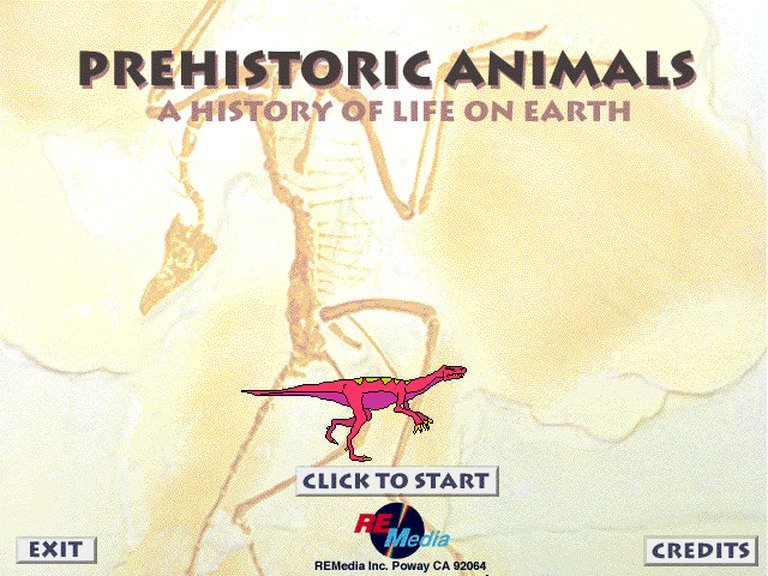
Prehistoric Animals is an educational video game from 1999 that immerses players in prehistoric life across eras like the Precambrian, Paleozoic, Mesozoic, and Cenozoic. It provides a comprehensive resource with hundreds of creatures explored through illustrations, articles, real photos, and videos, organized into thematic sections such as ‘Introduction’, ‘Early Life’, ‘Rise of Vertebrates’, ‘Fossils’, and ‘Display’. Players can access a searchable database, print materials, and engage in a trivia quiz to test their knowledge, all within an isometric visual style.
Prehistoric Animals Reviews & Reception
retro-replay.com : Prehistoric Animals excels at delivering an interactive educational experience that both kids and adults can enjoy.
Prehistoric Animals: A Scholarly Stroll Through Deep Time
In the late 1990s, as the internet began its crawl into the public consciousness and 3D accelerators promised new visual frontiers, a quieter, profoundly scholarly revolution was happening on CD-ROM. It was the golden age of the electronic encyclopedia, where titles like Microsoft Encarta and The Way Things Work aimed to condense knowledge into interactive, disc-based libraries. Into this landscape stepped Prehistoric Animals (1999), a project from the small studio REMedia Inc. that was less a “game” in the traditional sense and more a meticulously curated digital museum wing dedicated to Earth’s most magnificent extinct life. It represents a pivotal, often overlooked, bridge between the static appeals of the printed field guide and the dynamic, simulation-driven prehistoric experiences that would emerge decades later. This review argues that Prehistoric Animals is a masterclass in focused, curriculum-friendly edutainment—a title whose value lies not in emergent gameplay but in the scrupulous authority and user-friendly architecture of its knowledge base, a time capsule of both paleontological understanding circa 1999 and the design ethos of its medium.
Development History & Context: The CD-ROM Knowledge Archive
Prehistoric Animals was developed and published by REMedia Inc., a company that operated in the crowded but fertile market for educational software during the CD-ROM boom. The game’s credits, as listed on MobyGames, reveal a small, focused team led by writer Rob Ransom and photographer Whitey Hagadorn. The “Special Thanks” section notably includes names like Jim Angus, David Whistler, Gary Takeuchi, Kamaron Sardar, John Harris, Whitey Hagadorn, Bob Muir, Eric Scoot, Brooks Britt—a roster that strongly suggests collaboration with academic paleontologists, museum curators, and fossil photographers. This is not merely a game made by programmers; it is a compendium verified by experts, a crucial distinction that elevates it above many of its contemporaneous “edutainment” peers.
Technologically, the game was a product of its constraints. With system requirements calling for an Intel 486 or Motorola 68040 CPU, 8MB of RAM, and a 2X CD-ROM drive, its ambitions were bounded by the hardware of 1999. The “Isometric” visual tag on MobyGames is somewhat misleading; this is not a rendered 3D world but likely refers to isometric-style menu layouts and illustrative diagrams. The game world is a vast database of static illustrations, articles, real fossil photographs, and brief video clips. This was the era before widespread streaming video; embedding even 15-30 second clips represented a significant use of precious disc space and a technical achievement in seamless integration.
The gaming landscape of 1999 was dominated by 3D revolutions (Half-Life, Metal Gear Solid). The “educational” genre, while commercially viable in schools and homes, was often seen as a separate, less glamorous track. Prehistoric Animals sits squarely in this track, competing with titles like 3D Dinosaur Adventure or Microsoft Dinosaurs. Its vision was not to simulate predation or survival, but to catalog—to be a definitive, reference-grade resource. This context explains its lack of traditional game mechanics; its “gameplay” is the act of discovery itself, framed by a quiz show mechanic to provide a thin layer of gamified incentive.
Narrative & Thematic Deep Dive: The Story of All Stories
Prehistoric Animals possesses no conventional narrative with characters, dialogue, or plot. Its narrative is the grandest possible: the history of life on Earth spanning the Precambrian, Paleozoic, Mesozoic, and Cenozoic eras. This is a story written in stone, bone, and amber, and the game acts as its patient narrator.
The thematic through-line is deep time and evolutionary hierarchy. The structure itself tells a story of increasing complexity. The five thematic sections—”Introduction,” “Early Life,” “Rise of Vertebrates,” “Fossils,” and “Display”—chart a clear progression from primordial soup to the modern era, with a crucial metacognitive detour into the science of paleontology itself in the “Fossils” section. This is a sophisticated pedagogical choice, teaching not just what we know but how we know it.
The ten evolutionary classifications (e.g., Protomammals, Flying Reptiles, Ornithischian Dinosaurs) provide a parallel, phylum-based narrative. A user exploring “Protomammals” is reading a subplot of the main saga—the rise of the ancestors of mammals amid reptile-dominated worlds. The abundant illustrations and photographs are not merely decorative; they are the textual evidence. A stark, black-and-white fossil photo next to a full-color, speculative life restoration forces the player to engage with the gap between evidence and interpretation—a core theme of the field.
A point of potential confusion arises from a Reddit post recalling a game with similar content but featuring “3D renderings” and a bizarre “medieval theme” involving a knight and a dragon. This is almost certainly a misattribution or a memory conflated with another title (perhaps 3D Dinosaur Adventure or a similar ’90s/early-2000s edutainment CD-ROM). Prehistoric Animals, per its authoritative descriptions, is grounded in scientific illustration and photography. Its grandeur comes from the facts, not fantastical CGI vignettes. This distinction is vital: its authenticity is its selling point.
Gameplay Mechanics & Systems: The Logic of the Archive
As classified by multiple sources, the core gameplay loop is a hybrid of database navigation, informational consumption, and lightweight quiz assessment. The system is elegantly simple, designed for maximum accessibility with a mouse:
- Exploration: The primary activity is moving through the five thematic sections and ten taxonomic groups. This is a linear, chapter-based experience. Users click through menus, read text articles, and view embedded media.
- Database Lookup: A standout feature. The player can query a vast index of “hundreds of different prehistoric creatures.” This transforms the game from a passive book into an active reference tool. Want to know about Dimetrodon? Type it in. This feature anticipates the wiki-based research habits of the future.
- Print Function: The inclusion of a “print an article” button is a masterstroke for its target classroom and homeschooling audience. It extends the utility beyond the screen, allowing for offline study, worksheets, or simple fact-sheet creation.
- Quiz System: The “game show / trivia / quiz” mechanic is the sole traditional game-like element. Players can “take a quiz on different chapters.” A score is displayed. However, as MobyGames’ specs critically note: “there is no difficulty level or support for highscores.” This is both a flaw and a feature. It removes competition, framing the quiz as a personal comprehension check rather than a challenge. The lack of progression or persistence (no high scores) reinforces the title’s identity as a study aid, not a game to be “beaten.”
The user interface employs an isometric menu layout, common for the era, which efficiently packs categories into a clean, readable grid. The input is 100% mouse-driven, with no keyboard shortcut complexity. The systems are not “innovative” in a flashy sense; they are pragmatic, reliable, and optimized for a single, clear purpose: knowledge retrieval and verification. The flaw is the absence of any adaptive learning, branching paths based on quiz performance, or compelling meta-game to encourage repeated engagement. Once the database is queried and the quizzes taken, the experience is exhausted.
World-Building, Art & Sound: The Aesthetics of Authority
The “world” of Prehistoric Animals is not a playable environment but a hierarchical information space. Its atmosphere is that of a natural history museum reading room—quiet, orderly, and dense with specimen.
- Visual Direction: The art is a curated gallery. The illustrations are likely detailed, scientifically-informed paintings or digital drawings that reconstruct animals in plausible poses and habitats. These are complemented by real fossil photographs, providing the gritty, factual bedrock. The contrast between a gleaming Tyrannosaurus rex skeleton photo and a vibrant skin-and-muscle reconstruction is pedagogically powerful. The isometric menus are functional, using clear icons and legible fonts. There are no attempts at atmospheric lighting or cinematic camera work; authority comes from clarity and abundance.
- Sound Design: The audio is purely functional. Based on the IMDb plot summary citing “Doctor Rob Ranson narrates some of the animated presentations,” the narration is likely provided by the writer himself, Rob Ransom, or a similarly clear-voiced educator. The Reddit memory of a “female narrator with a British accent” again suggests confusion with another product; Prehistoric Animals‘ narration, if any beyond text-to-speech, would be American-accented, matching its likely US school-targeted distribution. The soundscape consists of gentle menu ticks, perhaps ambient room tone, and the narration itself. The goal is to not distract from the information.
- Contribution to Experience: These elements coalesce to create an experience of trustworthy scholarship. The mix of media (text, photo, illustration, video) caters to different learning styles. The clean, uncluttered interface reduces cognitive load, allowing the mind to focus on the staggering scope of 540 million years of history. The “Display” section likely serves as a curated gallery, reinforcing the museum metaphor. The world-building is thus achieved through cumulative factual density, not environmental storytelling.
Reception & Legacy: A Niche Footnote with Lasting Principles
Critical and commercial reception data for Prehistoric Animals is virtually non-existent, as evidenced by the empty review pages on MobyGames and the absence from major contemporary magazine archives. This is the fate of most targeted educational software. Its “MobyScore” is listed as n/a, and it is “Collected By” only a handful of users on the site. It was a commercial retail product (sold on CD-ROM), but its success was measured in classroom adoptions and library sales, not box-office charts.
Its legacy is one of principle over prominence. It represents a specific, high-water mark in a subsiding tide: the pre-internet, comprehensive, single-subject CD-ROM encyclopedia. Its design philosophy—a deep, searchable database paired with contextual learning modules and self-testing—is the direct ancestor of modern digital learning platforms like Khan Academy or educational YouTube channels. It understood that the value was in the curated, verified content.
In the broader context of prehistoric video games (as listed in the Game Rant and Hardcore Gamer articles), Prehistoric Animals is the anti-game. Where titles like Turok: Dinosaur Hunter (1997), Far Cry Primal (2016), or Saurian (2017) use prehistory as a backdrop for action, survival, or simulation, Prehistoric Animals treats prehistory as the sole subject. It has no combat, no crafting, no open world. Its influence is not seen in Ancestors: The Humankind Odyssey‘s survival mechanics, but in the meticulous, science-first approach of Saurian. It is a document of its time, proving that the fascination with prehistoric life could be served by pure information delivery just as effectively as by interactive fiction.
Conclusion: The Verdict of a Digital Fossil Record
Prehistoric Animals (1999) is not a game that will be remembered for its groundbreaking interactivity or its emotional narrative. By modern standards, its “gameplay” is sparse. Yet, to judge it by those criteria is to misunderstand its fundamental purpose and the ecosystem in which it was created.
It is, instead, a sublime piece of interactive scholarship. It is a meticulously compiled, academically vetted, and user-accessible portal to the ancient world. Its true innovation was in its structure: the seamless marriage of a searchable database, themed curricular modules, multimedia supplements, and self-assessment tools. For a student in 1999 with a home computer and a curiosity about Archaeopteryx or the Cambrian Explosion, this disc was a treasure trove, a portable paleontology department.
Its limitations are those of its era and genre. The lack of dynamic systems, adaptive challenges, or a compelling meta-narrative makes it a one-visit wonder for the casual user. But for the enthusiast, the teacher, or the budding paleontologist, it offered a depth and authority that few modern, gamified “learn to code” apps can match. In the grand museum of video game history, Prehistoric Animals deserves a placard not as a crown jewel, but as a perfectly preserved specimen of a specific, earnest, and knowledge-driven design philosophy. It is a testament to the idea that sometimes, the most powerful interaction with a subject is the unmediated, curious, self-directed act of looking it up, reading about it, and printing it out to keep. For that, it earns a quiet, respectful place in the annals of both educational software and the digital curation of our planet’s deep past.