
- Release Year: 1997
- Platforms: DOS, Macintosh, PlayStation, Windows
- Publisher: Empire Interactive Entertainment, Empire Interactive Europe Ltd., Ubi Soft Entertainment Software
- Developer: Cunning Developments
- Genre: Action
- Perspective: Third-person
- Game Mode: Hotseat, Single-player
- Gameplay: Pinball
- Setting: Futuristic, Prehistoric, Present-day, Roman
Description
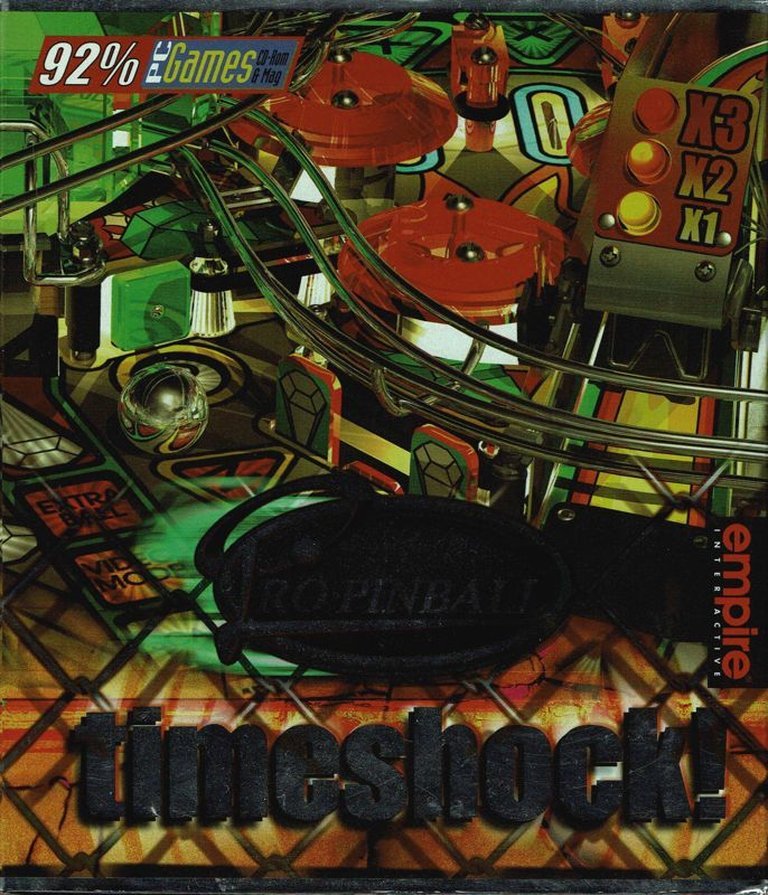
Pro Pinball: Timeshock! is a complex 3D pinball game where players travel through time by collecting crystals across four distinct eras: Roman, Prehistoric, Futuristic, and the present. Featuring multiple viewpoints, secret areas to discover, and a dot matrix display for videos, the game offers an immersive pinball experience with a mission-based structure.
Gameplay Videos
Where to Buy Pro Pinball: Timeshock!
PC
Pro Pinball: Timeshock! Free Download
Pro Pinball: Timeshock! Patches & Updates
Pro Pinball: Timeshock! Guides & Walkthroughs
Pro Pinball: Timeshock! Reviews & Reception
thepixelempire.net : It’s challenging, but fair, and incredibly satisfying when you manage to link combo ramps or ace a couple of quickshots, landing you with tens of millions of points.
oldpcgaming.net : this is the best hardcore pinball game to come to gamers in a long time, if not ever.
Pro Pinball: Timeshock! Cheats & Codes
PC
Use the following in-game menu sequences and button combinations.
| Code | Effect |
|---|---|
| Hold [Launch] and press [Start] to open the operator menu. Select ‘Adjustments’ (2), then ‘Feature Adjustments’ (2.2), then ‘Initial Time Zone’ (2.2.1) and set it to ‘Random’. Go back to the main operator menu, select ‘Tests’ (3), then ‘Switch Levels Test’ (3.1), then ‘Time Zone Lock Delta’ (3.1.47). Hold [Left Flipper] + [Right Flipper] for at least two seconds. | Unlocks all options in the operator menu. |
| Before shooting a new ball onto the table, hold down the keys for both flippers for several seconds. | Activates a skill shot, indicated by a voice notification and a blinking light on the table. |
PlayStation (PSX)
Enter codes using a GameShark or CodeBreaker device.
| Code | Effect |
|---|---|
| D00AEC60 ???? | Joker Command |
| 800BC934 0001 | Player 1: Infinite Balls |
| 800BC938 0001 | Player 1: Infinite Buy-Ins |
| 800BC93C 0800 800BC93E 2FAF |
Player 1: Have Score of 8 Billion |
| 800BCC18 0001 | Player 2: Infinite Balls |
| 800BCC1C 0001 | Player 2: Infinite Buy-Ins |
| 800BCC20 0800 800BCC22 2FAF |
Player 2: Have Score of 8 Billion |
| 800BCEFC 0001 | Player 3: Infinite Balls |
| 800BCF00 0001 | Player 3: Infinite Buy-Ins |
| 800BCF04 0800 800BCF06 2FAF |
Player 3: Have Score of 8 Billion |
| 800BD1E0 0001 | Player 4: Infinite Balls |
| 800BD1E4 0001 | Player 4: Infinite Buy-Ins |
| 800BD1E8 0800 800BD1EA 2FAF |
Player 4: Have Score of 8 Billion |
| 800AFC08 0852 | Ball Saver Always On |
| 800AFC08 0068 | Ball Saver Always Off |
Pro Pinball: Timeshock!: Review
Introduction
In an era dominated by polygonal 3D adventures and sprawling RPGs, Pro Pinball: Timeshock! emerged not just as a game, but as a meticulously crafted digital artifact—a virtual pinball table so astonishingly real it threatened to render its physical counterparts obsolete. Released in 1997 as the sophomore effort from British studio Cunning Developments, this sequel to The Web transcended the limitations of its genre, setting a gold standard for simulation that remains unmatched. Its legacy lies in an audacious marriage of technological prowess and design obsession: a single, impossibly dense table where time itself became the plaything. This review posits that Timeshock! is not merely a pinball game but a masterclass in interactive design—a symphony of physics, narrative, and artistry that captured the soul of arcade culture while redefining what a digital pinball experience could achieve.
Development History & Context
Crafted by a 40-person team at Cunning Developments under director Adrian Barritt, Timeshock! was a labor of love by developers who self-identified as “pinball fanatics.” The studio, founded in 1995, had already turned heads with The Web (1995), but Timeshock! was conceived as a quantum leap—a table designed on Silicon Graphics workstations to achieve unprecedented visual fidelity. Published by Empire Interactive, the game arrived amid a transitional period in PC gaming. While 1997 saw landmark titles like Final Fantasy VII and GoldenEye 007, pinball simulations were often dismissed as niche novelties. Technological constraints, however, became a catalyst for innovation. Pre-rendered 3D graphics allowed for table details invisible in real-world machines—from rotating time crystals to dynamic lighting—while CD-ROM audio enabled Dolby Surround sound and voice-overs. The PlayStation port (1998) further expanded its reach, though it faced hardware limitations that underscored the PC’s superiority in rendering smooth physics. Yet, these constraints fueled the team’s creativity: by focusing on one table, they poured resources into depth rather than breadth, creating a living, breathing machine where every element felt purposeful.
Narrative & Thematic Deep Dive
Timeshock! weaves a surprisingly intricate narrative around a time-traveling scientist (voiced by Gina Lee Lincoln) whose experiment shatters the “crystal of time,” threatening to unravel existence itself. Framed as a monologue to the player—the co-pilot of the time machine—the plot unfolds through the dot matrix display, which reveals cinematic sequences and objectives as the player progresses. The core mission involves retrieving four crystal fragments from distinct eras: The Present Day, The Distant Future, Ancient Rome, and The Prehistoric Age. Each zone thematically recontextualizes gameplay: Rome offers chariot races and gladiatorial combat, the Future introduces robot wars and ray guns, while the Prehistoric Age features volcanoes and dinosaurs. This structure transforms the table into a temporal playground, where narrative progression is intrinsically tied to mechanical mastery. Underlying themes explore hubris in science—the scientist’s accident stems from overreach—and the paradoxical nature of time as both fluid (future) and immutable (past). The dialogue, though sparse, is rich with urgency, effectively framing the player not as a passive gamer but as a savior of causality.
Gameplay Mechanics & Systems
At its core, Timeshock! is a triumph of physics simulation. The ball’s movement—governed by proprietary algorithms—reacts with uncanny realism to flippers, slingshots, and bumpers, demanding split-second reflexes and strategic nudging. Two anti-frustration features redefine pinball dynamics: the “Magno-Save” (an electromagnet near the right drain) and an escape hatch on the left. These turn potential rage-inducing drains into skill-based saves, rewarding precision over luck. The game’s depth lies in its layered objectives:
– Time Travel Mechanics: Players power the “Time Drive” via ramp shots to unlock eras, each with unique challenges like scaling Mount Rushmore or cooling a prehistoric volcano.
– Combos & Scoring: Sequences like the “Ultra Combo” reward tens of millions of points, while spelling “WARP” or “MAGNET” triggers bonus modes.
– Multiball Modes: “Timeshock! Frenzy” (the ultimate wizard mode) tasks players with locking four crystal fragments in a five-ball multiball, culminating in a billion-point “counter-shockwave.”
– Multiplayer: “Challenge Mode” allows up to four players to compete on the same table, sharing objectives but vying for individual scores.
The UI, though minimalist, is functional: a dot matrix display provides objectives, while camera angles (four fixed viewpoints) offer strategic perspectives. A “preview mode” lets players zoom into table sections, aiding discovery.
World-Building, Art & Sound
Timeshock’s greatest triumph is its sense of place. The table isn’t just a playfield but a time machine—a spherical core flanked by hover pads, surrounded by artifacts from each era. Ancient Rome’s pyramids and chariots contrast with the Future’s holograms and anti-matter plants, creating a visually cohesive yet thematically diverse experience. Art direction, led by Graham Rice, prioritized photorealism: textures gleam, metals reflect, and the time crystal pulses with otherworldly light. Pre-rendered graphics, running at 1600×1200 on high-end PCs, remain stunning even by modern standards—proof that detail trumps resolution. Sound design, composed by Jake Burns and Bruce Foxton (of The Ruts), is a genre-blending marvel: driving guitar riffs evoke the Prehistoric Age’s danger, while synth pulses underscore the Future’s tension. Sound effects—from the clank of slingshots to the hum of magnets—are sampled from real pinball tables, grounding the fantasy. The voice-over, though occasionally clipped, adds personality, turning the scientist’s warnings into a compelling duologue. Together, these elements forge an atmosphere that is both timeless and urgent—every shot feels like a battle against entropy.
Reception & Legacy
Upon release, Timeshock! was hailed as a revelation. PC-centric publications like Computer Gaming World awarded it 100%, praising its “pure, natural pinball simulation,” while PC Zone lauded its “seamless table design.” The PlayStation port received more mixed reviews (average 75% on GameRankings), with critics like Electronic Gaming Monthly bemoaning the lack of additional tables. Commercially, it sold steadily, boosted by inclusion in compilations like Pinball Madness 2. Its reputation, however, has only deepened. PC Gamer ranked it the 49th-best computer game ever in 1998, calling it a “masterpiece by fanatics.” Decades later, it’s cited as a benchmark for physics realism and design depth, influencing titles like Pinball FX2. Its most enduring legacy, though, is aspirational: in 2014, Dutch company Silver Castle announced plans to build a physical pinball machine, though the project remains in development due to technical hurdles. The 2015 ULTRA Edition—featuring enhanced lighting and mobile ports—further cemented its status as a timeless classic.
Conclusion
Pro Pinball: Timeshock! is more than a game; it’s a time capsule of gaming ambition. In 1997, when most simulations prioritized spectacle over substance, Cunning Developments delivered a profound experience where every flipper shot, every multiball frenzy, and every crystal fragment felt like a meaningful act. Its narrative depth, revolutionary physics, and artistic cohesion created a virtual pinball table that not only rivaled the real thing but surpassed it in ambition. While the genre has since shifted toward arcade-friendly experiences, Timeshock! remains a pinnacle of simulation—a testament to the idea that mastery lies not in breadth, but in the relentless pursuit of perfection. For players, it’s a challenge; for historians, it’s a landmark. Ultimately, it’s the digital equivalent of a holy grail: a pinball table so perfect, you’d swear it was forged in time itself.