
- Release Year: 2012
- Platforms: Macintosh, Windows
- Publisher: Alexander Martin (as Droqen)
- Developer: Alexander Martin (as Droqen)
- Genre: Action
- Perspective: Side view
- Game Mode: Single-player
- Gameplay: Platform
- Average Score: 67/100
Description
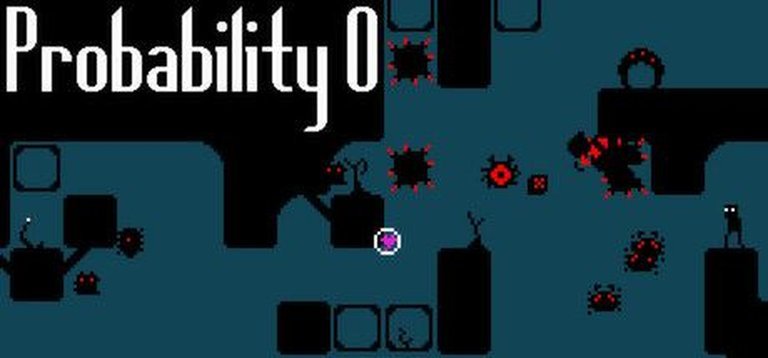
Probability 0 is a 2D side-scrolling action platformer developed by Alexander Martin (as Droqen) and released in 2012 for Windows and later for Macintosh. The game features a unique progression system where players gain skills and level up, but as they advance, their probability of survival decreases until it inevitably reaches zero. Built using FlashPunk and FlashDevelop, this commercial title offers a challenging experience where mastering skills becomes a race against diminishing survival odds.
Where to Buy Probability 0
PC
Probability 0 Guides & Walkthroughs
Probability 0 Reviews & Reception
metacritic.com (60/100): A fresh, solid roguelike platformer that kills time with as much efficiency as it kills the player.
store.steampowered.com : … more focused and refined than Spelunky, or almost any roguelike.
Probability 0: Review
Introduction
In the pantheon of punishing, procedurally generated platformers, Probability 0 stands as a singular, almost mythic entity. Released in 2012 by the enigmatic developer Alexander Martin (under the pseudonym Droqen), this game isn’t merely a test of reflexes—it’s a philosophical meditation on futility, mastery, and the infinite struggle against an uncaring void. Its legacy is one of cult adoration, revered for its brutal elegance and profound mechanical purity. To play Probability 0 is to descend into a pit where death is guaranteed, but the journey itself is the reward. This review will dissect how, despite its deceptively simple premise, the game transcends its genre to become a timeless masterpiece of design and consequence.
Development History & Context
Droqen (Martin) conceived Probability 0 in 2009 as a personal antidote to boredom, releasing a free prototype that laid the groundwork for its commercial evolution. The vision was stark: an infinitely descending arena where randomness and player skill would collide in perpetuity. Built using FlashPunk and FlashDevelop, the game leveraged Adobe’s ecosystem—a common tool for indie developers in the early 2010s—yet its execution defied the era’s trend toward narrative-heavy epics. Instead, Martin focused on systemic depth, aiming to “avoid boredom” through procedurally generated landscapes, escalating enemy hierarchies, and a sprawling, non-linear skill tree.
The game emerged during a pivotal moment in indie gaming. 2012 saw the rise of roguelikes like Spelunky and Binding of Isaac, but Probability 0 carved its niche by stripping away narrative pretenses. Martin’s design philosophy—detailed in his candid developer notes—prioritized mechanical experimentation over storytelling. He created enemies that “cannibalize and infect each other in their mad swarming” and skills that offered transformative choices (“immunity to spikes” vs. “one-punch kills”) rather than incremental stat boosts. This anti-boredom ethos was radical: death wasn’t a setback but a reset, ensuring every run felt novel. Commercially, it launched on Windows in October 2012 for $6.99, later expanding to macOS in 2014 via Steam. Though its audience was niche, it resonated with players craving unfiltered challenge, cementing Droqen as a visionary in the roguelike renaissance.
Narrative & Thematic Deep Dive
Probability 0 rejects traditional storytelling in favor of existential abstraction. There are no cutscenes, no dialogue, and no named characters. The plot is the descent itself—an endless spiral into a pit where “there are a million ways to fight for survival. There is no way to survive.” The player is a nameless entity, defined solely by their actions: jumping, punching, and accumulating power before succumbing to the abyss. This minimalist framing transforms gameplay into a brutal allegory for futility. Each death is a microcosm of Sisyphean struggle: the player pushes a boulder (their character) up a hill (the pit) only to watch it roll back down, only to begin anew.
The enemies embody this thematic weight. Beyond basic foes, Martin designed grotesque, biomechanical horrors that reflect the pit’s malice: an enemy that literally devours others and spits their digested remains; invisible stalkers; explosive kamikazes; and “reckless” chargers who ignore self-preservation. Their randomness and unpredictability symbolize the chaos of a hostile universe. Even the skill tree—where players buy “immunity to spikes” or “teleportation”—is a metaphor for human ingenuity against entropy. The game’s tagline, “Dive again. Dive into Probability 0,” reframes death not as failure but as participation in an infinite cycle. It’s a celebration of effort over outcome, where “getting deeper” is the only victory.
Gameplay Mechanics & Systems
At its core, Probability 0 is a downward-scrolling arcade platformer with roguelike permutations. The loop is deceptively simple: descend, fight, level up, die, repeat. Yet its mechanics are a masterclass in emergent complexity.
Core Combat & Movement: Controls are minimalist—jump, punch, and a secondary attack (e.g., throwing stars). Precision is paramount, as gravity is “unforgiving,” and platforms crumble under enemy fire. Movement feels weighty yet responsive, demanding split-second decisions to dodge spikes, projectiles, or environmental hazards.
Character Progression: The skill tree (~36 abilities) is a triumph of design. Unlike typical RPGs, it abandons linear progression and stat-padding. Players choose skills freely across unlocked rows, with only logical prerequisites (e.g., “never take fall damage” requires “take less fall damage”). This creates limitless build diversity: one run might focus on star-throwing for crowd control; another on teleportation for evasion. Upgrades like “punch through walls” or “walk on spikes” transform playstyles radically, rewarding experimentation over min-maxing.
Enemy & Level Systems: Procedural generation ensures no two runs are identical. Enemies spawn in “higher-order” sequences—basic grunts first, then evolved variants like cannibals or invisible threats at depth. Bosses appear intermittently, punctuating the descent with concentrated challenges. The environment itself is a threat: floors collapse, gravity shifts, and hazards respawn dynamically.
Punishment & Reward: Death is absolute, erasing all progress. Yet this isn’t frustrating; it’s a design choice. As Martin noted, it prevents “getting everything… and then getting bored.” Each run teaches something new—enemy patterns, optimal skill combinations, or environmental quirks. The reward isn’t survival but mastery: the thrill of briefly becoming “a star-throwing menace” before the pit reclaims you.
World-Building, Art & Sound
Droqen crafts a world through implication, not exposition. The “pit” is a labyrinth of abstract platforms, spikes, and void, rendered in stark 2D pixel art. Its visual design is functional but evocative: enemies are grotesque silhouettes (red globs, twitching worms), while the environment uses monochrome palettes to emphasize depth. As the player descends, the art subtly shifts—darker hues, more jagged platforms—mirroring the escalating dread. This minimalism focuses the player on mechanics, yet the pit’s oppressive atmosphere is palpable.
Sound design, by Jazz Mickle (queenjazz), is the game’s emotional core. The dynamic score layers bass, chords, and industrial sirens that swell as danger mounts. Deeper depths trigger dissonant melodies and piercing audio cues, making the descent a visceral experience. On the Steam store page, Martin describes it as “sirens screaming as death approaches,” a soundscape that turns each run into a symphony of tension. Combined with the rhythmic thump of jumps and punches, the audio creates a hypnotic loop of action and anticipation.
Reception & Legacy
Upon release, Probability 0 polarized critics and players. On Steam, it maintains a “Mostly Positive” rating (78% based on 23 reviews), with praise for its “focused and refined” gameplay compared to Spelunky (The Indie Game Magazine). JayIsGames lauded it as a game that “challenges your brain as much as your hands.” Yet others found its difficulty punishing; one Metacritic review (PC PowerPlay, 60/100) called it “efficient” but lacking accessibility. Player discussions on Steam reveal a dedicated community: requests for controller support, achievements, and Linux ports were common, though Martin noted the game’s “bit too hard?” design was intentional.
Commercially, it thrived in niche circles. The $6.99 price point and digital-only release limited mainstream reach, but its influence rippled through the roguelike genre. It paved the way for games like Downwell (2015), which similarly merged platforming with permadeath and minimalist aesthetics. Droqen’s subsequent works—N++, Baba Is You—further cemented his reputation for experimental design. Today, Probability 0 is revered as a foundational text in “arcade roguelikes,” celebrated for proving that depth could thrive in simplicity. Its legacy endures in community-led wikis, modding scenes, and the enduring appeal of its “dive again” ethos.
Conclusion
Probability 0 is more than a game—it’s a manifesto. In a medium obsessed with narratives and victories, Alexander Martin crafted an experience that embraces failure as the core loop. Its genius lies in its equilibrium: punishing yet fair, random yet skillful, minimalist yet infinitely replayable. The pit is a mirror, reflecting the player’s persistence against inevitable defeat. For genre purists, it remains a benchmark of roguelike design; for historians, it’s a snapshot of indie gaming’s golden age of experimentation.
Verdict: Probability 0 is a timeless masterpiece. It doesn’t just ask you to survive—it asks you to try, to die, and to dive deeper. In doing so, it transcends its genre to become a profound meditation on the beauty of struggle. If you seek a game that respects your intelligence while shattering your expectations, descend into the pit. You’ll never reach the bottom, but the journey will stay with you forever.