
- Release Year: 2009
- Platforms: Android, iPad, iPhone, Macintosh, Windows
- Publisher: Big Fish Games, Inc.
- Developer: ERS G-Studio
- Genre: Adventure
- Perspective: 1st-person
- Game Mode: Single-player
- Gameplay: Hidden object, Puzzle elements
- Setting: Dark, Empty streets, Mystery, Thriving city
- Average Score: 86/100
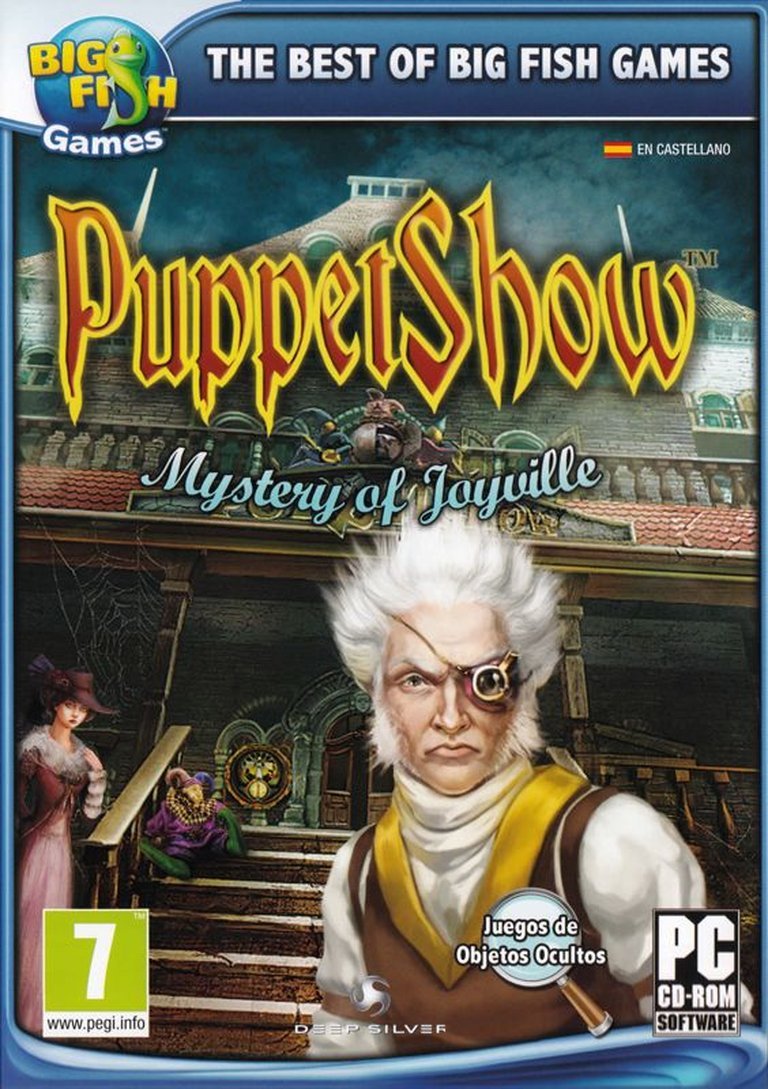
Description
PuppetShow: Mystery of Joyville is a hidden object adventure game set in the once-thriving city of Joyville, now nearly abandoned after its citizens began mysteriously disappearing. A detective is hired by a hotel owner to find his missing grandson, uncovering clues in the empty streets and vacant houses while interacting with eerie mechanical puppets left behind by the enigmatic Master. The game blends hidden object scenes, inventory-based puzzles, and atmospheric exploration, with a dark, whimsical aesthetic and a mix of logic challenges and skipable mini-games.
Gameplay Videos
Where to Buy PuppetShow: Mystery of Joyville
PuppetShow: Mystery of Joyville Free Download
PuppetShow: Mystery of Joyville Cracks & Fixes
PuppetShow: Mystery of Joyville Guides & Walkthroughs
PuppetShow: Mystery of Joyville Reviews & Reception
jayisgames.com (90/100): PuppetShow: Mystery of Joyville is one that is worth the effort.
mobygames.com (78/100): The main screen shows one of the Joyville’s locations, with sparkles shimmering over the interactive portions of the scenery.
steambase.io (92/100): PuppetShow™: Mystery of Joyville has earned a Player Score of 92 / 100.
PuppetShow: Mystery of Joyville: A Haunting Masterpiece of Hidden Object Adventure
Introduction
In the crowded landscape of casual games, few titles manage to carve out a lasting legacy. PuppetShow: Mystery of Joyville, released in 2009 by ERS G-Studio and published by Big Fish Games, is one such rarity—a game that transcends its genre to deliver an atmospheric, unsettling, and visually stunning experience. At its core, it is a hidden object adventure, but its ambition stretches far beyond the typical “find the teapot” fare. With its eerie narrative, meticulous world-building, and innovative mechanics, Mystery of Joyville stands as a pivotal title in the evolution of the hidden object genre, blending adventure, puzzle-solving, and horror into a cohesive, if brief, masterpiece.
This review will dissect the game’s development, narrative depth, gameplay systems, artistic achievements, and lasting influence, arguing that PuppetShow: Mystery of Joyville is not just a product of its time but a timeless example of how to elevate casual gaming into something hauntingly memorable.
Development History & Context
The Studio and the Vision
ERS G-Studio, a Ukrainian developer, was already making waves in the casual gaming scene by 2009. Known for their attention to detail and atmospheric storytelling, the studio had a knack for crafting games that felt richer than their peers. Mystery of Joyville was their attempt to push the boundaries of the hidden object genre, which was often criticized for its repetitive nature. The team, led by producers Rouslan Pismenniy and Vladimir Savenkov, sought to create a game that was as much about exploration and narrative as it was about finding objects.
The game’s scenario was penned by Mikhail Alexandrov and Pismenniy, who drew inspiration from Gothic literature, Victorian aesthetics, and the unsettling allure of automatons. The result was a story that felt like a lost chapter from The Twilight Zone, where the line between the mechanical and the macabre blurs into something deeply unsettling.
Technological Constraints and Innovation
Released in the late 2000s, Mystery of Joyville was constrained by the technical limitations of the era. The game was designed for low-system specifications, ensuring it could run on the average casual gamer’s PC. Despite these constraints, the developers leveraged the engine to create a game that was visually rich, with intricate hand-drawn environments and subtle animations that brought Joyville to life.
One of the most innovative aspects of the game was its use of a “sparkle” system to indicate interactive elements—a feature that would become a staple in later hidden object games. The inventory system, designed as a unfolding fan, was another standout, offering a tactile, immersive way to manage items that felt more organic than the typical bottom-of-screen bar.
The Gaming Landscape of 2009
The late 2000s were a golden age for casual games, with titles like Mystery Case Files: Return to Ravenhearst and Drawn: The Painted Tower setting high standards for narrative-driven hidden object adventures. Mystery of Joyville arrived at a time when players were hungry for more than just simple object hunts—they wanted stories, atmosphere, and challenges.
Big Fish Games, the publisher, was a dominant force in the casual gaming market, known for its vast library of downloadable titles. PuppetShow was part of their strategy to offer premium experiences that justified the $6.99 price point (a standard for the time). The game’s success would help solidify the hidden object adventure (HOPA) as a viable subgenre, paving the way for future titles in the PuppetShow series and beyond.
Narrative & Thematic Deep Dive
Plot Summary and Structure
PuppetShow: Mystery of Joyville begins with a simple premise: a detective arrives in the once-thriving town of Joyville, now a shadow of its former self, to investigate the disappearance of a hotel owner’s grandson, Simon. The town, once famous for its mechanical puppets crafted by the enigmatic “Master,” has been plagued by a series of vanishings, leaving its streets eerily deserted.
The narrative unfolds through environmental storytelling, journal entries, and cryptic notes scattered throughout the town. The player quickly discovers that the disappearances are tied to the Master’s sinister experiments—his puppets are not mere automatons but vessels for something far more sinister. The game’s climax reveals that the Master has been transforming the townspeople into puppets, with Simon as his latest victim. The detective’s journey culminates in a confrontation with the Master, who, in a twisted act of self-destruction, turns himself into a puppet before crumbling into dust.
Themes: The Horror of the Mechanical
At its heart, Mystery of Joyville is a meditation on the uncanny valley—the discomfort that arises when the artificial becomes too lifelike. The game’s puppets are not just creepy; they are tragic, their hollow eyes and jerky movements serving as a metaphor for the loss of humanity. The Master’s obsession with perfection and control mirrors the hubris of Victorian-era inventors, who often blurred the line between science and madness.
The game also explores themes of abandonment and decay. Joyville is a town frozen in time, its once-grand buildings now dilapidated, its streets empty. The hotel, the theater, and the Master’s house are all relics of a bygone era, their grandeur now tainted by the horrors that lurk within. The narrative’s focus on a missing child adds an emotional weight, grounding the supernatural elements in a very human tragedy.
Characters and Dialogue
While Mystery of Joyville is light on traditional dialogue (there is no voice acting, and interactions are limited to text), its characters are vividly realized through environmental clues and journal entries. The hotel owner, Egidio, is a grieving grandfather, his desperation palpable in the notes he leaves behind. Simon, the missing boy, is seen only in glimpses—a drawing in the hotel, a mention in a journal—making his fate all the more haunting.
The Master, the game’s antagonist, is a figure of Gothic horror. His presence is felt throughout the game, from the mechanical puppets that scurry across the screen to the eerie music that plays in his abandoned workshop. His final act—turning himself into a puppet—is a chilling moment that lingers long after the credits roll.
The Spider Puppet: A Silent Guide
One of the game’s most memorable elements is the spider-like mechanical puppet that serves as a guide (and occasional antagonist) for the player. This creature, with its doll’s head and arachnid legs, is both unsettling and fascinating. It appears at key moments, scurrying across the screen to lead the player to the next location or triggering a jump scare when least expected. The spider puppet is a masterstroke of design, embodying the game’s themes of the uncanny and the unknown.
Gameplay Mechanics & Systems
Core Gameplay Loop
PuppetShow: Mystery of Joyville is a hybrid of hidden object and adventure gameplay. The player navigates through Joyville’s various locations—hotels, theaters, graveyards, and more—searching for clues and solving puzzles. The game’s structure is linear, with each chapter unlocking new areas and challenges.
The hidden object scenes are the game’s bread and butter. These scenes are triggered by clusters of sparkles, and the player must find all the items listed at the bottom of the screen. Unlike many games in the genre, Mystery of Joyville ensures that the objects are logically placed within the environment, avoiding the frustration of pixel-hunting. Some objects are hidden behind interactive elements (e.g., opening a drawer or moving a curtain), adding a layer of depth to the searches.
Inventory and Puzzle-Solving
Items collected in hidden object scenes are stored in the player’s inventory, which is accessed via a fan-like interface at the bottom-left of the screen. The inventory system is one of the game’s most innovative features, eschewing the typical grid layout for something more immersive. Players must drag and drop items onto the environment to solve puzzles, such as using a screwdriver to open a panel or placing a gear into a mechanical lock.
The puzzles themselves are a mixed bag. Some are ingenious, requiring the player to manipulate mechanisms or decipher codes (e.g., the stained glass puzzle in the theater’s back room). Others, however, are simplistic, relying on trial-and-error mechanics that can feel tedious. The game’s difficulty is inconsistent, with some puzzles offering a genuine challenge while others can be skipped after 60 seconds—a feature that, while appreciated by some, undermines the tension for others.
The Hint System
The hint system in Mystery of Joyville is well-balanced. In hidden object scenes, the hint button (located in the bottom-left corner) will highlight a random item from the list, but it takes 60 seconds to recharge. This encourages players to rely on their own observation skills while providing a safety net for those who get stuck. The hint system is notably absent in puzzle scenes, where players must either solve the challenge or wait for the skip option to become available.
Exploration and Navigation
Navigation in Mystery of Joyville is intuitive, with the cursor changing to indicate interactive elements:
– Magnifying glass: Zoom in on an area.
– Hand: Pick up an item or interact with an object.
– Globe: Travel to a new location.
The game’s map is relatively small, but the environments are densely packed with detail, encouraging thorough exploration. The spider puppet often appears to guide the player, ensuring they never feel completely lost.
Critiques of the Gameplay
While Mystery of Joyville excels in atmosphere and innovation, its gameplay is not without flaws. The lack of difficulty settings means that experienced players may find the puzzles too easy, while newcomers might struggle with the more obscure challenges. The game’s linear structure also limits replayability, as there are no branching paths or alternate solutions.
The most common criticism, however, is the game’s brevity. With an average playtime of 3-4 hours, Mystery of Joyville feels more like an extended demo than a full-fledged adventure. This short length was likely a result of the game’s budget and the casual gaming market’s expectations at the time, but it remains a sticking point for many players.
World-Building, Art & Sound
The Setting: Joyville as a Character
Joyville is more than just a backdrop; it is a character in its own right. The town’s Victorian-inspired architecture, with its ornate details and gothic flourishes, creates a sense of decaying grandeur. The streets are empty, the buildings abandoned, and the air thick with tension. The game’s environments are meticulously crafted, from the cluttered hotel lobby to the eerie theater, each location telling a story of its own.
The graveyard, with its crumbling statues and overgrown weeds, is particularly effective, evoking a sense of dread that permeates the entire game. The Master’s house, filled with mechanical contraptions and half-finished puppets, is a masterclass in environmental storytelling, hinting at the horrors that have taken place within its walls.
Visual Direction: A Gothic Masterpiece
The art style of Mystery of Joyville is one of its greatest strengths. The game’s hand-drawn environments are rich in detail, with a color palette dominated by muted browns, grays, and blacks, punctuated by the occasional splash of red (often signaling danger or a clue). The character designs, particularly the puppets, are unsettling, their exaggerated features and jerky animations reinforcing the game’s themes of the uncanny.
The use of light and shadow is particularly effective. The game’s opening, set at sunset, bathes Joyville in a golden glow that quickly gives way to darkness as the player progresses. The theater, with its flickering candles and dimly lit corridors, is a standout, creating an atmosphere of creeping horror that few casual games have matched.
Sound Design: The Music of Madness
The sound design in Mystery of Joyville is subtle but effective. The game’s soundtrack, composed of eerie melodies and dissonant chords, enhances the atmosphere without overpowering it. The music shifts dynamically, becoming more intense during puzzle sequences or moments of discovery.
The ambient sounds are equally impressive. The drip of water in the Master’s dungeon, the creak of a floorboard in the hotel, the distant tinkling of a music box—these details immerse the player in Joyville’s haunted world. The absence of voice acting is a missed opportunity, but the game’s reliance on text and sound effects ultimately works in its favor, allowing the player’s imagination to fill in the gaps.
Reception & Legacy
Critical Reception
Upon release, PuppetShow: Mystery of Joyville received generally positive reviews, with critics praising its atmosphere, visuals, and innovative mechanics. JayIsGames awarded it a 4.5/5, calling it “casual gameplay done right” and highlighting its attention to detail. GameZebo gave it a 4/5, commending its dark tale and perfect Halloween atmosphere. LKI.ru, a Russian gaming site, compared its narrative to the works of H.P. Lovecraft, praising its slow descent into the macabre.
However, not all reviews were glowing. GadgetSpeak criticized the game’s lack of depth and animation, while some players found the puzzles too easy and the game too short. The average critic score on MobyGames stands at 78%, reflecting a consensus that the game was ambitious but flawed.
Commercial Success and Sequels
Despite its mixed reception, Mystery of Joyville was a commercial success, spawning a long-running series that continues to this day. The game’s sequel, PuppetShow: Souls of the Innocent, was released in 2010, followed by numerous other entries, including Return to Joyville (2012) and Destiny Undone (2013). The series has evolved over the years, incorporating more complex narratives and gameplay mechanics, but Mystery of Joyville remains the foundation upon which the franchise was built.
Influence on the Genre
PuppetShow: Mystery of Joyville played a significant role in shaping the hidden object adventure genre. Its use of environmental storytelling, atmospheric sound design, and innovative inventory systems influenced countless subsequent titles. Games like Dark Parables and Mystery Case Files owe a debt to Mystery of Joyville, particularly in their approach to blending narrative and gameplay.
The game’s success also demonstrated that casual games could be more than just time-wasters—they could be immersive, atmospheric experiences that resonated with players on an emotional level. This shift in perception helped elevate the genre, paving the way for more ambitious titles in the years that followed.
Conclusion: A Haunting Legacy
PuppetShow: Mystery of Joyville is a game that defies easy categorization. It is, at once, a hidden object game, an adventure, a horror story, and a work of art. Its strengths—its atmosphere, its visuals, its narrative—far outweigh its weaknesses, making it a standout title in the casual gaming landscape.
While its brevity and occasional lack of challenge may disappoint some players, the game’s haunting beauty and unsettling themes ensure that it lingers in the memory long after the final puzzle is solved. It is a testament to the power of atmosphere and storytelling in gaming, proving that even the simplest mechanics can be elevated by a strong vision and meticulous execution.
In the annals of gaming history, PuppetShow: Mystery of Joyville may not be remembered as a groundbreaking technical achievement or a commercial juggernaut. But for those who played it, it remains a haunting, unforgettable experience—a masterpiece of mood and mystery that continues to inspire and unsettle over a decade after its release.
Final Verdict: 9/10 – A masterclass in atmospheric storytelling and a must-play for fans of Gothic horror and hidden object adventures.