
- Release Year: 2006
- Platforms: Windows
- Publisher: Idigicon Limited
- Genre: Simulation
- Perspective: First-person
- Game Mode: Single-player
- Gameplay: Affection, Area navigation, Feeding, Hydration, Toy interaction
- Setting: Domestic, Household
Description
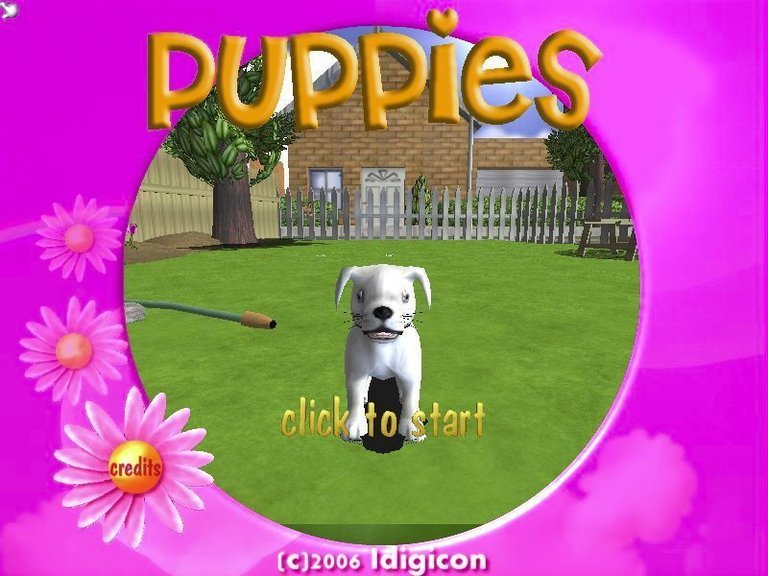
Puppies is a child-friendly simulation game released in 2006 for Windows, where players adopt and care for one of six virtual puppies in a home environment. Using simple mouse controls, players manage the puppy’s needs—such as feeding, watering, stroking, and playing with toys—across three locations (kitchen, garden, and living room), with status bars indicating requirements like food, water, sleep, and affection; keeping the puppy happy directly increases the player’s score in this straightforward, engaging experience.
Where to Buy Puppies
PC
Puppies (2006): A Historical Artifact of Casual Gaming’s Early Niche
Introduction: A Glimpse into a Forgotten Pastoral
In the vast and meticulously chronicled archaeology of video game history, certain titles occupy a curious liminal space. They are neither celebrated landmarks nor infamous failures, but quiet, functional artifacts that reflect a specific, often overlooked, moment in the evolution of game design and audience targeting. Puppies, developed by Psionic and published by Idigicon Limited in 2006 for Windows, is precisely such a title. Emerging in the same year as the DS’s debut and during the Wii’s ascendancy, it represents the tail end of an era where the PC was still a viable platform for straightforward, low-fidelity children’s software, a space that would soon be wholly dominated by mobile apps and console-focused experiences. This review does not seek to发掘 (unearth) Puppies as a lost masterpiece—its mechanics are transparently simple and its presentation dated—but to analyze it as a cultural and industrial specimen. My thesis is this: Puppies is significant not for what it achieved, but for what it exemplifies: the pre-smartphone, pre-Steam ecosystem of casual simulation games aimed at a youthful demographic, a genre whose DNA would later mutate and conquer the world on different platforms. Its legacy is one of quiet obsolescence, a roadmap of a design philosophy that was soon to be rendered archaic.
Development History & Context: The “Idigicon” Model and the 2006 Casual Landscape
The studio behind Puppies, Psionic, is a name that flickers briefly in the MobyGames credits before vanishing. Little is documented about this small UK-based team, but their work on Puppies and its near-identical sibling, Kittens (2006), suggests a specialized,assembly-line approach to children’s software. The publisher, Idigicon Limited, was a known entity in the budget and casual game space of the mid-2000s, often distributing titles for the “click-and-play” market through retail chains like Walmart or as part of software bundles. This context is crucial: Puppies was not born in an indie boom fueled by digital storefronts, nor was it a major studio project. It was a product of the boxed software era, designed to sit on a shelf next to Petz and Catz, targeting parents buying games for young children during the holiday season.
Technologically, the game’s constraints are its definition. Running on Windows with a mandated mouse interface, it uses a first-person perspective not for immersion or horror, but as a simple, literal viewpoint from within a home. The 3D environments (kitchen, garden, living room) are blocky and low-poly, and the “dog models” provided by Psionic are basic, static meshes. This was the state of the art for a low-budget 2006 simulation: functional, clear, and utterly unpretentious. The gaming landscape of 2006 was a bifurcated ecosystem. On one side were the hardcore-focused Xbox 360 (with Gears of War) and PlayStation 3 (with Resistance: Fall of Man). On the other was a surging “casual” wave led by Nintendo’s Wii (Wii Sports) and DS (Nintendogs), which emphasized intuitive control and immediate, affectionate engagement. Puppies landed squarely in the latter camp’s philosophical territory but on the dying platform of the PC’s casual retail shelf, a niche increasingly squeezed by the rising complexity and marketing power of the console “kid-friendly” franchises and the nascent mobile app stores that would follow.
Narrative & Thematic Deep Dive: The Absence of Story as a Design Choice
To speak of a “narrative” or “themes” in Puppies is to engage with a profound and intentional absence. The game provides no plot, no characters beyond the six selectable puppies, no dialogue, and no overarching goal beyond point accumulation. The player is an invisible, disembodied caretaker. The puppies are not individuals with names or personalities (the player names them, but the game itself gives them none); they are interchangeable vessels of need, defined solely by the five status bars: Hunger, Thirst, Hygiene (implied by “poo”), Sleep, and Affection.
This vacuum of narrative is, itself, the thematic core. Puppies is a pure mechanics-driven simulation. Its “theme” is responsibility-lite, distilled into a series of positive feedback loops. The game posits a world without consequence beyond a numerical score. There is no narrative of neglect or abandonment to overcome; there is only the immediate, satisfying resolution of a need. The “happiness” metric is a straightforward economic system: inputs (care actions) produce outputs (points). It is a pre-social, pre-emotional simulation. The player does not bond with a specific puppy because the game offers no mechanism for differentiation or memory. The choice of which puppy to play with is purely aesthetic. This is a stark contrast to the narrative-heavy, lore-intensive Poppy Playtime franchise popular today. Where Poppy Playtime builds a dark, decades-spanning mythology around the corruption of innocence, Puppies presents a sanitized, ahistorical moment of pure, consequence-free caretaking. Its world is one where the most complex event is a puppy needing to relieve itself in the garden, and the deepest emotional register is the satisfaction of a full status bar.
Gameplay Mechanics & Systems: The Loop of Minimalist Care
Puppies is a masterclass in minimalist, single-screen UI design, though not necessarily for the better. The core gameplay loop is a closed, repetitive cycle:
- Assess: Glance at the five status bars in the lower right. One or more will be depleted (often blinking).
- Act: Use the mouse to click the corresponding icon in the lower-left menu (Care for Food/Water/Bed; Toys for play; Area to move locations).
- Repeat: Return to step 1.
The “gameplay” is the management of this loop across three static, beautifully mundane environments: a cozy kitchen, a small fenced garden, and a living room with a bed. The only “progression” is the accumulation of points, which serve no purpose other than to increase the score. There is no unlockable content, no new toys, no puppy growth or change. The system is hermetically sealed.
Innovation? There is none. The game’s entire mechanical identity is predicated on its utter simplicity. Its “innovation” was its existence as a packaged, accessible pet simulator for very young children on PC, a demographic often underserved on that platform at the time. The mouse-only control was a barrier-lowering feature, eliminating keyboard complexity.
Flaws? The list is inherent to its design. The systems are shallow to the point of being vacuous. The lack of fail states (the puppy never dies, gets sick, or runs away) removes all tension. The inability to care for multiple puppies simultaneously feels less like adesign choice and more like a technological or budgetary limitation, breaking the illusion of “owning” a litter. The game is a digital screensaver with a task list. It succeeds at its narrow goal of mimicking the most basic repetition of pet care but fails to offer any compelling reason to engage beyond the first five minutes, unless the player is a very young child for whom the simple act of clicking to “feed” a digital animal is a novel magic trick.
World-Building, Art & Sound: The Aesthetic of Generic Comfort
The world of Puppies is a non-world. It is a series of three dioramas built from generic, soft-textured 3D primitives. The kitchen has a counter, a cupboard, a bowl. The garden has a fence, grass, and a flowerbed. The living room has a rug, a bed, and a sofa. There is no branding, no backstory, no implied life for the absent human owners. It is a Platonic ideal of a “home” stripped of all specificity. This genericness is both a strength and a crippling weakness. For a child, it is a blank, safe slate. For anyone analyzing it, it is a void. There is no atmosphere because there is no attempt to create one—no time of day, no weather, no ambient sounds of a neighborhood. The sound design consists of a few canned yips and barks, a generic “clink” for food, and a cheery, forgettable MIDI-style tune that loops endlessly. It is the audio-visual equivalent of plain oatmeal: inoffensive, nourishing in the most basic sense, and instantly forgettable.
This aesthetic directly serves the gameplay’s theme of sterile, risk-free care. There is no dirt, no mess, no chaos. The “poo” mechanic is abstracted to a status bar and a trip to the garden; there are no cleanup animations, no unpleasant textures. The puppy is perpetually clean and adorable. The soundscape never becomes threatening or even particularly lively. This is a world curated to eliminate any element that might cause anxiety or complexity, perfectly aligning with its target audience of preschoolers and early elementary children. Its artistic merit lies solely in its successful, if bland, execution of a calming, unchallenging visual template.
Reception & Legacy: A Whisper in the Retail Aisle
Puppies exists in a critical vacuum. There are no professional critic reviews aggregated on Metacritic or OpenCritic. Its MobyScore is “n/a” with only two collectors on the site. It was not reviewed by major gaming publications of 2006; it was the province of “family” or “kids” software round-ups in magazines like Computer Gaming World or PC Gamer, if mentioned at all. Its commercial reception is equally opaque. As a budget title from a minor publisher, sales figures are private. Its presence on MobyGames is owed to a single user contributor (“piltdown_man”) in 2014, a decade after its release—a digital epitaph.
Its legacy is one of complete and utter obscurity. It did not spawn a franchise. It left no mark on the simulation genre. The Petz series (Dogz, Catz) from PF.Magic/Ubisoft, with its more robust breeding and customization systems, was the genre’s ruler in the late ’90s/early 2000s. Puppies was a shallow, late-arriving competitor that offered none of the emergent gameplay or “raising” depth. Its true legacy is as a transitional fossil. It represents the last gasp of the low-budget, retail-boxed “virtual pet” for PC. Within five years, this space would be obliterated by the App Store (2008) and Google Play (2008). Games like Nintendogs (2005) on DS had already raised expectations for tactile, voice-activated pet interaction. Puppies, with its static environments and point-and-click care, looked archaic even in 2006. It failed to adapt to the touch-screen paradigm or the social, free-to-play models that would define mobile pet games (Surge On Dog, Pou). It is a snapshot of a design philosophy—isolated, single-player, boxed software for children—that the digital revolution made obsolete almost immediately after its release. Its contemporary, the vastly more popular and narratively rich Poppy Playtime (2021), exists in a completely different universe: a horror franchise built on deep lore, community speculation, and cross-media expansion. The only connection is nominal. Puppies is a silent, simple dog in a quiet, forgotten yard; Poppy Playtime is a roaring, narrative-hungry beast haunting the collective imagination of millions online.
Conclusion: A Verdict of Historical Curiosity
Puppies (2006) is not a good game by any conventional critical metric. It is shallow, repetitive, artistically generic, and offers no compelling long-term engagement. It is, in the parlance of modern aggregation sites, almost certainly a “Skip It.”
However, as a historical artifact, it is invaluable. It is a perfectly preserved example of a specific, dying breed of game: the low-ambition, high-clarity, retail-distributed children’s simulation for the PC. It demonstrates the bare-minimum requirements for such a title at the time: a clearly communicated goal, an intuitive (if brainless) control scheme, and a soothing, risk-free aesthetic. It fails to innovate because it was never meant to; it was meant to fill a shelf space cheaply and competently. Its value today is purely archival. It allows us to trace the lineage from the ambitious Petz series to the mobile casual boom and see exactly where a certain type of design philosophy hit a wall. Puppies did not influence Poppy Playtime, nor did it influence the modern pet simulator. It was left behind by the evolution it was unequipped to navigate.
In the grand canon of video game history, Puppies is a footnote—a single, simple sentence in a chapter about the fragmentation of the casual market at the dawn of the smartphone era. It is a game remembered by virtually no one, played by even fewer, and analyzed by almost none. Its true historical significance is that it is so utterly emblematic of its forgotten niche that to study it is to understand the chasm between the pre-iOS casual game design and the post-iOS world. It is the quiet, unassuming garden where the seeds of a more complex, narrative-driven, and socially connected genre (Poppy Playtime) would find no purchase, its soil too thin and its sun too weak. It remains, therefore, a poignant and utterly ordinary monument to a time when caring for a virtual puppy was the end of the journey, not the beginning of a mystery.