
- Release Year: 1997
- Platforms: Android, iPad, iPhone, Linux, Macintosh, Nintendo Switch, PlayStation 4, Windows 16-bit, Windows
- Publisher: Akella, Humongous Entertainment, Inc., Night Dive Studios, LLC, Tommo Inc., UFO Interactive Games, Inc.
- Developer: Humongous Entertainment, Inc.
- Genre: Adventure, Educational, Pre-school, toddler
- Perspective: Third-person
- Game Mode: Single-player
- Gameplay: Exploration, Item collection, Minigames, Puzzle-solving
- Setting: Future, Medieval Times, Time of Dinosaurs, Wild West
- Average Score: 92/100
Description
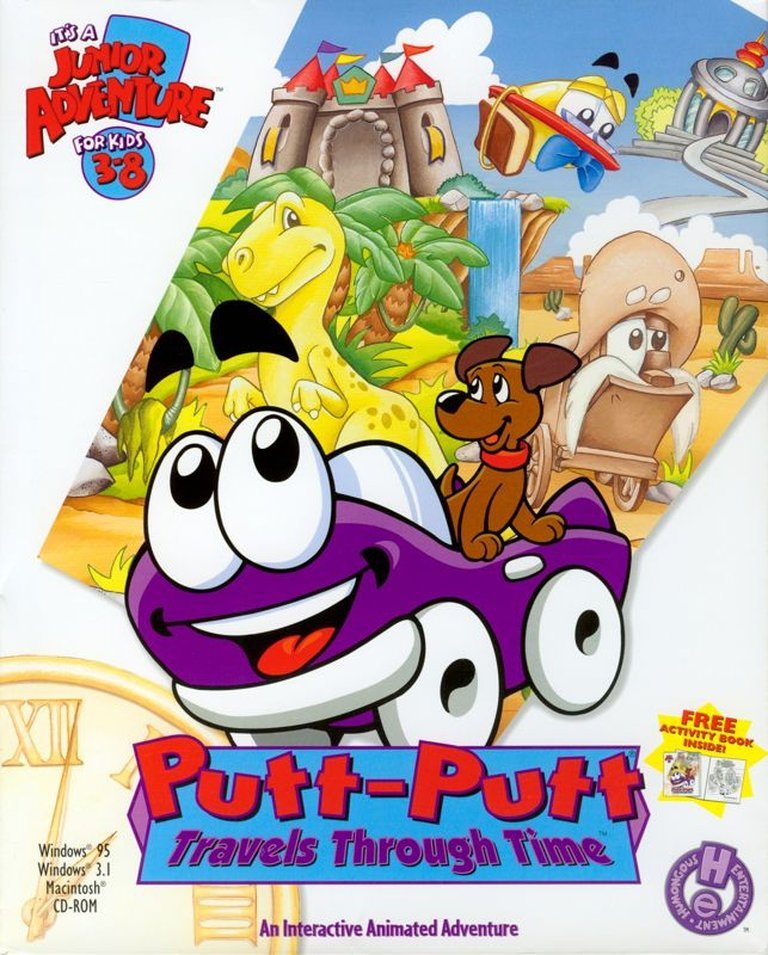
In Putt-Putt Travels Through Time, the cheerful car Putt-Putt accidentally activates his friend Mr. Firebird’s time machine, scattering his school supplies across four distinct eras: the Age of Dinosaurs, Medieval Times, the Wild West, and the Future. Players embark on an educational adventure, solving puzzles, collecting items, and meeting characters like Mr. Brachiosaurus and Silverado Sam to recover the lost supplies before Putt-Putt heads to school.
Gameplay Videos
Where to Buy Putt-Putt Travels Through Time
PC
Putt-Putt Travels Through Time Free Download
Putt-Putt Travels Through Time Guides & Walkthroughs
Putt-Putt Travels Through Time Reviews & Reception
store.steampowered.com (90/100): Putt-Putt® Travels Through Time is probably the best of the Putt-Putt® line of graphic adventures for kids. It features four distinct worlds to explore, including Putt-Putt’s own present time, and the puzzles are challenging and stimulating for young kids just learning how to problem solve and make predictions.
steamcommunity.com : It feels really good to finally beat a game I’ve owned since childhood.
Putt-Putt Travels Through Time: A Definitive Historical Analysis of Humongous Entertainment’s Pivotal Junior Adventure
1. Introduction: The Purple Convertible’s Chronological Leap
In the pantheon of 1990s children’s software, few franchises achieved the cultural ubiquity and heartfelt charm of Humongous Entertainment’s Junior Adventures. Centered on the anthropomorphic purple convertible, Putt-Putt, and his canine companion Pep, the series became a defining pillar of the “edutainment” genre—a term that, for many, evoked images of dry, didactic quiz programs. Yet, with 1997’s Putt-Putt Travels Through Time, Humongous crafted not merely a sequel but a quantum leap forward in ambition, design philosophy, and technical execution. This was the title that weaponized randomness, stretched its SCUMM-powered canvas across four vast historical vignettes, and featured a legendary musical score. It stands as the most sophisticated and, in many critical respects, the most accomplished entry in the Putt-Putt lineage, even as it exposes the inherent tensions between educational goals, playful scope, and the practical limits of its target audience. This review will argue that Putt-Putt Travels Through Time is a landmark of children’s interactive storytelling—a game whose expansive, randomized design fostered unprecedented replayability, whose artistic presentation set a new benchmark for the genre, and whose legacy is a complex tapestry of groundbreaking innovation tempered by the very scalability it sought to achieve.
2. Development History & Context: Humongous at Its Peak
To understand Putt-Putt Travels Through Time, one must situate it within the trajectory of Humongous Entertainment and the broader gaming landscape of the mid-1990s.
Studio & Vision: Founded in 1992 by LucasArts veterans Ron Gilbert and Shelley Day, Humongous carved a unique niche. Gilbert, co-creator of Maniac Mansion and the SCUMM engine, brought his narrative and interface expertise to a younger demographic. The studio’s “Junior Adventures” series—including Freddi Fish and Pajama Sam—shared core tenets: non-violent, point-and-click exploration, a focus on problem-solving over punishment, and a commitment to “fun first, learning second.” By 1997, following the critical darling Putt-Putt Saves the Zoo (1995), the studio was at the zenith of its creative and commercial powers, having been acquired by GT Interactive in 1996, which provided resources but maintained creative autonomy.
The Making of a Time-Travel Epic: As documented in Humongous’s own archived “Making Of” web pages (cited via Wikipedia and Everything Explained), the development process was a collaborative, pipeline-driven endeavor. The concept emerged from brainstorming sessions where titles like Putt-Putt Goes to the Carnival and Putt-Putt Saves the Universe were considered before settling on time travel. The established, simple designs of Putt-Putt and Pep were fixed, but new era-specific characters like Merlin the Medieval Sorcerer required iterative design work, with artists producing multiple sketches to finalize their look (Everything Explained). The production followed a clear sequence: writers (Laurie Rose Bauman) crafted scripts and storyboards; background artists painted environments, consciously leaving “sufficient space for clickable hotspots”; animators then produced approximately 30,000 hand-drawn frames for character movement and effects, which were scanned, cleaned, and colored—a process Humongous noted was “tedious” but allowed creative input from junior artists (Wikipedia, Everything Explained). Programmers coded the game logic, including the crucial randomization system, while sound effects were synced to animations. The music was composed in-house by Jeremy Soule, who had already scored several Humongous titles. Voice actor Jason Ellefson, who voiced Putt-Putt, was entering puberty during these sessions, resulting in the slightly deeper, strained tone that marks his final performance in the role (MobyGames player review).
Technological Constraints & SCUMM: The game was built on a modified version of the SCUMM (Script Creation Utility for Maniac Mansion) engine, licensed from Gilbert’s past. This robust, text-command-oriented engine was repurposed for a graphical, icon-driven interface suitable for pre-readers. The constraints of 1997 CD-ROM technology shaped the scope: hand-drawn art was labor-intensive, limiting the number of screens but allowing for lush, detailed backgrounds. The randomization system, a hallmark of Humongous games, was a programming triumph, ensuring that the four key items (history report, lunchbox, calculator, Pep) and their associated puzzle chains could be placed in any of the four eras across different playthroughs.
The 1997 Gaming Landscape: This was the era of Myst and the rising dominance of edutainment titles like The Oregon Trail. Humongous occupied a specific, underserved space: high-quality, story-driven adventures for preschoolers and early elementary children, devoid of the rote learning of earlier “educational” software. Competitors were scarce; the studio’s formula was virtually unmatched in its polished execution.
3. Narrative & Thematic Deep Dive: A Journey of Retrieval and Discovery
The narrative of Putt-Putt Travels Through Time is deceptively simple, serving as a elegant scaffolding for its exploratory core.
Plot Structure: The story begins in the present day with Putt-Putt preparing for school, eager to show his new supplies—a history report, a “Smokey the Fire Engine” lunchbox, and a calculator—to his inventor friend, Mr. Firebird. The inciting incident occurs when Firebird’s time portal machine (operated by inserting a coin, a clever meta-commentary on arcade mechanics) malfunctions, creating a vortex that sucks Putt-Putt’s supplies and Pep into four distinct temporal dimensions: the Time of Dinosaurs (Stone Age), Medieval Times, the Wild West, and the Distant Future. The portal cannot close until all items and Pep are retrieved, compelling Putt-Putt to journey through time himself.
This “retrieval quest” is a classic adventure trope (akin to Myst‘s book pages), but it is framed with child-appropriate urgency: the lost items are school-related, and the goal is to return in time for class. The resolution sees Putt-Putt succeed, Firebird shuts down the portal, and Putt-Putt arrives at school where he narrates his entire adventure to his classmates as his history report, cleverly tying the gameplay experience to the educational pretext. This framing device validates the player’s journey as a legitimate “learning” experience about different time periods.
Themes & Character Arcs:
* Friendship & Responsibility: The driving force is Putt-Putt’s devotion to Pep. The Big “NO!” upon Pep’s capture establishes the emotional stakes. The quest is as much about rescuing his best friend as it is about recovering property.
* Curiosity and Helpfulness: Putt-Putt’s defining trait is his proactive kindness. In every era, he assists the locals (helping Brachiosaurus, trading with a medieval king, panning for gold) not as a chore, but as a natural extension of his character. This reinforces Humongous’s moral philosophy: being nice is the primary tool for progression.
* History as Adventure: The game presents history not as a list of facts but as a series of vibrant, interactive worlds. The educational goal is to foster chronological awareness and cultural curiosity rather than memorization. The final school report scene is the explicit “lesson,” but the 90+ minutes of gameplay constitute the implicit education.
* Anachronism Stew & Playful License: As noted by TV Tropes, the game freely blends eras (Jurassic and Cretaceous dinosaurs together, futuristic robots next to medieval knights). This is not a bug but a feature—a cartoon logic that prioritizes fun, recognizable archetypes (a T-Rex, a dragon, a cowboy) over historical accuracy. The “education” is in the feel of different times, not their precise details.
Dialogue & Writing: The writing represents a step forward from earlier Putt-Putt games. While still simple, characters now possess more distinctive speech patterns. King Chariot tells jokes from his “Royal Joke Book,” Silverado Sam is hard-of-hearing (a source of gentle humor), and Merlin speaks in a whimsical, wizardly cadence. Putt-Putt’s dialogue, as voiced by Ellefson, carries earnest enthusiasm. The writing’s mild humor and personality were praised in player reviews for giving the world more life than its predecessors.
4. Gameplay Mechanics & Systems: The Architecture of Randomized Exploration
The gameplay of Putt-Putt Travels Through Time is a masterclass in accessible, system-driven adventure design for children.
Core Loop & Interface: The game employs a classic point-and-click interface built on SCUMM. Putt-Putt is controlled via mouse clicks to move along predefined paths. Interaction is handled through a “verbless” icon system: a white arrow indicates a clickable hotspot; a transparent arrow means “nothing there.” The dashboard features a glove box inventory (where collected items are stored and used), a horn (to honk at characters/objects), a radio (which plays tunes and occasionally delivers contextual facts or hints), and an accelerator (to move faster). This interface is identical to prior games, ensuring series veterans feel at home.
The Radical Randomization: The game’sdesign philosophy, as stated by designer Nick Mirkovich (Wikipedia), was to create an “immersive interactive world.” This is achieved through an unprecedented (for the series) randomization system. There are four key items to retrieve (Pep, lunchbox, history report, calculator). Each item can be found in any of the four eras. Furthermore, the puzzle chain required to obtain each item is randomized. For example, the history report might be:
1. In the possession of King Chariot, requiring you to win a checkers game.
2. Under the foot of a grazing Triceratops, requiring you to lure it away with hay.
3. In the Future’s museum, requiring a trade.
4. In the prehistoric tar pit, requiring you to fix a bridge.
This creates 16 possible combinations per full playthrough (4 items x 4 locations/sequences). Crucially, as the first player review notes, your first playthrough locks in a specific, more linear set of puzzles to teach mechanics, but subsequent playthroughs gradually unlock different combinations, ensuring significant replay value. This was the most heavily randomized Junior Adventure to date.
Puzzle Design & Minigame Integration: The puzzles are the game’s core. They range from simple fetch quests (“find the rope”) to more involved trading sequences and minigame challenges. The game is packed with optional minigames—a hallmark of the series—such as:
* Shoo, Crow, Shoo (balloon-popping in Medieval times).
* Follow the Volcano (a Simon-style memory game in prehistory).
* Squash (a Breakout-like paddle game in the Future).
* Gold Panning (tracing tracks in the Old West).
These minigames are not mere distractions; many are integrated directly into puzzle chains. The player review accurately notes this as a strength: “A lot of them are also incorporated into some of the game’s puzzles.” However, this integration also reveals a weakness. The push for 16 distinct puzzle chains forced compromises. The reviewer observes that “some of them are a lot simpler than others, with some requiring little more than to win a round of a minigame.” The sheer volume meant an uneven quality curve, with some chains feeling like full adventures (e.g., helping a dinosaur, trading with a king) and others feeling like brief, repetitive tasks.
Difficulty & Progression: The game is designed for ages 3-8, but reviews note it is “much harder than the first [Putt-Putt] game” (Ouders Online). Difficulty stems not from complex logic but from the scale of the world and the non-linearity. Players must deduce which items might be in which eras and figure out cross-era item usage (e.g., getting oil from the Old West to grease a stuck medieval gate). The order of puzzle chain unlocking does not always match difficulty, sometimes making later playthroughs feel easier if you encounter simpler chains first—a quirk of the randomization.
UI & Accessibility: The interface is clean and intuitive for young children, with no fail states. The game can be saved at any time, a crucial feature for short play sessions. A significant improvement from Putt-Putt Saves the Zoo is the enhanced character customization at “Paint-O-Rama”: players can now select brighter or darker shades of seven base colors, allowing for greater personal expression.
5. World-Building, Art & Sound: Four Ears, Four Eras, One Cohesive Universe
Where Putt-Putt Travels Through Time achieves its most consistent acclaim is in its artistic presentation, which successfully differentiates four distinct time periods while maintaining a unified, whimsical aesthetic.
Visual Direction & Era Distinction: The game uses a cartoony, candy-sweet art style introduced in Putt-Putt Saves the Zoo, with bright colors and exaggerated, expressive character designs. Each era is a visual feast:
* Time of Dinosaurs: A lush, dangerous jungle with volcanoes, tar pits, and dense foliage. The dinosaurs are friendly giants (Brachiosaurus, Apatosaurus) or comic threats (a cowardly T-Rex, a gluttonous Triceratops). Anachronisms abound (a surfing lizard).
* Medieval Times: A storybook European fantasy with a bustling castle courtyard, a blacksmith shop, and fortified walls. Characters include a jester, a dragon, and the pun-named King Chariot and Princess Chassis.
* Wild West: A bright desert town with saloons, ghost town ruins, and cacti-studded plains. The color palette shifts to warm oranges and browns. The anachronistic element is the presence of steam-powered carriages and vehicle-people.
* The Distant Future: A clean, high-tech, floating city with sleek architecture, hovering vehicles (Miss Electra’s flying car), robots, and zero-gravity transporters. It posits a future where “Everything Is an iPod”—newspapers are ancient artifacts, and battery-making is a child’s puzzle.
Clickable Hotspots & “Living” Worlds: A core Humongous design tenet is a world dense with hidden interactions. Hundreds of clickable hotspots exist in every scene—a small animal scurrying out, a plant moving, a cloud changing shape. The innovation here was the cursor hint system (white arrow = interactive, transparent = not), which reduced frustration and encouraged experimentation. This creates a sense of a living, breathing cartoon that rewards curiosity, a feature repeatedly praised in reviews.
Sound Design & Jeremy Soule’s Masterpiece: The game’s audio is universally lauded as its crowning achievement. Composer Jeremy Soule, in his fifth consecutive Humongous score (Wikipedia, Moby), created a soundtrack of “beautifully surreal and bouncy tunes” (player review). Each era has a distinct musical identity—prehistoric percussion and primal themes, medieval lutes and fanfares, twangy Western saloon piano, and futuristic electronic ambiance—yet they are unified by Soule’s signature melodic sensibility and recurring leitmotifs. The sound design is equally impeccable, with satisfying honks, boops, and character voices that bring the world to life.
6. Reception & Legacy: Critical Darling, Fondly Remembered, and Historically Significant
Contemporary Reception (1997-1998): The game was a critical and commercial success. It won Macworld‘s prestigious “Best Kids Game (1998)” award and was inducted into their Game Hall of Fame. Critics praised its scale, randomization, and presentation. The Cincinnati Post called it “outstanding” but warned it was more challenging than earlier titles. The Boston Herald gave it 4.5 stars, hailing it as one of the “finest kid titles ever,” specifically highlighting the abundance of clickable surprises. Rocky Mountain News (B+) and The Washington Times (“delightful,” “uncomplicated”) were similarly positive. The Mobyscore aggregates 5 critic reviews to 87%. It was the 4th best-selling PC Kids/Edutainment title in Q4 1997, demonstrating strong market penetration.
However, not all reviews were uniformly enthusiastic. Electric Playground (8/10) offered a measured take, stating it was great but that fans might prefer Pajama Sam or Freddi Fish, finding Putt-Putt’s concept “not as fresh or original as it could have been.” Computer Shopper felt it was fun but failed to live up to predecessors of the genre (likely referencing Myst). These early notes of diminishing returns in the Putt-Putt series would grow louder in later entries.
Modern Retrospective & Player Reception: On platforms like Steam, the game enjoys a “Very Positive” rating (94% from 356 reviews as of Steambase data), fueled by potent nostalgia. The player reviews on MobyGames are tellingly split:
* One passionate review hails it as “the peak of the Putt-Putt games… the best thing Humongous Entertainment ever did with the character,” praising the four distinct worlds, Soule’s music, improved puzzles, and writing.
* Another calls it “the most boring Putt-Putt game I know,” criticizing the disjointed, task-like feel of the puzzles compared to later games like Putt-Putt Joins the Circus, and highlighting the frustrating “apatosaurus itch” minigame.
This dichotomy captures the game’s dual nature: a bold, ambitious design that sometimes sacrifices tight, thematic puzzle cohesion for sheer quantity and replayability.
Legacy & Historical Importance:
1. Pinnacle of the Putt-Putt Series: It is widely regarded as the franchise’s creative apex, taking the established formula to its most expansive conclusion before subsequent entries (Enters the Race, Joins the Circus) were seen as lesser.
2. Refinement of Randomization: It perfected the “multiple pathways” system first experimented with in Pajama Sam. This design ensured that no two playthroughs were identical, a revolutionary concept for a children’s game aimed at encouraging repeat engagement.
3. Artistic Benchmark: The combination of four richly detailed, stylistically distinct worlds with Jeremy Soule’s score set a new bar for artistic cohesion in children’s software. The “clickable world” philosophy became a Humongous trademark.
4. The SCUMM Engine’s Last Stand: It was one of the last major games to use the classic SCUMM engine in its original form before Humongous transitioned to other technologies.
5. Enduring Cultural Presence: Through re-releases on Steam (2014), Nintendo Switch, and PlayStation 4 (2022), the game has been preserved for new generations. Its inclusion in Humongous bundles and its active Steam community prove its lasting appeal.
7. Conclusion: A Flawed Masterpiece of Children’s Design
Putt-Putt Travels Through Time is not a perfect game. Its pursuit of 16 randomized puzzle paths led to a sacrifice in consistent puzzle quality and narrative cohesion—some chains are undeniably thin, and the quest can feel like a “collection of…tasks” rather than a singular, flowing adventure (Nowhere Girl review). The voice acting, while charming, betrays the actor’s changing voice, a subtle reminder of the passage of time even within a game about time travel.
Yet, these flaws are inseparable from its ambitious, pioneering design. The game’s greatest strength—its vast, randomized, multi-era scope—is also the source of its minor weaknesses. It dared to imagine a children’s adventure game that was truly huge, that could be played differently each time, that rewarded curiosity with hundreds of little animated surprises. It married this systemic depth with an unparalleled artistic presentation, from Jeremy Soule’s iconic score to the lovingly painted, interactive landscapes.
In the history of video games, Putt-Putt Travels Through Time represents the culmination of a specific, noble design philosophy: that games for the youngest players can be expansive, systemic, and artistically rich without being punitive or overly complex. It is the point where the Junior Adventure formula achieved its maximum expression—a themed park with four distinct lands, each with its own music, characters, and secrets, all connected by a clever randomization system that encouraged endless revisiting. For its ambition, its craftsmanship, its influential design, and its enduring charm, it stands not just as the best Putt-Putt game, but as one of the most significant and expertly crafted titles in the entire edutainment genre. It is a timeless adventure, imperfections and all, that earns its place in the canon as a landmark of thoughtful, child-centered game design.