
- Release Year: 2006
- Platforms: Windows
- Publisher: Selectsoft Publishing
- Genre: Battleship, Board game, Compilation, Hangman, Jigsaw puzzle, Number puzzle, Othello, Reversi, Word
- Perspective: Top-down
- Game Mode: Single-player
- Gameplay: Drag and drop, Logic puzzles, Piece Placement, Piece Rotation, Tile matching, Turn-based
Description
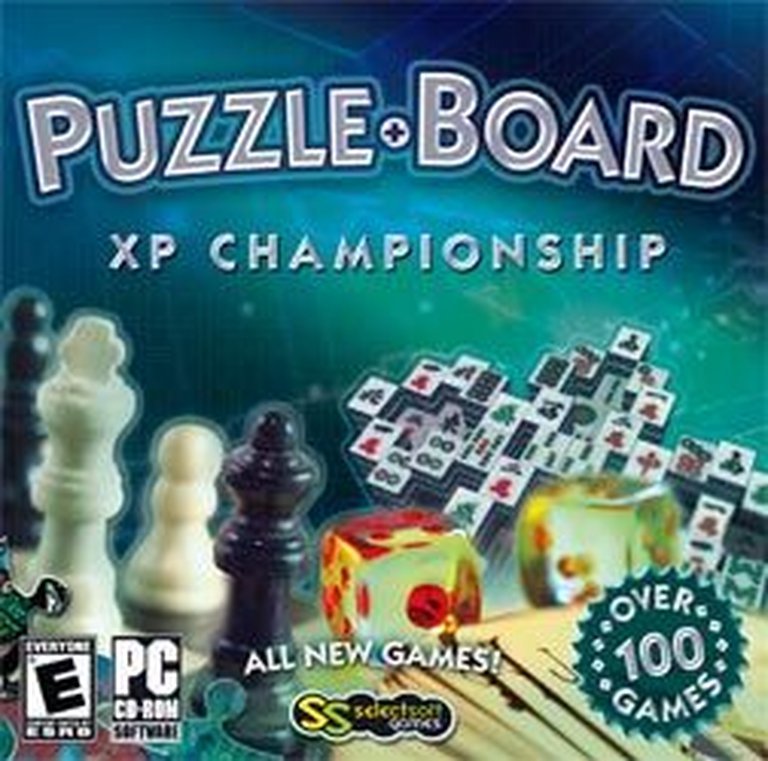
Puzzle & Board XP Championship is a 2006 Windows compilation of over 100 single-player casual board and puzzle games, including variants of Backgammon, Battleships, Bingo, Checkers, Chess tasks, Chinese Checkers, Gomoku, Jigsaw Puzzles, Knight tours, Mahjongg, Queens placement, frog-hopping races, Reversi, and Hangman-style word games, all controlled entirely with the mouse, featuring 2D/3D views, sound, music, multiple board sizes, and difficulty levels for endless replayability.
Puzzle & Board XP Championship: Review
Introduction
In the mid-2000s, as broadband internet began reshaping gaming toward online multiplayer spectacles and high-octane action titles, a quieter revolution simmered in the realm of casual compilations—digital anthologies resurrecting timeless board and puzzle games for the modern PC. Puzzle & Board XP Championship, released in 2006 by Selectsoft Publishing for Windows, stands as a quintessential artifact of this era, bundling over 100 single-player variants of classic parlor pursuits into one unassuming package. With its mouse-driven simplicity, optional 3D visuals, and a focus on solitary mental challenges, it evokes the spirit of rainy afternoons with wooden boards and printed puzzles, digitized for the XP generation. This review posits that while Puzzle & Board XP Championship lacks innovation or narrative flair, its exhaustive variety and faithful recreations cement it as a valuable historical preserve of analog gaming traditions, offering enduring value for casual players seeking low-stakes, brain-teasing diversion amid the rising tide of complexity in mainstream titles.
Development History & Context
Selectsoft Publishing, a California-based outfit known for budget-friendly casual game bundles, spearheaded Puzzle & Board XP Championship amid a burgeoning market for “value-packed” compilations tailored to Windows XP—the dominant OS of 2006, with its Pentium III/IV-era hardware demands (700 MHz minimum CPU, 128 MB RAM, DirectX 9 graphics). This title emerged from the post-2003 casual gaming boom, where publishers like Hoyle and Big Fish Games capitalized on the video game crash of 1983’s lessons: avoid oversaturation by bundling proven, low-risk classics rather than risky originals. Selectsoft’s vision, as gleaned from ad blurbs, was to “see your old-time favorite games with brand-new twists,” blending fidelity to tradition with modest tech upgrades like resizable windows, 2D/3D toggles, and remixable layouts (e.g., Mahjongg shuffles).
The gaming landscape of 2006 was bifurcated: AAA juggernauts like The Elder Scrolls IV: Oblivion and Gears of War dominated headlines, while the indie scene gestated via Flash portals like Newgrounds. Casual compilations filled the gap for non-gamers—parents, seniors, and office workers—mirroring physical board game sales amid a digital shift. Technological constraints shaped its design: mouse-only controls suited XP’s ubiquity, avoiding keyboard complexity; 32 MB 3D cards enabled basic polyhedral boards without taxing era hardware (e.g., no shaders or physics beyond dice rolls). No named developers are credited on MobyGames, suggesting outsourced or in-house work by a small team, akin to contemporaries like 555 Games XP Championship (2005) or Hoyle Puzzle & Board Games (2009). Added to MobyGames in 2013 by contributor piltdown_man, it reflects preservation efforts for ephemeral budgetware, now archived on sites like Internet Archive as a CD-ROM ISO relic.
Narrative & Thematic Deep Dive
As a pure compilation, Puzzle & Board XP Championship eschews plot, characters, or dialogue entirely—there are no heroes, villains, or branching stories to dissect. Instead, its “narrative” unfolds through thematic purity: the eternal dance of intellect versus chance, isolation versus strategy, preserved in pixelated form. Each mini-game embodies archetypal human pursuits—conquest (Battleships, Reversi), endurance (Knight tours, Jigsaw), wit (Chess Tasks, Hangman), and luck (Bingo, Turns)—echoing millennia-old pastimes from ancient Senet to Victorian parlors.
Underlying themes revolve around solitary mastery and variation as virtue. Backgammon’s three setups (long, short, symmetrical) explore positional asymmetry; Checkers’ 17 variants (8×8/10×10 boards, 3/4 ranks, remove rules, Giveaway, Corners) probe rule tweaks’ impact on depth. Mahjongg’s 15 layouts and remix feature thematize resilience against dead ends, while Words’ five Hangman themes (e.g., trivia silos) nod to lexical discovery. Queens (9 puzzles) and Gomoku/Down XO (10 grids) delve into non-attacking placement and linear dominance, philosophical echoes of Go or N-Queens algorithms. Absent voiced tutorials or lore, themes emerge analytically: progression via high scores, remix/shuffle as “second chances,” and AI opponents scaling three difficulty levels, fostering a meditative rhythm. In XP’s context, it counters narrative-heavy epics, affirming casual gaming’s thesis: joy in rules, not stories.
Gameplay Mechanics & Systems
At its core, Puzzle & Board XP Championship is a mouse-exclusive anthology of 111+ mini-games (per category tallies), emphasizing tactile precision over twitch reflexes. Core loop: select category → choose variant → play → score/rank → remix/retry. UI is utilitarian—resizable windows, menus for 2D/3D/sound toggles—prioritizing accessibility on XP desktops.
Core Categories Deconstructed:
- Backgammon (3 variants): Standard board, altered starts (long: full armies; short: halved; symmetrical: mirrored). Roll dice (AI auto-moves player?), bear off for win. Difficulty tiers ramp AI foresight.
- Battleships (5 grids): Mouse-place/rotate ships (RMB/LMB), then hunt opponent’s via clicks. Asymmetrical fog-of-war; victory by total fleet elimination. Innovative: pure deduction loop.
- Bingo (1): Vs. two AIs; mouse-click reveals numbers, auto-daubs cards. First full line/house wins—luck-dominant, communal vibe simulated.
- Checkers (17): Six standard (8×8 3-rank, 10×10 3/4-rank, two remove rules); six Giveaway (suicide variants); five Corners. King jumps mandatory captures; boards scale complexity.
- Chess Tasks (10): Puzzles (e.g., mate-in-two). Static boards demand optimal sequences—no full games, pure tactical vignettes.
- Chinese Checkers (2 board sizes): Hop to opposite star; solo vs. AIs, emphasizing pathing.
- Gomoku/Down XO (10): Five grids; align five-in-row (Gomoku) or block (XO). Forbidden centers in some for balance.
- Jigsaw Puzzles (20): Five images × four types (two rotational—correct orientation; two drag-drop: shaped/square pieces). Progressive reveals aid novices.
- Knight (5 boards): Tour every square sans revisit—Hamiltonian path solver, escalating sizes test memory.
- Mahjongg (15 layouts): Mouse-match pairs; 2D/3D, high scores, remix deadlocks. Tile physics simulate stacking.
- Queens (9): N-Queens/Knights: place max without attacks. Grid-filling logic puzzles.
- Turns (4): Frog-race vs. three AIs; 1/2 dice (max 3/6), auto-moves over lily pads (obstacles/bonuses). Click-roll simplicity.
- Reversi (10, incl. Mage): Five boards; flip territories. Mage variant adds magic? (Unspecified, likely power-ups).
- Words (5 Hangman themes): Guess letters; themed word banks.
Progression: Global high scores, no metasystem. Flaws: AI occasionally rote (e.g., Bingo randomness); no multiplayer/local saves beyond tables. Strengths: Variant depth yields replayability—Checkers alone rivals full titles. Mouse UI shines in placement (ships, queens) but drags in rapid rolls.
| Category | Variants | Key Innovation/Flaw |
|---|---|---|
| Checkers | 17 | Rule/board scaling; deep but repetitive AI |
| Jigsaw | 20 | Rotational types; intuitive drag physics |
| Mahjongg | 15 | Remix lifeline; 3D immersion uneven |
World-Building, Art & Sound
No expansive worlds here—settings are abstracted boards/grids, evoking minimalist elegance. Atmosphere derives from fidelity: Battleships’ oceanic grids, Mahjongg’s bamboo stacks, Jigsaws’ serene photos (five unspecified landscapes?). Visuals toggle 2D (flat, crisp) to 3D (polygonal boards, rotatable Mahjongg pyramids), leveraging XP’s DirectX 9 for subtle depth without bloat. Resizable windows adapt to widescreens; UI clean, icon-driven.
Sound design enhances tactility: Dice clatters in Turns/Backgammon, tile clinks in Mahjongg, triumphant chimes on wins. Background music loops mellow jazz/classical, toggleable—non-intrusive for focus. Collectively, elements forge cozy immersion: 3D Backgammon boards gleam like polished wood; Reversi flips satisfy viscerally. On period hardware, it hums efficiently; modern ports (e.g., Archive.org ISO) retain charm, though 3D may stutter sans tweaks. Atmosphere: Nostalgic hearthside glow amid XP’s beige desktop era.
Reception & Legacy
Critically invisible—no MobyScore, zero user/critic reviews on MobyGames (as of 2023). Commercially, a budget CD-ROM (~$10-20 via outlets like DiscoveryVIP/Aussie Kids), it targeted impulse buys alongside Hoyle Board Games. Sales untracked, but parallels Casino/Board Games (2003) suggest modest longevity via jewel-case retail. Evolved rep: Forgotten amid Flash/mobile casuals, yet preserved digitally (Archive.org 2004 ISO variant hints early iterations).
Influence: Bolsters 2000s compilation trend (Swift Classics, Card & Board Games 3), bridging analog-digital divide pre-mobile puzzles (Candy Crush). Echoes in modern apps (Steam board bundles, mobile Mahjong); inspires genre history (pioneers like Tetris 1984, board digitization 1980s). In crash-proof casuals, it exemplifies accessible preservation, influencing post-2010 indies like Into the Breach‘s tactical purity.
Conclusion
Puzzle & Board XP Championship endures not as a masterpiece but a meticulous museum: 100+ variants distilling board/puzzle essence into mouse-friendly XP bliss. Its exhaustive mechanics, modest 3D flourishes, and thematic purity outweigh absent narratives or flash. In video game history, it occupies a humble yet vital niche—counterpoint to bombast, affirming casual gaming’s role in broadening access. Verdict: 8/10—Essential for historians, delightful for downtime; a championship worth revisiting in our hyperkinetic age. Download the ISO, resize that window, and rediscover the board.