
- Release Year: 2015
- Platforms: Windows
- Publisher: UIG Entertainment GmbH
- Developer: Cheerful Deer
- Genre: Puzzle
- Perspective: Side view
- Game Mode: Single-player
- Gameplay: Business simulation, Managerial, Tile matching puzzle
Description
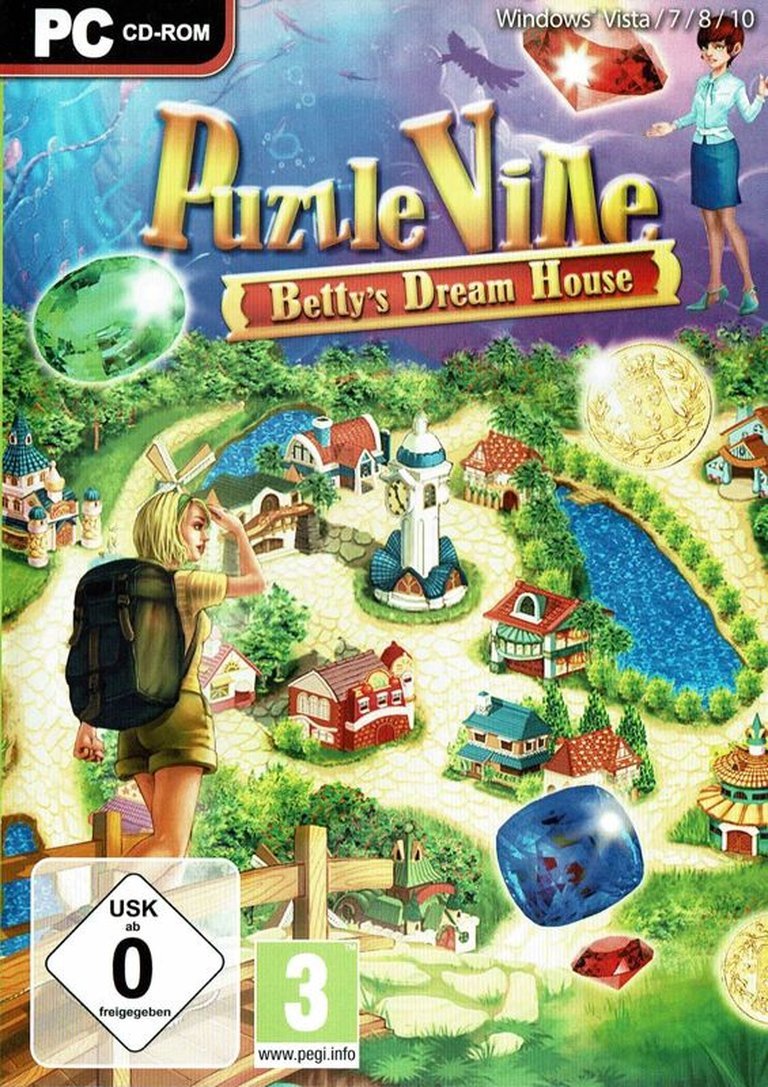
Puzzle Ville: Betty’s Dream House is a match-3 puzzle game where players combine three or more identical symbols to clear them and complete time-based level objectives, earning money to purchase and decorate items for Betty’s dream house, allowing for creative customization of a virtual living space.
Puzzle Ville: Betty’s Dream House: Review
Introduction
In the crowded landscape of casual puzzle games, few titles manage to blend addictive mechanics with a compelling, player-driven vision. Puzzle Ville: Betty’s Dream House, released on December 11, 2015, for Windows by developer Cheerful Deer and publisher UIG Entertainment GmbH, attempts this fusion with a deceptively simple premise: match tiles to earn currency and construct a personalized dream home. Yet beneath its family-friendly PEGI 3-rated exterior lies a microcosm of mid-2010s indie aspirations—one part resource management, one part spatial creativity, and one part match-3 drudgery. While the game’s core loop offers fleeting satisfaction, its execution, narrative framing, and technical limitations anchor it firmly in the realm of forgotten curiosities rather than timeless classics. This review dissects its legacy as a product of its time—a snapshot of developer ambition constrained by genre conventions and market saturation.
Development History & Context
Cheerful Deer (a studio with sparse documented history) conceived Puzzle Ville as a hybrid of two dominant casual gaming trends: the tile-matching boom epitomized by Bejeweled and the “ville” simulation craze popularized by titles like The Ville (2012) and Happy Ville: Quest for Utopia (2010). The developer’s vision, inferred from its dual-genre classification (Managerial/Business Simulation + Tile Matching Puzzle), was to create a low-stakes, reward-driven experience where puzzle-solving directly fueled a creative outlet. Technologically, the game adhered to era-appropriate constraints: a fixed/flip-screen visual system with first-person and side-view perspectives, CD-ROM distribution, and support for keyboard and mouse inputs. This design choice likely prioritized accessibility over graphical fidelity, aligning with the PEGI 3 rating targeting a broad, casual audience.
The 2015 release landscape was saturated with free-to-play mobile games and premium casual PC titles, making it a challenging market for a commercial, single-player CD-ROM title. Competitors like Dream House Days (2013) had already blended puzzle mechanics with home-decoration, raising the bar for innovation. Puzzle Ville’s lack of online features or DLC further isolated it from the evolving digital ecosystem, positioning it as a niche, offline experience. The studio’s limited resources are evident in the game’s static environments and repetitive visual assets, reflecting the constraints of small-scale development against industry giants.
Narrative & Thematic Deep Dive
The narrative framework, as described by the official description, is minimal yet evocative: Betty, an everywoman protagonist, stumbles upon the enigmatic village of PuzzleVille, where prosperity hinges on a mystical “Puzzle Generator” and daily puzzle rituals. Intrigued by the village’s peculiarity, she resolves to uncover its secrets while using her earnings from puzzle-solving to build and decorate her dream house. This setup establishes a central tension between exploration and creation—a theme of self-actualization through labor.
Betty lacks depth, serving as a blank slate for the player’s ambitions. Her “quest” feels tacked-on, existing merely to justify the decoration minigame. Dialogue is absent beyond brief task prompts, reducing interaction to transactional exchanges: “Match 5 stars,” “Earn $500.” The village of PuzzleVille, hinted to harbor deeper lore, remains an underdeveloped backdrop. Its “mystery” is never explored, leaving the narrative an unresolved prologue. Thematically, the game leans into aspirational fantasy—reinforcing the idea that piecemeal effort (tile-matching) can manifest grand dreams (a custom-built home). Yet without meaningful character growth or conflict, this theme feels superficial, a veneer over the game’s true purpose: a puzzle loop with cosmetic rewards.
Gameplay Mechanics & Systems
The core gameplay revolves around a familiar match-3 mechanic: players align three or more identical symbols (stars, hearts, gems) in a grid, triggering their disappearance and cascading refills. Each level presents a task (e.g., “clear 20 red tiles,” “earn $300”) against a timer, creating urgency. Successful completion awards currency, which fuels the managerial component: a catalog of decorative items (furniture, paint, ornaments) for Betty’s Dream House.
Strengths:
– Dual-Loop Design: The cycle of puzzle-solving → currency-earning → house-decoration provides intermittent dopamine hits, satisfying completionist instincts.
– Accessibility: Simple controls (mouse-click tile-swapping) and forgiving difficulty (PEGI 3 rating) cater to casual players.
Weaknesses:
– Repetitive Core: The tile-matching lacks innovation—no power-ups, complex combos, or time-based challenges. Levels feel interchangeable, with escalating difficulty coming from faster timers, not strategic depth.
– Shallow Progression: Currency unlocks cosmetic upgrades, but these have zero gameplay impact. Decorating the house is a solitary, static activity with no feedback or customization constraints, diminishing its appeal.
– Technical Flaws: The fixed-screen grid limits visibility, forcing backtracking. Collision detection is inconsistent, occasionally failing to register matches. The timer creates artificial pressure, turning relaxation into frustration.
The UI is functional but dated, with clunky menus for item selection and a lack of visual polish. No combat or RPG elements exist, narrowing the experience to a single, repetitive loop.
World-Building, Art & Sound
PuzzleVille is depicted as a quaint, stylized village with colorful, low-poly buildings and lush, cartoonish environments. However, the setting is rarely explored outside of the puzzle grid, reducing it to a backdrop. The Dream House, the game’s centerpiece, is a blank canvas where furniture items float statically in pre-defined slots, devoid of physics or personalization.
Visual Direction: The art adopts a bright, child-friendly aesthetic reminiscent of early 2000s casual games. Character sprites are simple and expressive, but environments lack detail, with repetitive tilesets across levels. The flip-screen transition between puzzle and house modes is jarring, breaking immersion.
Sound Design: Audio is limited to generic match-3 sound effects (pops, chimes) and a forgettable, looping piano soundtrack. No voice acting or environmental ambience exists, further flattening the world. The absence of audio cues for combos or critical failures leaves feedback feeling muted.
These elements collectively create a sterile, impersonal atmosphere. While visually inoffensive, the art fails to evoke the whimsy or mystery hinted at in the narrative, reducing PuzzleVille to a generic placeholder.
Reception & Legacy
Puzzle Ville: Betty’s Dream House arrived with a whisper, not a roar. MobyGames lists no critic scores, and Metacritic displays “tbd” for both critic and user reviews, indicating a launch devoid of mainstream attention or player discourse. Its commercial performance is undocumented, but its CD-ROM release in an increasingly digital era likely limited its reach.
Contemporary reception, inferred from sparse community mentions, leans toward indifference. Players on platforms like RAWG highlight its “relaxing” nature but criticize its lack of originality. In the context of the “ville” genre, it failed to stand beside titles like Dream House Days, which integrated deeper simulation mechanics. Its legacy is one of obscurity—a footnote in the history of casual gaming, remembered only for its literal title and unfulfilled potential.
Influence on subsequent games is negligible. Its hybrid approach (puzzle + decoration) was more successfully executed by later titles like Homescapes (2017), which added narrative context and interactive design. Puzzle Ville remains a cautionary tale of good intentions undone by genre stagnation.
Conclusion
Puzzle Ville: Betty’s Dream House encapsulates the double-edged sword of mid-2010s casual game development: a solid concept undermined by shallow execution. Its blend of match-3 puzzles and home-decoration offers a satisfying, if repetitive, loop, yet the absence of narrative depth, mechanical innovation, or technical polish relegates it to the dustbin of forgotten indies. The game’s vision—empowering players through incremental creation—is admirable, but its realization feels half-baked, a product of limited resources and a saturated market.
As a historical artifact, it serves as a benchmark for genre conventions, illustrating how even simple ideas require nuance to endure. For modern players, its appeal is largely nostalgic; for historians, it’s a case study in how ambition alone cannot overcome formulaic design. In the pantheon of puzzle games, Puzzle Ville is neither a masterpiece nor a failure, but a missed opportunity—a dream house built on a foundation of sand. Verdict: A niche curiosity for genre enthusiasts, but ultimately a forgettable entry in the casual canon.