
- Release Year: 2008
- Platforms: Windows
- Publisher: Candella Software Ltd.
- Developer: Eipix d.o.o.
- Genre: Action, Driving, Racing
- Perspective: 1st-person / Behind view
- Game Mode: Single-player
- Gameplay: Anti-gravity, Combat racing, Weapon Upgrades
- Setting: Futuristic, Sci-fi
- Average Score: 58/100
Description
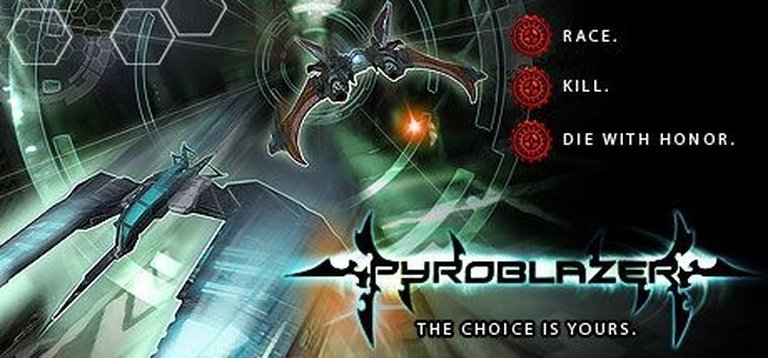
Pyroblazer is a futuristic combat racing game set in the awe-inspiring world of New Apeiron, where players pilot anti-gravity craft called Blazers through diverse environments including the scorched valleys of Gnosis, deserted cities of Haedra, and the densely populated Underdome of Evelads. As they compete in a championship, racers can upgrade their Blazers for improved speed, handling, and firepower, while collecting weapon and ammo pickups during races to battle opponents and secure glory.
Where to Buy Pyroblazer
PC
Pyroblazer Free Download
PC
Pyroblazer Guides & Walkthroughs
Pyroblazer Reviews & Reception
metacritic.com (45/100): Another middle-of-the-road glimpse of the future.
metacritic.com (50/100): Totally uninspired Wipeout rip-off that has horrible flaws in track design and lacks variety.
metacritic.com (70/100): Despite the outdated gameplay, the game can still bring positive emotions.
metacritic.com (70/100): it’s an all right game
Pyroblazer Cheats & Codes
PC
Enter codes at the main menu or in-game menu as specified.
| Code | Effect |
|---|---|
| RISEOFAPEIRON | Unlock Everything |
| MIGHTOFARAKHON | Unlock All Cheats |
| QUADQUANTUM | Quad Damage |
| HYPERBLAZE | Unlimited Turbo |
| SHIELDOFARAKHON | God Mode |
| FULLPYROENGINE | Pyro Engine |
| EYEOFARAKHON | Invisibility |
Pyroblazer: A Forgotten Blaze in the Combat Racing Wasteland
1. Introduction: The Ghost in the Anti-Gravity Machine
In the crowded pantheon of anti-gravity combat racers, a niche forged by Wipeout and F-Zero, countless titles have attempted to capture that intoxicating blend of breakneck speed and strategic weaponized violence. Most are forgotten. Pyroblazer, released in November 2008 by the Serbian studio Eipix Entertainment, is not merely forgotten—it is a profound archaeological specimen of ambition hamstrung by constraint, a game whose beautifully fractured vision is almost more compelling than its finished, flawed reality. This review posits that Pyroblazer is a critical case study in the perils of mid-tier development: a title brimming with creative world-building, potent audio-visual identity, and a core combat-racing loop with potential, yet systematically undermined by foundational issues in physics, track design, and a crippled multiplayer promise. It stands not as a classic, but as a poignant, often frustrating monument to “what could have been.”
2. Development History & Context: Shadows of the Ultra Engine
The Studio and Its Vision:
Eipix Entertainment, under CEO & Lead Game Designer Mirko Topalski, was a studio with a clear creative streak but operating well outside the major studio ecosystem. Based in Serbia, their portfolio included casual titles and puzzle games (Ultra Tubes, Eclosion), but Pyroblazer represented a bold swing for the fences—a full-scale, technologically ambitious sci-fi racer. The team’s passion is evident in the elaborate lore they constructed for the world of New Apeiron, a setting that merges “science fiction and fantasy… reminiscent of ancient Egypt with motives of Cyber-Punk,” as documented on Gamepressure.com. This wasn’t just a racer; it was intended to be an experience embedded in a mythos.
Technological Constraints and The Ultra Engine:
The game wasBuilt on Eipix’s proprietary Ultra Engine, a significant investment for a small studio. Its partnership with Ageia’s PhysX middleware was a major selling point, promising advanced cloth, fluid, and destruction physics. In 2008, PhysX was a cutting-edge (if sometimes problematic) PC-exclusive feature, signaling the team’s desire to compete on a technical level. However, as critic reviews later revealed, the implementation became a core flaw. The physics simulation, meant to enhance realism, instead created a “fundamental gap between what you see and what you do,” with “polystyrene-physics blocks” causing arbitrary clipping and slowdowns, as GamesRadar starkly articulated.
The 2008 Market Landscape:
Pyroblazer arrived in a saturated market. The genre’s gold standard, Wipeout, had a loyal following, and F-Zero remained a revered memory on Nintendo platforms. Mid-tier PC racers like Ballistics (2001) and Death Track: Resurrection (2008) had already explored similar territory with mixed results. The rise of Steam as a digital storefront was opening doors for smaller studios, but also increasing competition. With a budget price point (eventually $4.99 on Steam, a “half-budget tag” compared to full releases as noted by Out of Eight), Pyroblazer was competing not just on quality, but on value perception.
The Scaled-Back Dream:
Perhaps the most telling aspect of its development history is the post-launch removal of multiplayer. The initial press release and Wikipedia/HandWiki entries explicitly promised “6-person local multiplayer… and an online multiplayer mode.” Yet, as the Večernje novosti article (cited in Wikipedia) bluntly stated in translation: “I za igre treba para” (“Even for games, you need money”). The multiplayer component was removed due to lack of funding, a devastating blow to a combat racer’s longevity. This truncation transformed Pyroblazer from a potentially social experience into a purely solitary, and thus limited, championship run. Plans for Wii and PSP ports (mentioned in the press release and Alchetron) were also cancelled, further illustrating the project’s precarious footing.
3. Narrative & Thematic Deep Dive: The Cataclysm of Apeiron
While often relegated to a backdrop for racing, Pyroblazer possesses a surprisingly dense, if clumsily delivered, narrative framework. The lore, attributed to writers Uroš Banješević and Mirko Topalski, constructs a mythic history for the planet New Apeiron.
The World and Its Schism:
Apeiron, the fourth planet in the binary system Xarthas, survived a cataclysm that shattered its civilization into three fractious territories:
1. Gnosis: The “scorched valleys,” a post-apocalyptic wasteland.
2. Haedra: The “deserted cities,” ruins of a former advanced society.
3. Evelads: The “densely populated Underdome,” a stark contrast, suggesting a more crowded, industrialized, or perhaps domed survival habitat.
This tripartite division immediately establishes a world of environmental and socio-political diversity, a strength that the track design only partially realizes.
The Hero’s Journey and Cosmic Conflict:
The protagonist is a young pilot entering the “Pyroblazer” championship. The narrative twist, as detailed on VGtimes, is that this rookie is the successor to the ancient hero Shan-Tor. Shan-Tor wielded the “Divine Flame” to usher in a golden age before the cataclysm. The antagonist is Fekuam, initially a “messenger of the dark deity Loardi” linked to the old civilization’s destruction. The plot’s climax reveals a cosmic twist: “Loardi” is merely “the destructive aspect of Arakon, who wished to destroy the reality he had created.” The hero’s ultimate victory over Fekuam leads him to “leave his world in search of a creator god.”
Themes and Execution:
Thematically, Pyroblazer grapples with legacy, rebirth, and the cyclical nature of cataclysm. The racing championship itself becomes a metaphor for the civilization’s struggle to reclaim its former glory through controlled, competitive conflict—a ritualized war. The fusion of sci-fi (anti-gravity craft, alien worlds) with fantasy (divine flames, creator gods, dark deities) is an intriguing hybrid that elevates the setting above a pure Wipeout clone. However, the integration is almost entirely extradiegetic. The story is confined to the manual, website, or cryptic loading screens; there is no in-cockpit narrative delivery, no character banter, no plot progression woven into the races. The rich lore remains a buried treasure, a world-building missed opportunity that could have given weight to the championship beyond simple “Win Race → Unlock Next.”
4. Gameplay Mechanics & Systems: Speed Without Traction
Core Loop and Progression:
The fundamental loop is sound in theory: race a “Blazer” (anti-gravity craft) through a track, collect weapon/ammo pickups, attack opponents, and finish to earn credits/points to unlock 15+ different Blazers with improved speed, handling, and firepower. The Steam store page touts “20 deadly weapons” and “physics-based weapons.” Championship mode is the primary single-player offering, supplemented by Quick Race.
Innovations and Notable Systems:
* The Coin Collection Mechanic: Out of Eight highlighted a unique feature: collectible coins that “give you an alternative objective during the race that grants more bonuses.” This adds a risk/reward layer—prioritize coins or combat?—a smart design choice that rewards mastery of track routes.
* PhysX-Based Interaction: The use of PhysX was meant to create dynamic track elements and weapon effects. In concept, this allows for environmental strategy.
Flaws: A Cascade of Disconnection:
The critic consensus homed in on devastating systemic flaws:
* The Floaty, Disconnected Physics: This is the game’s mortal sin. As GamesRadar excoriated, the craft have no meaningful connection to the track: “you simply float free, unable to connect.” This destroys the essential sensation of * grip* that defines great anti-gravity racers (Wipeout‘s “air brakes” and magnetic adherence, F-Zero‘s tight cornering). The result is a pervasive feeling of unresponsiveness and randomness.
* Track Design & Clipping: The tracks are criticized as “cramped” (Out of Eight) and filled with arbitrary obstacles—”polystyrene-physics blocks and boards”—that cause unpredictable slowdowns. The “randomness of the clipping” means the player’s visual judgment of spacing is constantly betrayed by the hitbox, creating immense frustration. The three environments (Gnosis, Haedra, Evelads) may be aesthetically distinct, but the underlying track logic is consistently flawed.
* AI and Challenge: Opponents are described as “keinerlei Herausforderung” (no challenge at all) by PC Games (Germany). The AI is passive and unintelligent, removing the competitive tension that would otherwise compensate for poor control feel.
* Lack of Content & Customization: With only 40 levels (which feels sparse for a championship) and no ability to customize your ride (Out of Eight), the game’s depth is severely limited. The four power-ups, while varied, cannot compensate for the shallow progression and uninspired track layouts.
* The Missing Multiplayer: The removal of online and local multiplayer is catastrophic. For a combat racer, the chaos and emergent play of human opponents is the genre’s lifeblood. Its absence leaves a gaping void, making the single-player experience feel like a sterile tutorial for a party that never happens.
5. World-Building, Art & Sound: A Beautiful, Acidic Mirage
Visual Direction and Setting:
Pyroblazer’s greatest asset is its aesthetic ambition. The world of New Apeiron is a striking blend of sun-bleached post-apocalypse (Gnosis), monolithic cyber-ruins (Haedra), and neon-drenched industrial sprawl (Evelads). The art direction, led by Uroš Banješević and Nenad Tomić, uses a vibrant, often acidic color palette—deep oranges, electric blues, stark whites—that makes every track visually distinct. The Underdome of Evelads, in particular, with its dense, layered architecture and perpetual night, offers a memorable, Blade Runner-esque backdrop.
Technical Execution and Shortcomings:
The Ultra Engine and PhysX do deliver on some spectacle. Particle effects for weapons and explosions have a satisfying weight. However, the visual coherence is undermined by the same issues plaguing gameplay: the track geometry often feels artificial and disjointed. Lighting is cited as “strange” by a Steam user, and the overall chromatic intensity can be visually fatiguing, a case of style overwhelming functional clarity. The “too acidic” graphics hurt the eyes, creating a barrier to sustained play.
Sound Design and the Legendary Soundtrack:
Here, Pyroblazer achieves unequivocal triumph. Composed, arranged, recorded, mixed, and mastered by Xtruist (with Valerijan Buila and Aleksandar Buzadžić), the over 2 hours of original music are universally praised. The soundtrack masterfully blends pulsating electronic beats, driving rock guitar, and haunting ambient tones to perfectly match each environment’s mood—desolate and cavernous for Gnosis, tense and metallic for Haedra, propulsive and rhythmic for Evelads. It is a genre-defining achievement for a game of this scale, a collection that remains “pleasant to listen to” years later, as a Metacritic user noted. The sound design for weapons and engines is similarly crisp and impactful, providing crucial feedback that the track physics often lack.
6. Reception & Legacy: The 50% Paradox
Critical Reception at Launch:
The game’s Metacritic-equivalent aggregate on MobyGames is a damning 50% from three critics. The reviews are brutally consistent:
* GamesRadar (5/10): “Pretty, but no fun.” Cites the core physics/track disconnect as a fatal flaw.
* PC Games (Germany) (50/100): “Totally uninspired Wipeout rip-off that has horrible flaws in track design and lacks variety.” Laments the lack of the “rasante Gefühl” (rapid/rapacious feel) of F-Zero.
* Out of Eight (4/8): Acknowledges “good” control scheme and unique weaponry but concludes the poor AI, cramped tracks, lack of multiplayer, and limited content make it not worth its $30 price, suggesting a $20 value.
User Reception:
Player ratings on MobyGames average 3.8/5, with Steam user reviews being similarly mixed (ranging from 7/10 to negative). The divergence suggests a small, forgiving audience that appreciates the aesthetic, music, and niche PC-exclusive nature, despite the gameplay issues. A Steam user aptly summarized: “Despite the outdated gameplay, the game can still bring positive emotions… The main advantage of the game is music. She’s gorgeous.”
Commercial Performance and Fate:
The game was a commercial non-factor. Released on Steam, Gamersgate, and Direct2Drive at a budget price, it found a tiny audience. The cancellation of the Wii and PSP ports and the removal of multiplayer shortly after launch signaled the project’s failure to meet its own ambitions or find a sustainable market. Its continued availability at a steep discount ($4.99) on Steam is less a testament to its quality and more to its status as digital inventory—a curiosity for completionists or fans of obscure 2000s PC racers.
Legacy and Influence:
Pyroblazer has no discernible influence on the genre or industry. It stands as an isolated artifact. It is not cited as an inspiration by later developers. Its legacy is purely that of a cautionary tale: a small studio biting off more than it could chew technically (over-reliance on unrefined PhysX), creatively (lore not integrated into gameplay), and commercially (unrealistic feature scope without the funding to see it through). It represents the “long tail” of PC gaming—a title that persists in the archives of Steam and MobyGames, remembered by a handful, studied by few, and serving as a sobering lesson in the gap between vision and viable execution.
7. Conclusion: A Beautiful, Broken Machine
Pyroblazer is a game of profound contradictions. It offers a rich, mythic world that it never lets you truly inhabit. It boasts a soundtrack of genuine quality that plays over a racing experience defined by frustration. It promises the dynamic chaos of PhysX physics but delivers arbitrary collisions and a pervasive sense of detachment from the track. Its ambition—in world-building, in technological showcase, in genre fusion—is visibly, palpably real. Its execution is where the vision collapses.
For the historian, Pyroblazer is invaluable. It captures a specific moment: the late-2000s push by small European studios to leverage new middleware like PhysX to punch above their weight, the optimism (and peril) of the early Steam digital marketplace, and the perennial struggle to translate a compelling aesthetic and lore into a mechanically satisfying game. It is not a lost classic. It is, instead, a fascinating failure—a game where every positive element (art, music, lore) is counterbalanced by a core flaw (physics, track design, missing features). Its place in history is not on a pedestal, but in a glass case: a meticulously preserved specimen of what happens when a team’s reach exceeds its grasp, leaving behind a game that is more compelling to analyze than it is to play. It is, ultimately, a blazing fire that sputtered out before it could truly warm the genre it sought to join.