
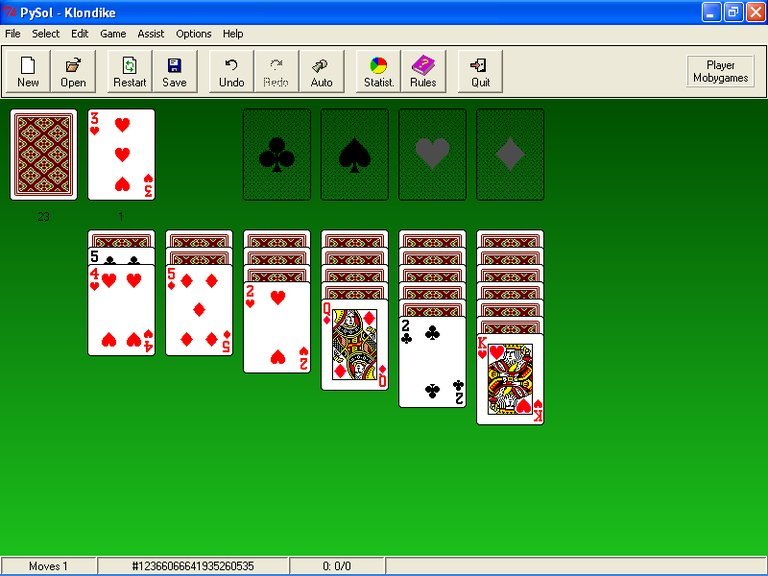
Description
PySol is a free, open-source solitaire card game originally developed in Python, offering a vast collection of over 200 customizable solitaire variants. Initially released in 1998 with four game types, it features unlimited undo/redo functionality, animated card movements, multiple deck styles, and helpful tools like rulesets, hints, and demo modes to assist players. Though its main development ceased in 2004, the project continued as PySol Fan Club Edition, maintaining its cross-platform accessibility and extensible design for solitaire enthusiasts.
PySol Free Download
PySol Guides & Walkthroughs
PySol Reviews & Reception
handwiki.org : A tremendous collection of Solitaire games, going well beyond the usual mix.
en.everybodywiki.com : A tremendous collection of Solitaire games, going well beyond the usual mix.
PySol: Review – An Open-Source Solitaire Odyssey
Introduction
In an era when digital solitaire was synonymous with Windows 3.0’s Klondike, Markus Franz Xaver Johannes Oberhumer’s PySol (1998) emerged as a revolutionary labor of love—a modular, cross-platform solitaire engine that would eventually morph into one of the most expansive digital card game collections ever conceived. Born from Python’s nascent ecosystem and fueled by open-source collaboration, PySol transcended its humble origins to become a cultural touchstone for solitaire enthusiasts, Linux adopters, and modding communities. This review dissects the game’s technical ambition, its metamorphosis under community stewardship, and its enduring legacy as a freeware titan.
Development History & Context
Creator’s Vision & Technological Constraints
PySol’s genesis traces to September 12, 1998, with Oberhumer’s inaugural release on Linux. Written in Python 1.5.2 and leveraging Tkinter for its GUI, PySol was a technical marvel for its time, prioritizing cross-platform accessibility when OS fragmentation was rampant. Oberhumer’s vision was clear: democratize solitaire through extensibility. Initial builds included just four games (e.g., Gypsy, Klondike), but the engine’s plugin architecture invited contributors like T. Kirk (later of FlowerSol fame) to expand its repertoire.
The Open-Source Crucible
The late ’90s Linux gaming scene was sparse, dominated by ports and CLI utilities. PySol stood out by embracing Python—a then-emerging language championed by Guido van Rossum (credited for the “Initial Example Program”)—and integrating multimedia via SDL for sound. By 2000, it boasted Windows/Mac ports with self-contained installers, sidestepping Python dependency headaches. Yet, technological growing pains persisted: The loss of Oberhumer’s Windows development environment in 2001 halted native builds until community forks resurrected them.
The Forking Renaissance
Oberhumer ceased development in 2004, but PySol’s open-source DNA birthed derivatives:
– PySol Fan Club Edition (PySolFC): The dominant fork (2007 onward), ballooning to 1,060+ games by 2020.
– FlowerSol/UltraSol: T. Kirk’s expansions added Hanafuda and Mahjongg variants.
– PySolitaire: Trevor Lowing’s Mahjongg-inclusive Windows build.
This decentralized evolution mirrored Linux’s ethos, transforming PySol from a static title into a living ecosystem.
Narrative & Thematic Deep Dive
Mechanical Poetry Over Plot
As a solitaire anthology, PySol lacks traditional narrative. Instead, its “themes” emerge through cultural inclusivity:
– Card Deck Diversity: Ranging from standard Anglo-French designs to Hanafuda (Japanese flower cards), Ganjifa (Indian circular cards), and Tarot decks.
– Geographic Flavors: Games like Gypsy (inspired by German Patience traditions) and Pagoda (Hanafuda-based) evoke global card-playing rituals.
The Solitaire as Story
Each variant—whether Klondike’s gold-rush Americana or Baker’s Dozen’s arithmetic rigor—becomes a micro-story of strategy and chance. Demo modes and rulesets (accessible via F1) serve as “lorebooks,” guiding players through obscure Patience derivatives like Die Böse Sieben (“The Evil Seven”), a German variant. The absence of characters is offset by the player’s own statistical narrative—win/loss records bookmarking sessions like diary entries.
Gameplay Mechanics & Systems
Core Loop & Innovation
PySol’s genius lies in its unified framework for hundreds of discrete rule sets. Key mechanics include:
– Unlimited Undo/Redo: A revolutionary feature in 1998, empowering experimentation.
– Adaptive Difficulty: From Klondike’s randomness to Spider’s deterministic brutality.
– Extensible Systems: Users could code custom games via Python plugins, with T. Kirk contributing 65+ variants in 1999 alone.
UI/UX: Elegance via Customizability
- Point-and-Select Interface: Streamlined for mouse-driven navigation, with drag-and-drop intuitiveness.
- Modular Toolbars: Players reposition panels, tweak animations, or disable sound.
- Hint/Demo Modes: AI-driven suggestions and auto-play tutorials demystify complex variants.
Flaws & Constraints
- Performance Quirks: Tkinter’s limitations caused lag on period hardware, especially with animated card flips.
- Learning Curve: With 200+ games, newcomers faced option paralysis—mitigated only by categorical filters (e.g., “Baker’s Dozen,” “Forty Thieves”).
World-Building, Art & Sound
Aesthetic Flexibility
PySol’s custom cardsets (e.g., Maritime, Hard a’Port) and tableau backgrounds transformed sterile solitaire into a visual motif. Screenshots reveal Art Nouveau-inspired backs, pixel-art mosaics, and photorealistic textures—a stark contrast to Windows’ flat greens.
Audio Atmosphere
Carl Larsson’s ambient MP3/MOD tracks (included post-1999) and subtle SFX (card slides, deal ticks) created ASMR-like serenity. Yet, audio remained optional, respecting players preferring silence.
Thematic Cohesion
Despite its sprawl, PySol’s identity coalesced around digital craftsmanship: Every card and background felt hand-curated, rejecting the era’s clip-art trends. The FlowerSol fork’s Hanafuda art—vibrant chrysanthemums and sakura—epitomized this attention to detail.
Reception & Legacy
Critical & Commercial Impact
- Linux Darling: CNN named it a “Top 10 Linux Game” (2000); Linux Game Tome awarded it “Best Free Cards/Board Game” (2003).
- Mainstream Crossover: Bundled in retail compilations like 3 in 1 Gold Collection: Card Crazy Solitaire (2001).
- Reviews: PC World praised PySolFC as “a tremendous collection… beyond the usual mix” (2009), while Novell hailed its “quality and playability” (2005).
Industry Influence
- Open-Source Blueprint: Demonstrated Python’s viability for game dev, inspiring titles like Battle for Wesnoth.
- Casual Game Design: Features like unlimited undo and dynamic hints presaged mobile F2P conveniences.
- Preservation: Archived at the Internet Archive, PySol persists as a textbook example of abandonware revival.
Modern Resonance
PySolFC’s 350,000+ downloads (2006–2020) and inclusion in Ubuntu/Fedora/Debian repos underscore its timelessness. Ports to OpenPandora and macOS extend its reach, while SourceForge metrics confirm its cult status.
Conclusion
PySol is more than a solitaire suite—it is a testament to open-source perseverance. Oberhumer’s initial code ignited a community flame that, decades later, burns brighter than ever in PySolFC’s 1,000-game pantheon. While its Tkinter-fed visuals and Python dependencies feel dated, the core experience—infinitely customizable, relentlessly expansive—remains peerless. For historians, it’s a landmark in Linux gaming; for players, a bottomless well of card-table solace. In the annals of digital solitaire, PySol reigns as the definitive Patience simulator—a deck shuffled, dealt, and eternally resurrected by the hands of its devotees.
Final Verdict: ★★★★★ (5/5) — An essential artifact of gaming’s open-source revolution, unmatched in scope and spirit.