
- Release Year: 2015
- Platforms: Macintosh, Windows
- Publisher: AltImage Games
- Developer: AltImage Games
- Genre: Role-playing, RPG
- Perspective: Diagonal-down
- Game Mode: Single-player
- Gameplay: Action, RPG
- Setting: Fantasy
- Average Score: 50/100
Description
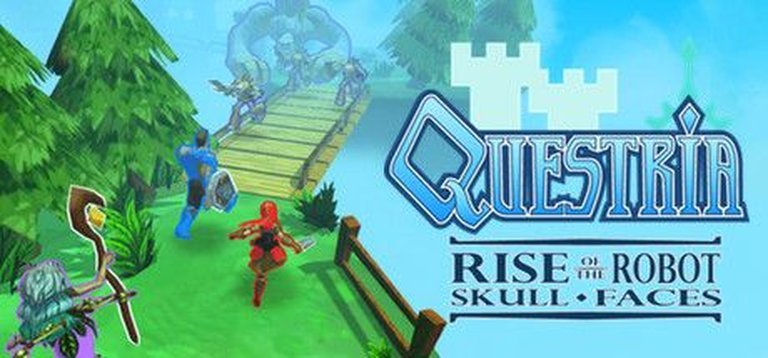
Questria: Rise of the Robot Skullfaces is a chaotic multiplayer action RPG set across procedurally generated dungeons in the Floating Islands, where players battle mechanical enemies called Skullfaces to rescue prisoners and restore peace. Designed for cooperative play, it supports up to 8 players with optional friendly fire, or solo adventures with AI companions. Strategic teamwork is emphasized through ability-replenishing ‘cheers,’ while randomized environments and enemy encounters keep each run fresh and challenging.
Where to Buy Questria: Rise of the Robot Skullfaces
PC
Questria: Rise of the Robot Skullfaces Patches & Updates
Questria: Rise of the Robot Skullfaces Guides & Walkthroughs
Questria: Rise of the Robot Skullfaces Reviews & Reception
opencritic.com (50/100): Even with its eye-catching art and a bubbly soundtrack, it needs a deeper combat system in what tools you are given, mainly in its lack of a parry function
Questria: Rise of the Robot Skullfaces: A Flawed Experiment in Cooperative Chaos
Introduction
Questria: Rise of the Robot Skullfaces (2015) is a forgotten curio in the indie dungeon-crawling landscape—a game that boldly promised chaotic 8-player local multiplayer at a time when couch co-op was waning, yet ultimately stumbled under the weight of its own ambition. Developed by the obscure studio AltImage Games, Questria positions itself as a whimsical action-RPG hybrid where players battle robotic foes to “save Friendship” across procedurally generated floating islands. This review argues that while the game’s mechanical premise and maximalist multiplayer vision were innovative, its execution suffered from shallow systems, technical anonymity, and a failure to resonate within a crowded indie market.
Development History & Context
Studio Vision & 2015 Gaming Landscape
AltImage Games, a developer with no prior catalog or public footprint, positioned Questria as a tongue-in-cheek antidote to the era’s单人叙事驱动experiences. Released in November 2015—a time dominated by The Witcher 3, Fallout 4, and Undertale—Questria’s pitch leaned into absurdist humor and accessible co-op frivolity. Its core hook: support for up to eight players via local multiplayer, a rarity even among indie darlings like TowerFall Ascension (2014). Technologically, the game targeted modest specs (2GHz CPU, 2GB RAM, DX9 compatibility), prioritizing accessibility over graphical ambition, but this also confined it to a rudimentary 2D scrolling perspective with “diagonal-down” fixed camera angles.
The Multiplayer Gambit
In an era shifting toward online connectivity, AltImage doubled down on local camaraderie. The studio’s press materials framed Questria as a “ballet of carnage” designed for living-room chaos, leveraging Steam’s emerging “Remote Play Together” feature as a bridge for distant friends. Yet the absence of proper online infrastructure—relying solely on Valve’s nascent streaming tech—limited its reach. The development cycle appears rushed; Steam Early Access was notably bypassed, and post-launch support vanished, leaving the game frozen in time.
Narrative & Thematic Deep Dive
A Skeletal Story
Questria’s narrative is perfunctory: the titular “Robot Skullfaces” invade the Floating Islands, kidnapping villagers and “stealing Friendship.” Players assume the role of generic heroes rescuing prisoners and battling bosses like the “Furnace Kings.” Dialogue is minimal, with NPCs serving as quest dispensers rather than characters. Thematically, the game’s tongue-in-cheek tone—evident in taglines like “Evil Robots stole Friendship!”—suggests a satirical jab at RPG tropes, but this never evolves beyond surface-level parody.
Whimsy vs. Weight
The juxtaposition of “whimsical” floating islands with mechanical enemies (Robots in a fantasy setting) hints at deeper metaphors—technology corrupting organic joy, perhaps—but Questria lacks the narrative scaffolding to explore this. Instead, it relies on aesthetic dissonance (cartoonish sprites vs. skull-faced drones) as its primary storytelling device. Without lore logs, environmental storytelling, or character arcs, the world feels hollow, a backdrop for mechanics rather than a living space.
Gameplay Mechanics & Systems
Core Loop: Repetition Without Reward
Questria’s gameplay orbits four pillars:
1. Procedural Dungeons: Auto-generated rooms spawn traps, enemy waves, or prisoners to rescue.
2. Chaotic Combat: Melee-focused hacking with basic combos and limited special abilities.
3. Friendship Mechanic: Players “cheer” (a button press) to recharge allies’ abilities.
4. 8-Player Local Multiplayer: Supports controllers and AI companions.
The “cheer” system is Questria’s most innovative idea—transforming camaraderie into a resource—but in practice, it reduces teamwork to a monotonous minigame. With no penalty for spamming cheers, the mechanic feels undercooked, failing to incentivize tactical timing. Combat, meanwhile, lacks depth: no parries, dodges, or stamina management reduce encounters to button-mashing frenzies, exacerbated by friendly-fire toggle jank.
Progression & Polish Issues
Character progression is stripped to bare essentials: players unlock spells and items, but these lack transformative impact. The UI, while functional, suffers from cluttered co-op displays and unclear ability cooldowns. Technical gripes include inconsistent hit detection and unstable framerates in 8-player scenarios. While procedurally generated dungeons add variety, recycled room templates and enemy types breed fatigue within hours.
World-Building, Art & Sound
Aesthetic Anonymity
Questria’s 2D pixel art embraces a colorful, cartoonish style, with floating islands evoking Castle Crashers-lite vibes. However, enemy designs—generic robots with skull insignias—lack visual flair, and environments feel sparse, devoid of interactivity or lore-rich details. The diagonal-down perspective, while functional, obscures level geometry during chaotic battles.
Sound Design: Cheerful Yet Forgettable
A “bubbly soundtrack” (per COGconnected) complements the lighthearted tone but fails to leave an impression. Sound effects—clanging swords, robotic death rattles—are serviceable but lack punch, undermining combat feedback. The absence of voice acting exacerbates the narrative’s thinness.
Reception & Legacy
Critical Indifference
Questria launched to crickets. Only one formal review exists: COGconnected’s middling 50/100 critique lamenting its “lack of parry function” and repetitive combat. Steam user reviews total a mere two (both positive), while Metacritic and OpenCritic lack aggregated scores. Commercial performance was likely dismal; AltImage’s silence post-launch and zero marketing footprint suggest a swift burial.
Legacy: A Cautionary Tale
Questria’s legacy is one of unrealized potential. Its 8-player local multiplayer ambitiously predated Crawl (2017) and Knight Squad 2 (2020), yet its shallowness condemned it to obscurity. The “cheer” mechanic’s underuse remains a missed opportunity—a proto-Overcooked teamwork dynamic abandoned in infancy. Today, the game survives as a Steam curio, occasionally surfaced via deep-dive articles on “failed multiplayer experiments.”
Conclusion
Questria: Rise of the Robot Skullfaces is a fascinating fossil—a game ahead of its time in championing couch co-op maximalism, yet hopelessly behind in execution. Its flashes of ingenuity (the cheer system, 8-player support) are suffocated by repetitive combat, narrative vapidity, and technical anonymity. While indie historians may salvage it as a cautionary case study in multiplayer ambition, most players will find little to resurrect here. In the annals of gaming history, Questria remains a footnote: a flawed experiment that dared to ask, “What if friendship could defeat robots?” but forgot to make the battle compelling.
Verdict: A mechanically earnest but painfully shallow relic—best left to archivists and contrarian co-op completists.