
- Release Year: 2002
- Platforms: Windows
- Developer: Quicksilver Fantasies
- Genre: Adventure, Compilation
- Perspective: Unknown
- Game Mode: Single-player
- Gameplay: Choice-based gamebook, Inventory management, Randomization, Stat tracking
- Setting: Fantasy, Medieval
- Average Score: 64/100
Description
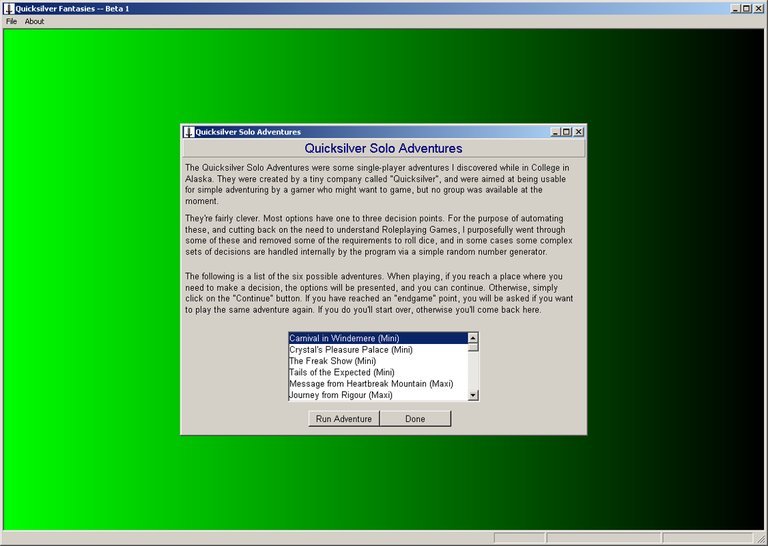
This unauthorized fan adaptation transforms classic Quicksilver gamebooks (1981-1983) into a digital Windows adventure set in a Dungeons & Dragons-inspired medieval fantasy world. Using a dB2K database, the game automates hypertext transitions between story segments, manages character stats and inventory, and handles random events such as die rolls. It includes all four Mini-series gamebooks, each offering three distinct adventures for different player classes, as well as the first two Maxi-Solo adventures for single-class play.
Quicksilver Fantasies Solo Gaming Adventures Cracks & Fixes
Quicksilver Fantasies Solo Gaming Adventures Reviews & Reception
sockscap64.com : This Game has no review yet, please come back later…
Quicksilver Fantasies Solo Gaming Adventures: A Retrospective
Introduction
In the early 2000s, as the digital revolution began to reshape interactive entertainment, a small but ambitious project emerged: Quicksilver Fantasies Solo Gaming Adventures. This fan-made adaptation of classic gamebooks from the 1980s offered a unique bridge between the tactile charm of tabletop role-playing and the emerging world of digital gaming. Released in January 2002, this freeware compilation sought to modernize the solo adventure experience, translating the pen-and-paper mechanics of Quicksilver’s Mini-Series and Maxi-Solo gamebooks into an executable format. While largely overlooked in its time, the game’s legacy as a niche but innovative experiment in interactive fiction deserves closer examination.
Development History & Context
The Studio and Its Vision
Quicksilver Fantasies Solo Gaming Adventures was the brainchild of Kenneth J. Mayer, who programmed the adaptation, and drew from the original works of Pat Apodaca and Paul L. Meier. The project was an unauthorized but reverent homage to the Quicksilver gamebooks, which had been published between 1981 and 1983. These books were designed for solo play, allowing players to experience Dungeons & Dragons-inspired adventures without the need for a game master or other players.
The adaptation was built using dB2K, a database management system, which automated hypertext transitions, stat tracking, and randomization—features that would have otherwise required manual die rolls and note-taking in the original gamebooks. The choice of dB2K was deliberate, as the developer emphasized its independence from the Borland Database Engine, though the exact reasoning behind this preference remains obscure.
Technological Constraints and the Gaming Landscape
Released in 2002, Quicksilver Fantasies arrived during a transitional period in gaming. The industry was shifting from 2D to 3D graphics, and digital distribution was still in its infancy. The game’s reliance on a database-driven approach was unconventional, reflecting the experimental spirit of early indie developers who sought to push the boundaries of what was possible with limited resources.
The gaming landscape of the early 2000s was dominated by titles like The Elder Scrolls III: Morrowind and Neverwinter Nights, which offered expansive open worlds and multiplayer experiences. In contrast, Quicksilver Fantasies was a minimalist affair, focusing on text-based interactivity—a format that harked back to the early days of computer gaming but was increasingly seen as outdated.
Narrative & Thematic Deep Dive
The Plot and Its Structure
The game compiles six adventures from the original Quicksilver series:
– Mini-Series: Carnival in Windemere, Crystal’s Pleasure Palace, The Freak Show, and Tails of the Expected.
– Maxi-Solo Adventures: Message from Heartbreak Mountain and Journey from Rigour.
Each adventure is designed for a specific character class, allowing players to experience the game from different perspectives. For example, Carnival in Windemere offers three distinct paths for fighters, assassins, and clerics, while Journey from Rigour is tailored for mid-level characters who cannot use magic.
Characters and Dialogue
The narratives are rich with medieval fantasy tropes, featuring quests, moral dilemmas, and encounters with fantastical creatures. The dialogue is straightforward but effective, often presenting players with binary choices that lead to branching outcomes. The writing is reminiscent of classic choose-your-own-adventure books, with a focus on immersive world-building and player agency.
Themes
The game explores themes of heroism, morality, and the consequences of choice. For instance, The Freak Show delves into themes of empathy and justice, as players must decide whether to help or exploit the titular freaks. Meanwhile, Message from Heartbreak Mountain touches on the weight of prophecy and the burden of destiny.
Gameplay Mechanics & Systems
Core Gameplay Loops
The gameplay is primarily text-based, with players navigating through hyperlinked paragraphs that describe their actions and the consequences thereof. The dB2K engine automates stat management, inventory tracking, and die rolls, streamlining the solo gaming experience.
Combat and Progression
Combat is resolved through automated die rolls, with outcomes determined by the player’s character stats. Progression is linear within each adventure, but the branching narrative paths offer replayability. Players can revisit adventures with different character classes to uncover new storylines and endings.
User Interface
The UI is functional but dated by modern standards. Text is displayed in a simple, monospaced font, and navigation is handled through mouse clicks. The lack of visuals or sound design places the emphasis squarely on the narrative, which may appeal to purists but could feel sparse to contemporary players.
World-Building, Art & Sound
Setting and Atmosphere
The game’s setting is a generic but evocative medieval fantasy world, populated by towns, dungeons, and magical realms. The absence of visuals means that world-building is conveyed entirely through text, requiring players to use their imagination to visualize the environments.
Art and Sound Design
As a text-based game, Quicksilver Fantasies has no traditional art or sound design. The focus is purely on the written word, which, while limiting, allows for a high degree of player interpretation. The lack of auditory or visual elements may be a drawback for some, but it also ensures that the narrative remains the primary focus.
Reception & Legacy
Critical and Commercial Reception
Quicksilver Fantasies Solo Gaming Adventures received little attention upon its release, likely due to its niche appeal and the dominance of graphical games in the early 2000s. The single available review on MobyGames awarded it a modest 3.7 out of 5, suggesting a mixed reception. The game’s unauthorized nature may have also limited its distribution and recognition.
Influence and Evolution
Despite its obscurity, the game holds historical significance as an early example of digital gamebook adaptations. It predates the resurgence of interactive fiction in the 2010s, which saw titles like 80 Days and The House of Da Vinci bring text-based gaming back into the mainstream. The game’s use of a database to automate traditional RPG mechanics foreshadowed the rise of digital tools for tabletop gaming, such as virtual tabletop platforms and AI-driven Dungeon Masters.
Conclusion
Quicksilver Fantasies Solo Gaming Adventures is a fascinating artifact of early digital gaming, bridging the gap between analog and digital interactive storytelling. While its technical limitations and lack of visual polish may deter modern players, its innovative approach to adapting gamebooks for a digital audience is worthy of recognition. As a historical curiosity and a testament to the enduring appeal of solo adventures, the game occupies a unique niche in gaming history. Its legacy lies not in commercial success but in its pioneering spirit, offering a glimpse into the experimental spirit of early indie development.
In the grand tapestry of video game history, Quicksilver Fantasies Solo Gaming Adventures may be a small thread, but it is one that contributes to the rich and varied fabric of interactive entertainment. For fans of classic gamebooks and early digital adventures, it remains a hidden gem worth exploring.