
- Release Year: 2007
- Platforms: Windows
- Publisher: Noviy Disk, SimBin Studios AB
- Genre: Compilation
- Average Score: 80/100
Description
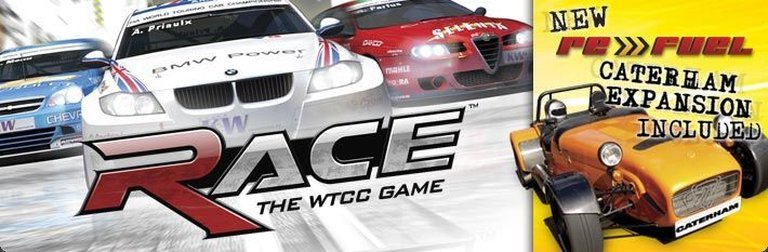
Race + Caterham Expansion, also known as Race: Gold Edition, is a compilation package that bundles Race: The Official WTCC Game with its Caterham Expansion. Set in the World Touring Car Championship, it expands the simulation with 60 new Caterham sports cars and skins—including models like the CSR series—alongside two additional tracks: Imola and Estoril. The expansion also enhances gameplay with improved performance scalability, a performance monitor, and refined controller options for a more realistic racing experience.
Gameplay Videos
Where to Buy Race + Caterham Expansion
PC
Race + Caterham Expansion Cracks & Fixes
Race + Caterham Expansion Reviews & Reception
hookedgamers.com (80/100): New Cars, extra tracks but still the same great gameplay.
Race + Caterham Expansion: A Definitive Analysis of a Sim Racing Milestone’s Final Refinement
Introduction: The Compleat Sim
In the mid-2000s, the landscape of PC sim racing was undergoing a quiet revolution. While arcade racers dominated mainstream consciousness, a dedicated cadre of developers was pursuing an increasingly authentic, physics-driven, and license-focused evolution of the genre. At the forefront of this movement stood Sweden’s SimBin Studios, whose GTR series had already redefined expectations for GT racing simulations. Their 2006 title, Race: The Official WTCC Game, was a critical darling that brought the gritty, door-banging spectacle of the World Touring Car Championship to the masses with unprecedented authenticity. Yet, like many focused simulations, its initial release felt like the first draft of a grander vision. Enter Race + Caterham Expansion—a compilation released in June 2007 that did more than just add content; it served as the definitive, polished “gold edition” of a foundational sim. This review argues that the Caterham Expansion is not merely an add-on but a crucial artifact of sim racing history: a case study in post-launch refinement, niche automotive culture preservation, and the transitional period between hardcore simulation and broader accessibility. Its legacy is one of quiet competence, a love letter to a specific brand of motorsport that cemented SimBin’s reputation for obsessive detail while hinting at the studio’s future dominance.
Development History & Context: SimBin’s Ascendance and the WTCC License
To understand the Caterham Expansion, one must first situate it within the trajectory of SimBin Development Team AB. By 2006, SimBin had already carved a respected niche with GTR – FIA GT Racing Game (2004) and GTR 2 – FIA GT Racing Game (2006). These titles were lauded for their laser-focused replication of GT2/GT3-class sports car racing, featuring accurate physics, comprehensive car/track rosters, and a steep, rewarding learning curve. The studio’s philosophy was clear: prioritize simulation integrity over mass-market appeal, and cultivate a loyal community of enthusiasts.
Securing the official World Touring Car Championship (WTCC) license in 2006 was a logical, if ambitious, next step. Touring car racing—with its production-based sedans, close-quarters combat, and dramatic performance balancing—presented a different simulation challenge than the purer GT discipline. Race: The Official WTCC Game released to strong critical praise but, as was common for complex sims of the era, was seen as a robust foundation requiring iteration. The technological constraints were significant: running detailed car models, dynamic lighting, and sophisticated physics on mid-2000s hardware (minimum spec: Pentium 4 1.7GHz, 512MB RAM) was a constant optimization battle.
The Caterham Expansion arrived in this context as both a celebration and a corrective measure. It was developed to commemorate the 50th anniversary of Caterham Cars Ltd., the iconic British manufacturer of minimalist, high-performance sports cars derived from the Lotus Seven. For SimBin, this was a perfect synergy: Caterham’s philosophy of lightweight, driver-focused machinery resonated deeply with their simracing ethos. The expansion was also strategically timed, arriving as discussions about a sequel (RACE 07) were already underway. It functioned as a content bridge and a technology testbed, implementing features that would become standard in the next iteration.
Narrative & Thematic Deep Dive: The Story of the Cars and the Circuits
Unlike narrative-driven games, Race and its expansion convey their “story” through the meticulous curation of real-world motorsport history. There is no plot, no characters with dialogue, no scripted drama. Instead, the narrative is diegetic—written in the carbon fiber and tarmac of the objects themselves. The Caterham Expansion deepens this historical tapestry on two fronts: the machinery and the venues.
The Caterham Chronicle: The inclusion of 60 individual car skins for three models—the Caterham CSR 200, CSR 260, and the concept CSR 320—is more than a numbers game. It’s a digital museum of Caterham’s circa-2007 identity. The CSR (Caterham Silence Revolution) range represented the brand’s modern, supercharged evolution from its kit-car roots. The 320 Concept, with its “grueling 320hp,” speaks to the endless tuning culture and one-upmanship that defines the Caterham owner community. Each skin, likely representing liveries from racing series, privateer teams, or commemorative editions, tells a micro-story of British motorsport’s grassroots and its aspirations. The expansion implicitly argues that these spartan, terrifyingly quick machines are the spiritual antithesis of the heavy, aerodynamic WTCC Touring Cars—and thus, a perfect, complementary fantasy for the sim racer.
The Sanctity of Circuit History: The two new tracks, Imola and Estoril, are not just new locations; they are loaded with gravitas. Imola, the Autodromo Enzo e Dino Ferrari, was, in the mid-2000s, still processing the trauma of Ayrton Senna’s 1994 death while remaining a temple of racing. Its long straights (like the Tamburello approach) and technical corners (Acque Minerali, the Variante Alta) present a stark contrast to the stop-and-go nature of many WTCC circuits. Estoril, the former Portuguese Grand Prix venue, with its undulating layout and famous上升 home straight, carries the ghosts of championship deciders from the 1980s and 1990s. By adding these circuits, the expansion positions Race not just as a WTCC simulator, but as a broader touring car and sports car simulator. The thematic link is one of legacy: the Caterhams, with their direct lineage to 1960s Lotus F1 cars, feel at home on these historic, classic circuits.
The Unspoken Theme: Purist Fulfillment: The overarching narrative is one of service to the fan. This is not a game trying to tell you a story; it is a game providing you with the tools to create your own stories. Whether it’s lapping a virtual Imola in a digitally recreated CSR 320, imagining the roar of a Super 2000-spec SEAT Leon against a Caterham on the Estoril back straight, or tuning a livery to honor a specific real-world Caterham racer, the game’s theme is curatorial authenticity.
Gameplay Mechanics & Systems: Refinement Over Revolution
The core gameplay loop of Race: The Official WTCC Game was already established: select a car (from a licensed WTCC roster or a generic “Club” class), choose a circuit, and compete in race weekends featuring practice, qualifying, and one or two-race formats with a reverse-grid draw for the second race. The physics model was point-perfect in its simulation of tire wear, brake fade, and the delicate balance of front-wheel-drive touring cars versus the brutal oversteer of rear-engine Caterhams.
The Caterham Expansion’s genius lies not in overhauling this loop, but in enhancing the experience of it through subtle, meaningful system improvements:
-
Vehicle Dynamics – The Caterham Difference: The three CSR models introduce an entirely new vehicle class to the game. Where WTCC cars are heavy, aerodynamic, and reliant on momentum, the Caterhams are feather-light (around 500kg), high-power-to-weight machines with a mid-engine layout. This fundamentally changes driving technique. Trail-braking is more critical, throttle application must be surgical to avoid sudden oversteer, and maintaining momentum through corners is paramount. The expansion thus dramatically expands the game’s skill ceiling. Mastering the Caterham’s instinctive, almost kart-like handling provides a profound contrast to the plowy, stable feel of a factory-tuned Ford Focus or BMW 320i.
-
Technical and Interface Enhancements: This is where the expansion’s “gold edition” status is cemented. The source material repeatedly highlights three key quality-of-life improvements:
- Improved Performance Scalability: The optimization of track and car Level of Detail (LODs) suggests SimBin addressed framerate inconsistencies, particularly on the new, complex circuits. This made the game more accessible to users with mid-range hardware (still demanding a Pentium 4 3GHz and 256MB GPU for recommended settings).
- Performance Monitor: A built-in tool to help players dial in their graphical settings was a significant usability win for a sim with notoriously complex options menus. It reduced the trial-and-error for non-technical users.
- Enhanced Controller Interface: This was crucial. The original Race was often criticized for being heavily biased towards force feedback wheel users. The expansion added “more options for joy-pad or keyboard/mouse controls,” acknowledging the substantial portion of the audience using gamepads. The addition of a mappable hotkey for the ghost car (a replay/racing line tool) further streamlined the practice experience.
-
Game Modes and Structure: The expansion did not introduce new game modes but ensured the base game’s robust suite—Championship, Single Race, Time Trial, and extensive online multiplayer via the SimBin framework—was fully compatible with the new content. The ability to mix Caterhams and WTCC cars in practice or online events (if host settings allowed) was a hidden gem, creating ludicrously varied and fun race meets.
Flaws and Omissions: The expansion is not without its limitations. Primarily, it is parasitic—it requires the base Race: The Official WTCC Game to function, a模型 that sometimes led to confusion in digital storefronts (as noted in Steam community discussions). The “60 individual new cars/car skins” are, in reality, 3 car models with 20 liveries each—a respectable number but perhaps inflated in marketing speak. There is no standalone career mode or Caterham-specific championship; they are injected into the existing structure. Finally, while the controller options improved, the game’s underlying simulation remained uncompromisingly hardcore. The learning curve for the Caterhams was steep, and without a comprehensive tutorial overhaul (a feature of later SimBin titles), many casual players may have found them inaccessible.
World-Building, Art & Sound: A Functional, Atmospheric Grind
The artistic and auditory design of Race and its expansion is a masterclass in functional simulation art. It prioritizes clarity, reference accuracy, and environmental immersion over stylistic flair.
- Visual Direction: Using the RenderWare engine, the game presents a clean, if有时略显平淡, graphical style. Car models are exceptionally detailed for 2006/2007, with separate components for wheels, brakes, and suspension that move realistically. The Caterham models are particularly beautiful in their exposed mechanical simplicity—the raw alloy, the tiny cockpit, the prominent roll bar. Tracks are laser-scanned references (a SimBin hallmark). Imola and Estoril are recreated with obsessive attention to grandstand detail, signage, and the specific texture of their asphalt. The atmosphere is one of documentary realism: you are not in a vibrant arcade world, but at a real, often overcast, European racetrack on a cool day.
- Sound Design: The soundscape is where the game soars. The WTCC cars emit the guttural, raspy roar of 2.0-liter turbocharged engines with bubbling wastegate chatter. The Caterhams, with their supercharged Ford Duratec engines (in CSR reality), produce a sharp, mechanical whine that escalates into a frenetic scream—a visceral contrast to the turbo whoosh. The audio is positional and clear, crucial for identifying car position and engine state. Tire squeal, gearshift clatter, and the thump of a kerb are all present and accurately modeled.
- Atmosphere and UI: The user interface is utilitarian, mimicking a race team’s data screen. The heads-up display (HUD) is dense with telemetry (speed, RPM, gear, lap time, tire wear indicators) but configurable. The overall feel is cold, professional, and focused on the task. This的艺术 direction successfully builds tension and seriousness. You are not playing a game; you are working as a race driver.
Reception & Legacy: A Cult Classic’s Cornerstone
At the time of its release, the catering to a specific, knowledgeable audience was both its strength and commercial limit.
- Critical Reception: MobyGames aggregates a 77% score from 7 critics for the standalone Caterham Expansion (ID 44541), a solid but not spectacular figure. Contemporary reviews, like the one from Hooked Gamers (August 2007), were positive but measured: “New Cars, extra tracks but still the same great gameplay.” The praise centered on the value for existing fans and the quality of the new content, with little criticism of the core mechanics because they were already proven. The expansion was seen as a successful, if niche, content pack.
- Commercial Performance & Community: As a $3.99-$4.99 digital download (and part of the “SimBin Mega Bundle”), it was a low-risk purchase for the existing player base. Steam data shows only a handful of reviews (with a current “Mixed” consensus on Steambase), indicating modest sales but a dedicated owner base—those 2,648 owners (per completionist.me) are almost certainly hardcore sim fans. The fact that it requires the base game inherently limits its audience to those already invested in the RACE ecosystem.
- Legacy and Influence: The Caterham Expansion’s most significant legacy is as a proof of concept and final polish for the RACE formula. The technical improvements (performance monitor, controller support) directly fed into the more broadly successful RACE 07. Furthermore, it demonstrated SimBin’s commitment to post-launch support and deep content creation—a model later perfected with the extensive car and track packs for GTR 2 and Race 07. In the wider industry, it represents the peak of the “focused expansion” model for simulation games: adding a coherent, themed package of content (a manufacturer, a era) rather than fragmented, generic DLC. It also serves as an important digital preservation effort for Caterham’s CSR models and the historic configurations of Imola and Estoril as they existed in the mid-2000s, a snapshot that specialists and historians value.
Its influence is most strongly felt in the DNA of later SimBin/ Sector3 Studios titles (RaceRoom, Automobilista 2) and in the broader expectation that modern sims should offer comprehensive manufacturer partnerships and historic track renditions.
Conclusion: The Gold Standard for a Specific Era
Race + Caterham Expansion is not a game that seeks to conquer the world. It is a precision instrument crafted for a specific audience: the sim racer who understands the subtle difference between understeer and oversteer, who appreciates the historical significance of a circuit’s layout changes, and who derives joy from driving a car that feels like a barebones, mechanical beast. As a narrative experience, it is nonexistent. As a gameplay revolution, it is iterative. But as a comprehensive refinement of a beloved simulation, and as a lovingly curated artifact of a very specific slice of automotive culture, it is an unqualified success.
It captures SimBin at their most confident: no need to reinvent the wheel, just to perfect it. The addition of the Caterhams diversifies the garage in a meaningful way, while Imola and Estoril elevate the track list to classic status. The behind-the-scenes technical tweaks show a developer listening to its community’s pain points. For these reasons, Race + Caterham Expansion transcends its status as mere DLC. It is the definitive version of Race: The Official WTCC Game, a complete package that honors the WTCC license while boldly expanding its horizons. In the grand canon of sim racing, it may not have the blockbuster fame of a Gran Turismo or iRacing, but among connoisseurs, it is remembered as a masterclass in focused, passionate game development—a quiet, robust, and essential chapter in the story of virtual motorsport. Its final, most telling virtue is that it doesn’t just add content; it deepens the simulation’s soul, ensuring that when you fire it up today, you are not just driving a car, but participating in a preserved moment of racing history.