
- Release Year: 1998
- Platforms: DOS, Windows 16-bit, Windows
- Publisher: S.A.D. Software Vertriebs- und Produktions GmbH
- Developer: S.A.D. Software Vertriebs- und Produktions GmbH
- Genre: Compilation
- Game Mode: Hotseat
Description
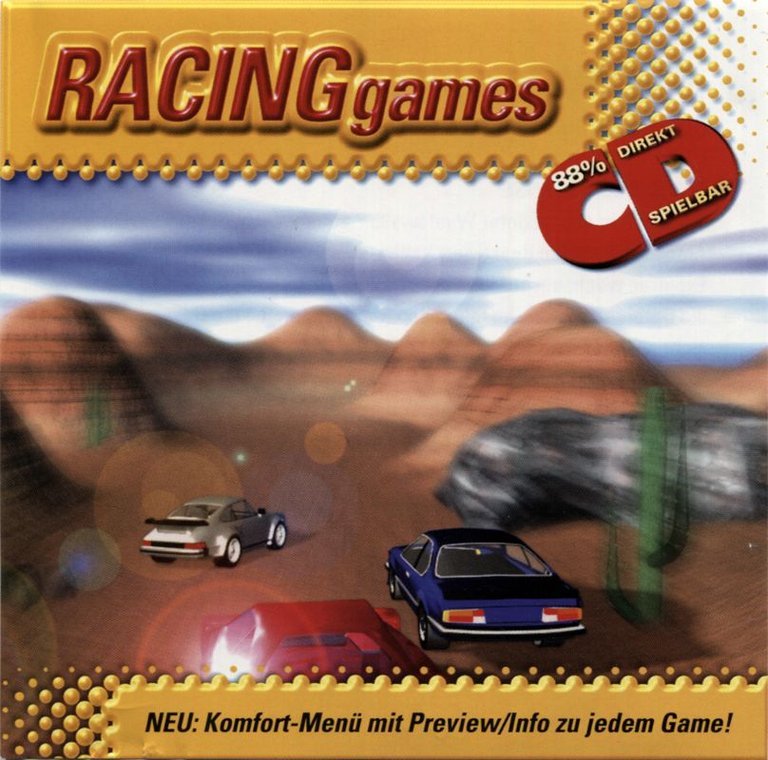
RACINGgames is a shareware compilation released in 1998 for DOS, Windows 3.1, and Windows 95, featuring 25 racing-themed games across various subgenres. The collection includes not only traditional car racing simulations but also titles like horse race betting (Digital Downs), maze challenges (SpeedKar!), and strategic racing (Race Track). A built-in Windows 3.1 browser allows players to explore game descriptions and screenshots, with most titles playable directly from the CD-ROM. The compilation offers a diverse mix of racing experiences, from arcade-style action to tactical gameplay.
RACINGgames Cheats & Codes
PlayStation
Enter codes during race setup, options screen, or car selection as specified.
| Code | Effect |
|---|---|
| Hold L1 + R1 + L2 + R2, then press Triangle | Shoot paintballs at other cars |
| Hold L1 + R1 + L2 + R2 + Triangle, then press Square | Activate machine gun to shoot at other cars |
| Highlight Bobby Labonte’s car, hold X, then press Up, Down | Unlock Pinnacle Trading Cards car (lost if left Exhibition Mode) |
| Highlight Kenny Wallace’s car, hold X, then press Up, Down | Unlock EA Sports car (lost if left Exhibition Mode) |
| Hold Circle, then press Up, Left, Down, Right | Enable Turbo Mode option (increases frame rate) |
| Hold Triangle for 2 seconds while viewing driver | Make driver wave |
Sega Saturn
Enter codes during car selection, options menus, or gameplay as specified.
| Code | Effect |
|---|---|
| Highlight Bobby Labonte’s or Kenny Wallace’s car, hold C and press Up, then Down | Transform vehicle into tow truck |
| Hold A + B + C and press Start | Reset the game |
| Pause game, highlight Race Statistics, hold L + R + X and press A | Access hidden options menu |
| Highlight Stereo option, hold Z and press B, X, Y, then A and B simultaneously | Enable wide cars (press Start + A + B + C to activate) |
| Highlight Control Setup, hold Z and press A, B, X, then A and Y simultaneously | Enable wire frame track (press Start + A + B + C to activate wire frame cars) |
| Hold Z and press B, then X, then Y, then press A and B simultaneously | Activate Fat Car Mode (cars twice as wide) |
| Pause gameplay, highlight Race Stats, hold L-shift + R-shift + Y and press A or C | Modify in-car vehicle aspects |
RACINGgames: Review
An exhaustive examination of the 1998 shareware compilation that captured the frenetic essence of late-’90s PC gaming
Introduction
The video game industry in 1998 was a crucible of innovation: Metal Gear Solid redefined cinematic storytelling, The Legend of Zelda: Ocarina of Time revolutionized 3D exploration, and Half-Life reshaped the FPS genre. Yet amid these titans, German publisher S.A.D. Software Vertriebs- und Produktions GmbH released RACINGgames, a humble but revealing time capsule of the era’s shareware ecosystem. This compilation of 25 racing-themed titles—ranging from arcade-style sprints to genre-defying oddities—offered budget-conscious players a smorgasbord of digital thrills. This review argues that while RACINGgames lacked polish and cohesion, its chaotic diversity mirrors the experimental spirit of late-’90s PC gaming, preserving forgotten relics of a transitional technological age.
Development History & Context
Studio Background & Vision
The late 1990s were marked by tectonic shifts in gaming: the PlayStation’s dominance, the waning of DOS, and Windows 95’s emergence as a gaming platform. Against this backdrop, S.A.D. Software—better known for distributing niche European-focused titles—curated RACINGgames as a low-risk anthology targeting casual PC users. Unlike AAA releases such as Gran Turismo or Need for Speed III: Hot Pursuit, this compilation relied on pre-existing shareware titles, repackaging them for retail convenience. Its vision was pragmatic: exploit the waning shareware model by aggregating disparate racing experiences into a single CD-ROM.
Technological Constraints & Gaming Landscape
In 1998, PC gaming straddled two worlds. DOS-era limitations persisted (CPU bottlenecks, VGA palettes), while Windows 95/98 opened doors to DirectX-enhanced visuals and CD-ROM storage. RACINGgames encapsulated this duality:
– Platform Reach: Supported DOS, Windows 3.1, and Windows 95/98 (16-bit and 32-bit architectures).
– Installation Quirks: Three titles required manual installation; others ran directly from the CD, optimizing accessibility for pre-SSD storage.
– Shareware Model: Many included games were demos or scaled-back versions, leveraging “try-before-you-buy” mechanics popularized by Doom and Apogee titles.
While juggling these constraints, S.A.D. Software’s anthology arrived alongside critical darlings (Grim Fandango, StarCraft) but carved a niche as a budget novelty.
Narrative & Thematic Deep Dive
A Compilation Without a Core
As a non-narrative anthology, RACINGgames lacks overarching storytelling. Yet its eclectic roster reveals thematic currents in late-’90s game design:
– Speed as Spectacle: Titles like Crazy Cars III and SpeedKar! emphasized frenetic, risk-reward gameplay, echoing the era’s arcade sensibilities.
– Genre Hybridity: Race Track (strategic management) and Digital Downs (horse betting sim) blurred racing conventions, reflecting experimental trends.
– Techno-Utopianism: Futuristic titles like SkyRoads (anti-gravity platforming) and Hover Ski embraced the cyber-aesthetic popularized by Wipeout.
Character & Tone
The compilation’s tone is schizophrenic: Road Hog! leans into Mad Max-inspired vehicular combat, while Skunny Kart offers family-friendly whimsy. Dialog is minimal (typical of shareware), but titles like Taxi Run hint at emergent open-world aspirations through urban navigation challenges.
Gameplay Mechanics & Systems
The Browser Framework
The compilation’s Windows 3.1 launcher functioned as a primitive game hub:
– List View: Alphabetical sorting with brief descriptions.
– Screenshot Previews: A novelty for budget releases, aiding navigation.
– Direct-Access Design: Reduced friction between selection and play.
Diverse Gameplay Loops
The anthology’s strength lies in its chaotic variety:
| Game | Genre | Core Mechanics |
|---|---|---|
| SkyRoads | Physics-based platformer | Momentum-driven jumping across floating roads |
| TC Car War | Vehicular combat | Weaponized cars in arena battles |
| Race Drivin’ | Arcade sim | Stereo 3D-supported stunt driving (if hardware permitted) |
| Whahoo | Top-down racer | Power-up collecting, à la Micro Machines |
Flaws & Innovations
– Quality Inconsistency: Dirt Bike’s clunky controls contrasted with Crazy Cars III’s refined handling.
– UI Limitations: Fixed resolutions (640×480 max), no rebindable keys.
– Hidden Gems: SkyRoads: Xmas Special showcased modular level design, while Speed Racer hinted at early open-world ambitions.
World-Building, Art & Sound
Visual Heterogeneity
Art styles ranged from functional to charming:
– DOS-Era Pragmatism: Fatal Fumes used lo-fi sprites and palette-limited asphalt textures.
– Windows 95 Flourishes: Crazy Cars III embraced SVGA colors and pseudo-3D tracks.
– Thematic Whimsy: Skunny Kart’s cartoonish anthropomorphism clashed with Taxi Run’s grimy urbanism.
Sound Design
Hardware limitations dictated audio:
– MIDI Dominance: Repetitive but energetic tracks in Rally Racers, TC Racer.
– PC Speaker Quirks: Dirt Bike’s engine noises approximated through tinny beeps.
– Atmospheric Absence: Minimal ambient sound, focusing on core feedback (engine roars, collision crunches).
Atmosphere as a Byproduct
While lacking cohesive art direction, the anthology’s sprawl evoked the era’s “digital frontier” ethos—unrefined but brimming with possibility.
Reception & Legacy
Critical & Commercial Silence
Unlike 1998’s AAA hits (Ocarina, Half-Life), RACINGgames garnered no notable reviews. As a budget compilation ($9.99-$14.99), it targeted impulse buyers and shareware enthusiasts. MobyGames records no sales figures, but its obscurity suggests modest reach.
Evolution of Reputation
Initially dismissed as shovelware, retro archivists now value the compilation for:
– Preservation: Saving ephemeral shareware (JJR Raceway, Whahoo) from digital extinction.
– Historical Curiosity: Illustrating pre-Steam distribution models and European PC gaming tastes.
Industry Influence
While not revolutionary, the compilation foreshadowed trends:
– Genre-Blending: Race Track’s strategy elements predated MotorSport Manager.
– Anthology Appeal: Presaged digital storefronts like Ultimate Genesis Collection.
Conclusion
The Verdict
RACINGgames is neither a masterpiece nor a catastrophe. Its value lies not in individual brilliance but in collective chaos—a mosaic of late-’90s gaming’s virtues (experimentation, accessibility) and vices (technical jank, uneven quality). As a historical artifact, it immortalizes the shareware era’s grassroots spirit, where pixelated passion projects coexisted with corporate juggernauts. While unpolished, this anthology remains a compelling dig site for historians and nostalgists alike, cementing its place as a footnote in gaming’s relentless march forward.
Final Rating: ★★☆☆☆ (2/5 stars)
A flawed but fascinating relic, best appreciated as a museum exhibit rather than a playable experience.