
- Release Year: 2007
- Platforms: Windows
- Developer: Greentube I.E.S. AG
- Genre: Sports
- Perspective: Third-person
- Game Mode: Single-player
- Gameplay: Bike, Racing, Time Attack, Vehicular
- Setting: Austrian, Scottish
- Average Score: 47/100
Description
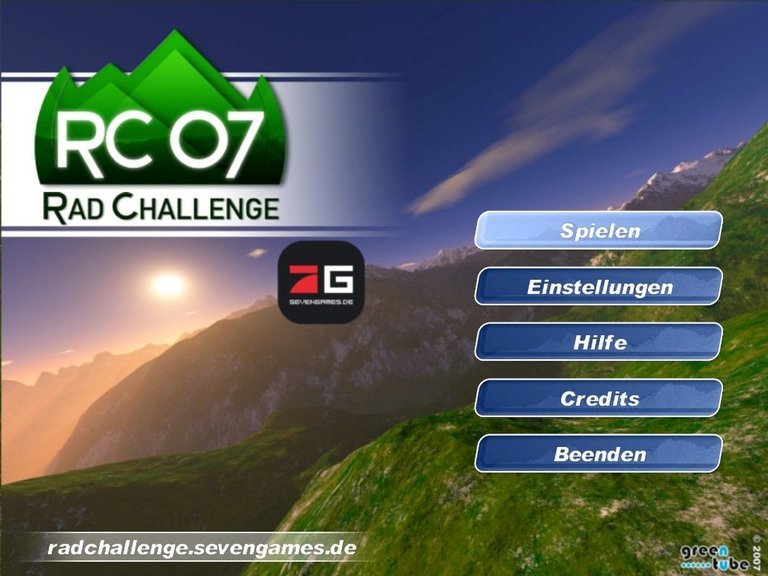
Rad-Challenge 07 is a freeware mountain biking game presented by German TV channel Pro Sieben, featuring authentic downhill tracks from the 2007 world championship in Heiligenblut (Austria) and Fort William (Scotland). Players navigate treacherous terrain across three modes—training, qualification, and contest—avoiding obstacles while racing against ghost riders from online rankings to improve times, with top competitors winning real bicycles.
Gameplay Videos
Rad-Challenge 07: Review
Introduction
Released in 2007 as a freeware title sponsored by German television giant Pro Sieben, Rad-Challenge 07 stands as a fascinating artifact of a bygone era in digital sports simulation. Part of a broader series including the popular Ski-Challenge titles, this mountain biking game arrived amidst the mid-2000s boom in advergaming and competitive freeware. While lacking the budget or polish of commercial releases, Rad-Challenge 07 carved a unique niche by leveraging real-world championship courses and a high-stakes online leaderboard. Its thesis lies in this singular focus: to distill the pure adrenaline of downhill racing into a minimalist, yet compulsively replayable package. This review will dissect its development context, thematic resonance, mechanical elegance, and unexpected legacy as a cult classic of competitive freeware.
Development History & Context
Rad-Challenge 07 emerged from the Austrian studio Greentube I.E.S. AG (later acquired by Novomatic) under the creative direction of CEO Eberhard Dürrschmid and lead developer Marcel Wasserer. The project was explicitly conceived as a promotional tie-in for Pro Sieben, aiming to replicate the success of their earlier Ski-Challenge series by capitalizing on the 2007 Mountain Bike World Championship. Technologically constrained by the era’s modest hardware standards—designed to run smoothly on Windows XP systems with a mere 32.9 MB footprint—the team prioritized performance over graphical fidelity. The gaming landscape of 2007 was witnessing a surge in browser-based games and advergames, driven by rising broadband adoption and the decline of paid shareware. Rad-Challenge 07 epitomized this trend, offering a free, accessible entry point for sports fans while serving as a viral marketing tool for both the TV network and real-world sponsors (notably, the top two players won actual mountain bikes). This fusion of sport, media, and interactivity positioned it as a pioneering example of gamified television sponsorship.
Narrative & Thematic Deep Dive
As a pure sports simulation, Rad-Challenge 07 intentionally eschews traditional narrative in favor of experiential storytelling. Its “plot” is the real-world championship itself: players navigate the exact courses of the Austrian Heiligenblut and Scottish Fort William downhill events. The narrative unfolds through gameplay progression alone—beginning with the solitary practice of Training mode, advancing through the competitive pressure of Qualification, culminating in the communal contest. This structure creates a powerful arc of personal achievement, where the player’s dedication to mastering a track becomes the central character. Thematically, the game explores the tension between human skill and digital precision. The ghost-rider system—pitting players against the recorded time of the leaderboard’s immediate superior—embodies the relentless pursuit of perfection. The tangible prize of real bikes adds a layer of aspirational realism, transforming virtual competition into a tangible opportunity. Ultimately, Rad-Challenge 07’s “story” is one of solitary struggle against the clock and global community, a testament to the universal allure of competitive excellence.
Gameplay Mechanics & Systems
At its core, Rad-Challenge 07 delivers a streamlined, physics-driven racing experience. The controls—using arrow keys for steering, braking, and leaning—are deceptively simple yet demand mastery of weight distribution and momentum. The core loop revolves around three interdependent modes:
– Training: Unrestricted practice for memorizing track layouts and perfecting lines.
– Qualification: A timed trial requiring sub-3:10 performance to unlock competitive entry.
– Contest: Live leaderboard battles during scheduled windows, with cumulative times determining rankings.
The ghost-rider mechanic is the game’s genius touch. By racing against the player ranked one spot above, it dynamically scales difficulty, ensuring continuous challenge. The absence of traditional progression systems (e.g., unlocks, upgrades) is deliberate, forcing players to hone raw skill. The UI is minimalist, displaying only time, rank, and a mini-map—zeroing focus on the track itself. Flaws are minimal: the physics, while responsive, occasionally feel floaty during landings, and the lack of dynamic weather or day/night cycles limits variety. Yet these omissions are strategic, reinforcing the game’s devotion to pure racing purity.
World-Building, Art & Sound
Rad-Challenge 07’s world-building is rooted in meticulous geographic authenticity. The Heiligenblut track captures the sweeping Alpine vistas and winding gravel paths of Austria, while Fort William’s Scottish Highlands descent reimagines the championship’s rugged terrain with misty, rock-strewn slopes. This fidelity extends beyond aesthetics; the tracks’ layouts replicate real-world racecourses, bridging the gap between virtual and physical sport. Artistically, the game achieves remarkable efficiency within its constraints. Textures are functional—gravel, grass, and rock are rendered with clarity—and environmental details like guardrails and signage ground the experience. Performance is impeccable; even on low-end hardware, the game maintains a consistent 60 FPS, crucial for split-second decision-making. Sound design is sparse but effective: a driving, synth-heavy score (noted for its “extreme racing feel” in contemporary reviews) amplifies adrenaline, while minimalist audio cues (gravel crunches, wind) enhance immersion. The result is an atmosphere of professional athletic grit, devoid of spectacle yet brimming with tension.
Reception & Legacy
Upon release, Rad-Challenge 07 polarized audiences. Critics like Caiman’s agizzer hailed its “awesome 3D graphics” and “perfect” controls, declaring it an “excellent” must-download. Conversely, MobyGames’ solitary user rating of 2.0/5 reflected frustration with its online-centric model and lack of depth. Commercially, its freeware status ensured wide dissemination, though precise player numbers remain elusive. Its legacy, however, transcended sales. As a progenitor of TV-sponsored esports, it foreshadowed modern titles like Rocket League’s cross-promotions. The ghost-rider system and time-trial leaderboards directly influenced indie racers such as Descenders and Trials Rising. Culturally, it became a touchstone for advergame enthusiasts, remembered for its audacious real-bike prizes and community-driven competition. Today, it survives in niche gaming archives, revered for its efficiency and pure gameplay ethos—proof that ambition need not be measured in megabytes or marketing budgets.
Conclusion
Rad-Challenge 07 is a masterclass in focused design, a relic of an era when freeware dared to prioritize substance over spectacle. Its genius lies in stripping downhill biking to its essence: speed, precision, and the thrill of global competition. While limited by its era’s technology and niche appeal, its seamless blend of real-world authenticity, minimalist mechanics, and high-stakes online play created an experience that remains surprisingly compelling. In the annals of video game history, it occupies a unique space—not as a commercial juggernaut, but as a testament to the creative possibilities of advergaming and the enduring appeal of pure competition. For players willing to embrace its austerity, Rad-Challenge 07 offers not just a race down a mountain, but a vivid snapshot of gaming’s ambitious past and a blueprint for its competitive future. Verdict: An unsung gem of freeware, essential for historians and competitive purists alike.