
- Release Year: 2005
- Platforms: Windows
- Publisher: Akella, Frogster Interactive Pictures AG, Merscom LLC, QI Creations, Valve Corporation, ZOO Digital Publishing Ltd.
- Developer: QI Creations
- Genre: Action
- Perspective: Third-person
- Game Mode: Co-op, LAN, Online PVP, Single-player
- Gameplay: Fighting, Minigames, Mouse control, Physics-based
- Setting: Martial arts, Parody
- Average Score: 74/100
- Adult Content: Yes
Description
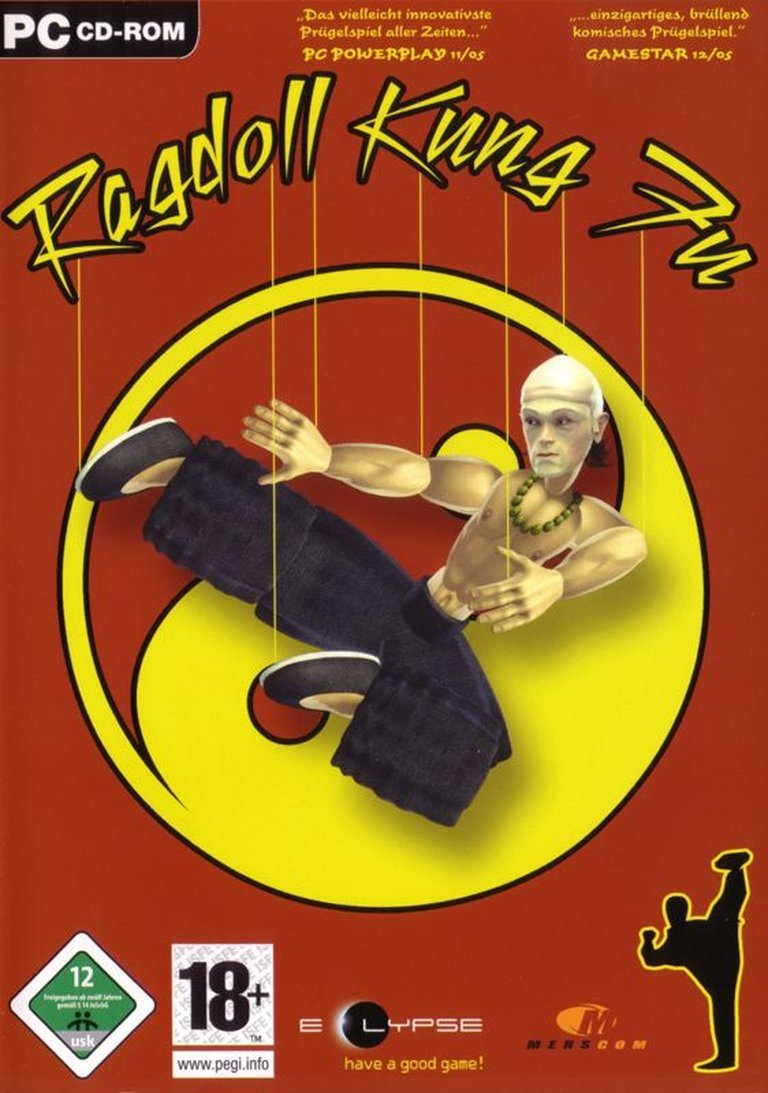
Rag Doll Kung Fu is a mouse-driven fighting game where players control ragdoll characters by directly manipulating their limbs, as the fighters are incapable of movement without player assistance. Set in a physics-based environment, the game blends humorous combat with ‘chi power’ for dramatic yet awkwardly graceful battles, alongside physics-based minigames like soccer and a 20-minute FMV story mode parodying kung fu epics. The chaotic experience supports both solo play and multiplayer matches for up to eight players.
Gameplay Videos
Where to Buy Rag Doll Kung Fu
Rag Doll Kung Fu Free Download
Rag Doll Kung Fu Cracks & Fixes
Rag Doll Kung Fu Guides & Walkthroughs
Rag Doll Kung Fu Reviews & Reception
metacritic.com (69/100): Even though this game is an indie effort, the art and sound production are professional-quality.
gamepressure.com (77/100): Sounds tricky maybe, but it doesn’t take long before you’re spinning through the air like a Russian gymnast.
gambit.mit.edu : All in all, the experimental nature of Rag Doll Kung Fu hampers gameplay, though it is still an enjoyable game to play, and more to watch.
jayisgames.com : an innovative and new, gorgeous and outrageous fighting game
Rag Doll Kung Fu Cheats & Codes
PC
During gameplay in level 1 (Basic Training level), type the code and press Enter.
| Code | Effect |
|---|---|
| I like sticky rice | Unlocks all bonuses at the main menu. The Master will confirm by saying ‘In that case let’s unlock everything’. |
| ilikerice | Unlocks everything at the main menu. |
Rag Doll Kung Fu: Review
Introduction
In the annals of video game history, few titles embody the spirit of unbridled experimentation and indie hustle quite like Rag Doll Kung Fu. Developed almost single-handedly by Mark Healey—a then-artist at Lionhead Studios (creators of Black & White and Fable)—this 2005 PC fighting game is best remembered as the first completely independently developed game released on Valve’s Steam platform. It arrived with a premise so audacious it bordered on madness: what if you controlled a kung fu fighter by puppeteering their limbs with a mouse, using ragdoll physics to create every movement, punch, and kick? The result is a game that defies categorization—a chaotic, physics-driven brawler that doubles as a parody of 70s martial arts cinema and a landmark in digital distribution. While its gameplay is divisive and its content sparse, Rag Doll Kung Fu endures as a cult classic not for its polish, but for its fearless originality and the sheer audacity of its vision. This review argues that despite its flaws, Healey’s creation remains a vital artifact of indie gaming’s golden age—a testament to how constraint (ragdoll physics) can breed creativity, and how a passion project can inadvertently shape the industry’s future.
Development History & Context
The Visionary and His Vision
Rag Doll Kung Fu was born from the fertile mind of Mark Healey, a British artist and programmer who spearheaded the project while employed at Lionhead Studios. The game’s genesis is as unconventional as its gameplay: Healey, along with friends, produced a £50-budget kung fu film in 2003-2004, shot with plastic swords, borrowed cameras, and minimal acting talent. The project evolved into a game when Healey, frustrated by rigid fighter controls, envisioned a digital counterpart where “kung fu” was reimagined through ragdoll physics. “The game was started after I and a few friends made a £50 kung fu film, and I felt a game should go along with it,” Healey recalled in a 2005 interview. His vision was to subvert genre conventions by eliminating pre-scripted animations entirely—players would literally drag a character’s feet to walk or swing their head to attack, making every battle a unique, emergent dance of physics and player ingenuity.
Technological Constraints and Innovations
Developed under the pseudonym “Qi Creations,” the game was Healey’s solo passion project, coded and designed during his spare time. Technically, it leveraged a custom-built physics engine—not Valve’s Source engine—to simulate ragdoll dynamics, allowing characters to flop, flail, and collide organically. This choice was deliberate; Healey wanted gravity and momentum to be the only rules, creating unpredictable combat where fights could devolve into comedic chaos. The mouse-driven control scheme was revolutionary at the time, though it required players to relearn basic movement: walking wasn’t a button press but a sequence of dragging limbs. Healey tested this vision with early physics demos like Stair Dismount, which inspired him to “be like a puppeteer.” The game’s development culminated in a 2005 Game Developers Conference (GDC) demo that impressed Valve’s Gabe Newell, leading to a $10,000 deal for exclusive Steam distribution—a landmark moment that marked Valve’s expansion into publishing.
The Landscape of 2005
Rag Doll Kung Fu emerged during a pivotal era for PC gaming. Digital distribution was gaining traction, but Steam was still in its infancy, primarily known for Valve’s own titles. The indie scene was nascent, with developers relying on shareware or publisher funding. Healey’s project—self-published, physics-obsessed, and distributed digitally—was a gamble. It stood in stark contrast to the era’s bloated AAA titles, instead echoing the ethos of experimental pioneers like Katamari Damacy (2005). Its release coincided with debates about gaming’s artistic potential, and Healey explicitly positioned it as an “antidote” to button-mashing fighters. The game’s Mature ESRB rating (for “blood, gore, language, and drugs”) further underscored its willingness to embrace adult themes absurdly, including psychedelic mushrooms as power-ups—a nod to Healey’s admitted drug-fueled inspiration. By the time it launched on October 12, 2005, Rag Doll Kung Fu had already secured its place as a trailblazer, even if its reception would be as divided as its chaotic battles.
Narrative & Thematic Deep Dive
The Kung Fu Epic, Parodied
The single-player campaign, titled “Training/Story Mode,” is a 16-level love letter to 70s martial arts cinema—filtered through a lens of deliberate, low-budget absurdity. Interspersed between levels are 20 minutes of live-action FMV cutscenes starring Healey and friends, shot in the same £50 style as the original film. These sequences are a masterclass in parody: Healey, clad in a bathrobe and wielding a plastic sword, delivers mock-serious monologues like “Get in that tree!” and “Idiots! Bring me his pubes!” with subtitles that intentionally mismatch the dialogue. The narrative follows a ragdoll warrior’s quest for “Chi Power,” a journey that lampoons classic tropes—training montages, wise masters, and villainous henchmen—all while embracing the limitations of its production. As one critic noted, it’s a “parody kung fu epic in appallingly and intentionally cheap pictures,” a self-aware farce where the “story” is merely a vehicle for the game’s anarchic energy.
Characters and Dialogue: Absurdity as Art
The game’s characters are ragdoll puppets, but their personalities emerge through physics and performance. The protagonist, a paper-cutout avatar of Healey himself, embodies the player’s struggle—his movements are as clumsy as they are determined. Dialogue is sparse but peppered with non-sequiturs: characters demand “more, more mushrooms” while high-flying, or meditate in a lotus pose to recover health. The villains, meanwhile, are equally ridiculous—foes like “The Pubes Bandit” (whose name alone signals the game’s tonal boundary-pushing). This isn’t narrative depth in the traditional sense; it’s thematic cohesion through silliness. The game satirizes martial arts tropes by exaggerating their physicality: fights are not dignified duels but flailing collisions, and wisdom is found in meditating to regrow health. As Healey quipped in an interview, the game’s tone is “brilliantly comical,” borrowing the spirit of Bruce Lee films while adding “tons of (seemingly) drug-addled eye candy.”
Undercurrents of Rebellion
Beneath the slapstick, Rag Doll Kung Fu explores subtle themes of rebellion against convention. The ragdoll physics themselves are a metaphor for liberation—characters break free from rigid animations, embodying chaos as freedom. The Chi energy system, cultivated by “drawing circles” with the mouse, mirrors Eastern philosophies of discipline and flow, yet subverts them by being fueled by absurdity (mushrooms = enlightenment). This duality extends to the game’s design: it rejects fighting game norms (combos, health bars) in favor of emergent play, where victory is as much about accidental slams as skill. Even the ESRB’s Mature rating becomes part of the joke—violence is cartoonish, and “drug use” is a mechanic where eating mushrooms grants flight, framed as a psychedelic power fantasy. In essence, Rag Doll Kung Fu is a punk-rock fable: it celebrates imperfection, mocks authority (the “master” cutscenes), and posits that true mastery lies in embracing the absurd.
Gameplay Mechanics & Systems
The Puppetry Paradigm
At its core, Rag Doll Kung Fu redefines control. Players manipulate their ragdoll via mouse clicks and drags: left-clicking a limb allows it to be repositioned, while right-clicking triggers attacks. Walking isn’t automatic; it requires dragging feet sequentially, turning movement into a deliberate, rhythmic act. This “puppetry paradigm” is the game’s signature innovation. As Healey described it, “You’re not just going to press a key to walk in a direction; you quite literally must pick up one foot after the other.” To prevent utter chaos, the game introduces subtle constraints: feet “stick” to the ground for stability, and characters auto-right themselves after jumps or attacks. A brief freeze-frame post-attack adds a “kung fu choreography” feel, making flailing limbs resemble exaggerated martial arts poses. The result is a learning curve that’s steep but rewarding—once mastered, players achieve a zen-like flow, dragging limbs to create graceful (or ridiculous) combos.
Combat and Resource Systems
Combat is physics-based and improvisational. Attacks are directional: cursor position dictates whether a punch or kick lands left or right. Special abilities revolve around three energy bars:
– Chi: Built by circling the mouse, it powers enhanced strikes, shields, and high jumps.
– Mushroom: Eaten from the environment, it enables flight (by dragging characters upward) but causes nausea if overused.
– Butterfly: Collected mid-air, it unlocks “lightning fists” via a split-pose stance, unleashing bolts that destroy objects.
These systems add strategic layers—mushrooms for aerial dominance, butterflies for area control—but emphasize creativity over precision. Weapons like nunchakus or swords can be picked up and swung, but their efficacy depends on momentum, not combos. The AI, too, mirrors the player’s control scheme, using “virtual mice” to move, ensuring fair but frustratingly agile opponents.
Modes and Customization
Single-player offers 16 levels with objectives like defeating waves of ninjas or collecting stars. These unlock minigames (e.g., Rag Doll Soccer, ChuChu Wing Pooh) and arenas, but the mode is criticized for being short and hectic. Multiplayer is the game’s salvation: local play supports up to 8 players via multiple USB mice, while online (via LAN/Steam) enabled chaotic deathmatches. A character editor lets players import custom skins, turning ragdolls into self-inserts or beloved icons (e.g., Mario or anime characters). The PS3 port, Fists of Plastic (2009), adapted controls to the DualShock 3 and Sixaxis motion controls, adding split-screen multiplayer but sacrificing precision. Crucially, the game includes a “Movie Maker” tool, allowing players to record and edit fights—transforming brawls into physics-driven comedies. This suite of features, while limited, fostered emergent play; as one player noted, “Verliezen is leuk!” (Losing is fun!).
World-Building, Art & Sound
A World of Paper and Physics
Rag Doll Kung Fu’s world is a playground of exaggerated physics. Environments are destructible arenas—barns dojos, and forests—where walls crumble and objects fly. The aesthetic blends 2D cut-out art with 3D physics: characters are flat, paper-like figures that react realistically to impacts, creating a visual paradox of simplicity and depth. The cutscenes, shot on grainy DV footage, contrast sharply with the game’s polished gameplay, reinforcing the parody of low-budget cinema. Day-night cycles and particle effects (e.g., Chi auras) add vibrancy, but the world’s charm lies in its absurdity: characters can “take a pee or a poo,” and mushrooms sprout in patches like psychedelic flora. This design isn’t just stylistic—it reinforces gameplay, turning arenas into stages for slapstick. As Healey put it, the goal was to create a world where “you can touch the world and affect it,” a tangible playground of chaos.
Art Direction: Cheap and Proud
The art is defined by its intentional crudeness. Cutscenes feature Healey in bathrobes and friends wielding plastic swords, while gameplay uses stylized, painted ragdolls. The contrast between “professional” story art and ragdoll physics is deliberate—a nod to the gap between fantasy and reality in martial arts films. Textures are simple, but physics lend them weight: a nunchaku swing arcs believably, and a character’s limp body floors realistically. The PS3 port enhanced this with HD visuals and Havok physics, but the core aesthetic remains rooted in its 2005 origins—a testament to Healey’s “outrageous silliness.” Even the UI is minimalist, with health bars shaped like hearts and Chi meters glowing like halos, merging function with theme.
Sound: Funky and Frenetic
Audio is equally idiosyncratic. The soundtrack, composed by Healey and Kareem Ettouney, blends funk, cello (played by Alex Evans), and rap (via “Silver Kid Steel”). Tracks are upbeat and percussive, mirroring the game’s energy. Sound effects are physics-driven: thuds from impacts, jingles from power-ups, and exaggerated “whooshes” for swings. The cutscenes feature mumbled dialogue and tinny music, amplifying their B-movie charm. Voice acting is sparse but memorable—Healey’s gravelly delivery in story scenes adds authenticity to the parody. Together, the sound design creates a sensory experience that’s as chaotic as the visuals, with music swelling during dramatic moments and sound cues guiding resource use (e.g., chimes for butterfly collection).
Reception & Legacy
Launch: Innovation and Division
Upon release, Rag Doll Kung Fu polarized critics. Its Metacritic score of 69/100 reflected praise for novelty and derision for execution. PC Zone lauded it as “enjoyable and unbelievably funny,” while Eurogamer called it “hell, it’s fun—but for a really short time.” Complaints centered on controls (“imprecise limb movements,” GamesRadar+) and brevity (completing the story in hours). The PS3 port fared worse (Metacritic 68/100), with IGN criticizing motion controls as “obnoxious.” Yet, many celebrated its spirit: PC Powerplay (78%) deemed it a “party-game” for groups, while GameStar noted its “trashy Hong-Kong flair.” Players were equally split—Steam user scores hover around 77/100 (“Mostly Positive”), with nostalgia for its quirkiness outweighing frustration. As one retrospective noted, it’s “not for everyone. In fact, those who can switch their brains to ‘kung-fu-movie-hyped-six-year-old-sugar-rush’-mode will probably get the most out of it.”
Commercial and Cultural Footprint
Sales were modest but respectable for an indie title, with “tens of thousands” of units sold by 2006. Its legacy, however, extends beyond units sold. As the first third-party Steam game, it proved digital distribution could support indies, paving the way for titles like Garry’s Mod and Team Fortress 2. The game inspired a cult following, particularly for its multiplayer and modding scene—custom skins flooded the internet, and LAN parties became its natural habitat. Healey’s team (Healey, Alex Evans, David Smith) later co-founded Media Molecule, directly applying Rag Doll Kung Fu’s physics ethos to LittleBigPlanet (2008), where sackboys echoed ragdoll puppetry. The game’s influence is even cited in modern physics fighters like Gang Beasts, though none replicate its mouse-driven control scheme.
Enduring Relevance
Today, Rag Doll Kung Fu is remembered as a “historical oddity” with a devoted fanbase. Steam reviews praise its “quirky indie charm,” while retrospectives (e.g., the 2018 documentary The First Non-Valve Game on Steam) highlight its role in democratizing game development. Its flaws—clunky controls, sparse content—are now part of its charm, seen as artifacts of its ambitious scope. The PS3 port, Fists of Plastic, remains a footnote, but the original endures as a playable relic. In a gaming landscape dominated by AAA polish, Rag Doll Kung Fu stands as a monument to the power of passion: a game made by one man that inadvertently changed the industry, one flailing ragdoll at a time.
Conclusion
Rag Doll Kung Fu is a flawed masterpiece—a game that succeeds not in spite of its limitations, but because of them. Its mouse-driven puppetry is imprecise yet revolutionary, its narrative is absurd yet resonant, and its physics are chaotic yet compelling. As a product of its time—a pre-*Steam era indie title—it embodies the risks and rewards of unbridled creativity. While it may not offer the depth of traditional fighters or the polish of modern titles, its legacy is undeniable: it proved that a small team (or even one person) could disrupt the industry, that digital distribution could empower creators, and that kung fu could be fought with floppy limbs and psychedelic mushrooms.
In the pantheon of video games, Rag Doll Kung Fu occupies a unique space: it’s a historical artifact, a cult classic, and a blueprint for physics-based innovation. Its place in gaming history is secure—not as a perfect game, but as a fearless one. As Mark Healey himself mused, “Isn’t there a kung fu movie-hyped six year old in all of us sometimes?” For anyone who answered yes, Rag Doll Kung Fu remains not just a game, but a joyful, flailing reminder of why we play.